The Technical Vault
By SOSCleanroom
The 4" × 4" Wiper That Quietly Protects Optics: Why TX404 Absorbond Is Built for High-Residue Work Without Losing Cleanroom Control
Last reviewed: Jan. 1, 2026 | Audience: contamination control, cleanroom operations, EHS, quality
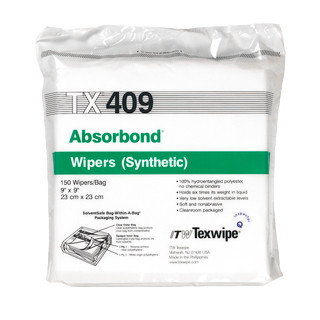
Texwipe TX404 Absorbond (4" × 4") is a dry, Made in the USA, 100% polyester hydroentangled nonwoven cleanroom wiper designed for the real-world cleaning problems that derail yields: oil and grease films, adhesive and lubricant residues, and scratch-sensitive components that cannot tolerate abrasive wiping behavior.
TX404 is positioned for ISO Class 5–8 environments where teams need a small-format wipe that is soft, solvent-compatible, and controlled for extractables, while still being practical for precision assembly and detail cleaning work.
What it’s for
TX404 is best used for targeted wipe-downs and detail cleaning on small parts, tool interfaces, fixtures, and sensitive surfaces where a large wipe is cumbersome and tends to be overhandled.
It is specifically positioned for cleaning optical devices (including lenses and other scratch-sensitive surfaces), applying and removing lubricants and adhesives, cleaning residues and solutions (including disinfectants), and solvent cleaning with IPA, acetone, and degreasers.
Decision drivers
- 100% polyester hydroentangled nonwoven substrate designed to be soft and non-abrasive for scratch-sensitive surfaces.
- No-binder construction, reducing the risk of extractables and residue formation during solvent wiping.
- Cut-edge strategy appropriate for routine critical cleaning where wipe technique and change-out discipline are the primary controls.
- Published typical values for NVR and extractable ions to support residue-sensitive process reviews.
- SolventSafe bag-within-a-bag packaging and lot traceability positioning tied to contamination-control consistency.
- Small-format size that reduces wipe overuse and supports early discard in precision cleaning tasks.
Materials and construction, explained in practical terms
TX404 uses a hydroentangled (spunlaced) polyester nonwoven construction. Hydroentangling mechanically interlocks fibers using high-pressure water jets rather than chemical binders, supporting low-residue performance in solvent-facing tasks.
This construction is valued for combining soft hand, good wet and dry strength, and high sorption behavior—critical when cleaning oils and greases where smearing creates rework.
The 4" × 4" format supports controlled folding, rapid face rotation, and early discard, reducing the likelihood that a loaded face becomes a redeposition source.
Cleanliness and performance metrics
Texwipe publishes typical-value performance data for Absorbond® to support qualification and change-control discussions.
- Particles and fibers: values reported for particles ≥0.5 µm and fibers >100 µm using IEST/ASTM-aligned methods.
- NVR: IPA extractant 0.01 g/m²; DI water extractant 0.005 g/m²; ethanol extractant 0.01 g/m².
- Extractable ions: typical values including sodium 7 ppm, potassium 2 ppm, and chloride 5 ppm.
- Sorption: capacity reported at 210 mL/m² with a sorptive rate of 1.4 seconds.
These values are presented as typical analyses rather than specifications and should be used as qualification baselines.
Interpretation tip: For high-residue soils, plan for shorter wipe life per face. The fastest way to smear oils is to “save” a wipe after it loads.
Why TX404 is often chosen for high-residue tasks
Oil and grease removal fails when a wipe cannot hold contaminant load without smearing. TX404 is positioned for excellent oil and grease absorption and absorbency up to five times its own weight, while remaining soft enough for delicate surfaces.
TX404 is also described as autoclave safe and appropriate for temperatures below 400°F (205°C), supporting use near warm equipment zones without substrate degradation.
Best-practice use
- Fold into consistent pads to create multiple clean faces.
- Wipe in single-direction, overlapping strokes.
- Rotate faces early before visible loading.
- Maintain controlled wetness to lift and hold residues without pooling.
- For optics and coated parts, standardize a two-phase wipe method with a fresh final face.
Common failure modes and prevention
- Overusing a loaded face: prevent with aggressive face rotation and discard discipline.
- Edge wear from aggressive scrubbing: fold deliberately and refresh wipes frequently.
- Inconsistent chemistry application: standardize wetness volume and contact time.
Closest competitors
Contec Amplitude™ Delta™
100% polyester spunlaced nonwoven positioned for softness, sorption, and solvent compatibility in controlled environments.
Berkshire Polx® Nonwoven 4" × 4"
Polyester hydroentangled nonwoven recommended for ISO Class 5 and above where cellulose-free substrates are preferred.
Where TX404 sits in a controlled wiping program
TX404 is a strong choice for detail cleaning and residue-sensitive wipe-downs in ISO 5–8 workflows, especially where oils, greases, and adhesives are present.
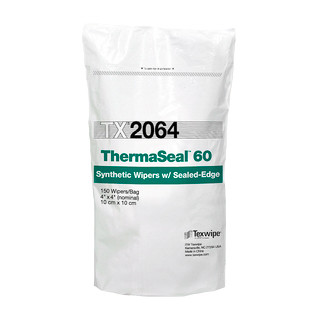
In disciplined wiping programs, TX404 is often used as the precision work wipe for small surfaces and critical touchpoints, paired with larger-format wipes for broad cleaning and sealed-edge platforms when edge-derived contamination becomes the limiting risk.
Terminology note: TX404 is engineered for low-linting performance; no wiper is truly “lint-free” in every process condition.
Source basis
- SOSCleanroom product page: Texwipe TX404 Absorbond 4" × 4" polyester cleanroom wiper.
- ITW Texwipe technical data sheet: Absorbond® family including TX404.
- Contec Amplitude™ Delta™ product positioning.
- Berkshire Polx® Nonwoven product positioning.