The Technical Vault
By SOSCleanroom
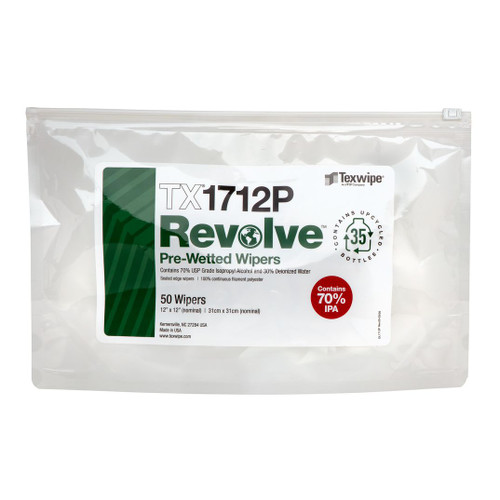
TX42P Vertex 12" x 12" pre-wetted 70% IPA wiper: laser-edge polyester knit for repeatable large-surface solvent wipe-downs
Last reviewed: Jan. 4, 2026 | Audience: contamination control, cleanroom operations, EHS, quality
Texwipe TX42P Vertex is a pre-wetted cleanroom wiper designed to remove films and particles while keeping two variables stable across operators and shifts: edge behavior and solvent delivery. It combines a 100% continuous-filament polyester knit with a laser/thermally sealed edge and a controlled pre-wet system (70% IPA / 30% DI water) to reduce streaking variability, frayed-edge shedding, and “too-wet/too-dry” operator drift during wipe-downs.
For many facilities, the real value of a pre-wetted 12" x 12" format is not convenience — it is repeatability: consistent wetness out of a resealable package, standardized wipe patterns, and a realistic way to train and audit wiping as a controlled process step rather than an improvised act.
What it’s for
TX42P is best suited for solvent wipe-downs on larger surfaces where smaller wipes force extra folds, extra passes, or early discard — behaviors that increase re-deposition risk. Typical use includes equipment exteriors, process benches, hood/isolator touch surfaces, pass-through items, and parts staging areas, plus applying/removing residues, lubricants, adhesives, and solutions (including disinfectants when the site SOP specifies IPA as the wipe agent).
Decision drivers
When selecting a pre-wetted knit wiper for critical spaces, focus on edge strategy, solvent discipline, and the contamination metrics that matter to your product and test methods.
- Format and coverage: 12" x 12" knit provides more usable contact area per fold cycle, which supports fewer wipe strokes per surface and more consistent overlap patterns.
- Edge strategy: Laser/thermal sealed edge is intended to control edge-derived particle/fiber release — a common limiting risk for knit wipes in defect-sensitive workflows.
- Pre-wet control: Pre-wetted with 70% IPA / 30% DI water (USP-grade IPA is called out in the TX42P/TX49P datasheet; Vertex platform documentation also notes 0.2 µm filtration for 70% USP-grade IPA/30% DIW pre-wet products), reducing operator variability versus ad hoc spray-and-wipe.
- Packaging discipline: TX42P is packaged 50 wipers per bag, 4 bags per case, and the Vertex platform describes resealable “slider” style packaging intended to reduce evaporation drift and preserve wetness consistency.
- Cleanroom fit: Vertex documentation positions the platform for ISO Class 3–7 environments; the SOSCleanroom listing tags TX42P for ISO 3 through ISO 8, enabling step-based deployment where validation and risk tolerance allow.
- Assurance signals: Vertex documentation highlights quarterly testing for cytotoxicity and bacterial endotoxins (program-level contamination control assurance).
Materials and construction
TX42P uses a continuous-filament polyester knit substrate. In process terms, that matters because continuous filaments generally reduce the “short fiber” behavior that can show up as loose fuzz or linting in some staple-fiber materials, while polyester improves compatibility with common cleanroom solvents.
The sealed (laser/thermal) edge is the second design pillar. In many knit wipe failures, the edge is where fibers and particles originate under abrasion. A sealed edge is intended to lock down the perimeter so the wipe behaves more like a controlled tool rather than a fraying textile.
Specifications in context
Size: 12" x 12" (nominal 30 cm x 30 cm). Packaging: 50 wipers per bag, 4 bags per case (case quantity listed by SOSCleanroom and on the TX42P/TX49P datasheet). Pre-wet: 70% IPA / 30% DI water (USP-grade IPA is stated on the TX42P/TX49P datasheet; Vertex platform documentation notes 0.2 µm filtration for 70% USP-grade IPA/30% DIW pre-wet products).
In practice, a controlled pre-wet reduces over-application (pooling) and under-application (dry wiping that smears rather than removes), and it makes training easier because “how wet is wet enough” is no longer a subjective call.
Cleanliness and performance metrics
Use typical contamination metrics as qualification starting points (not specifications). Confirm your own acceptance limits, surface risk, and test methods.
Typical performance (Vertex TX42/TX49/TX42P/TX49P datasheet):
• Sorptive capacity: 450 mL/m²; sorptive rate: 0.3 seconds
• LPC ≥0.5 µm: 9.5 x 10⁶ particles/m²
• Particle breakdown (typical): 0.5–5.0 µm: 3.0 x 10⁶ particles/m²; 5.0–100 µm: 66,000 particles/m²; Fibers >100 µm: 200 fibers/m²
• Nonvolatile residue (NVR): 0.02 g/m² (IPA extractant); 0.01 g/m² (DIW extractant)
• Ions (typical examples; see datasheet for full list and detection/quantification limits): Chloride <0.05 ppm; Sodium <0.17 ppm; Calcium <0.10 ppm; Magnesium <0.01 ppm
Packaging, solvent control, and EHS realities
With pre-wetted IPA wipes, the “process” is the package as much as the substrate. Resealable packaging is intended to reduce evaporation drift and keep wetness repeatable from first wipe to last. Storage guidance for the Vertex platform calls for ambient storage (59°F to 86°F / 15°C to 30°C) and following applicable requirements because flammable liquid may be present. SOSCleanroom also flags TX42P as a hazmat shipment that ships ground only and may require a per-case hazmat fee and a commercial delivery address depending on shipping rules.
Rule of thumb: Treat the bag opening like a controlled step — open, remove what you need, and reseal immediately. If a bag sits open long enough that the top wipes feel “lighter” or start to streak, pull that bag from critical work and replace it with a freshly sealed bag.
Best-practice use
A high-performance wiper only performs if the wipe pattern is disciplined. Standardize a method, train it, then audit it.
- Quarter-fold in mid-air: Fold into quarters without placing the wipe on a surface. This creates multiple clean faces and improves contact control.
- Unidirectional strokes with overlap: Wipe in one direction and overlap each pass by about 10% to 25% to avoid skip lanes.
- Clean-to-less-clean progression: Wipe from cleanest to least clean areas; work systematically (top-to-bottom, far-to-near) to reduce re-deposition.
- One face, one straight stroke: Rotate/refold to a clean portion rather than reusing a loaded face; avoid circular wiping patterns that re-contaminate cleaned areas.
- Wet spill response: Identify the liquid (SDS/MSDS), choose compatible gloves/wiper, use dry wipes to pick up bulk liquid first, then re-clean using the standard wipe-down sequence.
Common failure modes
The most common real-world failures are behavioral, not material: leaving bags unsealed (evaporation drift), “polishing” in circles (re-deposition), using a loaded wipe face for a second pass (smearing), and wiping hot surfaces without caution (accelerated evaporation and streaking). Control these with bag discipline, unidirectional wipe patterns, a “one face per stroke” rule, and clear escalation logic (fresh wipe, fresh bag, or different chemistry) when residue persists.
Closest competitors
Contec PROSAT Polynit Heatseal (70% IPA / 30% DI water): A comparable pre-saturated polyester knit offering with heat-sealed edges and resealable pouch packaging; often chosen when users want a presaturated knit wipe format with standardized saturation and ISO-aligned use cases.
Berkshire SatPax MicroSeal-VP (70% IPA / 30% DI water): Another sealed-edge polyester knit presaturated option positioned for ISO Class 3 and above applications. Mechanistically, the comparison is about edge sealing method, packaging format, and how each supplier documents cleanliness and lot-level traceability for audit needs.
Where it fits in a cleanroom wiping program
TX42P typically sits in the “repeatable solvent wipe-down” tier for controlled environments — especially where teams want to reduce VOC variability from spray bottles and standardize wipe behavior for training and audits. Use it as a primary wipe-down tool for benches and equipment exteriors in ISO Class 3–7 spaces (and broader areas when your internal qualification supports it), with clear rules on when to escalate to sterile wipes, different chemistries, or validated disinfectant dwell-time procedures.
Terminology note: Engineered for low-linting performance; no wiper is truly “lint-free” in every process condition.
Source basis
- SOSCleanroom product page (TX42P): https://www.soscleanroom.com/product/wipers/texwipe-tx42p-vertex-12-x-12-polyester-laser-edge-cleanroom-wiper-pre-wetted-70-ipa/
- Vertex TX42/TX49/TX42P/TX49P datasheet (SOS-hosted PDF): https://www.soscleanroom.com/content/texwipe_pdf/42%2049%2042p%2049p.pdf
- Texwipe Vertex Series Technical Data Sheet (manufacturer PDF; US-TDS-022 REV. 03/23): https://www.texwipe.com/images/uploaded/documents/Wipers/Texwipe-VertexSeries-TDS.pdf
- SOSCleanroom Cleanroom Wiping Guide (How-To PDF): https://www.soscleanroom.com/content/How%20To%20Guides/wiping_guide_a4.pdf
- IEST-RP-CC004 (wiper evaluation/testing recommended practice overview): https://www.iest.org/Standards-RPs/Recommended-Practices/IEST-RP-CC004
- Contec PROSAT Polynit Heatseal (70/30 IPA/DIW) product reference: https://cleanroom.contecinc.com/product/1779194641
- Berkshire SatPax MicroSeal-VP presaturated product reference: https://berkshire.com/shop/presaturated-cleanroom-wipes/ipa-wipes-isopropyl-alcohol/resealable-pouch-wipes/satpax-microseal-vp/spxvp00112/
Source: SOSCleanroom Technical Vault | Last reviewed: Jan. 4, 2026
© 2026 SOS Supply. All rights reserved.