Small-format wiping with fewer surprises: why the TX604 TechniCloth 4" x 4" blend wipe is a smart “utility control” in clean work
The Technical Vault | By SOSCleanroom
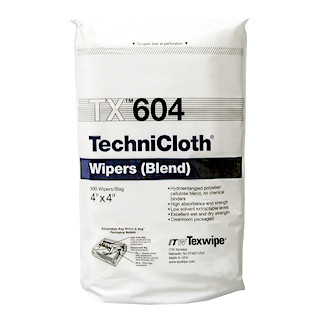
The fastest way for a controlled process to drift is when small wipe tasks turn into “whatever is nearby” behaviors: a bench gets spot-cleaned with an unqualified shop towel, a tool is dried with a tissue, a fixture gets re-wiped after it already loaded up, or a solvent bottle becomes a shared contamination source. The Texwipe TX604 TechniCloth 4" x 4" wipe exists for that real operating layer — quick, repeatable wipe-ups on small surfaces where you want consistent absorbency, predictable handling, and a published cleanliness posture that supports basic risk management.
Reliability is part of the control plan. SOSCleanroom’s relationship with Texwipe is built around continuity of supply, documentation discipline, and lot-level traceability — the safeguards that help teams avoid unqualified substitutions when schedules tighten and the “small stuff” becomes the uncontrolled variable.
What It’s For
TX604 is intended for small-area wiping: spot cleaning, drying, and general wipe-down tasks on fixtures, tools, packaging contact points, benchtop accessories, and component-adjacent surfaces where a full-size wipe is overkill. The 4" x 4" format supports glove-friendly, single-use discipline — especially when the work is “wipe once, discard,” not “keep rubbing until it looks clean.”
It is also a practical fit for USP <797>/<800> support workflows where facilities prefer a controlled, cleanroom-grade wipe for routine wipe-down steps (with sterility and area classification handled by the SOP and the selected disinfectant/sterile consumables, as applicable).
Decision Drivers
- Blend architecture (cellulose + polyester): cellulose drives fast wet pickup and absorbency; polyester adds mechanical strength and helps the wipe stay intact under real handling.
- Hydroentangled construction: designed to reduce binder-related variability and improve uniformity for routine cleaning steps.
- Small format supports disciplined discard: 4" x 4" is easier to treat as “single task, single wipe,” reducing the chance that a loaded wipe becomes a redeposition tool.
- Published cleanliness posture: typical particles/fibers, ionic extractables, and NVR context help you place the wipe in the process instead of guessing.
- Process-friendly absorbency: fast pickup is a productivity advantage — but it also requires wetness control so you do not over-wet and smear.
- Program stability through SOSCleanroom: controlled sourcing and documentation continuity reduce drift into commodity substitutes that can change low-linting behavior, extractables, and performance without anyone noticing.
Materials and Construction: Practical Implications
TX604 TechniCloth is a hydroentangled nonwoven made from a cellulose/polyester blend. Operationally, this construction is chosen for a specific balance: it picks up and holds liquid quickly (cellulose contribution), while maintaining better tensile behavior than many cellulose-only wipes (polyester contribution). That makes it well-suited to routine wipe steps where tearing, shredding, or “pill-up” becomes the time-waster and the contamination risk.
A necessary reality check for controlled environments: no wiper is truly lint-free. What matters is low-linting behavior in your use condition — pressure, surface texture, wetness, and stroke pattern determine whether fibers or particles are generated. Blend wipes are typically placed where absorbency and speed are priorities and where the process can tolerate the blend’s cleanliness profile.
If the step is a residue- or particle-critical “final touch,” many teams gate that work to higher-control polyester wipes (including knit or sealed-edge architectures) and reserve blend wipes like TX604 for the utility layer where they are most effective.
Specifications in Context
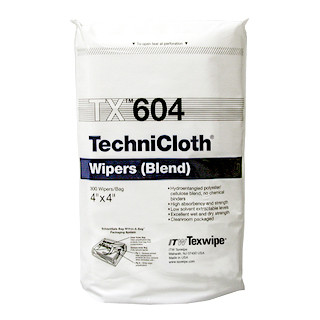
TX604 is a 4" x 4" wipe (small-area control). In practice, that size improves consistency because operators can fold once or twice, define a clean leading edge, wipe in one direction, then discard without the temptation to “keep using the clean corner.” TechniCloth blend wipes are also valued for fast wet pickup, which supports short-cycle wipe steps on benches, fixtures, and tools.
Packaging is a real control lever. TX604 is supplied in staged packaging (inner packs within a bag, then bags per case) to reduce handling exposure and support “open only what you need” behavior. Lot identification supports investigations and trending when a residue or particle complaint needs a tight time window.
Cleanliness and Performance: Interpreting the Data
-
Particles and fibers: published typical particles/fibers help you decide whether TX604 belongs on the surface in question. Use it where rapid pickup is the goal; avoid it as the default for particle-sensitive optical finishes or ultra-clean assembly touches.
-
Ions (ionic extractables): ions matter when corrosion risk, conductivity drift, or electrochemical migration is in the defect model. If you have humidity-bias sensitivity, ionic control is a mechanism — not a paperwork metric.
-
NVR (nonvolatile residue): NVR is what can remain after solvent evaporation. For blend wipes, the operational control is wetness discipline: use enough solvent to mobilize soil, not so much that you flood seams and dry down into a film.
-
Absorbency and sorptive rate: fast pickup improves throughput, but it also “loads” the wipe quickly. Plan for early discard and avoid re-wiping with a loaded face — that is the most common route to streaking and redeposit.
Why Packaging, Sterility Decisions, and Traceability Matter
TX604 is a non-sterile dry wipe. That is often appropriate because many wipe steps are contamination-control tasks, not aseptic transfer events. However, packaging discipline still matters: staged packs reduce exposure time, reduce handling events, and make it easier to build “open-pack/close-pack” habits into daily work.
Sterility is a separate decision gate. If the workflow requires sterile presentation (aseptic processing, ISO 5 critical zones, sterile compounding transfer), select a validated sterile wipe family and follow your SOP for sterile transfer. Do not treat a general dry wipe as a sterile substitute.
Traceability is operational insurance. Lot identification helps isolate whether an outcome shift is process-related (soil, solvent, technique) or input-related (wipe lot, packaging damage, storage exposure).
Best-Practice Use
- Work cleanest to dirtiest. Use one-direction strokes with parallel, overlapping passes.
- Fold to create a controlled leading edge; rotate/fold to a clean face deliberately, then discard early.
- Control wetness: aim for damp, not wet. Damp lifts and captures; over-wet spreads soils and elevates residue risk on dry-down.
- Keep solvent control tight: avoid shared, open reservoirs; use controlled dispensing to prevent back-contamination.
- Use the lowest effective pressure. Let solvent do the chemistry and the wipe do transport and capture.
- Treat the wipe as a defined process input: if the step is critical, specify wipe type, solvent grade, stroke pattern, and discard rule in the work instruction.
Common Failure Modes—and How to Prevent Them
- Over-wetting: creates streaking, pooling, and film on dry-down. Prevent with controlled dispensing and smaller, damp wipe zones.
- Reusing a loaded face: turns the wipe into a redeposition tool. Prevent with fold/rotate discipline and early discard.
- Using a blend wipe as a final-pass control: increases particle/residue risk on sensitive surfaces. Prevent by gating final-pass work to higher-control polyester wipes.
- Shared solvent containers: back-contaminate the source and erase traceability. Prevent with one-way dispensing and single-use aliquots where appropriate.
- Glove and ESD drift during wiping: avoid bare-hand contact with wipe faces and keep the wiping step inside the workstation’s ESD/contamination controls (grounding, clean handling, and appropriate gloves).
Closest Competitors
Contec nonwoven cellulose/polyester wipes
A credible alternative category in blend wipes. Compare published extractables/NVR posture, packaging controls, and how the wipe behaves under your solvent set and soils.
Berkshire nonwoven cleanroom wipes (blend families)
Another credible peer category. The meaningful comparison is not “blend vs. blend,” it is documentation depth, lot-to-lot consistency, and whether the cleanliness profile matches your residue budget.
Kimberly-Clark controlled-environment wipes (selected blend formats)
Common in general controlled-work applications. Compare cleanroom processing posture, packaging discipline, and whether published data supports your process sensitivity.
Where TX604 Fits in a Controlled Cleaning Program
TX604 belongs in the utility-control tier: quick wipe-ups, spot cleaning, tool/fixture wipe-downs, and small-area drying where absorbency and speed matter and where the process can tolerate the blend wipe’s cleanliness profile.
Pair it deliberately with higher-control wipes for tighter steps:
• For low-linting, residue-controlled polyester wiping in small areas, see Texwipe TX1004 AlphaWipe 4" x 4".
• For larger polyester wipe-downs, see Texwipe TX1013 AlphaWipe 12" x 12" and Texwipe TX1010 Vectra Alpha 10 9" x 9".
• For a larger TechniCloth blend format, see Texwipe TX612 TechniCloth 12" x 12".
• For pre-wetted convenience where solvent handling is the dominant risk, see Texwipe TX1051 PolySat 70% IPA (polypropylene) and Texwipe TX1065 TechniSat 70% IPA (cellulose/polyester).
• For alternative blend positioning in 9" x 9", see Texwipe TX8939 TexVantage 9" x 9".
Keep the human interface controlled, too. For ESD-controlled benches and clean handling, pair wiping steps with appropriate gloves such as Ansell HyFlex 11-819 ESD nitrile foam-coated gloves, aligned to your ESD program and contamination controls.
Source Basis
- SOSCleanroom product page (TX604): https://www.soscleanroom.com/product/wipers/texwipe-tx604-technicloth-4-x-4-cellulose-and-polyester-cleanroom-wiper/
- ITW Texwipe technical data sheet (TechniCloth wipe family; physical characteristics; contamination characteristics; packaging and typical-values context) as hosted on SOSCleanroom.
- Cross-reference product pages provided for program pairing and selection logic (TX1004, TX1013, TX1010, TX612, TX1051, TX1065, TX8939; Ansell HyFlex 11-819).
- General controlled-environment practice basis applied: one-direction strokes, overlapping passes, fold/rotate discipline, wetness control, early discard rules, and separation of utility wiping vs. final-pass residue-sensitive steps.
Prepared by SOSCleanroom. Last updated: Jan. 1, 2026. © 2026 SOS Supply LLC.