
The Technical Vault
By SOSCleanroom
Small Wipe, Big Control: Why TX606 TechniCloth (6" × 6") Is a Better “Utility Wiper” Than Shop-Rag Substitutes in ISO-Class Work
Last reviewed: Jan. 2, 2026 | Audience: contamination control, cleanroom operations, EHS, quality
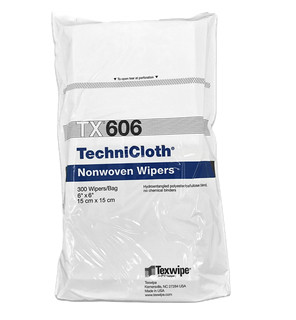
Texwipe TX606 TechniCloth (6" × 6") is built for the “small spill / quick wipe / fast reset” moments that happen every shift: a drip at a cart, a coolant film on a fixture, a smudge on a tool handle, or a bench that needs to be wiped before the next step starts. Those are absorbency-driven jobs, but they still need controlled-environment discipline.
TX606 uses a hydroentangled cellulose/polyester nonwoven designed to pick up aqueous liquids quickly while staying strong when wet. It is a practical choice when you want a blended wipe that behaves like a cleanroom tool (published cleanliness context, controlled packaging) instead of a “whatever was nearby” rag that becomes the uncontrolled variable.
Quick specs (use for kitting/planning): 6" × 6" nonwoven hydroentangled cellulose/polyester blend; cut edge; typically supplied as 600 wipers per bag (often as two inner bags of 300) with multiple bags per case. Verify the case label and inner-bag configuration you receive for SOP alignment.
What it’s for
TX606 is best used for general-purpose wiping and small-spill pickup in controlled environments: benches and carts, equipment exteriors, staging surfaces, tools, fixtures, and routine housekeeping steps where absorbency and speed matter. It is often used for precision component cleaning and laboratory apparatus wipe-downs when the process window tolerates a blended nonwoven and the team needs stronger pickup than many all-polyester wipes provide.
For residue-critical “final-pass” work (optics, coatings, ultra-trace residue programs, or inspection-driven cosmetic surfaces), many facilities step up to a tighter-control wipe architecture (for example, a knit polyester with more controlled shedding behavior) after bulk soil removal.
Decision drivers
TX606 earns its place as a “utility-control” wipe when the facility wants fast pickup without losing documentation and handling discipline:
- Absorbency-first behavior: cellulose supports rapid wet-out and aqueous pickup for small spills and wipe-downs.
- Wet strength and handling stability: polyester supports tensile strength and reduces “falls-apart-when-wet” behavior.
- Hydroentangled construction: mechanical entanglement (not binder-heavy construction) helps simplify the extractables model in many programs.
- Published cleanliness framework: typical particles/fibers, NVR, and ions support qualification discussions and role definition.
- Small-format control: 6" × 6" supports tight, local cleaning (fixtures, handles, interfaces) without overreach and incidental contact.
- Program stability through SOSCleanroom: predictable supply and consistent documentation reduce the risk of unqualified substitutions during schedule pressure.
Materials and construction – explained like an engineer
“Blended cleanroom wiper” covers a wide range of behaviors. What matters for TX606 is the hydroentangled (spunlace) construction: fibers are mechanically entangled to create strength and integrity without relying on high levels of chemical binders. This is one reason TechniCloth is commonly selected when teams want a blended wipe that picks up liquid quickly but still behaves predictably across wet handling.
Practically: cellulose delivers the uptake and fluid hold that makes spill pickup fast, while polyester contributes the reinforcement that keeps the wipe from tearing and leaving debris when pressure increases or when wiping across textured surfaces.
Terminology note: TX606 is engineered for low-linting performance. No wiper is truly “lint-free” in every process condition. Technique (pressure, surface texture, wetness, and face life) is often the dominant driver of fiber and particle outcomes.
Cleanliness and performance metrics
In most facilities, a wipe becomes a risk in three categories: releasables (particles/fibers), residues (NVR), and ions. TX606’s published typical values help place it responsibly as a utility wipe and define where to gate it out.
- Sorptive capacity (typ.): ~360 mL/m². Translation: strong capacity for small aqueous spill pickup, but still use face-rotation discipline to avoid redeposit when the wipe gets loaded.
- Particles ≥0.5 µm (typ.): reported per m². Translation: appropriate for many routine ISO-class wipe-down tasks, but it is not the same risk posture as higher-control polyester knit/sealed-edge finishing wipes.
- Fibers ≥100 µm (typ.): reported per m². Translation: manage with directional strokes, controlled pressure, and early change-out.
- NVR (typ.): reported in IPA and DI-water extractants. Translation: if haze/film shows up after dry-down, the primary levers are wetness control, chemistry control, and wipe face life—not “wiping harder.”
- Ions (typ.): sodium/potassium/chloride values are published. Translation: if ionic background is a defect mechanism (corrosion, ECM, high-impedance electronics), validate the wiping step or consider a lower-ionic polyester family.
Important: Manufacturer contamination values are commonly published as typical analyses describing process capability, not as per-lot specification limits. Validation-sensitive users should confirm performance in their own solvents, soils, and acceptance criteria.
Why the 6" × 6" format matters operationally
In real clean operations, “spill pickup” failures are often handling failures: overusing one wipe, smearing the same soil over multiple passes, or dragging contamination across a larger area than necessary. A 6" × 6" wipe is a control move for local cleaning—handles, fixtures, corners, interfaces—because it encourages short, deliberate strokes and frequent change-out. It also reduces the temptation to “make one wipe do everything” across a broad surface.
Best-practice use
TX606 performs best when operators treat it like a controlled tool—not a rag:
- Fold for control: fold into quarters to create multiple clean faces; treat each face as single-pass when the step is sensitive.
- Directional strokes: use straight-line, overlapping passes; avoid circular scrubbing unless the SOP requires it.
- Wetness discipline: aim for damp, not wet; over-wetting drives pooling, wicking, and residue redistribution.
- Spill logic: blot/pickup first, then wipe with fresh faces; do not chase a spill with a loaded face.
- Change-out triggers: replace when the face begins to smear, the wipe approaches saturation, or visible soil appears.
Common failure modes — and how TX606 helps
A blended utility wipe becomes a contamination source in predictable ways. TX606 helps when used within its role boundaries:
- Overworking one wipe face: turns pickup into redeposit. Control: fold/rotate aggressively; discard early.
- Dry wiping textured surfaces: increases friction-driven particles and smear risk. Control: dampen appropriately or switch architecture for rough surfaces.
- Using a utility wipe as default final-pass: can elevate residue/ion/fiber risk on sensitive surfaces. Control: define an explicit finishing wipe step for the most defect-sensitive work.
- Over-wetting and pooling: spreads soils into seams and corners. Control: controlled solvent/disinfectant loading and local strokes.
Closest comparators
The most practical comparisons are to other cellulose/polyester hydroentangled cleanroom wipes intended for routine wiping and spill pickup.
Contec nonwoven cellulose/polyester wipe families are common peers for utility wiping; compare published particles/fibers/NVR and packaging discipline for your ISO placement and investigation posture.
Berkshire blended nonwoven cleanroom wipes are close category peers; qualification typically hinges on residue behavior in your chemistry set and how the wipe behaves under your pressure and stroke patterns.
Avantor/VWR blended cleanroom wipe offerings are widely available through procurement systems; selection should be driven by documentation depth and lot-to-lot stability—not convenience alone.
Where TX606 fits in a cleanroom wiping program
TX606 fits best as a utility-control wipe for routine wipe-downs and small-spill pickup where absorbency and speed matter, but the facility still wants controlled packaging and published cleanliness context. Use it for benches, carts, equipment exteriors, fixtures, and localized cleaning. Keep the program mature by defining escalation tools: a higher-control polyester knit (and/or sealed-edge) for residue- or fiber-sensitive finishing steps, and method-aligned sampling consumables when the wipe becomes part of a measurement system.
Rule of thumb: When absorbency and pickup speed are the constraint, a blended nonwoven like TX606 is often the right tool. When residue, ions, or edge-driven releasables become the acceptance driver, step up to a tighter-control polyester architecture and validate the full wipe/chemistry/technique system.
Source basis
- SOSCleanroom product page: “Texwipe TX606 TechniCloth 6" × 6" Cellulose and Polyester Cleanroom Wiper” (positioning, size, packaging presentation, features/benefits).
- ITW Texwipe TechniCloth® Wipers data sheet DS-609 (blend and construction framing; typical cleanliness and performance framework; packaging configurations by SKU).
- General controlled-environment practice basis applied: directional strokes; fold/rotate/discard discipline; wetness control; separation of utility wiping vs. residue-critical finishing vs. validation sampling.
Source: SOSCleanroom Technical Vault (TX606) | Last reviewed: Jan. 2, 2026
© 2026 SOS Supply. All rights reserved.