The Technical Vault
By SOSCleanroom
When “Everyday Wiping” Still Has to Be Controlled: Why TX609 Is the Polycellulose Standard for Absorbency With Low Extractables
Last reviewed: Jan. 1, 2026 | Audience: contamination control, cleanroom operations, EHS, quality
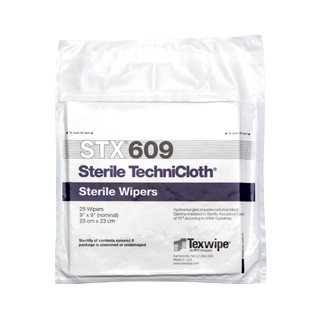
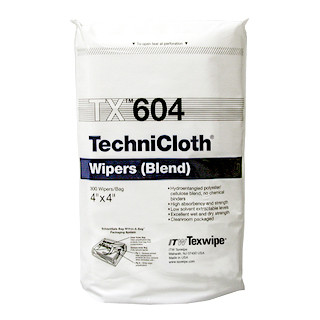
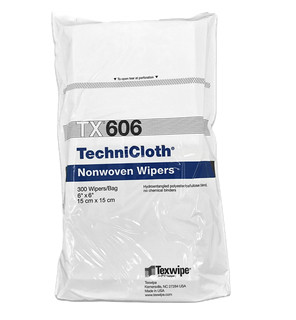
Texwipe TX609 TechniCloth (9" × 9") is a dry, cellulose/polyester cleanroom wiper designed for the most common reality inside controlled environments: many cleaning steps are not about achieving the absolute lowest releasables possible, but about repeatable removal of liquids and soils while keeping extractables, residues, and handling risk under control.
TX609 is positioned on SOSCleanroom under Wipers Made in the USA and is most often qualified for ISO Class 5–8 workflows where operators need a practical workhorse wipe that absorbs quickly, stays strong when wet, and supports contamination-control discipline.
What it’s for
TX609 is best used for general-purpose wipe-downs, aqueous spill pickup, and solution application and removal on benches, carts, equipment exteriors, pass-through items, staging surfaces, and laboratory apparatus. It is frequently chosen where teams want a blended wipe that can load quickly and hold fluid without tearing or smearing.
By reducing the number of passes required to remove liquids and soils, TX609 helps limit re-deposition—one of the most common real-world failure modes in routine cleanroom cleaning.
Decision drivers
- Substrate and construction: hydroentangled nonwoven blend of 55% cellulose / 45% polyester tuned for high absorbency and wet strength.
- Edge strategy: cut edge suited for routine cleaning and spill control.
- Cleanliness framework: published typical values for particles, fibers, NVR, and extractable ions to support qualification.
- Residue positioning: TechniCloth is positioned as lowest NVR in a blended nonwoven wipe.
- Packaging discipline: solvent-safe Bag-Within-A-Bag cleanroom packaging to protect the wipe before use.
- Compounding alignment: positioned as autoclave safe and described as meeting USP <797> and USP <800> expectations.
- Manufacturing control: statistical quality control practices are explicitly part of the product framework.
Materials and construction, explained in practical terms
TX609 is a blended nonwoven because cellulose and polyester solve different contamination-control problems when combined. Cellulose provides the absorbency engine—fast wet-out, strong wicking, and high fluid hold—while polyester contributes tensile strength and abrasion tolerance so the wipe remains intact during wet wiping and repeated strokes.
The hydroentangling process mechanically bonds fibers without chemical binders, supporting durability while helping control extractables. As with all cleanroom wipes, there is no truly lint-free option; the technical requirement is that the wipe be low-linting enough for the step and used with a method that prevents re-deposition.
Cleanliness and performance metrics
TX609 publishes typical values that map directly to the four lenses most facilities use during qualification:
- Absorbency behavior: fast wet-out and strong capacity reduce push-and-smear behavior and lower stroke count.
- Particles and fibers: typical values support routine ISO 5–8 wipe-downs and spill control.
- NVR: low typical IPA and DI water extractables reduce film and streak risk.
- Extractable ions: sodium, potassium, and chloride values support risk review where corrosion or residue sensitivity matters.
These values are best used as a qualification baseline, followed by validation under actual surfaces, soils, chemistries, and inspection criteria.
Why packaging discipline matters
TX609 is supplied in 300-count, double-bagged units using solvent-safe Bag-Within-A-Bag packaging. This approach reduces handling contamination during receiving, staging, and high-frequency access in active areas—where wipes most often fail due to exposure drift rather than substrate performance.
Best-practice use
- Fold consistently to create multiple clean faces.
- Use single-direction, overlapping strokes rather than circular wiping.
- Rotate faces early to prevent re-deposition.
- Maintain controlled wetness to avoid pooling and streaking.
- For residue-sensitive endpoints, follow with a higher-purity synthetic final-pass wipe.
Common failure modes and prevention
- Using a cut-edge blended wipe as a final wipe on defect-sensitive surfaces.
- Overusing a loaded face and spreading contamination.
- Inconsistent wetting that creates variable outcomes.
Closest competitors
Contec Amplitude™ Sigma™
Hydroentangled cellulose/polyester wipe positioned for ISO 5–8 general cleaning and spill control.
Berkshire Durx® 670
55/45 cellulose/polyester nonwoven wipe with published sorption, particles, NVR, and ion data for qualification comparisons.
Where TX609 sits in a controlled wiping program
TX609 is a strong choice for absorbency-driven cleaning in ISO 5–8 environments: spill control, routine wipe-downs, and solution handling. When workflows become more defect-sensitive, it is commonly retained for first-pass cleaning and paired with a higher-purity, edge-controlled synthetic wipe for the final pass.
Source basis
- SOSCleanroom product page: Texwipe TX609 TechniCloth 9" × 9".
- ITW Texwipe manufacturer documentation and datasheet DS-609.
- Contec Amplitude™ Sigma™ documentation.
- Berkshire Durx® 670 documentation.