The Technical Vault
By SOSCleanroom
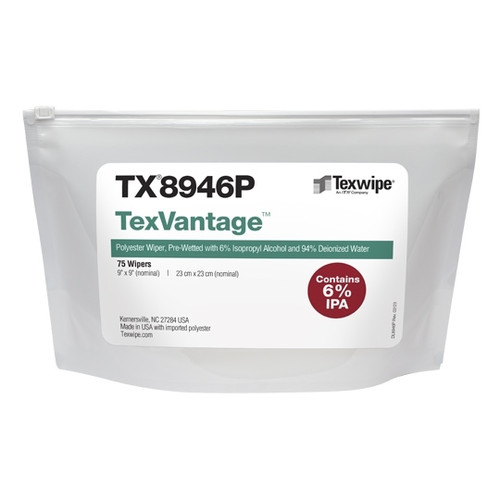
TX8946P TexVantage (6% IPA) pre-wetted wipers: “just-enough solvent” control for repeatable wipe-downs
Last reviewed: Jan. 4, 2026 | Audience: contamination control, cleanroom operations, EHS, quality
Texwipe TX8946P TexVantage is a 9-inch by 9-inch, sealed-edge, 100% polyester cleanroom wiper pre-wetted with a controlled 6% IPA / 94% DI water blend. The point is not “more solvent.” The point is repeatability — consistent wetness, consistent wipe coverage, and fewer operator-driven variables than spray bottles or open solvent containers.
In practice, 6% IPA is often selected for routine wipe-downs where you want predictable wetting and particulate pickup without turning every wipe into a high-VOC event. TX8946P is positioned for ISO Class 3 through ISO Class 8 environments, and it is packaged as reclosable, lot-coded bags to support day-to-day discipline and investigation-ready traceability.
What it’s for
Controlled wet wipe-down of cleanroom surfaces, tools, equipment exteriors, carts, trays, and parts-handling accessories where you want standardized solvent delivery and consistent surface coverage. Common use cases include routine area wipe-downs, equipment turn/return, residue removal (adhesives, lubricants, light films), and solution application steps where overspray, puddling, and rework risk need to be minimized.
Decision drivers
Pre-wetted wipers only pay off when they reduce variation, reduce risk, or simplify compliance. Evaluate TX8946P like a process control, not a commodity.
- Solvent control (6% IPA): Supports repeatable wetting and coverage with lower volatility than 70%+ IPA routines, depending on your process needs and dwell-time expectations.
- Edge strategy (sealed edge): Helps control edge wear on corners, fasteners, and textured coatings — common sites for particle and fiber generation during aggressive wiping.
- Cleanroom fit (ISO range): Specified for ISO Class 3 through ISO Class 8 use, supporting a broad set of controlled-environment workflows.
- Packaging discipline: Reclosable slider bags reduce evaporation and help keep wetness consistent from first pull to last pull of the bag.
- Traceability: Individually lot-coded packaging supports investigations, deviations, and audit questions (what was used, where, and when).
- EHS/shipping reality: Even “low IPA” wipes may still be managed under HazCom/flammability classifications; handling and disposal should follow site rules.
Materials and construction
TX8946P uses 100% polyester with a sealed edge. Polyester is a workhorse material for critical wiping because it is durable, chemically resistant across many common cleanroom chemistries, and less prone to shedding than many nonwoven blends when used correctly.
The sealed-edge design is intended to reduce mechanical breakdown at the perimeter (where most wipers fail first in real wiping). No wiper is truly “lint-free” in every process condition; the practical target is predictable, low-linting behavior when pressure, fold technique, and surface roughness vary across operators and shifts.
Specifications in context
Format: Pre-wetted cleanroom wiper (6% IPA / 94% DI water) |
Size: 9" x 9" (23 cm x 23 cm) |
Material: 100% polyester |
Edge: sealed edge.
Packaging: 75 wipers per reclosable bag; 4 bags per case (300 wipers per case). Reclosable slider packaging is a real process feature — it helps maintain wetness consistency and reduces day-to-day variation tied to evaporation.
Cleanroom environment: ISO Class 3–8 (Class 10–100,000; EU Grade B–D). This range is best interpreted as “material and process controls suitable for broad controlled-environment use,” then verified against your facility’s qualification expectations for the actual task.
Shelf life: Manufacturer guidance lists 3 years from date of manufacture for non-sterile pre-wetted formats. Store and rotate as a chemical-containing consumable, not just a textile.
Cleanliness and performance metrics
Cleanroom wiping is usually evaluated through (1) particles and fibers released, (2) nonvolatile residue (NVR), and (3) ionic residue. Treat published “typical” values as a starting point — then align them to your own qualification strategy and surface/solvent pairings.
Typical contamination metrics (manufacturer typical analyses):
LPC (≥0.5 µm): 11.7 x 10⁶ particles/m2; Fibers (>100 µm): 700 fibers/m2.
NVR: 0.05 ppm (IPA extractant), 0.02 ppm (DI water extractant).
Ions: Sodium 0.10 ppm; Potassium 0.03 ppm; Chloride 0.05 ppm.
Typical physical metrics: Sorptive capacity 330 mL/m2; sorptive rate 0.5 seconds; basis weight 120 g/m2.
These numbers matter because they influence how quickly the wipe “loads,” how consistently it stays wet across folds, and how likely it is to redeposit residue when a wiper is overused.
Pre-wet system controls: filtration, evaporation, and EHS reality
TX8946P’s pre-wet solution is specified as 0.2 µm-filtered 6% IPA in DI water. The filtration element is the “quiet hero” — it reduces the likelihood that the chemistry itself becomes a particle contributor. The reclosable slider bag reduces evaporation, helping preserve consistent wetness and VOC behavior over the usable life of the bag. Finally, even low-percentage IPA wipes can fall under HazCom/flammability classifications and may carry site-specific shipping, storage, and disposal constraints.
Rule of thumb: If you are buying pre-wetted wipes for “repeatability,” keep the slider bag closed between pulls and standardize a fold-count (e.g., quarter-fold to 8 clean faces). Open-bag exposure and inconsistent folding are the fastest ways to turn a controlled wipe into an operator-variable wipe.
Best-practice use
The best cleanroom wiping technique reduces redeposit risk and protects the wiper from edge abuse. TX8946P performs best when you treat it as a single-use, controlled-contact tool — not a rag.
- Fold for clean faces: Quarter-fold and rotate through clean faces. When a face loads, switch faces — do not “polish” contaminants back onto the surface.
- One-direction strokes: Use overlapping, single-direction passes (top-to-bottom or back-to-front). Avoid circular scrubbing unless a validated method requires it.
- Edge management: Keep sealed edges from “catching” on sharp hardware. Let the wipe glide; do not hook corners around fasteners.
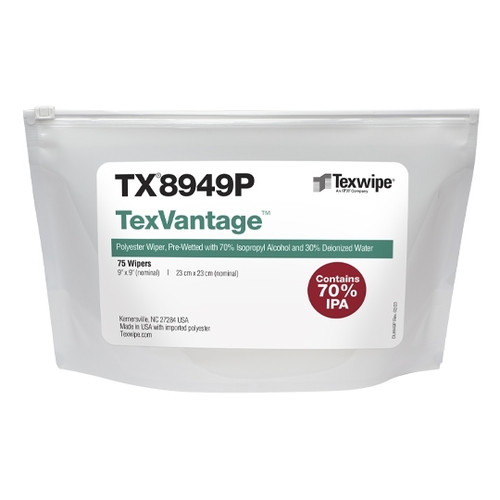
- Control contact time: 6% IPA will behave differently than 70% IPA. If your SOP requires dwell time, verify wet film persistence on your actual surface (temperature, airflow, and surface energy matter).
- Dispose like a chemical-containing consumable: Follow site rules for IPA-containing wipes. Do not allow wipes to accumulate near ignition sources or hot work areas.
Common failure modes
Bag left open: Evaporation shifts wetness, increases wipe-to-wipe variability, and can push operators to over-wipe a surface to “make it work.”
Overuse and redeposit: A loaded wipe can redeposit residues and particles, especially on smooth stainless or coated surfaces. Use clean-face discipline and change wipes early.
Wrong solvent strength for the task: 6% IPA is not a substitute for higher-strength IPA when you are chasing fast flash-off or aggressive residue removal. Match concentration to the mechanism you need.
Hot surfaces and ignition sources: Pre-wetted wipes should be used with caution at elevated temperatures, and handled per your facility’s flammability and HazCom controls.
Closest competitors
Contec Anticon presaturated polyester wipes (6% IPA / 94% DI water): Often positioned for very critical cleanrooms, emphasizing controlled solvent saturation and repeatable processing. Compare edge strategy, packaging discipline, and your required documentation set.
Berkshire SatPax MicroSeal-VP (6% IPA option): Sealed-edge polyester knit wipers pre-wetted in resealable pouches, commonly positioned for ISO Class 3 and above environments. Compare sealing method, fabric construction (knit vs. other builds), and residue/particle expectations for your surfaces.
Valutek pre-saturated polyester wipes (6% IPA / 94% DI water offerings): Broad portfolio with multiple IPA/DI concentrations. Compare cleanroom assembly controls, edge finish, and how “typical” cleanliness metrics are documented for your qualification package.
Where it fits in a cleanroom wiping program
TX8946P fits as a “standard work” wipe for routine wipe-downs where consistency matters more than maximum solvent strength. It is a strong choice for daily controlled cleaning of general surfaces and equipment exteriors, especially when you want to reduce spray-bottle variability and oversaturation.
In a tiered program, many facilities pair a low-IPA pre-wet for routine coverage and particulate pickup with higher-strength IPA options for specific residue challenges, then escalate to sterile or validated disinfectant systems where aseptic or regulatory controls require them.
Terminology note: Engineered for low-linting performance; no wiper is truly “lint-free” in every process condition.
Source basis
- SOSCleanroom product page: https://www.soscleanroom.com/product/wipers/texwipe-tx8946p-texvantage-9-x-9-polyester-cleanroom-wiper-pre-wetted-6-ipa/
- Texwipe product page (TX8946P): https://www.texwipe.com/Products/Wipers/Presaturated/ISO-3/TX8946P
- Manufacturer technical data sheet (SOS-hosted copy): https://www.soscleanroom.com/content/texwipe_pdf/Texwipe-TexVantagePolyester-TDS-ENG.pdf
- Manufacturer technical data sheet (Texwipe PDF): https://www.texwipe.com/images/uploaded/documents/Wipers/Texwipe-TexVantagePolyester-TDS-ENG.pdf
- Texwipe SDS (6% IPA pre-wetted wipes; includes TX8946P): https://www.texwipe.com/images/uploaded/documents/Safety%20Data%20Sheets/2023%20wipe%20sds%20us-can-mex/6/TX1048_US_CA_SDS_ENG_May_31_2023.pdf
- Contec Anticon presaturated wipes listing: https://www.fishersci.com/shop/products/contec-anticon-presaturated-wipers/191304500
- Berkshire SatPax MicroSeal-VP (6% IPA option): https://berkshire.com/shop/presaturated-cleanroom-wipes/ipa-wipes-isopropyl-alcohol/resealable-pouch-wipes/satpax-microseal-vp/satpax-microseal-vp-6-x-9-6-ipa-gowning-wipe-case/
- Valutek pre-saturated wipes collection: https://shop.valutek.com/collections/pre-wetted-wipers
Source: SOSCleanroom Technical Vault | Last reviewed: Jan. 4, 2026
© 2026 SOS Supply. All rights reserved.