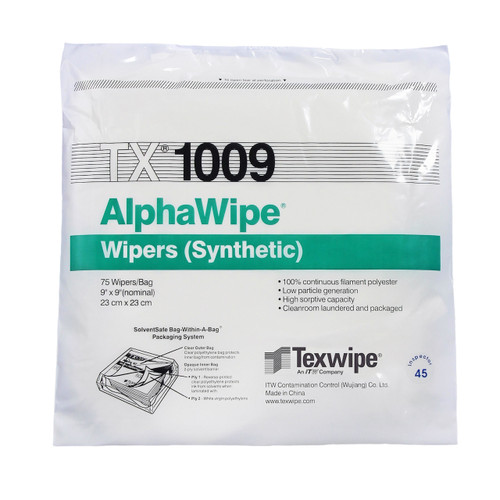
Texwipe TX1009 AlphaWipe 9" x 9" Polyester Cleanroom Wiper

$48.06
(No reviews yet)
SKU:
TX1009 BAG
Availability:
Stock Item
Shipping:
Calculated at Checkout
International Shipping:
Available for this product
Quantity Option (Bag):
150 Wipers per bag (2 Inner Bags of 75 Wipers)
Quantity Option (Case):
10 Bags of 150 Wipers Per Case
Type:
Dry Wiper
Wiper Material:
Polyester
Wiper Size:
9" x 9"
Wiper Edge:
Cut Edge
ISO Class:
ISO 4 (Class 10) - ISO 8 (Class 100,000)
Country of Origin:
Made in China

TX1009 AlphaWipe 9" x 9" 100% Polyester Cleanroom Wiper

TX1009 AlphaWipe is low-linting (no wiper is truly ‘zero-lint’ in every process condition), high-absorbency polyester knit wiper used for critical cleaning, spill control, and solution application in controlled environments. It is made from 100% continuous-filament polyester in a double-knit, no-run interlock pattern for durability on equipment, fixtures, and rougher surfaces.

Best-seller note: TX1009 is widely specified because it balances absorbency, durability, and contamination control for everyday cleanroom wipe-downs and wet processing steps.

Specifications:
  • Size: 9" x 9" (23 cm x 23 cm) nominal
  • Material: 100% continuous-filament polyester
  • Construction: Double-knit, no-run interlock
  • Edge: Laundered cut edge
  • Packaging: 150 wipers/bag (2 inner bags of 75); 10 bags/case
  • Use environments: Commonly used across a wide range of ISO-class cleanrooms and controlled areas (final suitability depends on your process and cleaning method)
About the Manufacturer: 

Texwipe (an ITW company) differentiates itself in cleanroom wiping by treating the wiper as an engineered product, not a commodity consumable. Its manufacturing approach starts with fabric and yarn selection (often continuous-filament polyester for lower shedding), then controls edge construction (cut-edge, sealed-edge, and patented sealed-border options), controlled cleaning/laundering, and packaging aligned to cleanroom application tiers.


Texwipe also emphasizes verification through fibers/particles/ions/residue/endotoxin testing and describes automation-forward processes—such as Vectra® continuous cleaning with 100% machine-vision inspection and hands-free sterile manufacturing steps—to improve lot-to-lot consistency and reduce handling-driven contamination risk. SOSCleanroom (SOS) supports that manufacturing discipline with a close working relationship with Texwipe focused on continuity of supply, clean documentation handoff (certs, lot traceability), and practical application support—so customers can standardize wiping materials with predictable performance while maintaining procurement reliability and audit readiness.

TX1009 Features:
  • 100% polyester fiber — continuous-filament, double-knit
  • Cleanroom laundered and packaged
  • Solvent-safe packaging
  • Lot-to-lot traceability
TX1009 Benefits:
  • Low-linting performance: Designed to help reduce particle and fiber contribution during wipe-downs (process-dependent)
  • Durability on surfaces: No-run interlock knit helps resist snagging and abrasion on rougher equipment and fixtures
  • Absorbency for wet steps: Effective for spill pickup and applying/removing cleaning agents and process solutions
  • Chemical resistance: Polyester knit construction is commonly used with IPA and many other cleanroom-compatible solvents/cleaners (verify compatibility to your chemistry and SOP)
Common Applications:
  • General wiping of benches, carts, tools, equipment exteriors, and fixtures
  • Spill control and pickup of process fluids
  • Cleaning and polishing stainless steel
  • Applying and removing disinfectants, cleaners, and process solutions
  • Protective covering for parts and product during staging, transfer, or temporary storage
Best-Practice Use:
  • Fold for control: Fold into quarters to create multiple clean faces; rotate faces instead of re-wiping with a loaded surface.
  • Wipe pattern: Use straight-line strokes (top-to-bottom or left-to-right) to avoid re-depositing contamination.
  • Wet vs. dry: For solvent wipe-downs, dampen—do not over-saturate—so you maintain control and reduce dripping.
  • Change-out triggers: Replace the wiper when the face becomes visibly soiled, tacky, or leaves streaks/residue.
  • Part protection: When lining trays, avoid dragging parts across the wiper; lift and place to reduce particulate transfer.
Selection Notes (TX1009 vs. Other Options)
  • TX1009 vs. TX1009B: Same AlphaWipe family and nominal size, but TX1009B is typically chosen when bulk-packed presentation is preferred for dispensing or staging.
  • Dry vs. pre-wetted: If you want consistent wetting and reduced solvent handling, consider AlphaSat pre-wetted wipers (70% IPA options are common for routine wipe-downs).
  • Size-up/size-down: Use smaller wipes for tight work areas; use 12" x 12" or larger formats when coverage per wipe matters.

Link to Texwipe Technical Datasheet:
Click Here

Other Similar Products Available From SOSCleanroom.com

AlphaWipe Dry Wipers

  • TX1004: 4" x 4" nominal (10 cm x 10 cm), 300 wipers/bag
  • TX1009B: 9" x 9" nominal (23 cm x 23 cm), bulk packed presentation
  • TX1013: 12" x 12" nominal (31 cm x 31 cm), 75 wipers/bag
  • TX1025: 24" x 44" nominal (60 cm x 112 cm), also used as a mop cover

AlphaSat Pre-Wetted Wipers

  • TX1034: 4" x 4" pre-wetted 70% IPA
  • TX1036: 6" x 6" pre-wetted 70% IPA
  • TX1039: 9" x 9" pre-wetted 70% IPA
  • TX7031: 9" x 32" pre-wetted 6% IPA

Notes: Looking for application guidance or qualification context for Texwipe TX1009 AlphaWipe 9" x 9" polyester cleanroom wipers? Open the SOSCleanroom Technical Vault tab above for practical wiping technique, selection notes (TX1009 vs. alternatives), and the documentation details teams typically review when standardizing cleanroom wipes across ISO-class controlled environments.

SOSCleanroom.com supports contamination-control programs with cleanroom consumables in stock, fair pricing, and responsive technical support—backed by same-day shipping options and customer service that understands real cleanroom workflows.

Product page updated: Jan. 1, 2026 (SOS Technical Staff)

© 2026 SOS Supply. All rights reserved.

The Technical Vault
By SOSCleanroom
What a “Standard” 9" x 9" Polyester Knit Wiper Actually Controls in a Cleanroom: Texwipe TX1009 AlphaWipe
Last reviewed: Dec. 31, 2025  |  Audience: contamination control, cleanroom operations, EHS, quality
The one-paragraph answer

Texwipe TX1009 AlphaWipe is a low-linting, high-absorbency, 9" x 9" knitted polyester wiper built for routine wipe-downs, spill control, and controlled application/removal of common cleanroom solvents and solutions. Its 100% continuous-filament polyester, double-knit, no-run interlock construction is specifically chosen to resist snagging on rougher surfaces while helping keep particle/fiber contribution low and keeping chemistry residue risk (NVR/ions) controlled from lot to lot.

Why it sells: It is an “everyday driver” knit wipe that holds up on carts, benches, fixtures, and equipment exteriors while supporting repeatable contamination control across shifts and operators.

Operational problem TX1009 is solving
  • Wipers that shed or fray under real wiping force become the contamination source.
  • Solvent wipe-downs can smear residues if the wipe loads slowly, streaks, or leaves nonvolatile residue behind.
  • Rough surfaces (brushed stainless, fasteners, textured plastics) can snag weaker wipes and create particle/fiber events.
  • Programs fail in practice when packaging and operator behavior create inconsistent “wipe-face discipline.”
What it’s for

TX1009 is typically used for routine cleaning and wipe-downs, spill pickup, and controlled application/removal of common cleanroom solutions on hard surfaces such as stainless steel, coated metal, plastics, and glass.

  • General wiping of surfaces, tools, equipment exteriors, carts, and fixtures
  • Spill control and pickup of process fluids
  • Applying and removing cleaning agents, disinfectants, lubricants, adhesives, and residues (process-dependent)
  • Cleaning with solvents such as IPA, acetone, and degreasers (verify compatibility with your chemistry/SOP)
  • Lining trays for holding, protecting, drying, staging, and storing parts/devices
Decision drivers (what actually matters in qualification)
  • Fiber type: continuous-filament polyester to reduce short fiber ends that can release during abrasion.
  • Fabric formation: double-knit, no-run interlock to resist unraveling and tolerate rigorous wipe patterns.
  • Edge strategy: laundered cut edge (balanced for many daily ISO 4–8 tasks; sealed edge is the step-up when edge-driven releasables are the dominant risk).
  • Residue risk: NVR and ionic extractables matter when haze, streaking, corrosion, or adhesion failures are in play.
  • Sorption behavior: capacity and uptake rate influence whether you lift contamination or spread it.
  • Packaging discipline + traceability: inner bagging and lot traceability support consistent behavior and change control.
Materials and construction

“Polyester wiper” is not a sufficient spec. TX1009 uses 100% continuous-filament polyester in a double-knit, no-run interlock pattern. In practical terms, that combination is selected to reduce shedding under abrasion and to keep the wipe intact when folded, pressed into corners, or dragged across brushed stainless and tool surfaces.

  • Material: 100% continuous-filament polyester knit
  • Pattern: double-knit, no-run interlock
  • Edge: laundered cut edge
  • Built for: abrasive/rougher surfaces where snag resistance matters
Specifications in context

For most programs, the “right” knit wipe is the one that stays intact during your actual wipe motion, loads quickly enough to avoid overworking one face, and controls residues (NVR/ions) to a level consistent with your process sensitivity. TX1009 is commonly selected as a standardization candidate when teams want one dependable knit wipe for daily wipe-downs across many surfaces, with published typical values available to support initial qualification discussions.

Cleanroom environment (common listings): ISO Class 4–8 (Class 10–100,000; EU Grade A–D). Always align final selection to your facility classification, surface criticality, and SOP.

Cleanliness metrics (typical values)

The numbers below are typically used as qualification starting points (they are not a substitute for your incoming inspection plan or process validation where required).

  • Basis weight: 158 g/m²
  • Sorptive capacity: 530 mL/m²
  • Sorptive rate: 0.5 seconds
Particles, fibers, and residue (typical)
  • LPC ≥ 0.5 µm: 8.4 x 10⁶ particles/m²
  • Particles 0.5–5.0 µm: 10 x 106 particles/m²
  • Particles 5.0–100 µm: 200,000 particles/m²
  • Fibers >100 µm: 2,000 fibers/m²
  • NVR (IPA extractant): 0.04 g/m²
  • NVR (DIW extractant): 0.02 g/m²
  • Ions: Sodium 0.22 ppm; Potassium 0.06 ppm; Chloride 0.05 ppm

Interpretation tip: If you are seeing streaking, haze, or unexpected residues, focus first on wipe-face rotation, wetting consistency, and surface chemistry compatibility before you blame the wipe.

Packaging, sterility, and traceability
  • Packaging: 150 wipers per bag (2 inner bags of 75); 10 bags per case (1,500 wipers/case)
  • Program controls: cleanroom laundered and packaged; solvent-safe packaging; lot-to-lot traceability
  • Sterility: TX1009 is a non-sterile dry wiper; if you need validated sterile wiping in ISO 5 / aseptic zones, use a validated sterile wipe and align to your site SOP.
  • USP programs: TX1009 is commonly referenced in USP <797> / USP <800> support cleaning workflows; confirm the exact role (ISO 5 vs. supporting areas) and documentation requirements with your QA and SOP.
Best-practice use (technique module)
Suggested SOP insert (template-style)
  1. Remove one wiper; keep remaining product sealed until needed.
  2. Fold into quarters to create 8 usable faces; treat each face as single-use.
  3. Dampen (do not soak) with approved solvent/solution to your defined wetting level.
  4. Wipe in straight, overlapping strokes; avoid circular wiping that re-deposits soils.
  5. Rotate to a fresh face after each pass (or sooner on visibly loaded areas).
  6. Discard when faces are consumed or when streaking/drag indicates loading.
  • Direction matters: wipe clean-to-less-clean; driest-to-wettest where applicable.
  • Solvent discipline: consistent wetting reduces smears and improves repeatability; pre-wetted formats can reduce operator variability when that is the constraint.
  • Rough surfaces: TX1009 is designed not to easily snag or abrade on abrasive areas, but always inspect for hooks/fasteners that can tear any knit.
  • Temperature note: commonly referenced for use below 400°F (205°C) in certain applications; validate for your process and safety requirements.
Common failure modes (and how to prevent them)
  • Redeposition: overusing one face drags soils back across cleaned areas. Fix: rotate faces early.
  • Streaking/haze: inconsistent wetting or incompatible chemistry leaves residue films. Fix: standardize wetting level and dwell expectations.
  • Edge-driven releasables: aggressive edge contact in defect-sensitive zones can favor sealed-edge products. Fix: match edge strategy to risk.
  • Snag events: textured surfaces and fasteners tear wipes. Fix: remove hooks/fasteners where possible; wipe with controlled pressure; switch to sealed-edge if needed.
Closest competitors (mechanism-based comparison)

The most meaningful comparisons are other knitted polyester cleanroom wipes intended for similar ISO ranges and wipe tasks. The difference is usually edge strategy and processing controls, not the word “polyester.”

  • Berkshire (knitted polyester category): a common comparator set when teams are evaluating knit polyester for ISO 3–5 style performance expectations and want sealed-edge options as the step-up control.
  • Contec (cleanroom wipes portfolio): an alternative when facilities want knit-wipe behavior and standardized sterile/presaturated program options in adjacent workflows.
  • Valutek (selection framework emphasis): useful benchmark thinking when your decision is driven by particles, extractables, ions, and absorbency as the key acceptance factors.

Rule of thumb: If edge-driven fibers are your primary defect driver, move to a sealed-edge/sealed-border knit. If operator variability in solvent loading is the constraint, move to a controlled pre-wetted format.

Program fit at SOSCleanroom
  • Role: standard “daily driver” 9" x 9" dry knit wipe for ISO 4–8 controlled areas and routine wipe-down stations.
  • When to step up: sealed-edge/sealed-border knit wipes for higher defect sensitivity and edge-risk points; validated sterile wipes for ISO 5/aseptic zones per your SOP.
  • Why teams standardize: predictable knit behavior, published typical contamination characteristics, and practical durability on rougher surfaces.
  • Supply continuity: SOSCleanroom supports repeat programs with dependable fulfillment, responsive customer service, and optional scheduled ordering for steady-state consumption.

Terminology note: TX1009 is engineered for low-linting performance; no wiper is truly “lint-free” in every process condition.

Source basis
  • SOSCleanroom TX1009 product listing (packaging configuration, ISO listing, product attributes).
  • ITW Texwipe “AlphaWipe Dry Wipers” datasheet (construction; published typical performance and contamination characteristics; referenced test methods).
  • Texwipe official TX1009 page (intended uses, abrasive-surface positioning, USP references, autoclave-safe statement, temperature note).
  • Cleanroom Technology (industry context on polyester knit wipes and wiper selection considerations).

Videos Hide Videos Show Videos