The Technical Vault
By SOSCleanroom
Stabilize the 70% IPA Step: Why TX1041 TechniSat Reduces Wetness Drift, Rework, and Open-Solvent Risk
Last reviewed: Jan. 3, 2026 | Audience: contamination control, cleanroom operations, EHS, quality
Many “mystery residue” and re-clean events do not start with the wipe substrate. They start with the solvent workflow:
a shared reservoir that gets back-contaminated, a squirt bottle that floods seams, an open beaker that evaporates and
concentrates, or a technician who re-wets mid-pass and drags dissolved soil across the next feature.
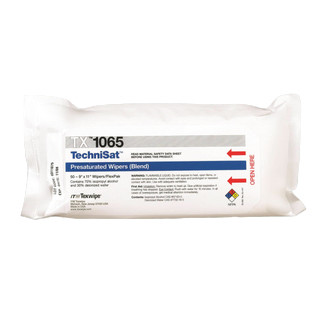
Texwipe TX1041 TechniSat (9" × 11") is designed to reduce those variables by delivering a controlled,
point-of-use 70% IPA / 30% DI water wetting condition in a resealable package.
In other words, TX1041 is a “process control consumable.” It helps make late-shift cleaning behave more like first-shift
cleaning—less mixing error, less evaporation drift, less temptation to re-dip, and fewer untracked technique changes when
production pressure rises.
What it’s for
TX1041 is intended for routine controlled cleaning where repeatable wetness and reduced open-solvent handling
matter: benches and tooling wipe-downs, fixtures and support surfaces, pre-clean steps before assembly, and maintenance cleaning where
spray bottles and shared reservoirs create consistency and contamination risk. It is commonly positioned for use in cleanroom and controlled
environments, including compounding areas where documented, repeatable handling is part of the quality posture.
Decision drivers
TX1041 earns its place when the solvent step is the variable you are trying to control:
- Pre-wetted repeatability: a fixed 70% IPA / 30% DI water condition reduces “damp vs. wet” drift across operators and shifts.
- Filtration as a control: the wetting solution is described as filtered to 0.2 µm, tightening the contamination model versus ad hoc mixing and dispensing.
- Substrate designed for real pickup: a hydroentangled cellulose/polyester blend supports film pickup and practical soil removal while improving wet strength versus straight cellulose.
- Resealable packaging: reduces evaporation loss and helps prevent “half-dry, half-wet” variability inside an opened package.
- Less open-solvent handling: reduces bottle, beaker, and reservoir exposure events that can back-contaminate solvent and complicate investigations.
- Operational discipline through sourcing: consistent replenishment through SOSCleanroom reduces unqualified substitutions when schedules tighten.
Materials and construction – explained like an engineer
TX1041 is described as a hydroentangled nonwoven made from 55% cellulose / 45% polyester.
Hydroentanglement matters because it is a mechanical bonding approach—useful for reducing one common source of variability associated with
binder-heavy nonwovens. The blend itself is the engineering decision: cellulose contributes fast wet-out and sorption for aqueous/IPA systems,
while polyester contributes tensile strength and handling stability when the wipe is already loaded with solvent.
Pre-wet changes operator behavior. It reduces the urge to re-wet mid-stroke—one of the fastest ways to turn “soil removal” into “soil redistribution,”
especially on smooth stainless, coated surfaces, and bench tops where dissolved films can be dragged into the next zone.
Specifications in context
Format: 9" × 11" is a practical hand size for wipe-down workflows—large enough for controlled folding and zone separation,
small enough to discourage overreach and accidental contact with adjacent areas. The wetting system is 70% IPA / 30% DI water, with the
solution described as 0.2 µm filtered.
Packaging (operationally important): TX1041 is listed as 70 wipes per resealable package and 12 packages per case.
Treat the package label and the exact received configuration as the governing control for SOPs, kitting, and EHS storage planning.
Cleanliness and performance metrics – what matters in practice
With pre-wetted wipes, the “performance feature” is often not a single published number—it is repeatability.
Standardized saturation level reduces streaking from over-application, reduces pooling at seams and interfaces, and improves day-to-day consistency
in visual cleanliness and re-clean rates.
Also, 70% IPA behaves differently than anhydrous IPA. The water fraction can improve wetting on some soils and supports general cleaning,
but it may also increase water-spot risk or slow dry-down on certain surfaces. If spotting is unacceptable, tighten technique (lighter contact, single-direction passes)
or define a finishing step with your approved solvent strategy for that surface.
Rule of thumb: When wetness repeatability is the constraint, step into a controlled pre-wetted system. When edge shedding
is the constraint, step toward sealed-edge knit architectures for finishing passes.
Packaging, EHS, and traceability – the controls people forget
Resealable packaging is not a convenience feature—it is a saturation-control feature. It helps preserve wetness level and reduces evaporation-driven drift
across package life. It also reduces incidental exposure compared with open solvent bottles, beakers, and tubs.
Because the wipe contains alcohol, treat storage and use as an EHS-managed activity: follow facility requirements for flammables storage, ventilation,
ignition-source control, and waste handling. For audits and investigations, rely on the documentation tied to the lots you receive and the exact SKU configuration in use.
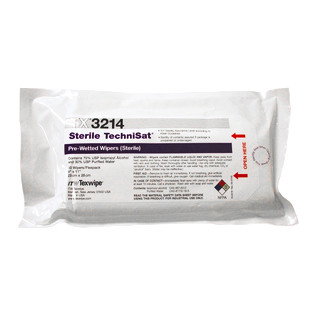
Sterility is a separate decision gate. Unless a sterile configuration is explicitly specified for the exact SKU and supported by documentation, treat TX1041 as non-sterile
and select a validated sterile pre-wetted program when sterile introduction is required by SOP and area classification.
Best-practice use
Pre-wetted wipes reduce variability—but they do not eliminate technique risk. TX1041 performs best when operators treat folding and face management as the control system.
- Fold for control: quarter-fold to create multiple clean faces; treat each face as single-pass for critical wipe-downs.
- Directional strokes: use straight-line, overlapping passes; avoid “scrub back and forth” unless a written procedure requires it.
- Do not top off: adding extra solvent changes saturation and undermines repeatability and qualification logic.
- Reseal discipline: keep packages closed between pulls to prevent dry-down and concentration drift.
- Escalation logic: for residue-sensitive finishing, define a finishing wipe/chemistry step that is qualified to acceptance criteria.
Common failure modes — and how TX1041 helps
A solvent wipe step fails in predictable ways. TX1041 reduces several of them by design, but the remaining controls are procedural.
- Evaporation drift: open beakers/bottles concentrate; resealable packaging helps preserve wetness level.
- Re-dipping / cross-contamination: shared reservoirs accumulate contamination; single-use pulls reduce back-contamination pathways.
- Overworking one face: causes redeposit and streaking; folding discipline and early discard remain mandatory.
- Using a general pre-wet as a final-touch tool: can leave background on ultra-sensitive surfaces; define a finishing step where the residue budget is tight.
Closest comparators
The defensible comparisons are other cleanroom-positioned, pre-wetted IPA wipe programs where packaging discipline and wetness stability are part of the value proposition.
Contec PROSAT® 70% IPA presaturated programs are commonly evaluated when sterility options, packaging architecture, and multiple substrates (knit and nonwoven) matter.
Compare substrate architecture, residue posture, and how consistently saturation holds across an opened pack.
Berkshire SatPax® IPA wipe families are a frequent comparator class in resealable pouch formats. Compare documentation depth, substrate choice, and compatibility with your surface sensitivity and dry-down window.
Valutek pre-wetted spunlace cellulose/polyester IPA wipes are a direct category peer for hydroentangled blend pre-wet formats. Compare cleanliness documentation, pack life behavior, and lot-to-lot stability.
Where TX1041 fits in a controlled cleaning program
TX1041 belongs in the “standardized solvent wipe-down” tier: routine cleaning steps where the dominant risk is not the chemistry—it is variability in solvent handling
and technique. Use it to stabilize day-to-day wipe-downs and reduce open-solvent failure modes. Keep the program mature by defining escalation tools: sealed-edge knit
polyester wipes for residue-sensitive finishing, specialty formats for abrasion-dominated surfaces, and method-aligned sampling consumables when the wipe becomes part
of the measurement system.
Terminology note: TX1041 is engineered for low-linting performance; no wiper is truly “lint-free” in every process condition.
Source basis
-
SOSCleanroom product page: “Texwipe TX1041 TechniSat 9" × 11" Cellulose/Polyester Cleanroom Wiper Pre-Wet 70% IPA” (description, filtration note, packaging/case configuration, handling notes).
https://www.soscleanroom.com/product/wipers/texwipe-tx1041-technisat-9-x-11-cellulose-polyester-cleanroom-wiper-pre-wet-70-ipa/
-
Texwipe (ITW) product listing: “TechniSat™ Presaturated Wipers – TX1041” (positioning, resealable packaging framing, use-case notes including USP compounding context).
https://www.texwipe.com/products/wipers/presaturated-wipers/technisat-presaturated-wipers/tx1041
-
Controlled-environment practice basis applied: single-direction wiping, fold/rotate/discard discipline, wetness control, and role separation between routine solvent wipe-downs and residue-critical finishing steps.
Source: SOSCleanroom Technical Vault (SOS Supply)
Last reviewed: Jan. 3, 2026
© 2026 SOS Supply. All rights reserved.