The Technical Vault
By SOSCleanroom
Microdenier Without the Nylon Tradeoff: Why TX59 Vertex Is a Sealed-Edge Control for Defect-Sensitive Wipe-Downs
Last reviewed: Jan. 3, 2026 | Audience: contamination control, cleanroom operations, EHS, quality, metrology
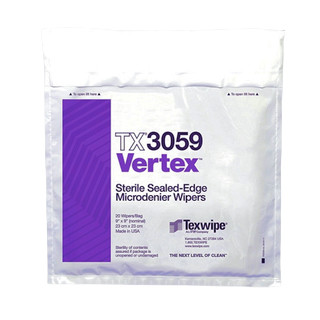
Texwipe TX59 Vertex (9" × 9") is a dry, microdenier polyester cleanroom wiper with a sealed-edge strategy intended for applications where “it wiped clean” is not the same as “it stayed clean” after dry-down and inspection. Microdenier construction increases effective surface area at the filament level, which can improve film pickup and reduce the amount of “pressure scrubbing” operators use to get a surface to visually clear.
TX59 is frequently specified when teams want microfiber-like wiping performance without nylon content (a common concern in regulated or residue-sensitive environments). The control logic is straightforward: keep the wiper durable, keep the edge stable, and keep releasables and residues predictable enough to defend in investigations.
What it’s for
TX59 is best used for routine controlled cleaning where surface quality and inspection sensitivity drive technique discipline: wipe-downs of tooling and equipment exteriors, work surfaces, stainless, glass, and process-adjacent areas where you want reliable pickup of light films and fine particulate without relying on aggressive scrubbing. It is also a practical choice when the facility wants a “higher-control” dry wipe than general-purpose nonwovens, but does not want to force sealed-edge knit costs into every station.
Decision drivers
TX59 earns its place when a program needs tighter control over edge behavior, wiping feel, and measurable releasables:
- Microdenier polyester construction: higher surface area can improve pickup of light films and reduce “wipe harder” behavior that drives streaking and abrasion events.
- Sealed-edge strategy: engineered edges are commonly selected when folding, corner work, or higher wiping force makes edge-driven fibers a credible defect mechanism.
- Published contamination framework: typical values for particles/fibers, NVR, and ions support qualification discussions and change-control documentation.
- Solvent and chemistry compatibility posture: designed for common cleanroom solvent workflows (qualification should still be tied to your solvent set, contact time, and residue budget).
- Packaging discipline and traceability: double-bag and lot controls reduce handling exposure and support faster containment when trends shift.
Materials and construction – explained like an engineer
“Microfiber” is often treated like a performance promise, but the mechanism is mechanical: smaller filaments increase contact points and help the wipe capture fine soils with less applied force. TX59 uses microdenier polyester so the substrate stays inside a polyester-only contamination model while still delivering a higher “effective contact surface” than conventional denier knits.
The second mechanism is edge control. If operators quarter-fold aggressively, wipe into corners, or work around fasteners and seams, edges become the first failure point. A sealed edge is not a marketing feature — it is a mitigation for edge-driven fibers when technique and surface geometry are non-ideal.
Cleanliness and performance metrics
In most programs, wipers are evaluated on three risk buckets: releasables (particles/fibers), residues (NVR), and ions. TX59’s published values are best treated as a qualification starting point, not a contractual specification.
- Absorbency: typical sorptive capacity 350 mL/m² and typical sorptive rate 0.3 seconds. Operationally, this supports fast wet-out and consistent wipe feel when operators dampen for solvent wiping.
- Releasables: typical LPC ≥0.5 µm 15.0 × 10⁶ particles/m². Typical fibers >100 µm 520 fibers/m². These are “placement” numbers — useful for deciding where TX59 belongs relative to nonwovens and relative to sealed-edge knits.
- NVR: typical 0.07 g/m² (IPA extractant) and 0.01 g/m² (DI water extractant). If haze/streaks appear after dry-down, the first levers are wetness control, face rotation, and chemistry concentration control — not higher wiping force.
- Ions: typical ionic extractables are reported at low levels (example: chloride <0.10 ppm; sodium <0.30 ppm; potassium <0.08 ppm). For corrosion-sensitive assemblies and high-impedance electronics, ions are a defect mechanism, not a paperwork metric — validate the full solvent + surface + dry-down window.
Interpretation note: Published contamination values are commonly reported as typical analyses. In validation-sensitive programs, treat the wipe as part of the method and confirm suitability in your process window (solvent, surface, contact time, and inspection criteria).
Why microdenier + sealed edge matters operationally
In real cleanrooms, many “wipe failures” are handling failures: too much force, too few face changes, and wiping patterns that re-deposit dissolved soils. Microdenier construction can reduce the temptation to scrub by improving pickup efficiency at lower pressure. Sealed edges reduce the probability that folding and corner work become a fiber generator. Together, those two controls reduce the number of ways a wipe becomes the uncontrolled variable during high-throughput maintenance events or inspection-driven re-clean cycles.
Best-practice use
TX59 performs best when technique is treated like a control input: quarter-fold consistently, rotate faces aggressively, and maintain one-direction, overlapping strokes.
- Face discipline: Treat each face as single-pass for inspection-sensitive wipe-downs; discard early once the face begins to load.
- Wetness control: Aim for damp, not wet. Over-wetting increases pooling, wicking into seams, and residue redistribution.
- Direction control: Use parallel, overlapping passes. Avoid back-and-forth scrubbing on residue-sensitive surfaces; it increases streak risk.
- Corner strategy: Fold to present a stable edge; avoid “sawing” the same edge across a corner repeatedly.
Common failure modes — and how TX59 helps
A wiper becomes a contamination source in predictable ways: edge degradation during folding/corner work, overuse of a loaded face, and inconsistent solvent loading that leaves streaks after dry-down. TX59’s sealed edge mitigates edge-driven fibers during higher-stress wiping, while the microdenier surface helps operators get effective pickup at lower force. The remaining controls are procedural: face rotation, directional strokes, and wetness discipline.
Closest comparators
The most defensible comparisons are to (1) sealed-edge polyester knit wipes selected for edge control and low releasables and (2) sealed-edge microfiber programs selected for high pickup on light films.
Berkshire MicroSeal 1200 (sealed-edge polyester knit) is the appropriate comparator when edge control and releasables reduction are the dominant risk drivers. Sealed-edge knits are commonly selected for more defect-sensitive surfaces because the edge is engineered to reduce fiber contribution during folding and aggressive wipe patterns.
Valutek low-texture microfiber sealed-edge wipers (ultrasonic sealed edge microfiber formats) are the comparator class when microfiber pickup is the primary driver. If your quality system restricts nylon content, verify substrate composition and extractables posture before treating microfiber programs as drop-in equivalents.
Rule of thumb: When edge-driven fibers are the complaint, sealed-edge/sealed-border is typically the next control step. When film pickup at low force is the constraint, microdenier/microfiber architectures are often evaluated — but the material model (polyester-only vs. polyester/nylon blends) must match your residue and compliance posture.
Where TX59 fits in a cleanroom wiping program
TX59 is a strong choice when a facility wants a polyester-only contamination model but needs a step-up in film pickup efficiency and edge stability for inspection-sensitive wipe-downs. It fits well as a “defect-prevention” wipe at benches, metrology-adjacent areas, and equipment wipe-down points where technique variability and edge handling are the recurring failure modes. When the process shifts to ultra-critical finishing or the tightest releasables budgets, the technical escalation is often a higher-control sealed-edge knit selected specifically for that surface and acceptance window.
Terminology note: TX59 is engineered for low-linting performance; no wiper is truly “lint-free” in every process condition.
Source basis
- SOSCleanroom product page: “Texwipe TX59 Vertex 9" × 9" Microdenier Sealed Edge Cleanroom Wiper” (positioning, packaging configuration, use-case framing).
- ITW Texwipe datasheet: “Vertex™ Dry Wipers — TX59” (typical sorptive capacity/rate; LPC/particles/fibers; NVR; ions; typical-values and test-method framing).
- Berkshire product information: “MicroSeal 1200” (sealed-edge polyester knit comparator context).
- Valutek product information: low-texture microfiber sealed-edge wiper formats (microfiber comparator class and edge strategy context).
Source: SOSCleanroom.com | Last reviewed: Jan. 3, 2026
© 2026 SOS Supply. All rights reserved.