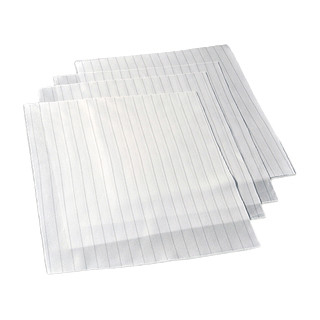
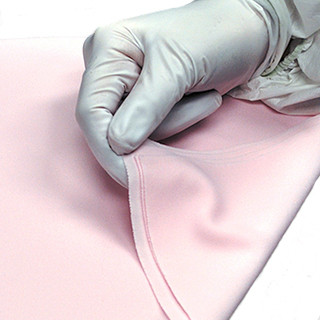
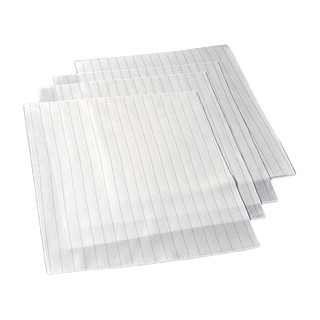
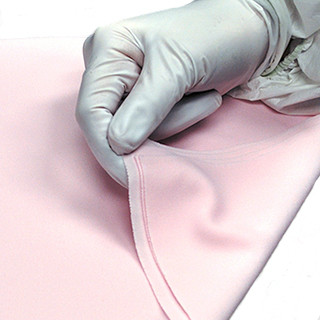
Visual check: striped knit pattern with sealed edges intended to reduce edge shedding in controlled environments.
1) Practical solutions in a critical environment
In high-sensitivity cleaning, two failures cause most “mystery defects”: (1) particles introduced during wiping, and (2) static events that attract (or re-attract) contamination right back onto the surface.
ULTIMATE 5 ESD wipers are positioned for ISO Class 3–4 cleaning where operators need a knit wiper that supports static control, stays mechanically stable in use, and is processed and packaged for controlled environments.
Note on terminology: many teams say “lint-free,” but no wiper is truly lint-free. The operational target is low-linting performance paired with sealed edges and disciplined technique.
2) What is this wiper used for
- Routine and event-driven wipe-downs of benches, fixtures, carts, and non-porous equipment exteriors in ISO Class 3–4 areas.
- Static-sensitive environments where a standard polyester knit can be “too insulating” and can contribute to attraction/redeposition behaviors.
- Application/removal of cleaning solutions and residues when your process calls for sealed edges and cleanroom-packaged wipes.
- Controlled spill response on smooth surfaces (use your facility’s chemical compatibility and spill-response rules).
3) Why should customers consider this wiper
- ESD/antistatic knit construction intended to support static-control handling while wiping.
- Sealed edges to reduce edge-related fiber release versus cut-edge knits.
- Cleanroom-focused processing described as cleaned/scoured, laser cut, and laundered with fine filtration practices.
- Packaging discipline described as hermetically sealed in cleanroom-cleaned packaging and double bagged.
- Lot-to-lot traceability is explicitly called out on the SOSCleanroom listing.
4) Materials and construction
The SOSCleanroom listing describes a knit fabric made from virgin polyester fibers combined with carbon core nylon fibers that are continuously filamented through a no-run knit structure.
In practice, that combination is typically selected for two reasons: mechanical stability during wiping and improved static-control behavior versus a fully insulating knit.
Edges are positioned as sealed/laser cut (per the listing’s process description). Sealed edges are a common control point because the edge is where a knit is most vulnerable to mechanical disturbance if you wipe across sharp corners, burrs, or poorly deburred fixtures.
5) Specifications in context
Use this table as an operator/QA cross-check. If a value is not explicitly published for this SKU on the SOSCleanroom page or an available manufacturer document, it is marked as not published.
| Attribute |
ULT5-1212 (12" x 12") |
| Product type |
ESD/antistatic cleanroom wiper; sealed edges; double bagged |
| Nominal size |
12" x 12" |
| Material (as described) |
Virgin polyester fibers + carbon core nylon fibers (no-run knit) |
| Cleanroom suitability (as listed) |
ISO Class 3 & 4 (Class 1 & 10) |
| Sterility |
Not stated as sterile on the SOSCleanroom listing |
| Edge treatment |
Sealed edges (process references include laser cutting) |
| Packaging |
Double bagged; “hermetically sealed” packaging is described |
| Traceability |
Lot-to-lot traceability (explicitly stated) |
6) Cleanliness metrics
The SOSCleanroom page positions this wiper as extremely low in particle generation and chemical extractables, but does not publish numeric ionic or NVR values in the visible listing.
For validation-driven programs, obtain the supplier’s current technical data and align it to your acceptance criteria and test methods.
Typical ion extractables
| Ion / group |
Published value |
Notes |
| Not published in visible listing |
Not published |
Request current technical data from the supplier for your QA file. |
Typical NVR (nonvolatile residue)
| Metric |
Published value |
Notes |
| NVR |
Not published |
Use your internal solvent/gravimetric method alignment for qualification. |
7) Packaging, sterility and traceability
- Pack options: Bag or case.
- Bag unit: 100 wipers per bag.
- Case unit: 10 bags of 100 wipers per case.
- Packaging controls (as described): double bagged; hermetically sealed in cleanroom-cleaned packaging under class 10 air-stream.
- Processing controls (as described): cleaned/scoured; laser cutting; proprietary cleaning; laundered in a Class 100 environment using ultra-filtered water and HEPA-filtered air during moisture removal.
- Traceability: individually inspected with lot-to-lot traceability; ISO 9000 standards are referenced on the listing.
- Country of origin: not stated for this SKU in the visible listing. The manufacturer is described as operating facilities in the USA, China, Germany, and Mexico.
8) Best-practice use
A high-grade wiper only performs like a high-grade wiper if the technique is controlled. The goal is simple: move contamination off the surface and keep it captured—without re-depositing it.
In ESD-sensitive areas, also confirm your grounding, bench-mat condition, and environmental controls before assuming the wiper is the variable.
Operator-level wiping technique module
- Fold for control: fold into quarters (or smaller) to create multiple clean faces; change faces on a timer or after a defined area (your SOP should define both).
- One direction beats circles: use straight passes with 10–20% overlap; circular wiping is a common cause of redeposition on smooth stainless and coated surfaces.
- Pressure is a process parameter: enough pressure to maintain contact, not enough to “polish” residue back into a film. If you see glossing or streaking, you’re often overworking the surface.
- Edge management: avoid dragging edges across burrs/sharp corners; wipe “off” edges rather than “into” them to reduce mechanical disturbance.
- Wet vs. dry discipline: if your process uses solvent, pre-wet consistently (do not flood). If dry wiping is required, ensure your ESD controls are active and humidity targets are met for your program.
- Glove-to-wiper interface: change gloves when you change tasks; oils from glove contact can drive streaks and can compromise low-residue outcomes.
- Define discard rules: discard when loaded, snagged, dropped, or used on a higher-risk surface (cross-contamination control).
9) Common failure modes
- Redeposition haze: usually technique-related (too many passes, not enough face changes, wrong solvent loading).
- Edge snagging / mechanical disturbance: wiping across sharp corners can damage any knit; sealed edges help, but they do not make a wiper “corner-proof.”
- Static attraction persists: typically a grounding/humidity/workstation issue rather than a wiper issue—confirm straps, mats, and ground points.
- Streaking: can indicate excess solvent, incompatible chemistry, residue load too high for a single wipe step, or a “smearing” pass pattern.
- Cross-contamination: the most common root cause is reusing a wiper face across zones or surfaces with different risk profiles.
10) Closest competitors
The closest alternatives are other ESD-focused polyester knit wipes with controlled edges and cleanroom packaging. Within the SOSCleanroom catalog, these are commonly evaluated alongside ULTIMATE 5 ESD depending on your class target, thickness preference, and whether you want antimicrobial positioning.
- VISION 50 ESD Cleanroom 12" x 12" Wiper (ISO Class 5): positioned for a different ISO class target; useful when the ESD requirement remains but the environment class differs.
- Ultimate 5 ESD Antibacterial Wiper (9" x 9"): a same-family alternative when size and antimicrobial positioning matter to your program.
- VISION 1 Pink ESD Cleanroom 12" x 12" Wiper (ISO Class 6): a pragmatic option for less critical zones where ESD control remains important.
11) Critical environment fit for this wiper
This product is explicitly marketed on SOSCleanroom for ISO Class 3–4 wipe-down tasks and is described as extremely low in particle generation and chemical extractables, with sealed edges and disciplined packaging.
Practically, that combination is most valuable when your contamination budget is tight and your operators cannot “wipe and hope”—you need repeatable outcomes across shifts.
If your quality system is ISO 14644-aligned, treat the wiper as one control within a larger chain: gowning discipline, solution control, workstation design, and verification (visual inspection, residue checks, particle trending) determine whether the wipe step is actually closing risk.
12) SOSCleanroom note about SOP's
The Technical Vault is written to help customers make informed contamination-control decisions and improve day-to-day handling technique.
It is not your facility’s Standard Operating Procedure (SOP), batch record, or validation protocol.
Customers are responsible for establishing, training, and enforcing SOPs that fit their specific risks, products, equipment, cleanroom classification, and regulatory obligations.
Always confirm material compatibility, cleanliness suitability, sterility requirements, and acceptance criteria using your internal quality system and documented methods.
If you adapt any technique guidance from this entry, treat it as a starting template. Your team should review and approve the final method, then qualify it for your specific surfaces,
solvents, cleanliness limits, inspection methods, and risk profile. In short: use these best-practice suggestions to strengthen your SOPs—not to replace them.
13) Source basis
SKU pages and manufacturer references
- SOSCleanroom product page (ULT5-1212): https://www.soscleanroom.com/product/wipers/ultimate-5-esd-cleanroom-12-x-12-wiper-iso-class-3-4/
- Manufacturer site (High-Tech Conversions): https://high-techconversions.com/
- Manufacturer cleanroom wipes category: https://high-techconversions.com/product-category/wipes/cleanroom-wipes/
- Manufacturer “Dry Cleanroom & Lab Wipes” brochure (general line card; not SKU-specific): https://high-techconversions.com/wp-content/uploads/2023/05/L-HTC-0021-S_Dry_Cleanroom_Wipes.pdf
- Manufacturer Ultimate-family reference (includes Ultimate line positioning; not ULT5-1212 specific): https://high-techconversions.com/product/ultimate-60-polyester-sealed-edge-cleanroom-wipers/
Standards and regulatory bodies (commonly referenced for controlled environments)
- ISO (cleanroom classification framework reference): https://www.iso.org/standard/53394.html
- FDA (regulatory context for controlled manufacturing): https://www.fda.gov/
- ASTM (test methods and material standards, program-dependent): https://www.astm.org/
- IEST (recommended practices and contamination control guidance): https://www.iest.org/
SOSCleanroom is the source for this Technical Vault entry.
Briefed and approved by the SOSCleanroom (SOS) staff.
If you have any questions please email us at Sales@SOSsupply.com
Last reviewed: Jan. 7, 2026
© 2026 SOSCleanroom