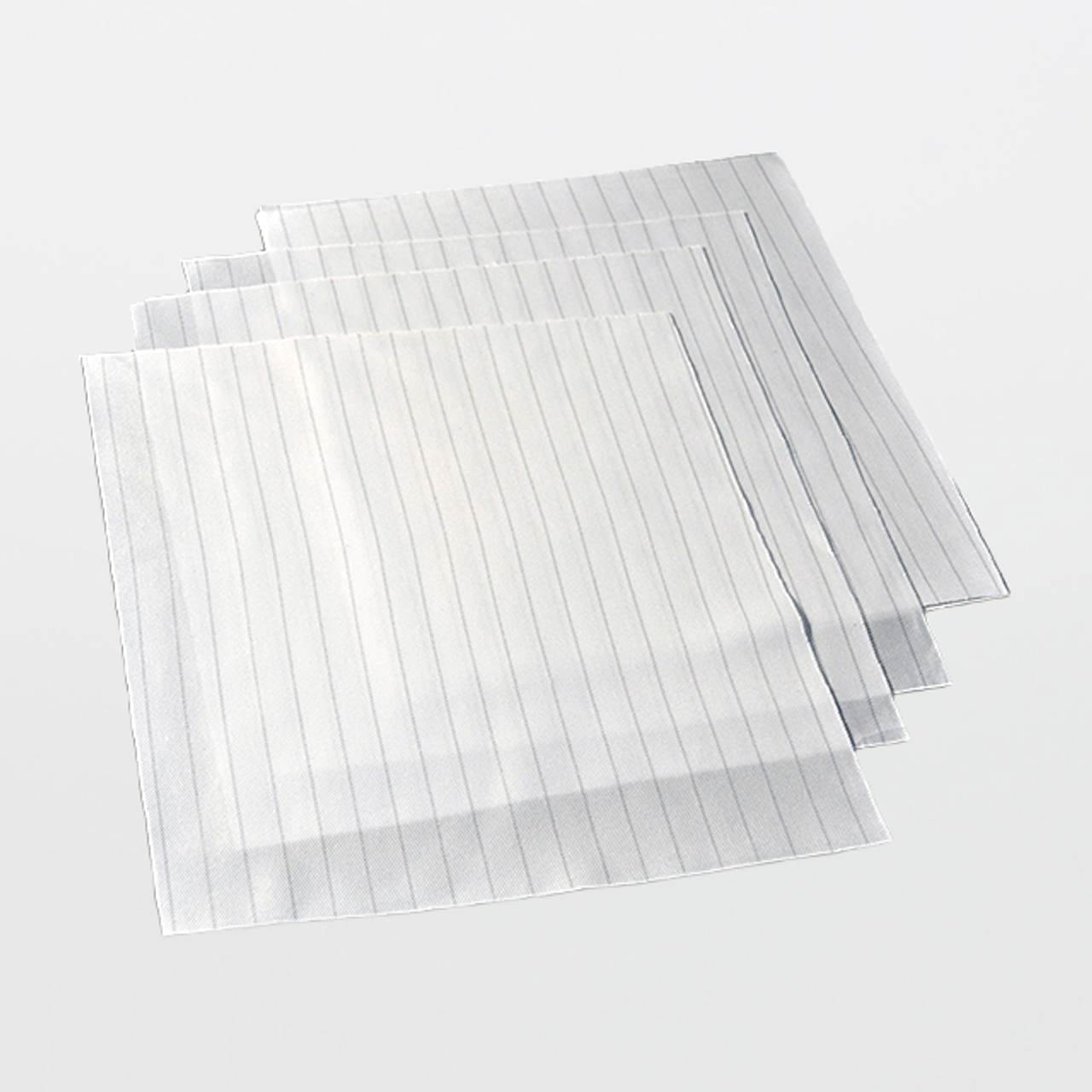
Ultimate 5 ESD striped 9" × 9" wipe (product image).
1) Practical solutions in a critical environment
When electrostatic discharge (ESD) risk overlaps with particle sensitivity, the wiping material becomes part of your process control.
Ultimate 5 ESD is positioned for ultra-critical controlled environments (ISO Class 3–4) where you want an ESD/antistatic wipe with sealed edges,
low particle generation, and disciplined packaging for cleaner handling at the bench. Nothing is truly lint-free; the practical goal is low-linting behavior
that stays consistent during real wiping (pressure, solvent wet-out, and repeated folds).
SOSCleanroom lists this wiper as a sealed-edge, double-bagged, ISO Class 3–4 compatible option, using a no-run knit polyester construction with
carbon-core nylon fibers for antistatic performance. The product is also presented as “antibacterial,” but the active chemistry and test method are not published
in the sources reviewed for this entry.
2) What is this wiper used for
- Wiping and cleaning ESD-sensitive equipment surfaces where fiber shedding and static events are unacceptable (e.g., electronics tooling, fixtures, work surfaces, and select equipment exteriors).
- Ultra-critical cleaning steps where sealed edges are preferred to reduce edge-related linting and loose fiber release.
- Controlled-environment wipe-down workflows where double-bagging supports cleaner transfer and staging.
- Applications cited by the manufacturer include wiping printed circuit boards and cleaning other antistatic electronics and equipment.
3) Why should customers consider this wiper
- ESD/antistatic intent built into the fabric: no-run knit virgin polyester with carbon-core nylon fibers continuously filamented throughout the construction.
- Edge control: sealed edges (laser cut) are used to reduce loose fibers from cut edges during wiping.
- Packaging discipline: double bagged and described as hermetically sealed cleanroom-cleaned packaging with lot-to-lot traceability and inspection.
- Positioned for ISO Class 3–4: selected when your contamination budget is tight and you do not want to “upgrade later” after a failure investigation.
4) Materials and construction
Ultimate 5 ESD is described as a premium no-run knit made from virgin polyester fibers with carbon-core nylon fibers continuously filamented throughout
the knit. In practical terms, the knit construction supports strength and wipe integrity, while the carbon-core component supports antistatic performance.
The product description states it is knitted on equipment intended for cleanroom use, then processed through cleaning/scouring steps, laser cutting,
and a proprietary cleaning step. It is described as laundered in a Class 100 cleanroom using ultra-filtered water (0.45 micron) and HEPA-filtered air for moisture removal.
5) Specifications in context
| Attribute |
Ultimate 5 ESD (ULT5-99 BAG) |
| Nominal size |
9" × 9" |
| Cleanroom compatibility (listed) |
ISO Class 3 & 4 (Class 1 & 10) |
| ESD / antistatic |
Yes (ESD/antistatic positioning; carbon-core nylon in knit construction) |
| Fabric type |
No-run knit of virgin polyester with carbon-core nylon fibers continuously filamented throughout |
| Edge finish |
Sealed edges (laser cut; described as melting/sealing each edge) |
| Packaging |
Double bagged; described as hermetically sealed in cleanroom-cleaned packaging |
| Inspection / traceability |
Individually inspected; lot-to-lot traceability; ISO 9000 standards referenced |
| Quantity (bag) |
150 wipers per bag |
| Quantity (case) |
10 bags per case (10 × 150) |
| “Antibacterial” positioning |
Listed as antibacterial; active agent and test method not published in sources reviewed |
| Site-listed shipping weight |
1.50 lb (listing value; not a fabric basis weight) |
Practical read: the combination of sealed edges + ESD-focused knit is meant to reduce two common failure triggers in electronics cleaning:
(1) edge-shed fibers that migrate into connectors or under components, and (2) static events that can damage sensitive assemblies or attract particles back to the surface you just cleaned.
6) Cleanliness metrics
Ultimate 5 ESD is described as extremely low in particle emission and low in nonvolatile residue (NVR) and ionic levels, but the sources reviewed do not publish numeric extractables tables for the ULT5-99 configuration.
Below, we present the table layout your QA team typically expects for wipe qualification; values are shown as “not published” where not stated.
Typical ion extractables
| Ion |
Typical level |
Notes |
| Sodium (Na+) | Not published | Manufacturer describes low ionic levels; numeric table not provided |
| Potassium (K+) | Not published | — |
| Chloride (Cl-) | Not published | — |
| Sulfate (SO42-) | Not published | — |
| Nitrate (NO3-) | Not published | — |
| Total ionic extractables | Not published | Recommend confirming acceptance limits via your internal method and supplier documentation |
Typical NVR
| Metric |
Typical level |
Notes |
| Nonvolatile residue (NVR) |
Not published |
Manufacturer describes low NVR; numeric table not provided in sources reviewed |
7) Packaging, sterility and traceability
- Packaging configuration: Bag (150 wipers) or case (10 bags of 150).
- Bagging: Double bagged; described as hermetically sealed in cleanroom-cleaned packaging under a Class 10 airstream.
- Inspection and traceability: Individually inspected with lot-to-lot traceability; ISO 9000 standards referenced in the product description.
- Sterility: Not stated as sterile in sources reviewed. If you require sterile presentation, do not assume equivalency; qualify a sterile product line instead.
- Country of origin (manufacturer statement): Not stated for the ULT5-99 configuration in sources reviewed. Manufacturer describes a global manufacturing footprint.
8) Best-practice use
In ultra-critical wiping, the wipe is only half the control. Technique determines whether you remove contamination or redistribute it.
Use a clean-to-dirty logic, keep the wipe face “fresh” by folding, and avoid re-wiping a cleaned area with a contaminated face.
Operator-level wiping technique module
- Stage correctly: Bring the inner bag into the controlled area; open it at point of use to reduce exposure time.
- Fold for control: Fold into quarters (or eighths) to create multiple clean faces. Change faces frequently; treat each face as a single-pass tool.
- Pressure and direction: Use light-to-moderate pressure and a consistent, overlapping stroke pattern. Avoid circular scrubbing that can redeposit particles.
- Wet-out discipline (if using solvent): Apply solvent to the wipe (not directly to sensitive equipment) when possible. Do not over-saturate; excess solvent can carry dissolved residues into crevices.
- ESD controls remain mandatory: An ESD/antistatic wipe supports the program, but it does not replace wrist straps, grounding, ESD garments, and verified dissipative work surfaces.
- Dispose decisively: If the wipe catches on hardware, snags, or loads visibly, discard it immediately. “One more pass” is how fibers migrate into connectors.
9) Common failure modes
- Over-reuse of one wipe face: redeposits particles and can create streaking, especially on polished or coated surfaces.
- Too much pressure: can drive contamination into microfeatures or abrade softer coatings. Sealed edges help, but technique still matters.
- Dry wiping when solvent is required: can increase static attraction and smear oils instead of removing them.
- Assuming “antibacterial” equals disinfecting: the sources reviewed do not publish an active ingredient, contact time, or test method. If microbial control is required, use validated disinfectants and facility procedures.
10) Closest competitors
The meaningful comparison is not brand-to-brand — it is construction and edge control versus your process risk. When you evaluate alternates, compare:
sealed-edge method (laser/ultrasonic), knit type (no-run vs standard knit), ESD strategy, extractables documentation, and bagging discipline.
- Sealed-edge polyester knit cleanroom wipers (ISO 3–5 class): strong alternates when your primary driver is edge-shed reduction, and ESD is handled by your workstation controls.
- ESD-focused polyester wipes (striped or pink identifiers): alternates when operator recognition and ESD intent are primary, and your acceptance criteria allow higher cleanroom classes than ISO 3–4.
- High-spec microdenier or nylon wipes: alternates when surface finish sensitivity and smear control matter more than ESD behavior, but confirm compatibility with your particle and extractables limits.
11) Critical environment fit for this wiper
Ultimate 5 ESD is a fit when your environment and product sensitivity justify ISO Class 3–4 compatible wiping materials and you want sealed edges plus an ESD/antistatic fabric strategy.
It is designed for electronics and other ESD-sensitive equipment cleaning, and it is packaged to support cleaner transfer and staging (double bagged).
From a program perspective, this is the kind of wiper you standardize when you want fewer “mystery defects” traced back to wiping variables.
If your QA team requires numeric extractables targets (ions/NVR) for release, confirm documentation availability before locking the wipe into a validated process.
12) SOSCleanroom note about SOP's
The Technical Vault is written to help customers make informed contamination-control decisions and improve day-to-day handling technique.
It is not your facility’s Standard Operating Procedure (SOP), batch record, or validation protocol.
Customers are responsible for establishing, training, and enforcing SOPs that fit their specific risks, products, equipment, cleanroom classification, and regulatory obligations.
Always confirm material compatibility, cleanliness suitability, sterility requirements, and acceptance criteria using your internal quality system and documented methods.
If you adapt any technique guidance from this entry, treat it as a starting template. Your team should review and approve the final method, then qualify it for your specific surfaces,
solvents, cleanliness limits, inspection methods, and risk profile. In short: use these best-practice suggestions to strengthen your SOPs—not to replace them.
13) Source basis
- SOSCleanroom product page (ULT5-99 BAG): https://www.soscleanroom.com/product/wipers/ultimate-5-esd-cleanroom-9-x-9-wiper-iso-class-3-4/
- Product image (SOSCleanroom CDN): https://cdn11.bigcommerce.com/s-3ob78/images/stencil/1280x1280/products/951/2915/094__72728.1408974746.png?c=2
- Manufacturer (High-Tech Conversions) reference article describing ULTIMATE 5 ESD sealed edges, ISO Class 3–4 suitability, and packaging/inspection concepts: https://high-techconversions.com/esd-safe-wiping-solutions/
- Manufacturer category context on ESD wipes and controlled environment positioning: https://high-techconversions.com/product-category/wipes/cleanroom-wipes/esd-wipes/
- Manufacturer PDF datasheet for ULTIMATE 5 ESD (ULT5-99): Not published/found in sources reviewed. Manufacturer provides a technical data request path: https://high-techconversions.com/request-technical-data-certificates/
- ISO (cleanroom classification reference page provided): https://www.iso.org/standard/53394.html
- FDA (regulatory body reference): https://www.fda.gov/
- ASTM (standards body reference): https://www.astm.org/
- IEST (recommended practices body reference): https://www.iest.org/
SOSCleanroom is the source for this Technical Vault entry.
Briefed and approved by the SOSCleanroom (SOS) staff.
If you have any questions please email us at Sales@SOSsupply.com
Last reviewed: January 7, 2026
© 2026 SOSCleanroom