Why eyewear matters in contamination control
Eye protection is easy to treat as “just PPE,” but in controlled environments it behaves more like a tool: it gets adjusted, it gets touched, and it sits near critical facial zones.
ISO cleanroom operations guidance emphasizes an operations control programme (OCP) that includes personnel management, training, and a gowning programme. In other words, eyewear is part of the same discipline set as gloves, hoods, and coveralls: controlled entry, controlled behavior, and consistent technique.
What 49301 is (published basis)
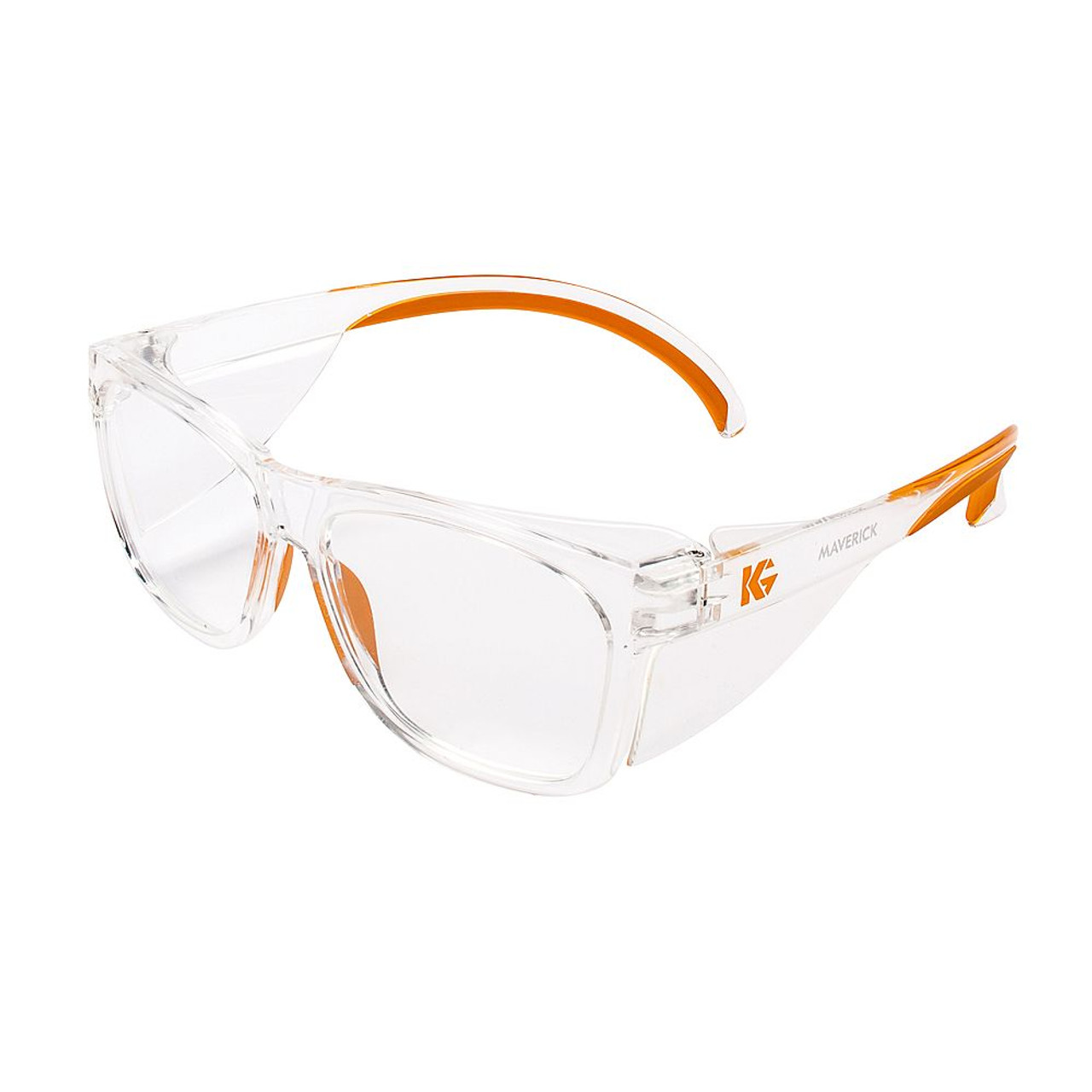
Maverick™ Eye Protection code 49301 is specified as Clear Anti-Fog with a Clear/Orange Tip frame and a 12-pair pack format.
Manufacturer literature also states ANSI Z87.1+ impact protection and 99.9% UVA/UVB/UVC lens protection.
For anti-fog and durability discussions, the same published sheet includes EN166 “N” (fogging resistance) and “K” (surface damage by fine particles) pass statements for eligible Maverick codes including 49301.
Where eyewear fits in a gowning (donning) sequence
Every facility has its own validated order, but the goal is consistent: cover shedding sources, keep outer surfaces clean, and reduce face-touching after you’ve crossed the gowning boundary.
A practical way to place safety glasses in the sequence is:
- Pre-stage clean: remove eyewear from the shipping carton outside the clean zone; keep the wearer-ready unit in a clean pouch or designated storage location.
- Cover hair/facial hair first: hair containment reduces shedding before eyewear goes on.
- Mask / hood alignment: properly seated masks and hoods reduce fogging drivers (warm air leaks) and reduce repeated eyewear adjustments.
- Don eyewear by the temples: avoid lens contact; avoid brushing lenses against hood fabric.
- Then outer garments/gloves: once gloves are on (especially sterile gloves), “fixing eyewear” becomes a contamination event risk.
- Final check: confirm fit, clarity, and that nothing is riding on skin in a way that will trigger constant readjustment.
Technique guidance that reduces contamination touches
Small habits that make a measurable difference
- Temples only: train “hands never on lenses.” It reduces residues, scratches, and re-clean cycles.
- One adjustment, then stop: if eyewear constantly slips, it’s a fit issue or mask/hood alignment issue—not an “adjust harder” issue.
- Wipe correctly: use a low-lint wipe and an approved cleaner; avoid paper towels and rough fabrics that micro-scratch anti-fog coatings.
- Don’t “park” eyewear on benches: set down locations become contamination collectors. Use a designated hook, pouch, or enclosed container.
- If fogging drives face-touching: fix the root cause (mask seal, humidity, airflow position) rather than repeatedly lifting eyewear.
Specifications in context (quick table)
| Attribute |
KleenGuard™ Maverick™ 49301 |
| Manufacturer code |
49301 |
| Lens |
Clear polycarbonate |
| Lens coating (published family) |
Premium anti-fog (KleenVision™ anti-fog referenced for Maverick coating options) |
| Published EN166 statements (eligible codes) |
Passes EN166 “N” (fogging) and EN166 “K” (fine-particle surface damage) for eligible Maverick codes including 49301 |
| Impact standard |
ANSI Z87.1+ (published); manufacturer product listing also references ANSI/ISEA Z87.1-2020 and CSA Z94.3:20 |
| UV protection |
99.9% UVA/UVB/UVC protection (published) |
| Frame |
Clear / Orange tip |
| Pack |
12 pairs |
| RightCycle™ |
Eligible (program-dependent) |
ISO first, then Annex 1: what “good gowning” expects
ISO perspective: ISO cleanroom operations guidance focuses on an OCP that includes personnel training, controlled entry/exit, and a gowning programme. That matters because eyewear problems are usually behavior problems (touching, re-seating, “parking” on surfaces), not product problems.
European Annex 1 perspective: Annex 1 goes further for sterile manufacturing by explicitly addressing gowning qualification, visual checks, and the use of sterilised garments and eye coverings (e.g., goggles) for higher-grade areas.
If your facility operates under Annex 1 expectations, treat eyewear selection (safety glasses vs. sealed goggles, sterile vs. non-sterile) as a documented part of your garment qualification and contamination control strategy.
SOSCleanroom + Ansell (KleenGuard): what changes for customers
As SOSCleanroom expands our controlled-environment PPE offering with Ansell’s KleenGuard portfolio, the objective is straightforward:
fewer substitutions, more predictable supply, and clearer model-to-room mapping so teams don the same way every time.
If you are rolling out standard eyewear across departments, we can help you align the selection to task hazards, fog drivers, cleanroom behaviors, and documentation expectations.
Common failure modes (and what to do instead)
- Fogging drives constant touching: fix mask seal/hood placement and reduce warm-air leaks before blaming the coating.
- Wiping with sleeves or paper towels: switch to approved lens wipes and low-lint materials to protect coatings.
- Eyewear placed on benches: use a designated storage spot/pouch; treat eyewear like a controlled accessory.
- “One model fits all rooms” assumption: higher-grade rooms may require goggles/sterile eye coverings per program requirements.
SOSCleanroom note about SOP's
The Technical Vault is written to help customers make informed contamination-control decisions and improve day-to-day handling technique.
It is not your facility’s Standard Operating Procedure (SOP), batch record, or validation protocol.
Customers are responsible for establishing, training, and enforcing SOPs that fit their specific risks, products, equipment, cleanroom classification, and regulatory obligations.
Always confirm suitability and acceptance criteria using your internal quality system and documented methods.
If you adapt any technique guidance from this entry, treat it as a starting point. Your team should review and approve the final method, then qualify it for your specific rooms, hazards, and contamination-control strategy.
Source basis
- SOSCleanroom product page (Maverick 49301): https://www.soscleanroom.com/product/apparel/kleenguard-maverick-clear-safety-glasses-clear-anti-fog-case-12/
- Manufacturer product listing (Ansell / KleenGuard Maverick Safety Glasses): https://www.ansell.com/us/en/products/kleenguard-maverick-safety-glasses
- Manufacturer literature (Maverick Eye Protection; Effective June 2018): https://www.zoro.com/static/cms/enhanced_pdf/Essendant%20Inc_KCC49311xxPRODLITxx01xx042ba4.pdf
- ISO 14644-5 (Operations / gowning programme referenced in abstract): https://www.iso.org/standard/88599.html
- EU GMP Annex 1 (Manufacture of Sterile Medicinal Products; personnel/gowning and eye coverings): https://health.ec.europa.eu/system/files/2022-08/20220825_gmp-an1_en_0.pdf
SOSCleanroom is the source for this Technical Vault entry.
Briefed and approved by the SOSCleanroom (SOS) staff.
If you have any questions please email us at Sales@SOSsupply.com
Last reviewed: Jan. 14, 2026
© 2026 SOSCleanroom