Technical Vault: KleenGuard™ V30 Maverick™ Safety Glasses 49301
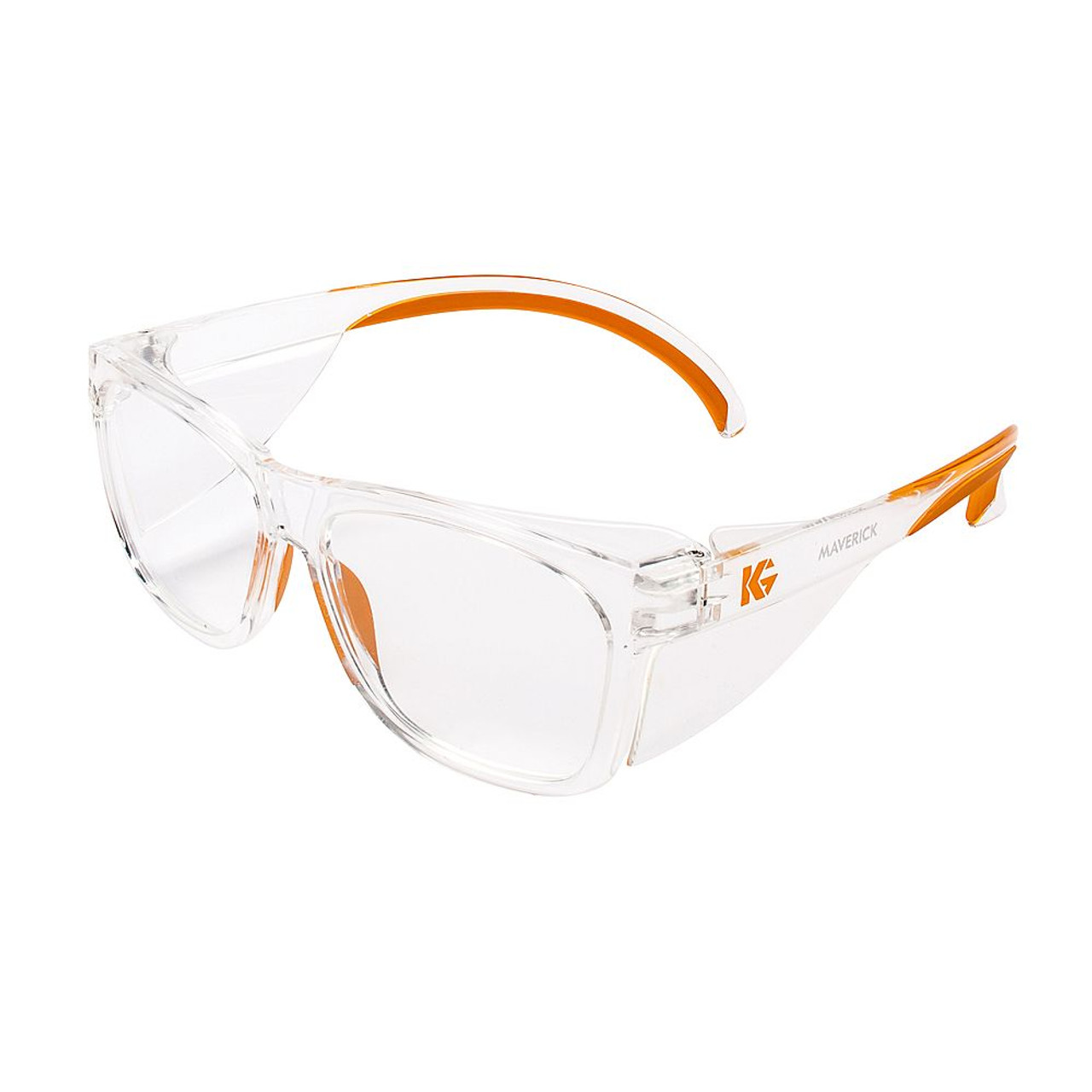
The KleenGuard™ V30 Maverick™ Safety Glasses 49301 are reusable, non-prescription industrial safety glasses built for indoor work that demands a clear lens and serious fog resistance. The configuration pairs a clear polycarbonate lens carrying KleenVision™ anti-fog technology and SKU-specific EN 166 “K” surface-damage resistance with a clear frame, orange comfort points, integrated clear side shields, a partial brow guard, padded nose contact, and soft-touch temple surfaces.
This entry covers product identity, protective standards, coating performance, frame geometry, lens materials, fog control, scratch-resistance classification, the fit system, PPE compatibility, controlled-environment notes, cleaning, inspection, storage, packaging, and use limitations. Selection rests on two things: the employer's documented hazard assessment, and verification that spectacle-style coverage suits the identified exposure.
Technical summary: Clear anti-fog industrial safety eyewear. ANSI/ISEA Z87.1-2020 compliant, Z87+ high-velocity impact, CSA Z94.3-20 certified, KleenVision™ premium anti-fog, anti-fog performance beyond the EN 166 “N” test, SKU-specific EN 166 “K” surface-damage resistance, 99.9% UVA/UVB/UVC filtration, integrated partial brow protection, clear side shields, padded nose contact, soft-touch temples, clear/orange styling.
Product Identification:
- Manufacturer: Ansell
- Brand: KleenGuard™
- Series: V30 Maverick™
- Manufacturer code: 49301
- SOSCleanroom SKU: 49301
- UPC: 036000493016
- Ansell shop SKU reference: 104930110
- Product type: Reusable, non-prescription industrial safety glasses
- Lens color: Clear
- Lens material: Polycarbonate
- Lens treatment: KleenVision™ anti-fog coating with scratch-resistant hardcoat
- Anti-glare coating: No. Ansell offers anti-glare in a separate Maverick configuration
- Polarized: No
- Photochromic: No
- Frame color: Clear
- Comfort-point color: Orange
- Frame style: Modern protective frame with partial brow guard and integrated side shields
- Upper protection: Integrated partial brow guard
- Lateral protection: Integrated clear side shields
- Nose contact: Padded comfort nose pads
- Temple design: Soft-touch temple contact points with soft-grip tips
- Principal materials: Polycarbonate, thermoplastic rubber, stainless-steel screw components
- Size: One size / universal
- RightCycle™ eligibility: Yes, subject to current program availability and acceptance criteria
- SOSCleanroom selling quantity: 12 safety glasses per case
Standards and Protective Performance
Current Ansell documentation lists the Maverick family as manufactured to comply with ANSI/ISEA Z87.1-2020, rated Z87+ for high-velocity impact, and certified to CSA Z94.3-20. These classifications cover occupational spectacle-style eye protection and should be read alongside the product markings, current manufacturer literature, and the employer's hazard assessment.
Older distributor and legacy records sometimes use the shorter ANSI Z87.1+ wording. Catalog content should lead with ANSI/ISEA Z87.1-2020 as the principal U.S. reference, keeping the historical wording only where older purchasing records or lot documentation require it.
| Standard or Rating |
Technical Meaning |
| ANSI/ISEA Z87.1-2020 |
Current U.S. occupational eye and face protection standard Ansell references |
| Z87+ |
High-impact designation under the applicable ANSI/ISEA spectacle requirements |
| CSA Z94.3-20 |
Canadian occupational eye and face protector certification Ansell references |
| EN 166 “N” |
Resistance-to-fogging performance. Ansell states KleenVision™ exceeds this test |
| EN 166 “K” |
Resistance to surface damage by fine particles, called out by Ansell specifically for code 49301 |
| 99.9% UVA / UVB / UVC filtration |
Polycarbonate lens filtration that helps reduce occupational ultraviolet exposure |
Impact-Rating Interpretation
Z87+ speaks to high-impact performance under the spectacle requirements. It says nothing about complete enclosure, and it does not cover every eye and face hazard.
- High-impact certification does not turn these into chemical-splash goggles
- Integrated side shields do not make the glasses dust-tight or gas-tight
- The partial brow guard is not a sealed upper barrier
- Some tasks need a compatible face shield on top of primary eye protection
- Welding, cutting, brazing, and laser work all require specialized optical filters
- Fine dust, aerosols, liquid splash, and multidirectional hazards may call for goggles
- Damaged eyewear comes out of service no matter what it was originally certified to
KleenVision™ Premium Anti-Fog Technology
Fogging happens when warm, moist air hits a cooler lens and condenses into microscopic droplets. Those droplets scatter light, hiding tools, workpieces, labels, process indicators, walking surfaces, and equipment controls.
The Maverick 49301 uses KleenVision™ premium anti-fog technology. Ansell states the coating is engineered for anti-fog performance 100 times greater than the ANSI Z87.1-2020 “X” mark requirement, and that it exceeds the EN 166 “N” mark test for resistance to fogging.
- Keeps vision usable in humid work areas
- Holds clarity through temperature transitions
- Handles the fogging that comes with masks, respirators, hoods, and face coverings
- Cuts down on removing, wiping, and readjusting the glasses
- Fewer interruptions from condensation mid-task
- Better compliance, since the glasses stay on and stay usable
- Less face-touching driven by obscured vision
Anti-Fog Performance Limitations
Anti-fog treatment reduces how often, how badly, and how long fogging occurs. It does not promise fog-free vision in every condition. Humidity, temperature differential, exertion, respirator exhaust, airflow, contamination, cleaning technique, coating wear, and chemical exposure all move the result.
- Check mask and respirator fit when warm air is blowing across the lens
- Look at hood placement and airflow when fogging keeps coming back
- Do not polish or scrub the coated surface aggressively
- Never apply unapproved household anti-fog treatments
- Keep chemicals that attack the anti-fog coating away from the lens
- Replace the glasses once fog resistance goes patchy or stops working
EN 166 “K” Surface-Damage Resistance
Ansell specifically identifies code 49301 as passing the EN 166 “K” mark test for resistance to surface damage by fine particles. That is a stronger claim than a generic scratch-resistant coating note, because the manufacturer ties this SKU to a defined European surface-damage test.
The “K” performance means better durability where fine airborne debris or routine handling would otherwise fog up clarity over time. It does not make the lens scratch proof.
- Clear grit and loose particles off before wiping
- Never dry wipe with metal dust or abrasive debris on the lens
- Keep rough paper towels, shop rags, and abrasive tissues away from it
- Do not rest the lens against tools, fasteners, or unfinished surfaces
- Replace the eyewear once scratches interfere with vision or inspection accuracy
- Do not read “K” performance as resistance to all chemical or mechanical damage
Combined Lens-Protection System
The 49301 lens stacks several protective functions into one clear polycarbonate structure, each answering a different operational requirement.
| Lens Feature |
Practical Benefit |
| Clear polycarbonate lens |
Clear indoor visibility, low weight, impact performance, and UV filtration in one material |
| KleenVision™ anti-fog treatment |
Limits visibility loss from condensation |
| EN 166 “N” performance |
Documents resistance-to-fogging performance |
| EN 166 “K” performance |
Documents resistance to surface damage by fine particles |
| 99.9% UVA / UVB / UVC filtration |
Reduces occupational ultraviolet exposure |
| Z87+ high-impact performance |
Meets programs that require high-impact spectacle protection |
Clear Lens and Indoor Task Visibility
The clear lens is meant for normally illuminated indoor work where natural color recognition, label reading, inspection accuracy, and plain task visibility matter. It offers no sunglass-style brightness reduction and no directional glare filtration.
- Preserves natural color recognition
- Fits indoor manufacturing and assembly
- Works for laboratory-support, inspection, and quality-control tasks
- Holds visibility in warehouses and facility areas
- The right choice where a tint would eat into available task illumination
- Delivers UV filtration without a dark lens
- May not hold up under intense exterior brightness without further evaluation
Integrated Partial Brow Guard
The Maverick frame includes an integrated partial brow guard above the lens. Ansell describes the feature as providing a sense of protection from falling dusts while cutting glare that enters from above.
The brow component adds upper-frame coverage that a fully frameless design lacks. It is not a sealed barrier against fine particles, aerosols, or liquids.
- Adds coverage along the upper lens area
- Blocks some direct entry of nuisance dust from overhead
- Cuts part of the overhead light coming in above the lens
- More substantial upper profile than frameless safety glasses
- Needs compatibility checks against hard hats and face shields
- Should never be described as sealed brow protection
Integrated Clear Side Shields
Clear side shields are built into the frame, extending coverage toward the lateral eye area without cutting peripheral visibility. Because the side protection is integral, there are no removable shield parts to lose, skip, or install backwards.
| Design Feature |
Practical Benefit |
| Integrated clear side shields |
Extends lateral coverage while keeping side vision open |
| Partial brow guard |
Adds upper coverage against nuisance dust and overhead light |
| Clear frame structure |
Less visual obstruction than opaque frame components |
| Single integrated assembly |
No bolt-on side shields to lose or misposition |
Padded Nose Contact and Soft-Touch Temples
Padded nose contact and soft-touch temple points cut pressure, improve grip, and keep the glasses from sliding through a long shift.
- Padded nose contact spreads out pressure
- Soft-touch temple areas reduce side pressure
- Thermoplastic-rubber contact points handle grip and retention
- Stable positioning means less repeated face and eyewear touching
- Orange contact points make this configuration easy to spot at a glance
- The comfort focus is what gets these worn for a full shift
Material Construction
Current Ansell product details list polycarbonate, thermoplastic rubber, and stainless-steel screw components in the Maverick build.
| Material |
Functional Role |
| Polycarbonate |
Primary lens and rigid protective-frame construction |
| Thermoplastic rubber |
Soft comfort, grip, nose, and temple contact areas |
| Stainless-steel screws |
Mechanical attachment within the frame and temple assembly |
Wear Compliance and Human Factors
Safety eyewear only works while it is being worn correctly. Glasses that fog, pinch, slide, or block vision get pushed up on a forehead or left in a drawer.
| Potential Wear Issue |
Maverick Design Response |
| Fogging obscures vision |
KleenVision™ premium anti-fog treatment |
| Temple or nose pressure |
Padded nose contact and soft-touch temple points |
| Glasses slide during work |
Grip-oriented comfort contact surfaces |
| Concern about side exposure |
Integrated clear side shields |
| Concern about falling nuisance dust |
Integrated partial brow guard |
| Fine-particle abrasion reduces clarity |
SKU-specific EN 166 “K” surface-damage resistance |
Fit Verification Procedure
- Put the glasses on the wearer without prying the temple arms apart.
- Confirm the padded nose contact sits securely without painful pressure.
- Verify the lens is centered in front of both eyes.
- Check the lateral coverage the integrated side shields provide.
- Confirm the partial brow guard does not block required upward vision.
- Have the wearer look up, down, and side to side.
- Have the wearer bend, turn, walk, and run through representative work movements.
- Verify the glasses stay put without constant readjustment.
- Repeat the assessment with all required head, hearing, respiratory, and face protection in place.
Recommended Applications and Industries
- Automotive assembly, repair, and maintenance
- Manufacturing and production operations
- Assembly, inspection, checking, and quality control
- Construction and general site work
- Facility and equipment maintenance
- Warehousing, shipping, receiving, and material handling
- Oil, gas, petrochemical, and energy operations
- Laboratory-support and technical work
- Humid or temperature-variable work areas
- Tasks requiring masks, respirators, hoods, or protective headgear
- Indoor work that needs a clear lens and natural color recognition
- General occupational eye-protection programs
PPE Compatibility Assessment
Evaluate the Maverick glasses with the full PPE ensemble. Hard hats, masks, respirators, earmuffs, hoods, face shields, and garments can shift frame position, redirect airflow, create pressure points, or cut into coverage.
- Confirm hard-hat suspension components clear the partial brow guard
- Make sure the temples do not cross tight-fitting respirator sealing surfaces
- Check whether mask or respirator airflow is aimed at the lens
- Verify earmuff cushions stay fully seated around the ears
- Confirm face-shield brackets do not displace the glasses
- Check compatibility with hoods, bouffants, and head coverings
- Verify secure positioning through representative work movement
- Never force the glasses over prescription eyewear unless that has been evaluated
Hazard Assessment Guidance
The employer should identify the source, direction, frequency, duration, and severity of each eye hazard before selecting protection. Spectacle-style eyewear handles general impact and particle exposure, but it does not enclose the eye area enough for liquid splash, fine dust, aerosols, or multidirectional hazards.
| Hazard |
Selection Consideration |
| Flying particles and general impact |
Confirm Z87+ spectacle protection and the frame coverage are adequate |
| Falling nuisance dust |
Partial brow coverage may help, but fine or hazardous dust needs greater enclosure |
| Chemical splash |
Use chemical-splash goggles or another suitably enclosed protector |
| Fine dust or aerosol |
Evaluate goggles or another protector with greater enclosure |
| Full-face impact or splash |
Add a face shield and keep appropriate primary eye protection |
| Welding, cutting, or brazing radiation |
Use task-specific filter lenses at the required shade |
| Laser radiation |
Use wavelength-specific laser eyewear with verified optical density |
| Intense exterior glare |
Look at a tinted or polarized configuration instead of this clear lens |
Controlled Environment Considerations
Industrial eye-protection certification and cleanroom suitability are two separate determinations. ANSI/ISEA and CSA compliance say nothing about sterility, ISO cleanroom classification, particle release, outgassing, disinfectant compatibility, or aseptic processing.
The anti-fog treatment and stable comfort contact points work in your favor here, since both cut down on removal and face-touch adjustment inside controlled areas. The flip side is geometry: the partial brow guard, side shields, hinges, screws, padded components, and frame interfaces all need evaluation under the facility's material-control and cleaning program.
- Evaluate the glasses against the facility's contamination-control strategy first
- Assign eyewear by employee or controlled area where practical
- Stage cleaned eyewear on the designated clean side of the gowning process
- Handle the glasses by the temples, not the lens
- Finish fit adjustments before entering the critical work zone
- Never set eyewear directly on benches, carts, gowning seats, or critical surfaces
- Do not move eyewear between uncontrolled and controlled areas without approved cleaning
- Use facility-approved cleaning agents and compatible low-lint wipes only
- Check around side shields, brow components, hinges, and comfort pads for trapped residue
- Replace the glasses once they fall short of facility visibility or cleanliness criteria
Cleanroom Donning and Handling Guidance
- Inspect the eyewear before starting the gowning sequence.
- Clean or disinfect the glasses per the approved facility procedure.
- Check the side-shield, brow, hinge, nose, and temple interfaces for trapped residue.
- Stage the eyewear in the designated clean-side location.
- Handle the glasses only by approved contact points such as the temples.
- Don the eyewear at the step the gowning SOP specifies.
- Finish fit positioning before final glove donning where permitted.
- Confirm compatibility with the mask, respirator, hood, bouffant, and face shield.
- Leave the glasses alone once inside the critical work area.
- Follow the defined deviation procedure if the eyewear is dropped, displaced, contaminated, or heavily fogged.
Cleaning Procedure
- Wash and dry hands, or don clean gloves, as the work area requires.
- Check the lens for loose dust, grit, metal particles, dried residue, or abrasive contamination.
- Blow off loose particles with clean air, or rinse gently with water where permitted.
- Apply an approved optical cleaner, mild soap and water, or another validated solution.
- Wipe gently with a soft optical tissue, microfiber cloth, or approved cleanroom wiper.
- Clean the side shields, brow guard, nose pads, temples, and hinge areas without driving debris into the joints.
- Keep off the pressure. No repeated polishing of the anti-fog surface.
- Rinse if needed to clear cleaner residue.
- Dry with a clean, soft, non-abrasive material.
- Inspect the lens, coatings, side shields, brow guard, nose pads, temples, screws, and safety markings before reuse.
Chemical compatibility note: Strong solvents, aggressive disinfectants, high-pH cleaners, abrasive compounds, and other incompatible chemicals can craze polycarbonate, kill the anti-fog treatment, damage the scratch-resistant coating, discolor the clear frame, degrade the thermoplastic-rubber comfort points, or weaken the assembly. Where repeated disinfection is required, validate the exact chemical, concentration, contact time, application method, rinse procedure, and frequency.
Inspection and Replacement Criteria
Inspect the eyewear before each use, and again after any impact, chemical contact, abnormal heat, or cleaning process that could affect protection or optics. Pull the glasses from service for anything that could compromise fit, clarity, impact performance, coating function, or structural integrity.
- Cracked, chipped, warped, or deformed lens
- Deep scratches or abrasion that interferes with vision
- Persistent haze, clouding, distortion, or discoloration
- Damaged, irregular, or ineffective anti-fog coating
- Cracked or deformed integrated side shields
- Cracked or deformed partial brow guard
- Damaged, detached, or permanently compressed nose pads
- Loose, cracked, bent, or deformed temples
- Damaged thermoplastic-rubber comfort points
- Loose, corroded, or damaged screws or hinges
- Loss of secure fit during normal movement
- Illegible required safety markings
- Exposure to a significant impact event
- Chemical contact that may have degraded lens or frame components
- Residue the approved cleaning process cannot remove
Storage and Handling
Store the glasses in a cool, clean, dry location away from direct sunlight, excessive heat, abrasive materials, heavy objects, and chemical vapors. Protect the coated lens, integrated side shields, brow guard, and comfort components from unnecessary contact and deformation.
- Use an individual case, sleeve, or designated storage compartment
- Do not store with sharp tools, fasteners, metal parts, or abrasives
- Do not set heavy objects on the lens, side shields, brow guard, or temples
- Avoid long storage in hot vehicles or near process heat
- Keep away from solvent, adhesive, fuel, and cleaning-chemical vapors
- Keep cleaned eyewear separate from contaminated PPE
- Never let the coated lens rest against a rough surface
- Do not force or flatten the frame in storage
RightCycle™ Program Consideration
Ansell lists the Maverick family as eligible for the RightCycle™ Program. Confirm the actual eligibility, contamination restrictions, collection methods, geographic availability, minimum quantities, and accepted product conditions with the current program before any glasses go into a recycling stream.
Packaging and Selling Unit Clarification
The SOSCleanroom purchase quantity for SKU 49301 is 12 safety glasses per case. Manufacturer or distributor logistics records may describe 12 pairs per inner package, or reference larger master cartons holding multiple inner cases. Do not present the larger logistics quantity as the customer selling unit unless the active SOSCleanroom inventory and purchasing record confirms it.
Important Use Limitations
- Not a sealed chemical-splash goggle
- Not dust-tight or gas-tight eyewear
- Integrated side shields do not create a sealed lateral enclosure
- Partial brow protection does not create a sealed upper enclosure
- Not polarized, photochromic, or sunglass-style eyewear
- Not welding, cutting, brazing, or infrared-radiation protection
- Not laser-protective eyewear
- Not electrical arc-flash or electrically insulating protection
- Not intended for molten-metal splash
- Not supplied sterile
- Not represented as autoclavable
- Not represented as cleanroom-certified or low-shedding eyewear
- Not a substitute for a face shield where full-face protection is required
- Not designed as over-the-glasses eyewear for prescription spectacles
- Not guaranteed compatible with every respirator, hard hat, hood, mask, face shield, or hearing protector
- Anti-fog performance does not guarantee completely fog-free vision in all conditions
Current and Legacy Documentation Note
Legacy SKU-specific records may use Kimberly-Clark Professional, Jackson Safety, V30 Maverick, ANSI Z87.1+, premium anti-fog, anti-scratch, clear/orange, or 12-pair terminology. Current Ansell documentation shows ANSI/ISEA Z87.1-2020 compliance, Z87+ high-velocity impact performance, CSA Z94.3-20 certification, KleenVision™ anti-fog performance, EN 166 “N” fog resistance, SKU-specific EN 166 “K” surface-damage resistance, polycarbonate construction, thermoplastic-rubber comfort components, stainless-steel screws, 99.9% UVA/UVB/UVC filtration, one-size fit, and RightCycle™ eligibility. Where certification traceability matters, verify the documentation for the supplied production lot.
Brand and Product Documentation Note
KleenGuard™ protective eyewear was previously marketed through Kimberly-Clark Professional, so it may appear under Kimberly-Clark Professional, Jackson Safety, KleenGuard™, or Ansell in historical and current documentation. Product-page content should use the active Ansell portfolio identity while keeping the established KleenGuard™ V30 Maverick™ name and manufacturer code 49301.
Technical Vault Disclaimer
This Technical Vault entry supports product evaluation, procurement, training, fit assessment, controlled-environment planning, and workplace PPE review. It does not replace the manufacturer's instructions, current product markings, workplace hazard assessment, exposure-control plan, cleanroom qualification, facility SOP, or regulatory guidance. Verify current certificates, declarations, chemical-compatibility information, coating details, and lot-specific documentation where the organization's quality or safety system requires it.
Technical insight: The Maverick 49301 is the indoor pick in this line. A clear lens keeps color recognition and inspection accuracy intact, the premium anti-fog handles mask and respirator heat, and the integrated brow guard and side shields add coverage without bolt-on parts to lose. The EN 166 “K” mark is called out for this specific code, which is worth citing when a customer asks about abrasion life. What it will not do is manage outdoor brightness, so keep a tinted configuration on hand for exterior crews.
Technical Vault updated: Jul. 2026 (SOS Technical Staff)
© 2026 SOSCleanroom.com