Where this item fits (and where it does not)
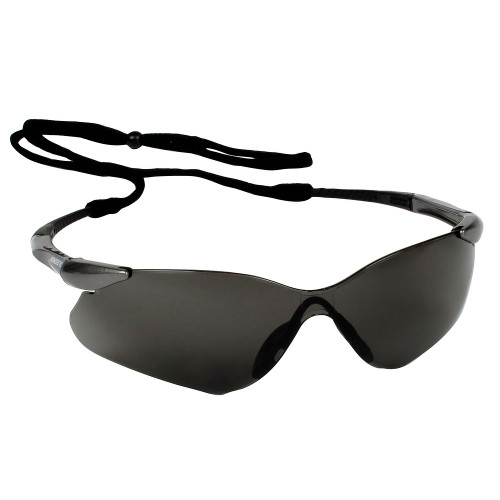
Manufacturer code 25704 is a Nemesis VL smoke-lens variant listed at VLT 9% with impact-resistant polycarbonate construction.
Operationally, it’s most often selected for bright-light environments (e.g., outdoor work, high-glare facility tasks) where reduced visible light transmission is preferred.
In higher-grade aseptic cleanrooms, confirm whether your program requires sealed/sterile eye coverings (goggles) instead of non-sterile safety glasses.
Manufacturer-defined product identity
| Attribute |
Manufacturer listing (25704) |
Why it matters |
| Code / former code |
25704 / 3013538 |
Supports receiving traceability and correct variant control. |
| Lens / VLT |
Smoke / VLT 9% |
Low VLT is typically preferred for bright-light conditions; confirm task visibility needs. |
| Frame/temples |
Gun Metal; ratcheted temples |
Fit stability reduces “adjustment frequency” (behavior + contamination driver). |
| Frame type / base curve |
Frameless / base curve 8 |
Wrap coverage and lighter weight can improve compliance. |
| Materials |
Polycarbonate lens; nylon frame/temple; Empilon nosepiece |
Material selection influences durability and cleaning compatibility. |
| Standards / certifications |
ANSI Z87.1:2010; CE certified EN 166:2001 |
Defines a baseline compliance posture for eye protection selection. |
| UV protection |
99.9% UVA/UVB/UVC protection |
Supports mixed-lighting work and general eye protection expectations. |
Contamination-control lens: eyewear as a “behavior control” tool
In controlled environments, eyewear can reduce splash risk and supports eye safety—but contamination control often fails for simpler reasons:
operators adjust eyewear frequently, touch their face, and transfer contamination to gloves and garments.
A stable-fit, comfortable eyewear choice can reduce these failure modes, especially in support areas and gowning transitions.
Donning (gowning) guidance: ISO-first, then Annex 1 overlay
ISO approach: build repeatable operations control (training + gowning program)
ISO cleanroom operations guidance emphasizes an operations control program that includes training, disciplined entry/exit behavior,
and a defined gowning program. Practically, eyewear should be staged, donned, and worn in a way that minimizes touchpoints and rework.
- Stage before gowning begins: avoid carrying eyewear through uncontrolled areas once gowning steps start.
- Don by temples only: treat lens + face interface areas as “no touch.”
- Integrate with hood/mask/veil: don in a repeatable order so fit is correct without repeated adjustments.
- Hands off after entry: if eyewear shifts or visibility becomes unsafe, follow SOP (often step out to correct).
European Annex 1 overlay (sterile manufacturing):
Annex 1 expectations for Grade A/B include sterile masks and sterile eye coverings (e.g., goggles) to enclose facial skin and reduce droplet/particle shedding.
If your operation is Annex 1 governed, confirm whether this area requires sealed/sterile goggles rather than non-sterile safety glasses.
Common failure modes (how contamination happens)
- Frequent eyewear adjustment: drives face touching and glove contamination transfer.
- Unqualified cleaning chemistry: can haze polycarbonate or degrade parts; qualify your wipe-down method.
- Wrong lens for lighting: smoke lenses can reduce indoor visibility; align lens selection to task risk.
- Annex 1 mismatch: using safety glasses where sterile goggles are required creates compliance risk.
SOSCleanroom note about SOP's
The Technical Vault is written to help customers make informed contamination-control decisions and improve day-to-day handling technique.
It is not your facility’s Standard Operating Procedure (SOP), batch record, or validation protocol.
Customers are responsible for establishing, training, and enforcing SOPs that fit their specific risks, equipment, cleanroom classification, and regulatory obligations.
Always confirm suitability, cleaning compatibility, and acceptance criteria using your internal quality system and documented methods.
If you adapt any technique guidance from this entry, treat it as a starting template. Your team should review and approve the final method, then qualify it for your specific process.
Use these best-practice suggestions to strengthen your SOPs—not to replace them.
Source basis (manufacturer-first)
- Manufacturer specification sheet (V30 Nemesis VL; includes code 25704, VLT, standards, materials): https://cdn3.evostore.io/documents/fusion_us/fus_us_29111_spec.pdf
- Manufacturer brochure (Nemesis/Nemesis VL platform positioning): https://cdn3.evostore.io/documents/fusion_us/fus_kcc_nemesis.pdf
- ISO operations context (operations control program includes a gowning program): https://www.iso.org/standard/88599.html
- EU GMP Annex 1 (sterile manufacturing gowning; sterile eye coverings/goggles expectation): https://health.ec.europa.eu/system/files/2022-08/20220825_gmp-an1_en_0.pdf
- SOSCleanroom product page (selling unit and listing context): https://www.soscleanroom.com/product/apparel/kleenguard-nemesis-vl-safety-glasses-smoke-uncoated-case-12/
SOSCleanroom is the source for this Technical Vault entry.
Briefed and approved by the SOSCleanroom (SOS) staff.
If you have any questions please email us at Sales@SOSsupply.com
Last reviewed: Jan. 14, 2026
© 2026 SOSCleanroom