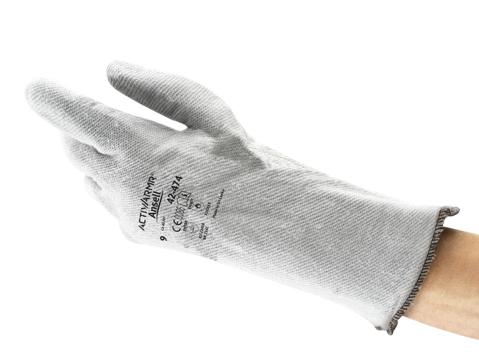
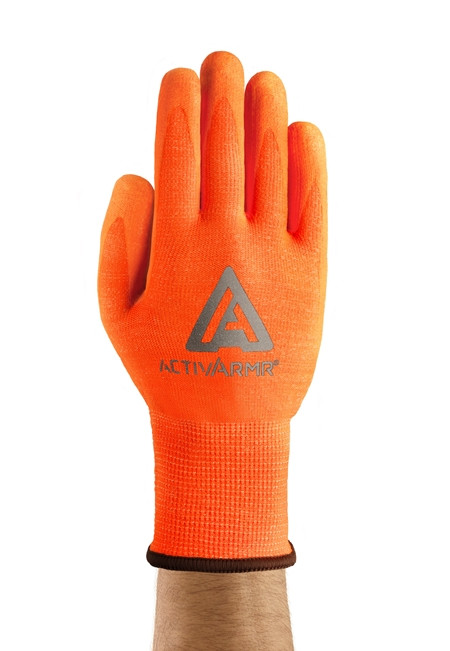
The Technical Vault: Ansell ActivArmr® 42-474
Vault purpose: Advanced technical analysis of bonded nitrile heat gloves, felt insulation, dry heat transfer, grip mechanics, heat soak, outseam-free construction, and industrial deployment limits.
1) What the ActivArmr 42-474 Is
The ActivArmr 42-474 is a full-length nitrile-coated heat glove built for intermittent handling of dry hot objects. It combines a bonded nitrile exterior, nonwoven felt insulation, and a full-length heat barrier to protect against moderate dry heat while improving grip and mechanical durability.
2) Contact Heat vs Continuous Heat Exposure
A rating of 250°C / 480°F does not mean the glove can hold a 250°C object indefinitely. Heat gloves are evaluated for limited contact windows, and real-world safety depends on how quickly heat moves through the glove stack.
- Contact temperature: surface temperature of the handled object
- Contact time: duration before heat reaches the wearer
- Contact pressure: higher grip force compresses insulation and accelerates heat transfer
- Thermal mass: heavy parts transfer more total heat than thin parts at the same temperature
- Recovery time: glove must cool between handling cycles to avoid heat accumulation
3) Felt Insulation Physics
The nonwoven felt liner protects by trapping air inside a fibrous structure. Air is a poor thermal conductor, so the felt layer slows heat transfer from the nitrile-coated exterior toward the hand.
- Trapped air reduces conductive heat transfer
- Fiber loft increases insulation thickness
- Compression reduces trapped air and lowers insulation performance
- Moisture or saturation can increase heat transfer dramatically
This is why a dry heat glove may perform poorly in steam, wet heat, or hot liquid exposure even if it performs well on dry hot objects.
4) Bonded Nitrile Coating Technology
The bonded nitrile coating functions as both a wear surface and grip layer. Compared with leather, nitrile is less absorbent in oily environments and provides more predictable friction on many industrial surfaces.
| Property |
Why It Matters |
| Oil resistance |
Helps maintain grip on slightly oily parts |
| Abrasion resistance |
Protects the liner from repeated contact wear |
| Snag resistance |
Reduces damage from rough molded parts or sharp edges |
| Cut and puncture support |
Adds a tougher exterior layer over the insulation |
5) Heat Soak: The Hidden Hazard
Heat soak occurs when the glove absorbs heat faster than it can release it. A glove may feel protective during the first handling cycle but become progressively hotter after repeated contacts.
- Repeated short contacts can accumulate heat inside the glove
- Insulation performance declines as the glove temperature rises
- Workers should allow cooling time between hot-part handling cycles
- Gloves showing hardening, cracking, glazing, or liner compression should be replaced
6) Outseam-Free Two-Piece Construction
Outseams are common failure and discomfort points in thermal gloves. By eliminating outseams, the 42-474 improves finger comfort, flexibility, and contact consistency.
- Reduces seam pressure points during gripping
- Improves finger flexibility compared with bulky seam designs
- Reduces seam abrasion against handled parts
- Helps maintain more uniform insulation around the fingers
7) Why Grip Matters in Heat Protection
In hot-part handling, grip failure can be more dangerous than moderate heat exposure. A dropped hot part can cause burns, equipment damage, process interruption, or secondary injuries.
- Nitrile improves friction on dry and oily surfaces
- Better grip can reduce required squeeze force
- Lower grip force reduces insulation compression
- Improved handling control supports safer transfer of hot parts
8) Injection Molding and Hot Plastic Handling
The 42-474 is well suited for injection molding workflows because newly ejected parts can be hot, slippery, and mechanically rough. Molded parts may also have flash, ribs, gates, or sharp edges that increase abrasion and snag risk.
- Handling molded housings and plastic components
- Removing parts from molds or fixtures
- Handling dry hot parts with slight oil or release-agent residue
- Moving hot parts between production, trimming, and inspection stages
9) Common Failure Modes
| Failure Mode |
What It Indicates |
| Cracked nitrile |
Thermal aging or flex fatigue |
| Glazed surface |
Heat exposure and surface hardening |
| Compressed felt |
Reduced insulation loft and lower thermal protection |
| Exposed liner |
Coating wear-through; remove from service |
10) Why This Is Not a Welding Glove
The 42-474 is a dry heat-handling glove, not a welding glove. Welding PPE must address flame, sparks, spatter, radiant heat, seam durability, electrical considerations, and molten-metal exposure. Use welding gloves where welding or hot-work hazards are present.
11) Critical Use Limitations
| Do Not Use For |
Reason |
| Steam or hot liquid saturation |
Wet heat transfers rapidly through insulation |
| Chemical immersion |
Not a chemical-resistant glove |
| Molten metal splash |
Requires specialized molten-metal PPE |
| Open flame or welding |
Thermal hazard profile differs from dry hot-object handling |
| Moving or serrated blades |
Mechanical hazards exceed intended use |
12) Best-Practice Deployment
- Validate glove performance against actual part temperature and contact duration
- Allow gloves to cool between repeated hot-part handling cycles
- Inspect for coating cracks, hardening, liner compression, or exposed felt
- Do not use if the glove becomes saturated, contaminated, or structurally damaged
- Use task-specific PPE for chemical, welding, molten-metal, or steam hazards
13) Source Basis
- Ansell ActivArmr 42-474 product documentation
- EN 388 and EN 407 industrial glove performance framework
- Industrial heat-transfer and PPE selection principles
- SOSCleanroom industrial PPE technical analysis