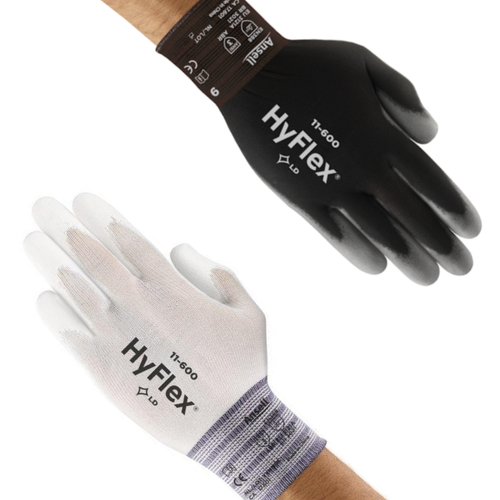
A glove that protects the product, not just the hand: why HyFlex 11-819 is built for ESD control, touchscreen work, and high-dexterity handling
The Technical Vault | By SOSCleanroom
Most “ESD events” in production do not announce themselves with a spark. They show up later as unexplained test failures, latent damage, intermittent behavior, or scrap that clusters in low humidity seasons. The uncomfortable reality: a glove can be the charge generator, the insulator, or the control layer — depending on how it is built and how it is used inside your grounding chain. Ansell HyFlex 11-819 targets that intersection with an ESD-certified liner, an ultra-thin foam nitrile coating for grip and tactile work, and touchscreen compatibility so operators do not defeat controls by removing gloves to tap a tablet or HMI.
Reliability is part of the control plan. Buying the same specified glove, with the same documentation package, helps keep your ESD and quality system stable. Sourcing through SOSCleanroom supports consistent replenishment and access to the manufacturer’s compliance documents so the consumable does not become the uncontrolled variable when schedules tighten.
What It’s For
HyFlex 11-819 is designed for precision handling and assembly where ESD control and dexterity both matter: general handling, mounting and dismantling, machine tool operation, quality inspection, and tasks requiring high tactile sensitivity — including work that involves consumer or industrial touchscreens.
It also fits workflows where gloves are expected to function as part of a grounding chain in explosion hazard zones (ATEX) when your program requires an ESD-capable hand interface.
Decision Drivers
- ESD certification (EN 16350:2014): built to reduce electrostatic risk in real handling work, especially when integrated into your grounding chain and verification routines.
- Touchscreen compatibility: supports disciplined glove-on behavior at tablets, scanners, and HMIs, reducing “quick bare-hand taps” that create handling contamination and control drift.
- 18-gauge dexterity: thin-gauge knit construction supports fine motor tasks where bulkier gloves drive rework, over-grip, and dropped parts.
- Foam nitrile grip and wear: Fortix™ foam nitrile coating is positioned for abrasion performance and grip, including scenarios where micro-texture matters (smooth housings, lightly oiled parts, frequent pick-and-place).
- Comfort engineering matters to yield: comfort features (including zoned knit concepts) reduce fatigue-driven errors, especially across long cycles where operators over-tighten grip to compensate.
- Materials choices that protect sensitive builds: latex-free and silicone-free positioning reduces avoidable sensitizer and residue risks in many electronics- and optics-adjacent environments.
Materials and Construction: Practical Implications
HyFlex 11-819 uses a nylon/spandex/carbon knitted liner paired with a foam nitrile palm coating. The operational translation: the knit liner gives stretch, fit, and fingertip control, while the carbon component is used to support dissipative behavior in use. The foam nitrile coating is a grip layer that is typically more forgiving than smooth coatings when parts are clean, lightly dusty, or handled in high repetition.
The glove is specified as palm coated with a knitwrist cuff. Palm coating preserves breathability and finger articulation while still delivering contact control where it matters: fingertips and the primary grip zone. Knitwrist helps reduce debris ingress at the cuff and stabilizes fit during repetitive motion.
A process-protecting reality check: no glove is “zero shed” in real work. Fibers, coating wear, and handling contamination are driven by friction, part geometry, and how long a glove stays in service. In tight-tolerance or residue-sensitive operations, glove change cadence and “do-not-touch” discipline often matter as much as the glove model.
Washability (specified to 40°C / 104°F) is a useful lever for cost and waste reduction — but only if your program qualifies what washing does to grip, fit, and ESD behavior over time. Treat laundering as a controlled process condition, not a casual convenience.
Specifications in Context
The key specs are aimed at high-dexterity ESD handling: 18 gauge knitted construction; available sizes 6–11; length 195–255 mm (size-dependent). Coating is specified as Fortix Foam Nitrile with a blue coating color; liner is dark blue and listed as nylon, spandex, carbon. The glove is positioned as antistatic, latex free, and silicone free.
Packaging options support different issuance models: 1 pair for controlled kitting, 12 pairs per bag for line-side replenishment, and 144 pairs per case (12 bags of 12) for stocking programs. Align the option to your contamination control posture: smaller units reduce open-bag time and uncontrolled handling on sensitive lines.
Cleanliness and Performance: Interpreting the Data
-
ESD control is conditional: EN 16350 certification supports electrostatic risk reduction, but outcomes still depend on the system: grounding method, verification frequency, and environmental conditions (especially low humidity). A glove is a risk-reduction layer, not a substitute for a working ESD program.
-
Grip and tactility are defect mechanisms: “More grip” can reduce drops and slip marks, but it can also increase abrasion on delicate surfaces if operators over-grip. Use a simple acceptance test: if operators are gripping harder to feel parts, the glove is too bulky; if parts are sticking or scuffing, the coating may be too aggressive for that surface.
-
Touchscreen compatibility is a control feature: it reduces workflow breaks that cause bare-hand contact, uncontrolled oils, and repeated glove doffing. If you deploy tablets on the floor, glove-on usability is often the difference between an SOP that works and an SOP that gets bypassed.
-
Wear-out is predictable if you look for it: foam nitrile coatings typically fail through polishing (loss of microtexture), thinning at fingertip contact points, and pinholes. If quality issues rise late in a shift, glove wear-out and change cadence are common root causes.
Why Packaging, Traceability Documents, and Change Control Matter
For gloves, “traceability” often lives in practical controls: buying the approved model, keeping packaging closed until issuance, and maintaining consistent replenishment so supervisors are not forced into last-minute substitutions. HyFlex 11-819 is supported by downloadable compliance documentation (product data sheet and declarations), which is what you want when an auditor asks, “Why this glove, and what does it control?”
If your program is sensitive to residues (silicone restrictions, coating transfer concerns, optics-adjacent work), tighten issuance: use pair-level or small-bag controls, train operators on doffing without touching critical surfaces, and treat gloves as a timed consumable rather than “use until torn.”
Best-Practice Use
- Size correctly. A glove that is too small drives fatigue and tearing; too large reduces fingertip control and increases snag risk.
- Treat gloves as a controlled input: issue clean, store closed, and avoid “open bag on the bench” behavior in sensitive areas.
- For ESD control, integrate the glove into the full chain: grounding method, verification routines, and documented workstation controls.
- Set a change cadence tied to your defect mechanisms: polishing of the palm, loss of grip, fingertip thinning, visible contamination, or task change.
- If laundering is used, keep it inside the qualified window: follow the 40°C guidance and verify grip/fit/ESD behavior over repeated cycles.
- Maintain “hands off critical” discipline even with ESD gloves: the glove protects from charge and handling, but it can still transfer oils, soil, and wear debris if overused.
Common Failure Modes—and How to Prevent Them
- “ESD glove” assumed to replace the ESD program: prevent with grounding verification, humidity awareness, and documented workstation controls.
- Gloves worn past the grip/ESD usefulness window: prevent with change cadence tied to polishing/thinning and shift-based replacement on critical lines.
- Wrong glove for the chemical exposure: prevent by aligning glove selection to chemical compatibility requirements; do not treat a foam nitrile handling glove as a splash-chemistry control.
- Touchscreen work defeats discipline: prevent by using a touchscreen-compatible glove so operators do not doff for “quick taps.”
- Packaging left open and gloves become “line-side dust collectors”: prevent with smaller issuance units, bag discipline, and closed storage at the point of use.
Closest Competitors
Comparable gloves usually sit in the same decision space: ESD-capable assembly gloves with thin-gauge liners and nitrile-coated grip zones. The right comparison is less about branding and more about: documented ESD approach, touchscreen behavior in your devices, grip stability as the coating wears, and how predictable supply is over time.
SHOWA ESD assembly glove families (e.g., AC series)
A credible peer category for ESD-controlled handling; compare fit, coating feel, and your program’s ESD verification results over time.
PIP G-Tek® ESD and nitrile-coated assembly gloves
Common in electronics and light industrial assembly; compare coating wear-out, touchscreen performance, and documentation availability.
Superior Glove ESD/touchscreen handling gloves
Often positioned for dexterity and device interaction; compare liner construction, dissipative behavior, and real-world grip as parts and gloves change condition.
Where HyFlex 11-819 Fits in a Controlled Work Program
HyFlex 11-819 fits best where product protection is the priority: ESD-sensitive handling with frequent touchscreen interaction, high repetition pick-and-place, and inspection/assembly tasks where dexterity is a yield driver. Deploy it as part of a system: defined issuance and change cadence, closed packaging discipline, and ESD verification routines. If your workflow is contamination-critical in the cleanroom sense (ISO particle control, low outgassing, residue budgets tied to optics/coatings), qualify glove shedding and residue transfer under your conditions and keep substitution control tight.
Source Basis
- SOSCleanroom product page: Ansell HyFlex 11-819 ESD Nitrile Foam Coated Gloves (features/benefits; recommended uses; packaging options; product details; downloads). https://www.soscleanroom.com/product/brands/ansell-hyflex-11-819-esd-nitrile-foam-coated-gloves/
- Manufacturer Product Data Sheet (via SOSCleanroom downloads): HyFlex 11-819 ESD (gauge; liner/coating; EN 16350; EN 388; sizes; lengths; packaging).
- Declaration of Conformity / UK Declaration of Conformity (via SOSCleanroom downloads): compliance documentation support for quality systems and audits.
- Competitor category basis (public manufacturer materials): SHOWA ESD assembly glove families; PIP G-Tek ESD/nitrile-coated assembly gloves; Superior Glove ESD/touchscreen handling gloves.