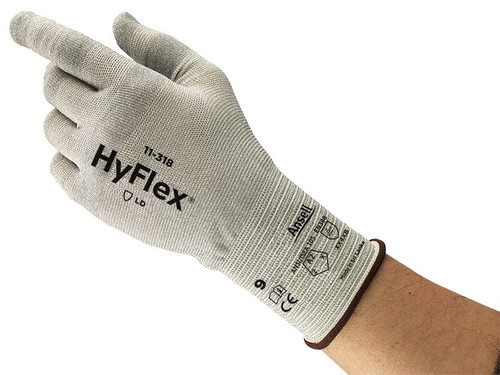
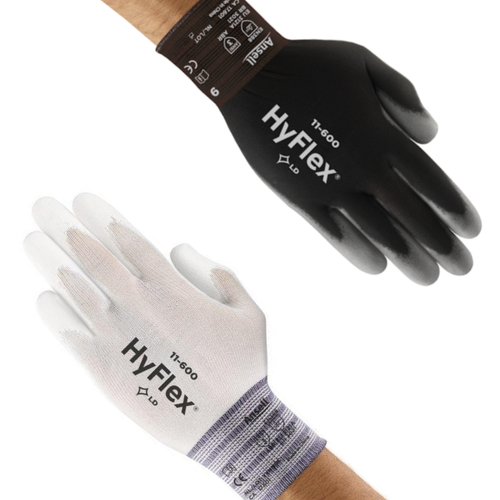
The Technical Vault: Ansell HyFlex® 70-215
Vault purpose: Advanced analysis of Kevlar fiber mechanics, ANSI A2 cut resistance, Neptune® treatment technology, terry-loop construction, industrial wear behavior, and reusable PPE lifecycle management.
1) What the HyFlex 70-215 Is
The HyFlex 70-215 is a medium-duty reusable Kevlar cut-resistant glove intended for dry industrial handling environments where workers encounter moderate cut hazards, abrasive surfaces, repetitive handling tasks, and intermittent warm-part contact.
2) ANSI A2 Cut Resistance Explained
ANSI/ISEA 105 cut ratings measure the amount of force required for a standardized blade to cut through glove material under controlled laboratory conditions.
- ANSI A2: intended for light-to-medium cut hazards
- Suitable for controlled industrial handling applications
- Not designed for extreme cut exposure
- Real-world performance depends on blade geometry, angle, motion, and force
Cut resistance does not equal puncture resistance or protection against powered cutting tools.
3) Kevlar® Fiber Mechanics
Kevlar is a para-aramid fiber engineered for high tensile strength and thermal stability. In glove construction, Kevlar yarns distribute cutting force across multiple fibers to resist localized blade penetration.
- High strength-to-weight ratio
- Flexible enough for repetitive handling tasks
- Better thermal stability than many conventional fibers
- Good durability under repeated flexing
4) Terry-Loop Construction and Thermal Buffering
The terry-loop knit structure creates a thicker, cushioned glove wall that improves comfort, impact absorption, and thermal insulation.
| Construction Feature |
Functional Benefit |
| Looped yarn structure |
Additional cushioning and insulation |
| Thicker glove wall |
Improved mechanical barrier depth |
| Flexible knit geometry |
Maintains ergonomic hand movement |
5) Neptune® Treatment Technology
Neptune treatment helps repel liquids from the glove surface, reducing fiber saturation and helping preserve Kevlar yarn integrity.
- Reduces liquid penetration into fiber structure
- Helps maintain glove flexibility over time
- Can improve glove wear life in dry-to-light-moisture environments
- Does not create chemical resistance or liquid-proof sealing
6) Reinforced Thumb Welt and Wear Zones
Industrial gloves typically fail first in high-flex and high-friction regions. The thumb-index interface experiences concentrated stress during gripping and repetitive handling.
- Thumb welt reinforcement improves abrasion resistance
- Grip stress concentrates at pinch zones
- Repeated flexing accelerates yarn fatigue
- Edge contact increases localized wear
7) Laundering and PPE Lifecycle Management
Reusable industrial gloves can reduce long-term PPE cost when laundering and inspection programs are properly controlled.
- Inspect gloves after laundering for thinning and damage
- Retire gloves showing cuts, holes, or severe abrasion
- Avoid laundering conditions that degrade fibers
- Track replacement intervals for standardized PPE programs
8) Critical Use Limitations
| Do Not Use For |
Reason |
| Chemical exposure |
Not chemical-resistant |
| Liquid immersion |
Not liquid-proof |
| Powered blades |
Mechanical hazards exceed intended design |
| Needle or puncture hazards |
Cut resistance is not puncture resistance |
9) Best-Practice Industrial Deployment
- Use for dry handling of moderately sharp industrial materials
- Select higher cut-rated gloves for uncontrolled cut hazards
- Replace gloves with visible abrasion or structural damage
- Use chemical-resistant gloves when liquids or chemicals are present
- Match glove size correctly to reduce snagging risk near machinery
10) Source Basis
- Ansell HyFlex 70-215 technical documentation
- Ansell industrial glove product data
- ANSI/ISEA 105 cut resistance methodology
- EN 388 and EN 407 industrial glove standards
- SOSCleanroom industrial PPE analysis
If you have any questions please email us at Sales@SOSsupply.com or give us a call at (214)340-8574.
If you need additional information please try our SOSCleanroom specific AI ChatBot which draws from our extensive cleanroom specific libraries.
Last reviewed: May 15, 2026
© 2026 SOSCleanroom. All rights reserved.