Grip is a quality control variable: why MICROFLEX® Diamond Grip® MF-300 is built for high-contact work that tears “normal” exam gloves
The Technical Vault | By SOSCleanroom
Most glove-related failures in controlled work are not dramatic. They show up as small drops, micro-tears that become rework events, fingerprints on critical parts, or “mystery contamination” that traces back to a glove that could not maintain grip on wet, oily, or slick surfaces. Ansell MICROFLEX® Diamond Grip® MF-300 is engineered for that reality: a robust, powder-free latex exam glove with textured fingers and a 7.9 mil fingertip thickness designed to keep handling stable when friction is not.
Reliability is part of the control plan. SOSCleanroom emphasizes specification-driven gloves and continuity of supply so your processes do not drift into “whatever was available” during high-demand periods—one of the most common drivers of untracked performance changes and investigation churn.
The Operational Problem It Solves
High-contact work stresses gloves in predictable ways: repeated tool contact, frequent part handling, exposure to oils/coolants/cleaning residues that reduce friction, and constant flex at the fingertips. When grip slips, operators compensate by increasing pinch force or adding re-grips—both of which increase drop risk and fatigue. When thin fingertips tear, the event is often invisible until after contact has already occurred.
MF-300 targets these failure modes with textured fingers for control on slick surfaces and a thicker fingertip/palm construction that better tolerates repeated contact and snag events compared with ultra-thin exam gloves.
What It’s For
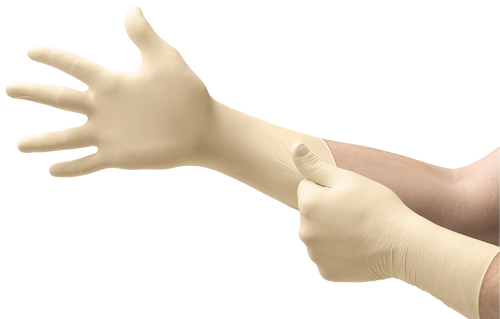
MF-300 is a powder-free latex exam glove used for high-contact handling where grip reliability and tear resistance matter. Manufacturer-listed use cases include inspection and checking parts; general-purpose automotive and maintenance work involving oils and fluids; maintaining lab furniture and equipment; sample taking and processing; and standard, moderate-risk examination procedures.
Operationally, it fits best where you need repeatable grip and durability at the point of contact (fingertips and pinch zones) more than ultra-thin tactile feel.
Decision Drivers (What Buyers Should Care About First)
- Grip under real contamination: textured fingers are designed to maintain control on wet, oily, or slick parts where smooth gloves slip.
- Durability where tears start: 0.20 mm / 7.9 mil fingertip thickness supports repeated high-contact handling.
- Dexterity vs. protection balance: 0.16 mm / 6.3 mil palm thickness aims to keep hand feel workable while improving robustness.
- Quality level: AQL 1.5 (freedom from holes) supports consistent incoming expectations for exam-grade gloves.
- Powder-free posture: reduces powder-related contamination risks versus powdered gloves.
- Traceability and sizing discipline: consistent part numbering by size reduces mix-ups and supports purchasing control in multi-area operations.
Materials and Construction: Practical Implications
Material: MF-300 is natural rubber latex and powder-free. Latex is often selected when users want strong elasticity and tactile response with good tear resistance for general handling tasks.
External surface: the glove uses textured fingers, which matters most where your parts are wet, oily, or carry residual films that reduce friction. Texture reduces “micro-slips” that cause drops and repeated re-gripping.
Thickness profile: the fingertip is specified thicker than the palm. In practice, this protects the highest-stress zone (pinch/precision contact) without making the entire glove excessively stiff.
Reality check: no glove prevents contamination if technique drifts. Gloves become contaminated by touch transfer. The control is how you stage boxes, how you avoid touching non-controlled surfaces, and how quickly you change gloves when a trigger condition occurs.
Important limitation: MF-300 contains natural rubber latex and may cause allergic reactions. Treat latex sensitivity as a selection gate for both operators and end-use environments.
Specifications in Context
MF-300 is specified as an exam grade glove with published dimensional and quality baselines:
| Material |
Natural rubber latex |
| Color |
Natural |
| Powder content |
Powder-free |
| External surface |
Textured fingers |
| Length |
245 mm / 9.6 in |
| Finger thickness |
0.20 mm / 7.9 mil |
| Palm thickness |
0.16 mm / 6.3 mil |
| Freedom from holes |
AQL 1.5 (Inspection Level I) |
| Silicone free |
No |
| Antistatic |
Not tested |
| Country of origin |
Malaysia |
| Standards / certifications (manufacturer-listed) |
ASTM D3578; EN ISO 21420:2020; FDA 21 CFR 177-2600 (US Food Contact Approved); US QSR/FDA 510(k) Medical Examination Grade |
Interpretation rule that protects programs: these specs define what you are buying (material, thickness, AQL, length). Your outcomes still depend on your glove-change triggers, staging discipline, and whether you are using latex where latex is appropriate.
Performance Guidance: What Matters on the Floor
MF-300 is a durability-and-grip glove. Use it where those are your controlling variables:
-
Grip prevents downstream defects: when parts are slick, texture reduces drops and reduces the “extra re-grip” behavior that drives fingerprints and uncontrolled touch transfer.
-
Thickness reduces micro-tears at the fingertips: repeated tool contact and part edges concentrate stress at the fingertip. A thicker fingertip reduces the frequency of silent failures that become quality or safety events.
-
Exam-grade is not sterile: MF-300 is non-sterile. For aseptic work or any SOP that requires sterile gloves, treat that as a separate procurement and qualification decision.
-
Chemical suitability is not assumed: latex can provide splash protection in many situations, but compatibility depends on chemical and exposure time. Use documented compatibility/permeation guidance for your specific chemicals.
Why Packaging and Traceability Matter
MF-300 is supplied as a case pack of 100 gloves per dispenser with 10 dispensers per case (1,000 gloves per case). A manufacturer note indicates size XXL may ship 90 gloves per dispenser (900 gloves per case). Packaging format matters because gloves are contamination-control inputs: open boxes attract dust and aerosols, and uncontrolled staging turns “new gloves” into handled consumables before use.
If you run investigations, treat glove models and lots as real variables: standardize on a defined glove, document what areas it is permitted in, and avoid quiet substitutions when supply fluctuates.
Best-Practice Use: Operator Controls That Prevent Drift
- Define where MF-300 is allowed: it is a non-sterile exam glove; use sterile cleanroom gloves where the SOP requires sterile-point-of-use controls.
- Set glove-change triggers: tears/snags, visible soil, wetting with process chemicals, after touching non-controlled surfaces, after breaks, and at defined time intervals based on risk.
- Stage dispensers correctly: keep boxes protected; prevent open boxes from becoming collection points for dust and aerosols.
- Donning discipline: use a consistent donning method to reduce fingertip stress and prevent micro-tears before work begins.
- Latex allergy gate: confirm operator suitability and site policy before standardizing latex in shared work areas.
Common Failure Modes—and How to Prevent Them
- Grip loss leads to drops: if drops persist, evaluate glove texture fit, oil/film sources, and whether the glove is being over-used past its effective life.
- Micro-tears from donning or tool contact: prevent with consistent donning technique and clear change-out triggers when high-contact tasks dominate.
- Cross-contamination by “touch drift”: train “touch the process, not the environment” (phones, carts, door hardware), and change gloves after non-controlled contacts.
- Using non-sterile gloves in sterile-required steps: prevent with area-based glove rules and enforced material controls at point of use.
Closest Competitors (Limited and Relevant)
Ansell MICROFLEX® Evolution One (EV series) and other robust latex exam gloves: similar category positioning where tactile control and durability are favored. Compare texture design, thickness baselines, and AQL.
Textured nitrile exam gloves (non-latex alternatives): relevant when latex sensitivity is a selection gate. Compare grip design on slick parts and tear resistance under repetitive tool contact.
Cleanroom-rated sterile gloves (when sterility is required): not a “brand swap” but a different control state with different documentation and transfer discipline requirements.
Where MF-300 Fits in a Controlled Program
MF-300 is best deployed where grip reliability and durability reduce handling errors and glove-change frequency: inspection benches, lab support work, maintenance and repair areas, and other high-contact workflows that face oils/films and repeated tool contact. For aseptic zones or any SOP requiring sterile gloves, treat glove selection as a separate decision and use sterile cleanroom gloves validated for that environment.
Source basis
- SOSCleanroom product page: “Ansell Diamond Grip Gloves – MF-300 Microflex Latex Gloves” (SKU MF-300; case quantity; thickness and length; AQL; storage/handling; country of origin; standards list; size ordering codes).
- SOSCleanroom-hosted Product Data Sheet (MF-300) as linked on the product page.
- Manufacturer product page and manufacturer PDF data sheet (Ansell) as linked on the product page.
- General controlled-environment handling logic applied: staging discipline, glove-change triggers, and separation of sterile vs. non-sterile control states.