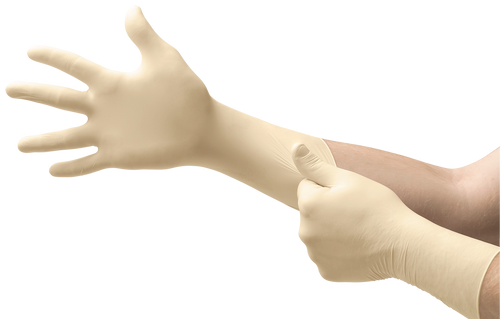
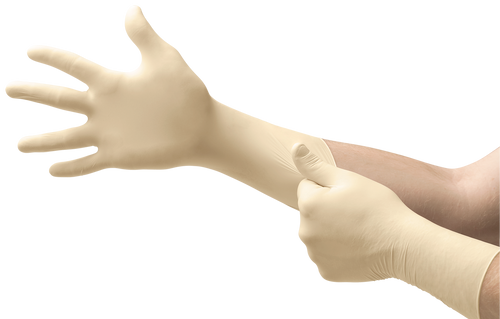
Ansell MICROFLEX MF-300 Diamond Grip Latex Exam Gloves
Ansell MICROFLEX® Diamond Grip® MF-300 is a durable, powder-free natural rubber latex examination glove designed for tasks where reliable grip, flexibility, and resistance to everyday handling damage are important. Its textured fingertips provide additional handling control when working with wet, oily, or slippery objects, while the reinforced fingertip profile is engineered to help resist snags, tears, and rips during demanding laboratory, industrial, automotive, and general examination procedures.
Diamond Grip MF-300 combines the natural elasticity of latex with a soft, comfortable fit and a standard-length beaded cuff. Ansell identifies the product as a robust examination glove with a nominal palm thickness of 0.16 mm (6.3 mil), 245 mm (9.65") glove length, and a 1.5 AQL freedom-from-holes specification at Inspection Level I.
The MF-300 is nonsterile and intended for standard, moderate-risk examination and general handling activities where natural rubber latex is permitted. Chemical compatibility, glove change frequency, and contamination-control requirements must be determined according to the actual task and facility procedures.
Natural rubber latex allergy warning: This product contains natural rubber latex, which may cause allergic reactions, including Type I latex hypersensitivity. Do not select MF-300 for latex-sensitive operators, patients, or environments where natural rubber latex is restricted. Choose an appropriately qualified latex-free alternative when latex exposure is a concern.
Product specification and packaging note: Ansell's current U.S. product information reports 0.21 mm (8.3 mil) finger thickness, while the introductory benefits section of its ©2025 technical sheet reports 0.20 mm (7.9 mil). Exact-model specification reconciliation remains pending. Standard sizes XS through XL contain 100 gloves per dispenser and 1,000 per case. XXL contains 90 gloves per dispenser and 900 per case. Verify the selected size and quantity before ordering.
Specifications:
- Manufacturer: Ansell
- Brand: MICROFLEX® Diamond Grip®
- Manufacturer Model: MF-300
- Product Type: Disposable latex medical examination glove
- Material: Natural rubber latex
- Color: Natural
- Powder Content: Powder-free
- External Glove Surface: Textured fingers
- Cuff Style: Standard-length beaded cuff
- Glove Length: 245 mm (9.65") nominal
- Palm Thickness: 0.16 mm (6.3 mil) typical
- Finger Thickness: 0.21 mm (8.3 mil) on the current Ansell U.S. product page and technical properties table; 0.20 mm (7.9 mil) appears in the ©2025 PDF benefits description
- Thickness Measurement References: ASTM D5151 / EN 455-2, as listed in the manufacturer technical properties table
- Freedom from Holes: 1.5 AQL, Inspection Level I
- AQL Testing References: ASTM D5151 / EN 455-1
- Sterile: No
- Silicone-Free: No
- Antistatic: Not tested
- Chemotherapy Drug Testing: No manufacturer claim for this model
- Manufacturer Product Segmentation: Robust
- Available Manufacturer Sizes: XS, S, M, L, XL, XXL
- XS–XL Packaging: 100 gloves per dispenser; 10 dispensers per case; 1,000 gloves per case
- XXL Packaging: 90 gloves per dispenser; 10 dispensers per case; 900 gloves per case
- Country of Origin: Malaysia, per manufacturer technical documentation
- Manufacturer-Listed Certifications: ASTM D3578, EN ISO 21420:2020, U.S. FDA 510(k) medical examination grade, and applicable U.S. food-contact reference
- Primary Applications: Standard examination procedures, automotive maintenance, inspection, laboratory support, and general material handling
Specification control: Typical material dimensions and physical properties are manufacturer-published reference values. A confirmed thickness tolerance, controlling document revision, and applicability to specific SOSCleanroom inventory lots must be obtained when exact measurements are required for controlled purchasing or qualification.
About the Manufacturer:
Ansell is a global manufacturer of hand protection and personal protective equipment for healthcare, life sciences, laboratories, automotive manufacturing, chemical handling, and industrial operations. Its protective glove portfolio includes natural rubber latex examination gloves, disposable nitrile gloves, specialty chemical-resistant gloves, and separately qualified cleanroom and sterile products.
The MICROFLEX® product family emphasizes application-specific protection, fit, comfort, dexterity, and handling performance. Diamond Grip® MF-300 is positioned as a robust latex examination glove with enhanced fingertip thickness and textured fingers for tasks involving frequent gripping, repeated tool contact, and moderate-risk examination activities.
SOSCleanroom provides Ansell protective glove products for industrial, laboratory, and contamination-control customers. Our team helps customers compare material types, verify size-specific packaging, and obtain applicable manufacturer documentation for purchasing and qualification requirements.
MICROFLEX Diamond Grip MF-300 Features:
- Natural rubber latex examination glove construction
- Textured fingertips for secure grip on wet, oily, and slippery objects
- Enhanced fingertip thickness compared with the glove's palm profile
- Powder-free design
- Soft, flexible natural rubber latex material
- Additional manufacturing wash step described by Ansell for a smooth feel and easier donning
- Standard-length beaded cuff
- 245 mm nominal glove length
- 1.5 AQL freedom-from-holes specification
- ASTM D3578 examination glove certification reference
- Manufacturer-listed U.S. FDA medical examination glove classification
- Nonsterile construction
- Natural glove color
- Available in sizes XS through XXL
- Size-dependent standard case quantities
MICROFLEX Diamond Grip MF-300 Benefits:
- Secure handling: Textured fingertips help improve control when handling slippery instruments, components, tools, and containers.
- Fingertip durability: The reinforced fingertip profile is designed to resist snags, tears, and rips during demanding routine handling.
- Natural elasticity: Latex provides a flexible fit and tactile response for tasks requiring frequent hand movement.
- Comfortable donning: Ansell's additional washing process is intended to create a smoother glove feel and facilitate donning.
- Powder-free construction: Avoids intentionally added glove powder and associated powder transfer.
- Barrier quality reference: The 1.5 AQL classification supports standardized evaluation of freedom from holes.
- Handling versatility: Suitable for qualified general-purpose laboratory, medical examination, automotive, and industrial tasks.
- Size selection: Six manufacturer sizes help accommodate different hand dimensions.
- Case procurement: Defined case packaging supports regular glove replenishment and purchasing standardization.
Natural Latex Allergy Warning and Material Selection
MICROFLEX Diamond Grip MF-300 is manufactured from natural rubber latex. Natural latex contains proteins capable of causing allergic reactions in sensitized individuals. Reactions may include skin symptoms or potentially serious immediate hypersensitivity responses.
Powder-free construction does not remove the underlying natural rubber latex allergy risk. Operators and facilities must evaluate latex sensitivity before approving this glove for routine use.
- Type I latex allergy: Natural rubber latex proteins may trigger immediate allergic reactions in sensitized individuals.
- Latex-sensitive operators: Do not use MF-300 when natural rubber latex exposure is prohibited or a known allergy makes the product inappropriate.
- Patient and customer exposure: Consider indirect exposure where gloves contact patients, medical equipment, products, or shared work surfaces.
- Powder-free does not mean latex-free: MF-300 contains natural rubber latex despite its powder-free design.
- Latex-restricted environments: Select a qualified synthetic nitrile, neoprene, or other suitable latex-free alternative.
- Skin reactions: Stop glove use and follow the facility's medical or occupational health procedures if an allergic reaction is suspected.
- Facility policy: Follow established latex allergy prevention, PPE selection, and exposure-control requirements.
Important safety limitation: MF-300 is not an appropriate replacement for latex-free gloves where an operator, patient, or facility requires avoidance of natural rubber latex. Select an alternative material with independently verified protection characteristics for the intended procedure.
MF-300 Thickness Source Discrepancy
Ansell's published information contains differing finger thickness values for the Diamond Grip MF-300. These differences should not be interpreted as proof of a product design change without manufacturer confirmation.
- Current Ansell U.S. product page: Lists 0.21 mm (8.3 mil) finger thickness and 0.16 mm (6.3 mil) palm thickness.
- 2025 Ansell technical sheet, technical properties table: Lists 0.21 mm (8.3 mil) finger thickness.
- 2025 Ansell technical sheet, product benefits text: Describes enhanced finger thickness as 0.20 mm (7.9 mil).
- Earlier SOS-hosted Ansell sheet: Reports 0.20 mm (7.9 mil) finger thickness.
- Palm thickness: 0.16 mm (6.3 mil) is consistent across the reviewed model-specific manufacturer references.
- Measurement scope: Published values are typical physical measurements and must be interpreted using the associated manufacturer testing methods.
Qualification requirement: Customers with critical minimum thickness requirements should request the current Ansell product specification, measurement tolerance, applicable revision, and any required lot documentation. Do not treat either published finger thickness value as a guaranteed minimum without manufacturer confirmation.
900 vs. 1,000 Gloves per Case by Size
Ansell MICROFLEX Diamond Grip MF-300 packaging depends on glove size. The manufacturer's standard case configuration contains 10 dispenser boxes, but the quantity per dispenser changes for XXL.
- Extra Small (XS): 100 gloves per dispenser; 1,000 gloves per case
- Small (S): 100 gloves per dispenser; 1,000 gloves per case
- Medium (M): 100 gloves per dispenser; 1,000 gloves per case
- Large (L): 100 gloves per dispenser; 1,000 gloves per case
- Extra Large (XL): 100 gloves per dispenser; 1,000 gloves per case
- Double Extra Large (XXL): 90 gloves per dispenser; 900 gloves per case
Ansell manufacturer ordering codes:
- XS (5.5–6): MF-300-XS
- S (6.5–7): MF-300-S
- M (7.5–8): MF-300-M
- L (8.5–9): MF-300-L
- XL (9.5–10): MF-300-XL
- XXL (10.5–11): MF-300-XXL
Purchasing guidance: XXL contains 10% fewer gloves than the standard XS–XL case. Confirm the manufacturer's size-specific configuration and the SOSCleanroom purchase option before ordering, particularly for blanket orders, recurring orders, or purchasing systems that assume a fixed 1,000-glove case.
Latex vs. Nitrile: Choosing the Correct Examination Glove
Natural rubber latex and synthetic nitrile are commonly used for disposable examination gloves, but they differ in elasticity, chemical resistance, allergy considerations, and handling characteristics. Neither material is universally superior for every procedure.
- Latex flexibility: Natural rubber latex offers high elasticity and a responsive fit for dexterity-sensitive tasks.
- Textured grip: MF-300's textured fingertips are intended to provide additional control during wet, oily, or slippery handling.
- Fingertip durability: MF-300's reinforced finger profile may be useful for repeated tool or component contact, subject to the hazards of the task.
- Latex allergy: Natural rubber latex can cause allergic reactions and is inappropriate for latex-restricted environments.
- Nitrile alternatives: Synthetic nitrile gloves eliminate natural rubber latex protein exposure and may offer different chemical resistance profiles.
- Chemical compatibility: Neither latex nor nitrile should be selected solely by material name. The actual chemical, concentration, exposure time, and temperature determine suitability.
- Cleanroom requirements: Both latex and nitrile gloves require separate evaluation of cleanliness, packaging, and sterility where applicable.
Selection guidance: Choose MF-300 when natural latex is permitted and its fit, grip, barrier quality, and documented protection characteristics meet the task requirements. Select an appropriate latex-free alternative whenever latex sensitization or facility restrictions are controlling considerations.
Chemical Splash Protection and Exposure Limitations
Ansell describes MF-300 as offering chemical splash protection, but the glove is not designated as universally resistant to solvents, oils, cleaning agents, or other chemicals. Chemical protection must be assessed using the exact substance and realistic exposure conditions.
- Incidental splash: Brief contact may be acceptable only when supported by appropriate chemical compatibility evidence and the workplace risk assessment.
- Repeated exposure: Repeated wetting can increase material exposure and may require more frequent glove changes.
- Prolonged contact: Long-duration chemical exposure requires specific permeation and degradation information.
- Immersion: Do not use a disposable latex examination glove for chemical immersion unless the exact exposure has been appropriately qualified.
- Oils and petroleum-based products: Some oils and petroleum products can adversely affect natural rubber latex. Automotive task recommendations do not establish compatibility with every oil, fuel, solvent, or lubricant.
- Chemical mixtures: Mixtures may produce different effects than individually tested substances.
- Temperature: Elevated chemical temperatures can alter material performance and permeation behavior.
- Glove degradation: Swelling, softening, tackiness, cracking, or reduced strength are potential warning signs of incompatibility.
Protection limitation: MF-300 is not manufacturer-designated as chemotherapy-tested. Do not infer chemotherapy drug protection, extended chemical immersion resistance, or compatibility with particular solvents without applicable manufacturer test evidence.
Common Applications:
- Standard, moderate-risk medical examination procedures where latex is permitted
- General automotive aftermarket tasks
- Inspection, selecting, checking, and marking components
- Engine and transmission maintenance involving qualified materials
- Oil, fluid, and filter changes where chemical compatibility has been confirmed
- Tire rotation and general automotive servicing
- Laboratory sample taking and processing
- Raw material sample collection
- Maintaining laboratory furniture and equipment
- General-purpose industrial inspection
- Handling slippery tools and small components
- Manufacturing support tasks requiring a textured-grip disposable glove
Application suitability: These are manufacturer-associated use cases, not blanket chemical approvals. Evaluate material compatibility, puncture hazards, natural latex sensitivity, and contamination-control requirements before use.
Best-Practice Use:
- Check latex restrictions: Confirm that natural rubber latex gloves are permitted for the operator, patient, product, and work environment.
- Select the correct size: Use a properly fitted glove that allows comfortable movement without excessive stretching or loose fingertips.
- Inspect before donning: Check for holes, tears, sticking, discoloration, and other visible material defects.
- Perform hand hygiene: Follow facility handwashing and drying procedures before donning.
- Don carefully: Avoid pulling excessively on the fingertips, cuff, or thin areas of the glove.
- Evaluate the chemical exposure: Verify compatibility before handling chemicals, solvents, oils, fuels, lubricants, or cleaning solutions.
- Change after contamination: Replace gloves when chemical exposure, surface contamination, or task transitions require it.
- Watch for degradation: Replace gloves showing swelling, softening, cracking, punctures, or reduced structural integrity.
- Avoid sharp objects: Latex examination gloves do not replace puncture-resistant or cut-resistant protective gloves.
- Prevent cross-contamination: Change gloves between different work areas, products, and procedures when required by the facility SOP.
- Remove carefully: Follow approved doffing procedures to avoid contact with potentially contaminated external surfaces.
- Dispose appropriately: Discard used gloves according to the biological, chemical, or industrial waste hazards associated with the task.
Nonsterile Latex Gloves and Cleanroom Qualification
MICROFLEX Diamond Grip MF-300 is a nonsterile latex examination glove. Its medical examination classification, AQL, thickness, and textured grip do not establish that the product is suitable for all cleanroom or contamination-sensitive manufacturing applications.
- Sterility: MF-300 is not supplied as a sterile glove.
- ISO cleanroom classification: A medical examination glove classification does not establish ISO cleanroom compatibility.
- Particle and fiber control: Glove cleanliness must be evaluated against the process's particulate contamination requirements.
- Extractables and residues: Applications with stringent organic, ionic, or other extractable limits require appropriate glove qualification.
- Natural latex restrictions: Some processes or facilities restrict natural rubber latex because of allergy or material compatibility concerns.
- Aseptic operations: Sterile processing and critical aseptic manipulation require separately qualified gloves and procedures.
- Contamination transfer: Dispenser handling, glove changes, and contact with non-controlled surfaces can affect process cleanliness.
Selection guidance: Where a process requires sterile gloves, controlled particle levels, specific extractables, or ISO-classified gowning compatibility, select a glove with documentation that directly supports those requirements.
Standards and Protection Classifications
Ansell publishes medical examination and protective glove standards for MICROFLEX Diamond Grip MF-300. These references must be interpreted within their specific testing and regulatory scope.
- ASTM D3578: Standard specification for rubber examination gloves.
- EN ISO 21420:2020: General requirements and test methods for protective gloves.
- U.S. FDA 510(k) Medical Examination Grade: Manufacturer-listed medical examination glove regulatory classification.
- U.S. FDA 21 CFR 177.2600: Manufacturer-listed food-contact regulatory reference, subject to applicable conditions of use.
- ISO 13485:2012: Manufacturer-listed medical device quality management audit reference.
- ASTM D5151 / EN 455-1: Manufacturer-identified freedom-from-holes testing references.
- ASTM D5151 / EN 455-2: Measurement references shown in the manufacturer technical table for thickness values.
- Antistatic: Not tested, according to manufacturer specifications.
- Silicone-Free: No, according to manufacturer specifications.
Regulatory limitation: These designations do not independently establish chemotherapy drug resistance, sterile presentation, cleanroom cleanliness, electrostatic protection, or chemical compatibility for every industrial material.
Storage and Handling:
- Storage environment: Store in a cool, dry location according to manufacturer instructions.
- Direct sunlight: Protect gloves from direct sunlight.
- Ozone exposure: Keep away from ozone sources that may affect natural rubber latex performance.
- Ignition sources: Store away from sources of ignition, as directed by Ansell.
- Packaging protection: Protect glove dispensers from contamination, moisture, and physical damage.
- Expiration and rotation: Follow manufacturer shelf-life instructions and any applicable product or lot expiration requirements.
- Receiving verification: Confirm glove size, material, manufacturer part number, and case quantity before accepting product into a controlled purchasing program.
Selection Notes (MF-300 vs. Other Glove Options)
- MF-300 vs. MICROFLEX Evolution One EV-2050: Both are natural rubber latex examination gloves. Diamond Grip emphasizes robust textured-fingertip handling, while Evolution One offers a fully textured exterior and a different fit and handling profile. Both require latex allergy consideration.
- MF-300 vs. TouchNTuff 92-600: MF-300 contains natural rubber latex and is positioned for examination and general handling tasks. TouchNTuff 92-600 uses synthetic nitrile and is positioned for chemical splash protection. Select based on allergy requirements, actual chemicals, grip, and task conditions.
- MF-300 vs. MICROFLEX Supreno EC SEC-375: SEC-375 is a nitrile examination glove with an extended cuff for higher-risk applications. MF-300 has a standard cuff and natural latex construction.
- MF-300 vs. cleanroom latex gloves: The MF-300 is nonsterile and not independently classified as an ISO cleanroom glove. Select a separately qualified cleanroom latex glove when controlled-environment specifications require it.
- Natural latex vs. synthetic gloves: Latex may provide desirable elasticity and fit, but synthetic materials should be considered whenever latex sensitivity or material compatibility is a concern.
- Standard vs. XXL case: XS through XL contain 1,000 gloves per case. XXL contains 900 gloves per case and should not be purchased using an inaccurate 1,000-glove quantity assumption.
Link to Ansell MICROFLEX Diamond Grip MF-300 Manufacturer Product Page: Click HereLink to Ansell MF-300 Technical Data Sheet: Click HereLink to SOS-Hosted Ansell Diamond Grip MF-300 Technical Data Sheet: Click HereOther Similar Products Available From SOSCleanroom.com
MICROFLEX Latex Examination Gloves
Latex-Free Nitrile Alternatives
Notes: Looking for additional technical information about Ansell MICROFLEX Diamond Grip MF-300 latex examination gloves? Open the SOSCleanroom Technical Vault tab above for educational information on natural latex allergy considerations, glove thickness, AQL interpretation, fingertip grip, chemical compatibility, size-specific case quantities, and cleanroom qualification limits.
SOSCleanroom.com supports laboratory, industrial, and contamination-control customers with specialty protective gloves, competitive pricing, and responsive customer service. Our team can assist with glove material selection, size-specific packaging, and applicable manufacturer documentation requests.
Manufacturer documentation: The Ansell MF-300 technical sheet bearing a 2025 copyright and the current manufacturer product information were reviewed. The manufacturer's current product page and technical properties table report 0.21 mm finger thickness, while the 2025 PDF benefits paragraph reports 0.20 mm. The older SOS-hosted Ansell sheet also reports 0.20 mm. A controlling manufacturer revision, thickness tolerance, and lot-specific applicability have not been independently confirmed. A separate model-specific SDS, chemical permeation report, and lot-specific certificates were not established during this review.
Product information reviewed: November 9, 2026 (SOS Technical Staff)
© 2026 Specialty Optical Systems, Inc. (dba SOSCleanroom). All rights reserved.