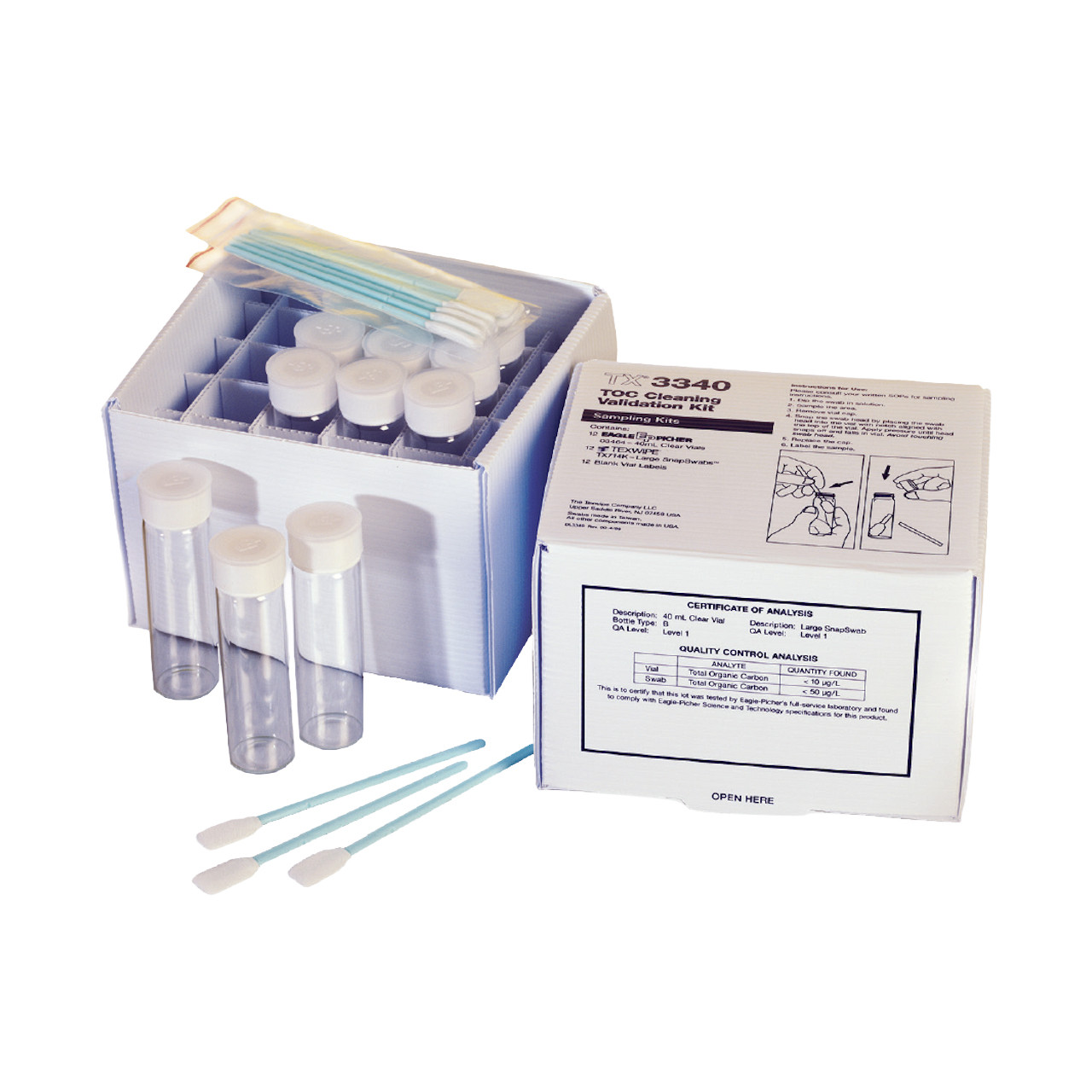
Texwipe TX3340 TOC Cleaning Validation Kit (12 samples): disciplined, repeatable sampling when residues drive risk
Practical solutions in a critical environment
TOC cleaning validation fails for predictable reasons: inconsistent sampling technique, uncontrolled consumables, and poor documentation of what touched the surface and when. In a critical environment, the swab or wipe is not “just a tool.” It becomes part of the measurement system, and any variability in residue background, solvent handling, or operator technique can blur the line between “process residue” and “sampling artifact.”
The Texwipe TX3340 TOC Cleaning Validation Kit is intended to make the workflow repeatable for a defined sample count (12 samples). The operational value is consistency: consistent consumables, consistent handling discipline, and a defined path for documenting lot information and sample lineage so investigations and audits do not collapse into guesswork.
Nothing is truly lint free in every condition; low-linting outcomes depend on technique and surface condition, including edge sharpness, burrs, solvent load, contact pressure, and stroke discipline.
What makes TOC sampling “go wrong” in real life
Over-wetting, re-dipping, and “extra scrubbing” are common when an operator is trying to be helpful. Those behaviors often increase variability, spread residues, or add background organics. A kit only works when paired with a disciplined method and clear stop conditions.
What is this swab used for
TX3340 is used to support TOC-oriented cleaning validation sampling workflows for a defined number of samples (12). It is commonly used when teams need consistent sampling materials and a repeatable approach for collecting residues from surfaces after cleaning, then transferring those residues into downstream analytical steps and documentation packages.
- Cleaning validation sampling where organic residue background and method consistency matter
- Qualification and requalification events where repeatability across shifts and operators is required
- Investigations and deviations where you must defend sample lineage, consumable control, and handling discipline
- Programs where documentation and lot capture are part of the quality system expectation
In regulated environments, the point is not simply “collect a sample.” The point is a controlled method that can be trained, repeated, and defended.
Why should customers consider this swab
- Defined sample count: Sized for 12 samples, which helps teams standardize runs, staging, and documentation without improvising consumable quantities mid-procedure.
- Workflow discipline: A kit format supports consistent staging and reduces “grab whatever is nearby” behavior that introduces uncontrolled background organics.
- Lot and lineage control: Validation sampling frequently turns on traceability. A kit approach supports capturing lot information and maintaining segregation of qualified materials.
- Method repeatability across people: A consistent consumables set reduces operator-to-operator drift, especially when sampling is performed across multiple shifts or sites.
- SOSCleanroom continuity and documentation posture: SOSCleanroom’s working relationship with ITW Texwipe supports continuity of supply and disciplined documentation expectations, helping customers keep validated methods stable after qualification.
Materials and construction
TX3340 is a cleaning validation kit intended for TOC-sensitive sampling workflows. The kit format is designed around controlled consumables use, repeatable handling, and traceability discipline. For exact contents and configuration, align the kit’s component list and any supplied certificates with your site’s sampling SOP and acceptance criteria.
Practical construction note: in TOC work, the “construction” that matters is not only the sampling head material, but also the packaging, staging method, solvent handling controls, and whether the workflow prevents recontamination (re-dipping, contact with nonqualified surfaces, and uncontrolled air exposure).
Specifications in context
TX3340 is identified as a TOC cleaning validation kit for 12 samples. In practice, that “12” should map to your sampling plan: surface area per sample, solvent volume per sample, stroke count per sample, and the chain-of-custody or batch record fields required by your quality system. If your procedure includes blanks, spiked recoveries, or duplicate samples, ensure your run plan accounts for those controls.
| Attribute |
TX3340 |
| Product type | TOC cleaning validation kit |
| Sample capacity | 12 samples |
| Use focus | Residue-sensitive sampling and documentation discipline |
Cleanliness metrics
In TOC sampling, the cleanliness metric that drives decision-making is often “background contribution” relative to your acceptance criteria and your method controls. A kit does not replace method validation. It supports it by reducing uncontrolled variables. The most defensible approach is to include appropriate controls in each run: a blank control (to characterize the sampling system background), a recovery or spike where appropriate (to prove the method can collect what you care about), and a clear definition of stop conditions for the operator.
Why “not specs” matters in practice: residue background can move with solvent choice, wetness, contact pressure, and how long a consumable is exposed to the environment during staging. If your workflow is trending toward tighter limits, treat consumable control, staging control, and operator discipline as part of the measurement system.
Quality-system reminder
If you are operating under FDA expectations, build the sampling method into the controlled procedure: training, documentation fields, deviation triggers, and data review rules. Consumables selection and control are part of that defensibility.
Packaging, sterility and traceability
For TOC validation sampling, packaging and traceability are not administrative details. They are contamination controls. Stage only what you will use. Keep unused components sealed until the moment of use. Capture lot information in the batch record or log when the sampling event has any potential to influence release decisions or investigations.
- Staging discipline: minimize open time; keep components covered; avoid placing sampling heads on benches or tray surfaces not designated for sampling.
- Traceability discipline: capture kit identifiers and any component lot identifiers required by your SOP; document solvent lot and water quality where applicable.
- Sterility note: sterility is not the same as low residue background. If your process requires sterile introduction, select a sterile workflow intentionally and confirm it supports your residue targets and your documentation expectations.
Best-practice use
The kit is most effective when paired with a controlled sampling technique. Treat every sampling contact as a “one-way trip” that must not be repeated on a clean area with a loaded tool or re-wetted with a contaminated solvent source.
Operator technique module
- “Damp” solvent technique: control wetness to “damp,” not dripping. Over-wetting creates pooling and can spread residues outside the defined sample area. If you can see a bead forming at first contact, you are too wet.
- Stroke count logic: use single-direction strokes with overlap. Define a stroke count per area and train to it. Stop when the tool loads or begins to leave a film. Do not “polish” for reassurance.
- Geometry control: when sampling tracks, corners, and joints, keep gloves and sleeves out of the sample envelope. Maintain a consistent angle to avoid scraping edges that can change shedding behavior.
- Pressure guidance: apply only enough pressure to maintain contact. Excess pressure can smear residues, increase shedding from edges, and change recovery behavior.
- Solvent compatibility framing: IPA is common in many plants, but sampling solvent choice is method-specific. Validate solvent compatibility with the surface, coatings, and your analytical method. Do not assume “stronger solvent” improves defensibility.
- Handling discipline: avoid re-dipping into shared solvent; use controlled dispense or single-use aliquots. Stage only what you will use. Keep the sample container closed except during transfer.
- Disposal and documentation cues: treat used tools as single-use. Capture kit identifier, solvent lot, operator, date/time, and the defined sample area in the record. This is frequently the difference between a fast investigation and an expensive one.
Common failure modes
- Over-wetting and pooling: creates tide marks and spreads residues beyond the defined sample boundary, which can distort recovery and inflate variability.
- Working past the stop condition: a loaded tool becomes a transfer tool. More strokes can reduce quality, not increase it.
- Re-dipping into shared solvent: cross-contaminates the solvent source and collapses your blank control logic.
- Uncontrolled staging: leaving components exposed increases environmental background contribution and reduces repeatability.
- Documentation gaps: missing lot/lineage details undermines defensibility even if the sampling was technically adequate.
Closest competitors
For TOC cleaning validation kits and residue-sensitive sampling workflows, competitive differentiation usually centers on: documentation support, traceability discipline, component control, and whether the supplier provides consistent, repeatable access to the same validated configuration over time.
- Contec validation sampling consumables and kits (residue-sensitive sampling workflows): often positioned for controlled environments. Compare documentation availability, traceability fields, and whether the configuration can be supplied consistently after you qualify it.
- Berkshire controlled-environment sampling consumables (TOC and residue-relevant programs): evaluate how well the supplier supports repeatable component control and whether their documentation package aligns with your SOP and investigation posture.
- Puritan controlled-environment sampling consumables (micro-sampling tools and workflow components): compare component control, traceability, and long-run supply continuity relative to your validation timeline.
Critical environment fit for this swab
TX3340 fits best where method defensibility matters: regulated manufacturing, validation and revalidation cycles, and any program where “the sampling system” must be controlled and repeatable. The kit approach supports consistent staging and documentation discipline when residues and recoveries drive go/no-go decisions.
SOSCleanroom supports validation programs with continuity of supply, fast shipping, and responsive customer service, with a documentation-forward posture aligned to ITW Texwipe’s approach. The practical advantage is stability after you qualify the method: fewer forced substitutions, fewer uncontrolled variables, and fewer surprises during audits and investigations.
Source basis
SOSCleanroom product page (TX3340): https://www.soscleanroom.com/product/clearance-deals/texwipe-tx3340-toc-cleaning-validation-kit-for-12-samples/
International Organization for Standardization (ISO) cleanroom classification context (ISO 14644-1:2015): https://www.iso.org/standard/53394.html
FDA (Food and Drug Administration): https://www.fda.gov/
ASTM (American Society for Testing and Materials): https://www.astm.org/
IEST (Institute of Environmental Sciences and Technology): https://www.iest.org/
SOSCleanroom is the source for this Technical Vault entry.
Briefed and approved by the SOSCleanroom (SOS) staff.
Last reviewed: January 5, 2026
© 2026 SOSCleanroom