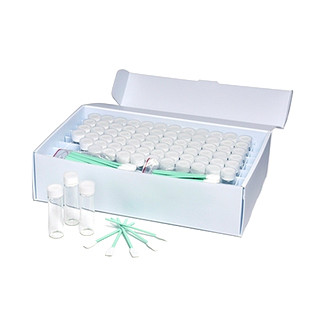
Left: kit-format transport box with vials, labels, and long-handle sampling swabs (TX3343).
Practical solutions in a critical environment
In TOC-based cleaning validation, the instrument is rarely the source of surprises. The surprises happen earlier: a vial cap set down on a bench “just for a second,”
a swab head brushed by a glove cuff, a sampling area that isn’t truly consistent across operators, or a consumable lot change that quietly shifts background.
TX3343 is designed to reduce sampling-driven variability by controlling the items that most often pollute TOC results: the swab, the vial/cap, and the way they travel
from storage to the sampling site to the lab.
This kit is most valuable when your program has real consequences tied to the number—batch release decisions, CAPA investigations, or trend reviews—where you need to
explain not only the result, but also why the sampling method itself did not create that result.
Note on fibers and residue: you will see “low-linting” language throughout cleanroom sampling literature, but nothing is truly lint-free.
Technique and surface condition determine what sheds, what transfers, and what ends up in the vial.
What is this swab used for
Although TX3343 is a kit, it functions as a swab-and-vial sampling system for TOC surface sampling in cleaning validation protocols.
Each kit supports sampling across 12 defined sampling areas using certified low-TOC consumables and cleanroom-compatible labeling.
It is also used in broader contamination investigations where you need to collect a controlled, traceable sample (including non-organic liquids sampling investigations,
as positioned in manufacturer literature) and transport it without introducing new background from packaging or handling.
Why should customers consider this kit
- Controls the usual TOC “gotchas.” Certified low-TOC vials/caps and certified low-TOC swabs help keep background contribution predictable when operator technique is consistent.
- Reduces handling exposure. The notched, break-away handle format is intended to drop the swab head into the vial with minimal contact—an important control point when teams are preventing false positives.
- Keeps chain-of-custody practical. Cleanroom-compatible labels and a dedicated box reduce “where did this vial come from?” questions during QA review and investigation work.
- Standardizes multi-operator sampling. Kit format encourages consistent staging, transport, and documentation habits across shifts.
- Audit-friendly by design. Lot coding supports traceability and ties the sampling event back to a controlled consumable lot when you need to defend data trends.
Materials and construction
TX3343 includes TX761K Low TOC Alpha® polyester knit swabs with a polypropylene handle.
Manufacturer documentation describes the swab head as double layered, double knit polyester intended to entrap contaminants during sampling and release into the diluent for recovery,
and the handle as a notched, break-away design for head transfer into the vial with reduced handling.
The kit uses 40 mL clear prewashed vials with bonded septa caps.
Manufacturer documentation notes a one-piece cap-and-septum design, a protective overcap for the septum surface, and a sloped-shoulder vial geometry intended to minimize headspace
for lower background.
Packaging is described as double-bagged components in a cleanroom-compatible polypropylene box—built for controlled movement from storage to sampling site to lab.
Specifications in context
The table below focuses on what matters operationally: how many sampling events you can execute per kit, what is included, and the key physical attributes of the included TX761K swab
that affect access, stroke control, and head transfer into the vial.
| Attribute |
TX3343 (SKU) |
| Kit purpose |
TOC surface sampling for cleaning validation protocols (kit-format sampling system) |
| Sampling capacity |
12 sampling areas per kit (12 vials + labels) |
| Kit includes (per kit) |
12 × 40 mL vials with bonded septa caps + 12 blank vial labels + 24 × TX761K swabs |
| Case pack |
18 kits per case |
| Certified background control (vials/caps) |
<10 µg/L TOC (<10 ppb) (manufacturer statement) |
| Certified background control (TX761K swabs) |
<50 µg/L TOC (<50 ppb) (manufacturer statement) |
| Included swab head material |
Knitted Alpha® polyester (TX761K) |
| Included swab head size (TX761K) |
Width 6.8 mm (0.268"); Length 16.8 mm (0.661"); Thickness 2.8 mm (0.110") |
| Included swab overall length (TX761K) |
162.3 mm (6.390") |
| Handle material / transfer method |
Polypropylene; notched break-away head transfer into vial (TX761K) |
| Packaging (kit) |
Double-bagged; cleanroom-compatible polypropylene box |
Cleanliness metrics
For TOC programs, the “headline metric” is the certified TOC background level for both vials/caps and swabs. However, teams often still care about ionic and residue background
because these can show up as secondary signals in troubleshooting, surface inspection, or unexpected method behavior. The tables below summarize typical contamination characteristics
published for the TX761K swab included in TX3343. (Values shown are typical analyses in manufacturer documentation—not specification limits.)
Typical ion extractables (TX761K swab) — µg/swab
| Ion |
Typical value |
| Calcium | 0.03 |
| Chloride | 0.02 |
| Fluoride | 0.08 |
| Magnesium | 0.02 |
| Nitrate | 0.11 |
| Phosphate | 0.10 |
| Potassium | 0.08 |
| Sodium | 0.14 |
| Sulfate | 0.13 |
Typical NVR (TX761K swab) — mg/swab
| Extractant |
Typical value |
| DI water (DIW) | 0.01 |
| IPA | 0.03 |
Packaging, sterility and traceability
- Packaging format: Double-bagged components in a cleanroom-compatible polypropylene box (kit-format transport control).
- Traceability: Lot coded for traceability and quality control (manufacturer statement).
- Vials/caps: 40 mL clear prewashed vials with bonded septa caps; protective overcap for septum surface; sloped-shoulder design intended to reduce headspace background (manufacturer statements).
- Sterility: Manufacturer documentation indicates sterile is available upon request for Texwipe swabs/TOC kits (confirm your sterility requirement and validation strategy before standardizing).
- Handle identification: Manufacturer documentation describes a trademarked light-green handle color with “TEXWIPE” embossed on the handle as a practical authenticity/traceability cue.
- Country of origin (manufacturer statement): Made in The Philippines.
Best-practice use
TX3343 controls consumables, but your method controls defensibility. Before you standardize, align the field technique with the lab workflow:
diluent selection, recovery expectations, acceptance criteria, and how blanks are handled and trended.
Operator-level swabbing technique module
- Stage clean. Open the kit box only in an appropriate controlled area. Pre-label vials where possible to reduce open-time at the sampling location.
- Define the sampling area. Use a consistent template (area, location ID, and orientation). “Same equipment” is not the same as “same sampling site.”
- Wetting discipline. Dampen with the specified diluent (do not flood). Over-wetting can dilute recovery, smear residues, or drive contaminants into seams/crevices.
- Stroke control. Use the swab head flat to the surface; execute unidirectional parallel strokes, then flip and repeat perpendicular strokes. Keep pressure consistent—let the knit do the capture work.
- Edges and corners. Finish by tracing the perimeter and any weld seams/gaskets with the swab edge, using controlled contact (avoid snagging).
- Hands off the head. Avoid touching the swab head at all times. Treat the notch/break point as a contamination boundary—keep gloves and fingers away from the head-side of the handle.
- Transfer discipline. Remove cap, snap the swab head at the notch with the head entering the vial, and recap immediately. Do not set caps down on benches or carts.
- Blanks and controls. Run field blanks and transport blanks per your SOP. When TOC is trending high, blank behavior is often the fastest way to separate “process residue” from “sampling artifact.”
- Document like you mean it. Operator ID, location ID, area size, diluent lot, swab/vial lot, time opened/closed, and any anomalies (wet surface, visible residues, roughness) should be recorded consistently.
Common failure modes
- Over-wetting or inconsistent wetting. Can dilute recovery, change stroke friction, and shift background by changing extract behavior.
- Cap and septum contamination. Caps placed on benches/carts or left open too long can dominate the TOC signal.
- Touching the head or crossing the notch line. Glove contact, sleeve contact, or poor grip control can introduce background and create “phantom residue.”
- Poorly defined sampling areas. “About this big” sampling creates noisy data. Area definition is as important as the swab itself.
- Pressure variation. Too much pressure can snag on rough surfaces and increase particle transfer; too little pressure can reduce capture of adherent residues.
- Delay to recap / poor transport control. Extended open-time invites airborne contamination; uncontrolled transport invites mix-ups and investigative pain later.
- Assuming “kit = validated.” TX3343 supports disciplined sampling, but your facility still must establish, train, and qualify the method for your equipment, residues, and acceptance criteria.
Closest competitors
In practice, “competitors” for TX3343 are usually alternative ways to run the same program goal (repeatable low-background sampling), not just alternative brands.
The options below are common decision points in cleaning validation programs.
- Texwipe TX3340 kit (TX714K-based). Similar kit concept for 12 areas, but built around the larger TX714K Low TOC Alpha® sampling swab (useful when your surface access and defined-area method favors a larger head).
- Texwipe TX3342 bulk kit (higher capacity). Higher count kit format (commonly selected when sampling volume and batching efficiency matter more than small-kit portability).
- Build-your-own approach. Separately sourcing TOC-certified vials/caps, low-background swabs, and cleanroom labels can work—but it often increases lot variability, staging errors, and chain-of-custody friction unless the process is very tightly controlled.
Critical environment fit for this kit
TX3343 fits best where controlled environments demand repeatability: pharmaceutical and biotech cleaning validation, microelectronics, and any program where TOC trends trigger
documented investigations. The kit is a practical “discipline enabler”—it reduces opportunities for uncontrolled background and strengthens traceability when the numbers get reviewed.
SOSCleanroom’s role is operational continuity. TX3343 is used inside quality systems, not just purchase orders. That means you need consistent supply, stable documentation,
and quick answers when a lot question or method question comes up. SOSCleanroom works closely with ITW Texwipe to support that continuity—helping customers keep validated
protocols stable, audit-ready, and easier to defend.
Program-fit reminder: align kit selection with your surface access (head size and handle reach), your diluent and recovery expectations, and how your lab wants samples staged,
labeled, and delivered. A “great kit” still fails if it doesn’t match the workflow.
SOSCleanroom note about SOP's
The Technical Vault is written to help customers make informed contamination-control decisions and improve day-to-day handling technique.
It is not your facility’s Standard Operating Procedure (SOP), batch record, or validation protocol.
Customers are responsible for establishing, training, and enforcing SOPs that fit their specific risks, products, equipment, cleanroom classification, and regulatory obligations.
Always confirm material compatibility, cleanliness suitability, sterility requirements, and acceptance criteria using your internal quality system and documented methods.
If you adapt any technique guidance from this entry, treat it as a starting template. Your team should review and approve the final method, then qualify it for your specific surfaces,
solvents, cleanliness limits, inspection methods, and risk profile. In short: use these best-practice suggestions to strengthen your SOPs—not to replace them.
Source basis
- SOSCleanroom product page (SKU): https://www.soscleanroom.com/product/clearance-deals/texwipe-tx3343-toc-cleaning-validation-kit-for-12-samples/
- Manufacturer product page (TX3343): https://www.texwipe.com/tx3343
- SOS-hosted manufacturer TDS (TOC Cleaning Validation Kits; includes TX3343 components): https://www.soscleanroom.com/content/texwipe_pdf/TX3343TDS_en.pdf
- SOS-hosted manufacturer TDS (Low TOC Alpha® swabs; includes TX761K physical + contamination characteristics): https://www.soscleanroom.com/content/texwipe_pdf/714k%20761k.pdf
- SOS-hosted sampling guide (Cleaning Validation Swab Sampling Procedure; Rev.01-1/17): https://www.soscleanroom.com/content/texwipe_pdf/Swabbing%20Guide_2017.pdf
- Texwipe.com PDF (Cleaning Validation Swabs & TOC Kits TDS): https://www.texwipe.com/images/uploaded/documents/Swabs/Texwipe-CleaningValidation-Swabs-TDS.pdf
- ISO (cleanrooms/controlled environments reference): https://www.iso.org/standard/53394.html
- FDA: https://www.fda.gov/
- ASTM: https://www.astm.org/
- IEST: https://www.iest.org/
SOSCleanroom is the source for this Technical Vault entry.
Briefed and approved by the SOSCleanroom (SOS) staff.
If you have any questions please email us at Sales@SOSsupply.com
Last reviewed: January 6, 2026
© 2026 SOSCleanroom