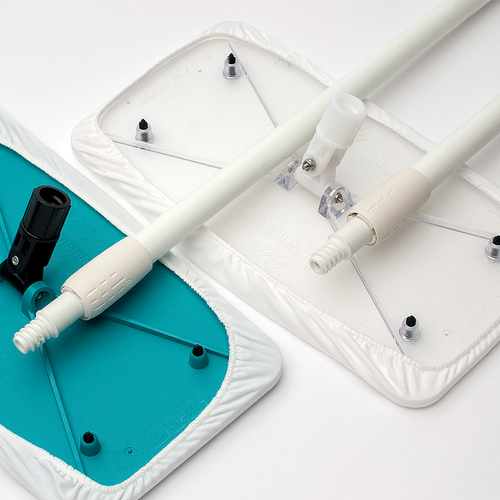
Texwipe TX7108H AlphaMop Replacement Head (HEAD ONLY)

$69.45
(No reviews yet)
SKU:
TX7108H
Availability:
7 - 10 Business Days
Shipping:
Calculated at Checkout
Type:
Dry Mop
Texwipe TX7108H AlphaMop® Replacement Mop Head — 15" x 8", Teal Thermoplastic (Head Only)
TX7108H is the replacement head assembly for the Texwipe AlphaMop® flat mop system used to clean floors, walls, and ceilings in controlled environments. It is a rigid, thermoplastic mop head designed for wider surface coverage and repeatable cleaning passes when paired with compatible AlphaMop covers/pads and a facility-defined wetting/wringing method.

For over 35 years, SOS and Texwipe have been close partners, and SOSCleanroom is the authorized Master Distributor of ITW Texwipe for the United States market. That relationship matters for critical-environment mopping programs: it supports continuity of supply, stable product lineage, and fast access to manufacturer documentation for qualification, change control, and audit readiness.

Published configuration (TX7108H)
  • Part number: TX7108H
  • Head size: 15" x 8" (38 cm x 20 cm)
  • Head material: Thermoplastic
  • Color: Teal
  • For use with: TX7108 AlphaMop® system
  • Packaging: 1 mop head / case
  • Cleanroom environment (AlphaMop series, as published): ISO Class 2–7; EU Grade A–D; Class 1–100,000
  • Shelf life (as published for mop heads/handles): Unlimited
Contamination control is driven by process discipline
A cleanroom mop head is hardware in a controlled process. Define the system (head + pad + cover), define the wet load, define the pass pattern, and define the change-out rules. Most floor “failures” trace back to inconsistent wringing, chemistry residue, or cross-contamination carryover — not the head itself.

System fit and matching components (for spec writers)
This head is typically qualified as part of a complete AlphaMop system (head + pad + cover + handle + bucket/wringer). Use the table below to keep part selection consistent across shifts and sites.
Component Published options (examples) Why it matters
Replacement head TX7108H (standard head); TX7108AH (autoclave safe head) Keep head type aligned to your sterilization/processing plan. If autoclaving is required by SOP, standardize the autoclave-safe head model and qualify the cycle.
Handle options Fiberglass and telescoping options are available in the AlphaMop series Reach control and operator ergonomics directly affect contact pressure, streaking, and missed coverage.
Pads and covers Polyester and microdenier cover/pad sets; sterile and non-sterile options; pre-wetted cover options (as published) The cover (not the head) is the primary contact layer for particle pickup and solution delivery. Standardize one cover family per room grade whenever possible.

Practical cleanroom use guidance (technicians and engineers)
  • Qualify as a system: Validate the head with the exact pad/cover you will run, using your actual disinfectant set, buckets/wringer, and floor finish. System changes are where variability enters.
  • Control wet load: Define a repeatable wet pickup target and wring method. Over-wetting drives streaking/filming and can spread residues into seams, corners, and transitions.
  • Use defined pass patterns: Overlap passes and avoid random scrubbing. Consistent direction and overlap reduce re-deposition and help QA troubleshoot deviations.
  • Prevent cross-contamination: Stage clean heads/covers separate from used items. Treat the mop as a “dirty tool” once it starts the route.
  • Change-out rules: Define area/time limits per cover and enforce replacement when streaking begins or visible loading occurs. Extending cover life is a common root cause of residue carryover.

Process control table (recommended for SOPs)
Control point What to standardize Failure symptom if missed
Wringing method Number of wring cycles, wring force, and dwell time before use Streaking, puddling, inconsistent disinfectant film
Bucket discipline Clean vs. rinse bucket order (if used), solution labeling, volume marks, and change frequency Residue carryover, concentration drift, odor/film complaints
Route design Direction, overlap, and boundary rules (doors, thresholds, drains) Missed coverage, re-contamination streaks, inconsistent visual results
Cover change-out Max area/time per cover; hard-stop replacement triggers Smearing, particle re-deposition, “sticky” floor feel after dry-down

Compatibility and wipe-down notes
  • Disinfectants and cleaners: The AlphaMop system is published for applying and removing solutions, including disinfectants, and for use with common disinfectants/cleaners. Qualify under your site chemistry set and floor finish.
  • Solvent handling: Avoid uncontrolled solvent pooling and do not store wet heads/covers against plastic surfaces where residues can concentrate. Follow your facility dry-down and contact-time rules.
  • Autoclaving: If your program requires an autoclaved head, standardize an autoclave-safe head model and qualify the cycle (the AlphaMop series publishes autoclave conditions for the autoclave-safe head option).

Common failure modes 
  • Streaking / filming: Usually chemistry residue plus inconsistent wringing. Prevent with wet pickup targets, controlled wring force, and defined pass patterns.
  • Residue carryover: Caused by extending cover life too long or poor bucket discipline. Prevent with hard change-out limits and (where used) rinse-then-recharge logic.
  • Particle re-deposition: Using a loaded cover past capacity or contacting dirty staging areas between passes. Prevent with controlled staging and replacement rules.
  • Corner/threshold contamination: Rolling the head onto edges or forcing solution into seams. Prevent with edge control and dedicated detailing tools where required.
  • Hardware damage: Impacts with sharp debris, drains, or rough flooring transitions. Prevent by clearing route hazards and avoiding aggressive scraping with the head assembly.

Storage and handling best practices
  • Keep the head in original packaging until use; stage in a designated clean storage location per your material transfer SOP.
  • Separate clean and used mopping components immediately after the route; do not place used items on carts intended for clean staging.
  • Inspect routinely for cracks, burrs, or embedded debris that could transfer contamination or damage flooring.
  • Store dry and protected from dust and chemical vapors; avoid stacking heavy items on the head where deformation could affect contact and coverage.
Documentation 
SOS-hosted Texwipe AlphaMop® Technical Data Sheet (AlphaMop TDS — ALL — 2014): Click Here
Texwipe manufacturer Technical Data Sheet (AlphaMop™ Series, TEX-LIT-TDS-002 Rev.02, 11-16): Click Here
Texwipe manufacturer page (TX7108H): Click Here
If you have any questions please email us at Sales@SOSsupply.com or give us a call at (214)340-8574.
Check out the our ChatBot powered by SOSCleanroom data libraries - give it a try!
THIS IS NEW FOR 2026!
Last updated: January 9, 2026
© 2026 SOS Supply. All rights reserved.