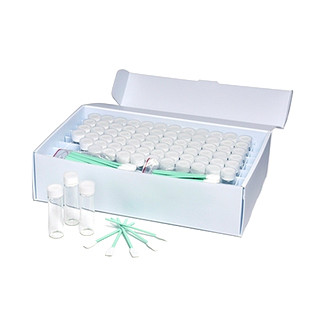
Transport-ready polypropylene box with low-TOC vials, TX714K SnapSwab™ sampling swabs, and cleanroom-compatible labels.
Practical solutions in a critical environment
TOC cleaning validation failures often trace back to the sampling moment, not the analyzer: a vial cap set down on a bench, a septum touched “just once,” a swab re-wetted mid-stroke,
or a sampled area that was never defined. Those small handling variables show up as elevated blanks, inconsistent recovery, and noisy trend lines that are difficult to defend during QA review.
Texwipe’s TX3342 Bulk TOC Cleaning Validation Kit is built as a controlled sampling chain for 72 locations: low-TOC certified vials, low-TOC certified TX714K Alpha® polyester knit SnapSwab™ sampling swabs,
and cleanroom-compatible labels staged inside a cleanroom-compatible transport box. The objective is simple: keep your TOC results focused on the surface being tested — not on background contribution
from uncontrolled components or inconsistent field technique.
What is this swab used for
TX3342 is a TOC surface sampling kit used to support cleaning validation and contamination investigations when Total Organic Carbon is the cleanliness indicator.
It is commonly selected for planned multi-point sampling (72 areas) where teams want consistent vials, consistent swabs, and consistent labeling/transport discipline across shifts.
- Surface sampling for TOC analysis as part of a cleaning validation protocol.
- Surface sampling as part of other cleaning validation protocols (method-dependent).
- Non-organic liquid sampling for contamination source investigations where trending organic burden matters.
Why should customers consider this swab
- 72-sample consistency: one kit supports a complete sampling campaign without mixing component lots mid-study.
- Low background contribution controls: vials are certified <10 µg/L TOC; TX714K swabs are certified <50 µg/L TOC.
- Snap-and-drop handling: TX714K break-away notch supports transfer into the vial with minimal handling of the swab head.
- Traceability-ready: lot coding plus labels and a transport container support chain-of-custody discipline for audit-sensitive programs.
- Lower handling-driven variability: standardized components and packaging help reduce the “operator effect” that inflates blanks and widens recovery variation.
Materials and construction
TX3342 is a system, not a single consumable. The kit’s performance depends on how the vial, cap/septum, swab head, handle, label, and transport container behave together during real sampling.
Nothing is truly lint-free; low-linting outcomes depend on technique and surface condition (sharp edges, burrs, solvent load, pressure, and stroke discipline).
- Vials/caps: 40 mL clear vials with bonded septa caps; one-piece cap-and-septum design; polyethylene overcap protects septum surface; sloped shoulder design is intended to minimize headspace.
- Swabs (TX714K): Alpha® polyester knit head; thermal bond construction (no adhesives noted for the Low TOC Alpha® series); break-away notch for transfer; 100% polypropylene handle for chemical resistance.
- Labels: cleanroom compatible labels intended for sample identification and traceability.
- Container/box: cleanroom-compatible polypropylene box; double bagged for controlled introduction and transport.
Specifications in context
For TOC work, “specs” are less about headline dimensions and more about what keeps blanks stable and recovery repeatable: certified low-TOC backgrounds, controlled transfer, and a transport/labeling workflow
that reduces mix-ups and open-container exposure.
| Attribute |
TX3342 (this SKU) |
| Sampling capacity |
72 samples / 72 sampling locations |
| Vials |
(72) 40 mL clear vials with bonded septa caps; certified <10 µg/L TOC (<10 ppb) |
| Swabs |
(144) TX714K Low TOC Alpha® Sampling SnapSwab™ swabs; certified <50 µg/L TOC (<50 ppb) |
| Labels |
(72) blank vial labels (cleanroom compatible) |
| Transport packaging |
Cleanroom-compatible polypropylene box; double bagged |
| Traceability |
Lot coded for traceability and quality control |
| Notable handling feature |
Notched, break-away swab handle supports placing the swab head into the vial with minimal handling |
| Vial design notes |
One-piece cap-and-septum design; polyethylene overcap; sloped shoulder geometry intended to minimize headspace |
Field note (why the kit format matters)
If your trending is unstable, do not change three things at once. A matched kit helps keep the sampling chain constant so you can evaluate cleaning changes with fewer hidden variables.
Cleanliness metrics
The tables below reflect typical contamination characteristics published for the TX714K swab component used in TX3342. These values are useful for background-risk thinking (ions/NVR),
while the TOC certifications for the swab and vial address organic background contribution directly. Values are typical analyses, not specification limits.
Typical ion extractables (TX714K swab component)
| Ion |
Typical level (µg/swab) |
| Calcium | 0.06 |
| Chloride | 0.05 |
| Fluoride | 0.05 |
| Magnesium | 0.03 |
| Nitrate | 0.12 |
| Phosphate | 0.09 |
| Potassium | 0.04 |
| Sodium | 0.16 |
| Sulfate | 0.12 |
Typical NVR (TX714K swab component)
| Extractant |
Typical NVR (mg/swab) |
| DIW extractant | 0.01 |
| IPA extractant | 0.03 |
Packaging, sterility and traceability
- Packaging (kit): 1 kit/case; components organized in a cleanroom-compatible polypropylene box; double bagged.
- Contents (per kit): (72) 40 mL vials with bonded septa caps + (144) TX714K SnapSwab™ sampling swabs + (72) blank vial labels.
- Sterility: Not stated for the kit in the published kit specs; treat as non-sterile unless your source basis explicitly states otherwise.
- Traceability: Lot coded for traceability and quality control; labels support chain-of-custody discipline.
- Handle identity cue (cleaning validation swabs): Manufacturer materials describe trademarked light-green handles with “TEXWIPE” embossed as practical receiving/line-side identity and traceability cues.
- Country of origin (manufacturer statement): Made in The Philippines.
Best-practice use
A strong TOC program is a behavior program. The kit lowers background risk, but it cannot compensate for uncontrolled wetness, inconsistent area definition, or cap/septum handling errors.
Build repeatability into what operators actually do at the surface.
Operator-level swabbing technique module
- Define the sample area: Use a template (e.g., 10 cm x 10 cm) or a validated equivalent so each sample represents the same footprint for trending and recovery comparisons.
- Control wetness (do not “guess”): Predefine the diluent and wetting method in your SOP (dip, pipette, or pre-wet vial). Wet enough for recovery — not dripping. Excess diluent spreads residues and can distort recovery.
- Use a repeatable stroke pattern: Parallel strokes (one direction) with full-face head contact, then perpendicular passes. Maintain consistent pressure. Avoid “scrubbing” that frays knits on sharp edges.
- One swab, one surface, one direction plan: Do not re-use a swab across unrelated areas. Avoid re-contacting a cleaned surface with the “dirty side” of the head.
- Hands and caps are major TOC vectors: Keep gloves clean, do not touch below the notch line, and treat septa/caps as contamination-critical surfaces.
- Snap-and-drop transfer: With the vial open only when ready, snap the swab head at the notch and allow it to fall into the vial with minimal handling. Cap immediately.
- Minimize open time: Air exposure and cap handling drive blanks upward. Stage everything before you open the vial; close promptly after transfer.
- Label at the moment of creation: Apply the label immediately after capping (not later). Record lot code, operator ID, location, surface type, and time per your documentation plan.
- Build controls into the day: Run field blanks and transport blanks at a frequency your QA team can defend; investigate spikes as workflow signals, not “lab noise.”
Common failure modes
- High blanks with no process explanation: cap/septum touched, vial left open, or swab head handled during transfer.
- Inconsistent recovery: sampled area not defined; stroke pressure/pattern varies by operator; re-wetting mid-stroke.
- Cross-contamination: same gloves used across multiple locations; swab set down; swab head contacts non-controlled surfaces.
- Sample identity risk: labels applied later; handwriting variability; vial mix-ups during transport.
- Edge damage / fiber transfer concerns: aggressive pressure on sharp edges; use controlled pressure and avoid “scrubbing” motions.
Closest competitors
In the TOC cleaning validation space, the closest alternatives are generally other matched sampling systems (low-background swabs + low-background vials + traceability packaging) offered by major contamination-control suppliers.
When comparing, focus on what impacts data defensibility: certified background levels, transfer method, packaging/transport discipline, and documentation support.
- Comparable TOC sampling kits from other cleanroom consumables manufacturers (matched vial + swab workflows).
- Low-background polyester knit sampling swabs paired with third-party low-TOC vials (higher risk of mixed-lot variability if sourced separately).
- General-purpose cleanroom swabs and vials assembled as an internal “kit” (often the least defensible approach if blanks/trending matter).
Critical environment fit for this swab
TX3342 fits regulated and audit-sensitive programs where operators need a repeatable sampling chain and QA needs documentation that stands up months later.
The kit’s value is not only certified components — it is the reduction of variability between people, shifts, and sampling campaigns.
SOSCleanroom’s relationship with ITW Texwipe supports continuity of supply, stable documentation, and lot-traceable replenishment so qualified methods do not drift when teams substitute “look-alike” components.
If TOC trending matters to your release or changeover decisions, component consistency is part of your control plan.
SOSCleanroom note about SOP's
The Technical Vault is written to help customers make informed contamination-control decisions and improve day-to-day handling technique.
It is not your facility’s Standard Operating Procedure (SOP), batch record, or validation protocol.
Customers are responsible for establishing, training, and enforcing SOPs that fit their specific risks, products, equipment, cleanroom classification, and regulatory obligations.
Always confirm material compatibility, cleanliness suitability, sterility requirements, and acceptance criteria using your internal quality system and documented methods.
If you adapt any technique guidance from this entry, treat it as a starting template. Your team should review and approve the final method, then qualify it for your specific surfaces,
solvents, cleanliness limits, inspection methods, and risk profile. In short: use these best-practice suggestions to strengthen your SOPs—not to replace them.
Source basis
- SOSCleanroom product page (this SKU): https://www.soscleanroom.com/product/swabs/texwipe-tx3342-bulk-toc-cleaning-validation-kit-for-72-samples/
- Manufacturer product page (TX3342): https://www.texwipe.com/tx3342
- Manufacturer technical data sheet (Cleaning Validation Swabs & TOC Kits) — includes TX3342 kit components, COO statement, and typical contamination characteristics:
https://www.texwipe.com/images/uploaded/documents/Swabs/Texwipe-CleaningValidation-Swabs-TDS.pdf
- SOS-hosted PDF copy (kit-focused): https://www.soscleanroom.com/content/texwipe_pdf/3340%203342.pdf
- SOS-hosted PDF copy (TX714K swab contamination characteristics): https://www.soscleanroom.com/content/texwipe_pdf/714k%20761k.pdf
- ISO (as applicable): https://www.iso.org/standard/53394.html
- FDA (as applicable): https://www.fda.gov/
- ASTM (as applicable): https://www.astm.org/
- IEST (as applicable): https://www.iest.org/
SOSCleanroom is the source for this Technical Vault entry.
Briefed and approved by the SOSCleanroom (SOS) staff.
If you have any questions please email us at Sales@SOSsupply.com
Last reviewed: Jan. 6, 2026
© 2026 SOSCleanroom