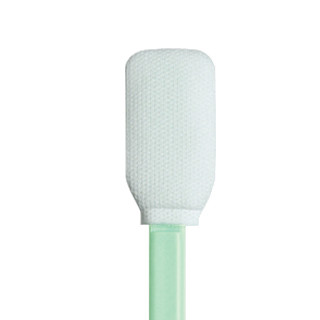
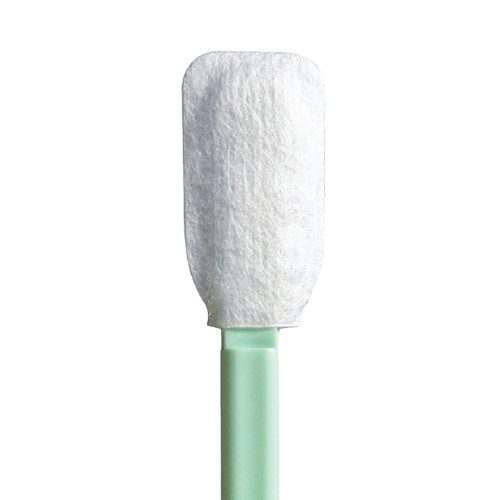
Texwipe TX714K Large Alpha Sampling Snap Swab Low TOC

$33.63
(No reviews yet)
SKU:
TX714K BAG
Availability:
Stock Item
Shipping:
Calculated at Checkout
Quantity Option (Bag):
20 Swabs Per Bag
Quantity Option (Case):
50 Bags of 20 Swabs Per Case
Type:
Dry Swab
Swab Family:
Alpha
Swab Material:
Polyester

Texwipe TX714K Large Alpha® Sampling Snap Swab (Low TOC) for Cleaning Validation and Surface Sampling

Texwipe TX714K is a low-linting (no swab is truly ‘lint free’ in every process condition), certified Low TOC Alpha® sampling snap swab engineered for surface validation and cleaning validation workflows where the swab’s background cannot be the reason results drift. It uses a double layered, double knit knitted Alpha polyester head designed to entrap residues during sampling and release them into diluent for strong recovery, paired with a 100% polypropylene handle for excellent chemical resistance. TX714K is manufactured to consistent tolerances without adhesives (thermal head bond), lot coded for traceability, and built around a notched break-away handle so the swab head can be snapped and dropped into a vial with minimal handling—supporting repeatable TOC sampling technique across operators, shifts, and sites.

Cleaning-validation note: TX714K is commonly selected when teams need a defensible low-TOC swab sample for TOC analysis (and method-sensitive residue checks) with repeatable area definition, controlled vial transfer (snap-and-drop), and lot-level traceability for trending, investigations, and audit readiness.

Specifications:
  • Swab type: Dry sampling swab (snap swab)
  • Swab family: Alpha® (Low TOC Alpha® Swab)
  • Head material: Knitted Alpha polyester (double layered, double knit)
  • Handle material: Polypropylene (100% polypropylene handle)
  • Head width: 12.7 mm (0.5")
  • Head thickness: 4.2 mm (0.165")
  • Head length: 25.7 mm (1.012")
  • Handle length: 101.8 mm (4.008")
  • Total swab length: 127.5 mm (5.02")
  • Head bond: Thermal (no adhesive pathway)
  • Handle color: Light green
  • Design notes: Flat head paddle; long, easy-grip handle; notched break-away for vial transfer
  • Cleanliness focus: Certified Low TOC (<50 µg/L, <50 ppb) to help control background contribution in TOC analysis
  • Autoclave compatibility: Autoclave safe for use in sterile environments and processes (validate to your method and SOP)
  • Packaging: 20 swabs/bag; 50 bags of 20 swabs/case
  • Use environments: Frequently used for GMP cleaning validation, surface sampling, and controlled-environment residue verification (final suitability depends on your sampling method, diluent, extraction, and analytical requirements)
About the Manufacturer: 

Texwipe (an ITW company) approaches cleanroom swabs as engineered sampling tools—built around material selection, controlled manufacturing tolerances, and contamination-control discipline intended to support repeatable results in critical environments. For cleaning validation and surface sampling, that discipline includes knit head construction designed for predictable contact, thermal bonding to eliminate adhesive contamination pathways, and proprietary cleaning processes to minimize background that can distort method-sensitive results.


Low-TOC programs also benefit from traceability expectations: lot coding, consistent build quality, and handling-reduction design features such as snap-and-drop vial transfer. SOSCleanroom (SOS) supports that program control with a close working relationship with Texwipe focused on continuity of supply, clean documentation handoff (certs and lot traceability expectations where applicable), and practical application support—so customers can standardize swab sampling consumables with predictable performance while maintaining procurement reliability and audit readiness.

TX714K Features:
  • Certified Low TOC level (<50 µg/L, <50 ppb) to help control background contribution in TOC analysis
  • Double layered, double knit polyester head designed to entrap contaminants during sampling and release them into diluent for strong recovery
  • Notched, break-away handle supports snap-and-drop transfer of the swab head into a vial with minimal handling
  • 100% polypropylene handle helps avoid introducing additional contaminants and provides excellent chemical resistance
  • Thermal head bond (no adhesives) to reduce method-sensitive contamination pathways
  • Autoclave safe for use in sterile environments and processes (validate to your workflow)
  • Lot coded for traceability, quality control, and investigation support
  • Operational traceability cue: Texwipe describes trademarked green/light-green handle identifiers (including registration Re. No. 5,343,973) and “Texwipe” embossing on applicable lines as practical line-side identification cues; use them as quick positive identifiers alongside approved sourcing and lot controls
TX714K Benefits:
  • Defensible low-background sampling: Certified low TOC helps keep blanks quiet when residues are near LOQ/LOD or when trending performance over time
  • Repeatable recovery: Knit head construction supports stable face contact during sampling and release into diluent when paired with a validated recovery/extraction method
  • Reduced handling contamination: Snap-and-drop vial transfer helps limit head handling and operator-to-operator variability
  • Method-sensitive cleanliness: Thermal bonding eliminates a common adhesive-related extractables pathway in trace-level workflows
  • Chemical resistance: Polypropylene handle supports compatibility with a variety of validated diluents and solvents (verify to your chemistry and SOP)
  • Audit readiness: Lot coding supports trending, investigations, and change control in regulated cleaning validation programs
Common Applications:
  • Surface sampling for cleaning validation protocols (including TOC sampling and method-sensitive residue verification)
  • Defined-area swab sampling on stainless steel, process-contact surfaces, and equipment exteriors (as specified by the validation protocol)
  • Sampling of hard-to-reach areas or small spaces where controlled contact and repeatable technique matter
  • Precision cleaning and residue pickup where a low-background, engineered polyester knit swab is required
  • Snap-and-drop vial transfer workflows to reduce handling contamination and support chain-of-custody discipline
Best-Practice Use:
  • Define the area: Use a validated template or fixture (commonly 10 cm x 10 cm) so results map to area-based limits and are defensible during review.
  • Control wetting: Dampen with your validated diluent (often low-TOC water or method-specific diluent). Remove excess liquid so the swab is damp, not dripping.
  • Stroke discipline: Swab with horizontal, unidirectional, overlapping strokes; flip the swab and repeat in a perpendicular direction to improve coverage and recovery consistency.
  • Keep the head flat: Maintain full head contact against the surface to reduce edge roll and pressure spikes that can change recovery.
  • Perimeter pass: Use the swab tip to trace edges and corners if the protocol requires it (common residue hold-up locations).
  • Snap-and-drop transfer: Snap the head at the notch and let it fall into the sample vial; avoid touching the head to reduce handling contamination.
  • Chain-of-custody controls: Pre-label vials, control blanks (lab/procedural/field as defined), and follow validated hold-time and extraction steps so recovery remains stable and defensible.
Selection Notes (TX714K vs. Other Options)
  • TX714K (large paddle, snap swab): Choose when you need a larger, flat contact patch for defined-area sampling plus break-away transfer into a vial, especially for TOC-driven cleaning validation where background control matters.
  • Long-reach alternative (TX761K): Consider when access depth or reach drives the risk (deeper equipment geometries), while maintaining low-TOC program intent and lot traceability expectations.
  • Method fit: Match the swab to the analytical method and diluent (TOC vs. HPLC/UV-Vis vs. other methods) and validate recovery in your actual procedure window (diluent, extraction, vial type, hold time, instrument method).

Link to Texwipe Technical Datasheet:
Click Here
Texwipe.com PDF: Click Here

Other Similar Products Available From SOSCleanroom.com

Low-TOC Cleaning Validation Swabs

  • TX761K: Low TOC Alpha® swab with long handle (low-background sampling intent with extended reach)
  • TX715: Alpha® sampling swab commonly used for method-sensitive sampling workflows (validate to your analytical method)

Standard Polyester Knit Alpha Swab (Non-Low-TOC)

  • TX714A: Large Alpha® polyester knit cleanroom swab (thermal bond; broad-use precision cleaning and spot wiping)

Notes: Looking for application guidance and qualification context for Texwipe TX714K low-TOC snap swab sampling (defined-area technique, wetting control, snap-and-drop vial transfer discipline, and method-fit selection)? Open the SOSCleanroom Technical Vault tab above for practical sampling technique, selection notes (TX714K vs. alternatives), and the documentation details teams typically review when standardizing cleaning validation swabs across regulated and controlled environments.

SOSCleanroom.com supports contamination-control programs with cleanroom consumables in stock, fair pricing, and responsive technical support—backed by same-day shipping options and customer service that understands real cleanroom workflows.

Product page updated: Jan. 5, 2026 (SOS Technical Staff)

© 2026 SOS Supply. All rights reserved.

The Technical Vault
By SOSCleanroom
Cleaning validation-ready: low-TOC background control, snap-and-drop vial transfer, lot-traceable handling.
Last reviewed: January 6, 2026
Texwipe TX714K low-TOC Alpha® sampling snap swab: defined-area TOC sampling that won’t let the swab become your background
TX714K at a glance
  • Primary job: surface sampling for TOC-based cleaning validation and investigations (snap head into vial with minimal handling).
  • Construction: double layered, double knit Alpha® polyester head; thermal bond (no adhesive at the head/handle interface); 100% polypropylene handle.
  • Cleanliness anchor: certified low TOC (<50 µg/L, <50 ppb) for swab background consistency.
  • Sterility status: non-sterile; autoclavable for sterile-process workflows (validate to your method and site controls).
  • Packaging: 20 swabs/bag; 50 bags/case (1,000 swabs/case).
Practical solutions in a critical environment

In cleaning validation and surface verification work, the real failure mode is often not “we missed a spot.” It’s that the sample result is dominated by background contribution, inconsistent technique, or extra handling. When the lab is chasing drift or investigating outliers, a swab that adds variable organic background, sheds inconsistently, or forces repeated touch points becomes a root-cause candidate—whether or not the process is actually dirty.

TX714K is designed to reduce that risk by controlling the swab’s own contribution and standardizing handling. The low-TOC processing target helps keep the swab background consistent for TOC methods. The notched, break-away handle lets operators snap the head into a vial with minimal handling—useful when you want a defensible chain of technique across shifts, operators, and sites.

Low-linting outcomes depend on technique and surface condition. No swab is truly lint-free; edge sharpness, surface roughness, solvent load, contact pressure, and stroke discipline govern what you see on the part and what you recover in the vial.

What is this swab used for

Texwipe TX714K is used for defined-area surface sampling and cleaning validation protocols where Total Organic Carbon (TOC) analysis is the endpoint, and where the swab’s background must be controlled to protect detection limits and trending. The head/handle format supports consistent wipe paths on stainless steel, equipment exteriors, process-contact surfaces, panels, and other sites where recovery can be sensitive to face roll, pressure spikes, and wetness drift.

The manufacturer positions cleaning validation swabs for use in determining the effectiveness of cleaning protocols as specified by the U.S. FDA, with TOC cited as one of the analytical methods used in these validations. TX714K is also NSF Certified as a cleaning swab (P1) for use in and around food processing areas, with the standard restriction that it must not have direct contact with food or potable water and must be used per the manufacturer’s directions.

Why should customers consider this swab
  • Certified low-TOC background target (<50 µg/L, <50 ppb) supports consistency in TOC sampling results and trending.
  • Notched, break-away “snap” handle supports vial transfer with minimal handling and reduced contamination opportunities.
  • Thermal bond construction (no adhesive pathway at the bond line) reduces a common, avoidable residue variable.
  • Double layered, double knit Alpha® polyester head is designed to entrap contaminants during sampling and release into diluent for recovery.
  • Lot-coded packaging supports investigations, deviations, and audit-ready documentation discipline.
  • Autoclavable for sterile environments and processes (validate to your site method; do not treat as a sterile item unless processed and controlled as such).
  • Trademarked light-green handle with “TEXWIPE” embossed on the handle supports practical line segregation and traceability cues in multi-swab environments.
Materials and construction

Head: Alpha® polyester knit (double layered, double knit)

Head bond: thermal bond (no adhesive at the head/handle interface)

Handle: 100% polypropylene; notched break-away for snap-and-drop vial transfer; handle color: light green

Practical implication: TX714K is meant for controlled sampling—not “scrub-cleaning.” Treat burrs and sharp edges as a process risk; reduce pressure near edges, keep the knit flat, and avoid dragging the head across sharp corners that can create local fiber/particle release and compromise recovery repeatability.

Specifications in context

For TOC sampling, geometry is not just “fit”—it is technique control. Use the head width to standardize overlap and stroke count so operators do not drift into scrubbing. Use the notched snap feature to standardize vial transfer and reduce touch points. Handle geometry matters for consistent pressure and face orientation, which directly affects recovery and repeatability when the sample site is polished, coated, or film-sensitive.

Attribute TX714K
Head material Knitted Alpha® polyester (double layered, double knit)
Head width 12.7 mm (0.500")
Head thickness 4.2 mm (0.165")
Head length 25.7 mm (1.012")
Handle material Polypropylene (100%)
Handle width 5.2 mm (0.205")
Handle thickness 3.0 mm (0.118")
Handle length 101.8 mm (4.008")
Total swab length 127.5 mm (5.020")
Head bond Thermal
Handle color Light green
Design notes Flat head paddle; long, easy-grip handle; notched break-away for vial transfer
Cleanliness metrics

The values below represent typical analyses and are not per-unit specifications. Use them to set background expectations, support method development, and speed troubleshooting. If you run film-sensitive work or validate cleaning analytically (TOC, HPLC/UV-Vis, ion chromatography), qualify the swab with your solvent/diluent, your surfaces, your defined area, your stroke count, and your vial handling method so the swab does not become the dominant background signal.

Typical ion extractables (µg/swab)
Ion TX714K
Calcium0.06
Chloride0.05
Fluoride0.05
Magnesium0.03
Nitrate0.12
Phosphate0.09
Potassium0.04
Sodium0.16
Sulfate0.12
Typical nonvolatile residue (NVR) (mg/swab)
Extractant TX714K
DIW extractant0.01
IPA extractant0.03

Operator takeaway: the method is the product. Keep the sampling area definition, wetness, and vial transfer consistent. If you see sample-to-sample variability, confirm the swipe pattern, the number of strokes, the swab face rotation point, and whether the snap-and-drop transfer is being done without touching the head.

Packaging, sterility and traceability
  • Packaging (TX714K): 20 swabs/bag; 50 bags/case; 1,000 swabs/case
  • Sterility: non-sterile; swab series is described as autoclavable for sterile environments and processes (validate against your site’s sterilization cycle, packaging integrity rules, and analytical method controls)
  • Traceability cues: lot-coded packaging supports investigations; trademarked light-green handle with “TEXWIPE” embossed supports practical line segregation
  • Country of origin: commonly listed as Philippines (PH) in distributor catalogs for this SKU; confirm the exact origin for your lot on the carton label and/or your receiving documentation (COC/traceability paperwork where applicable)
  • Shelf life: 5 years from date of manufacture (series statement)
Best-practice use

Treat TX714K as a controlled sampling tool, not a “cleaning swab.” Define the sampling area, define the wetting approach (if your method uses wet sampling), define stroke count and overlap, and define discard triggers. Your goal is repeatable recovery—not maximum scrubbing force.

Operator-level swabbing technique module
  • Area definition: Use a template (or measured boundary) to keep sample area consistent. Document the sampled cm² and the direction of strokes.
  • Wetness control (when applicable): If your protocol calls for wet sampling, keep the head damp—not dripping. Excess wetness increases pooling and can dilute or mobilize residue unevenly.
  • Stroke discipline: Single-direction strokes with defined overlap. Rotate to a fresh face on a defined schedule (for example, after a fixed number of strokes) rather than “when it looks dirty.”
  • Pressure guidance: Apply enough pressure to maintain full-face contact, then reduce slightly. Excess pressure can squeegee residue into lines and reduce recovery consistency.
  • Snap-and-drop transfer: Use the notched break-away feature to place the head into the vial with minimal touch points. Avoid contact with gloves, sleeves, bench mats, or vial rim threads.
  • Documentation cues: Record lot code, sampler identity, area sampled, stroke count, diluent and vial type, and any visible anomalies (film lines, roughness, burrs, or staining) that could explain recovery differences.
Cleaning validation qualification checklist (practical)
  • Confirm your method’s diluent compatibility with polyester knit and polypropylene (and any product-contact materials at the sampling site).
  • Run blank controls (vial + diluent + swab) per lot to quantify background contribution before sampling production equipment.
  • Define recovery expectations on representative coupons (same finish as equipment) before formal validation runs.
  • Standardize snap-and-drop handling and timing (time from sample to vial closure, time to analysis) to reduce variability.
  • Trend lot codes and investigate shifts early; uncontrolled substitutions are a common cause of “sudden” method drift.
Customer SOP disclaimer

This Technical Vault entry is provided as general, experience-based guidance and a suggested framework to help customers think through technique, handling controls, and validation considerations. It is not a substitute for your internal SOPs, quality system requirements, or regulatory obligations. Customers are responsible for qualifying products in their specific process conditions (surfaces, chemistries, methods, and acceptance criteria) and for drafting, approving, and training to their own SOPs. Always follow your site safety rules and the manufacturer’s instructions.

Common failure modes
  • Sampling without a defined area, causing inconsistent recovery and results that cannot be compared across lots or campaigns.
  • Over-wetting (when wet sampling is used), leading to pooling and inconsistent residue pickup/dilution.
  • Touch contamination during transfer (glove, bench, vial rim contact), especially when snap-and-drop discipline is not followed.
  • Scrubbing pressure that smears residue or damages soft finishes, reducing repeatability and changing recovery dynamics.
  • Poor control of blanks and lot trending, causing teams to chase “process contamination” that is actually background drift.
Closest competitors

The closest alternatives are cleaning validation-oriented polyester swabs where selection hinges on background control strategy (TOC and extractables), head construction, bond method, and traceability support. For validation work, insist on lot traceability and published contamination characteristics so your method is defensible when auditors ask what changed.

  • Contec cleaning validation swab formats (polyester classes): Compare background-control approach (TOC claims, extractables support), bond method, and documentation depth for investigations.
  • Berkshire validation-oriented polyester swab formats: Evaluate published cleanliness metrics, traceability discipline, and how the head releases into your diluent under your method timing.
  • Puritan polyester cleanroom swab formats (validation candidates): Confirm thermal-bond versus adhesive interfaces, method-specific contamination data, and lot coding/COC availability that supports qualification.
Critical environment fit for this swab

TX714K is a strong fit for controlled environments where the sampling result needs to be defensible and repeatable—especially in pharmaceutical and biotech programs where cleaning validation and residue investigations demand technique discipline, background control, and lot-level traceability.

SOSCleanroom’s relationship with ITW Texwipe supports continuity of supply and documentation discipline. That reduces the risk of unplanned substitutions that can change background contribution, wetting behavior, and recovery—an avoidable source of “mystery drift” in validation programs and ISO-aligned controlled environments.

When validation work is scheduled tightly, operational support matters. Fast shipping and responsive customer service help keep validated work instructions intact by preventing last-minute material swaps.

Source basis
  • SOSCleanroom product page (TX714K): https://www.soscleanroom.com/product/swabs/texwipe-tx714k-large-alpha-sampling-snap-swab-low-toc/
  • Texwipe manufacturer product page (TX714K): https://www.texwipe.com/low-toc-alpha-tx714k
  • SOS-hosted Texwipe technical data sheet (TX714K/TX761K): “Cleaning Validation Low TOC Alpha® Swabs” (TX714K, TX761K) PDF: https://www.soscleanroom.com/content/texwipe_pdf/714k%20761k.pdf
  • Texwipe technical data sheet (manufacturer): “Cleaning Validation Swabs & TOC Kits” PDF: https://www.texwipe.com/images/uploaded/documents/Swabs/Texwipe-CleaningValidation-Swabs-TDS.pdf
  • International Organization for Standardization (ISO) reference (ISO 14644-1:2015): https://www.iso.org/standard/53394.html
  • FDA (Food and Drug Administration): https://www.fda.gov/
  • ASTM (American Society for Testing and Materials): https://www.astm.org/
  • IEST (Institute of Environmental Sciences and Technology): https://www.iest.org/
  • Country-of-origin cross-check (catalog listing example): https://www.hisco.com/Product/TX714K-51286
SOSCleanroom is the source for this Technical Vault entry.
Briefed and approved by the SOSCleanroom (SOS) staff.
Last reviewed: January 6, 2026
Questions? If you have any questions please email us at Sales@SOSsupply.com
© 2026 SOSCleanroom

Videos Hide Videos Show Videos