The Technical Vault
Cleaning validation focus
HPLC/UV-Vis-ready swab background
Break-away notch transfer
By SOSCleanroom
Texwipe TX715 Alpha® Sampling Swab: Cleaner UV background for confident HPLC/UV-Vis recovery
Field note: If you are fighting unexplained peaks or baseline noise around ~230 nm, your swab background may be part of the story.

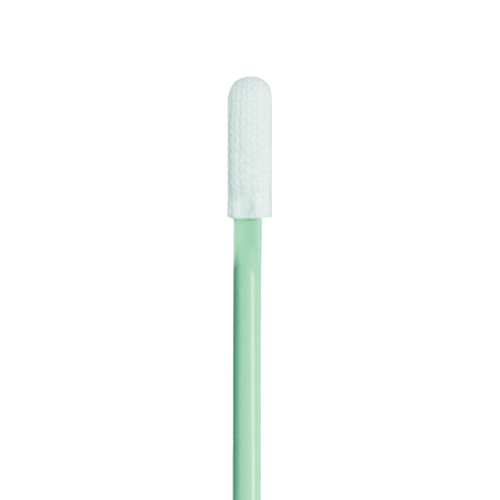
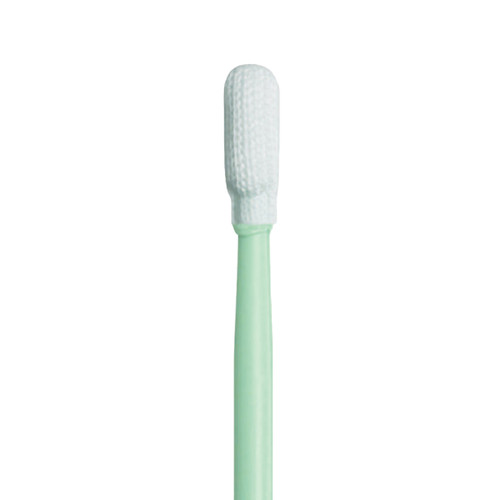
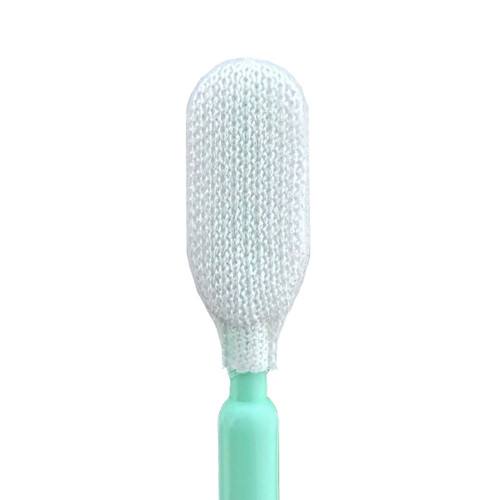
TX715 swab head close-up (representative image).
Practical solutions in a critical environment
Cleaning validation is rarely lost on the big things. It is lost on the little things—background contribution, handling variability, and
inconsistent transfer into the vial. The Texwipe TX715 Alpha® Sampling Swab is built for the jobs where your analytical method is
doing the heavy lifting and your consumable cannot get in the way.
Texwipe describes TX715 as a polyester knit sampling swab that is further processed to reduce UV-Vis background interference in the
220–240 nm region, improving sensitivity around ~230 nm for HPLC/UV-Vis cleaning validation workflows. It is also designed to
collect residues effectively and release them into diluent for recovery-based decisions—not “looks clean” decisions.
What is this swab used for
- Surface sampling for cleaning validation when using HPLC with UV-Vis detection (common in pharma, biotech, and regulated manufacturing).
- Precision cleaning and residue pickup in hard-to-reach or tight geometries where wipes cannot present a controlled contact patch.
- Sampling on irregular, porous, heated, or residue-prone surfaces where recovery can swing based on technique and swab construction.
- Transfer into a vial with minimized handling via a notched break-away handle design (reduce operator-driven contamination).
Why should customers consider this swab
- Cleaner UV background where it matters: TX715 is processed to reduce interference in the ~230 nm range, supporting a lower practical limit of detection in UV-Vis workflows.
- No adhesives in the head bond: Thermal bonding helps reduce the risk of extractable contributions associated with adhesive-based construction.
- Recovery-oriented knit structure: Double-layer, double-knit polyester is designed to entrap residues during sampling and then release them into your diluent for measurable recovery.
- Operator control and transfer discipline: The rigid handle and break-away notch support consistent sampling pressure and controlled vial transfer with less handling.
- Low-linting expectations, stated realistically: Customers typically choose polyester knit for controlled environments; still, nothing is truly lint-free—verify particle and residue limits in your qualification work.
Materials and construction
TX715 uses a knitted Alpha® polyester head paired with a polypropylene handle. The head-to-handle bond is thermal (not adhesive),
and the handle is light green. The swab is designed as a flat “paddle” head on a long, easy-grip handle—useful when you need
a controlled contact patch across a defined sampling area.
For cleaning validation teams, two construction details tend to matter in real life:
- Break-away notch: lets the head drop into the vial with minimal touch points when executed correctly.
- Traceability cues: Texwipe’s Cleaning Validation TDS calls out a trademarked light-green handle with “TEXWIPE” embossed on the handle as an identifier for this swab family.
Specifications in context
These are the physical and packaging characteristics most likely to affect real sampling outcomes: contact patch size, handle rigidity,
and how the packaging supports low-touch handling at the bench.
| Attribute |
TX715 |
| Head material |
Knitted Alpha® polyester |
| Head width |
12.7 mm (0.500") |
| Head thickness |
4.2 mm (0.165") |
| Head length |
25.7 mm (1.012") |
| Handle material |
Polypropylene |
| Handle length |
101.8 mm (4.008") |
| Total swab length |
127.5 mm (5.020") |
| Head bond |
Thermal |
| Handle color |
Light green |
| Packaging format |
Bag-Within-A-Bag®; 100 swabs/bag; 2 inner bags of 50; 10 bags/case (1,000 swabs/case) |
| Sterility |
Non-sterile (standard); sterile swabs available upon request |
Cleanliness metrics
The numbers below are typical extractables for the swab itself. In practice, teams use them as a “background contribution sanity check”
when they are troubleshooting unexpected signal, tightening method sensitivity, or establishing internal acceptance criteria. Values are reported
as typical (not specification limits).
Typical ion extractables (µg/swab)
| Ion |
Typical level |
| Calcium | 0.06 |
| Chloride | 0.13 |
| Fluoride | 0.10 |
| Magnesium | 0.03 |
| Nitrate | 0.11 |
| Phosphate | 0.12 |
| Potassium | 0.05 |
| Sodium | 0.16 |
| Sulfate | 0.10 |
Typical NVR (nonvolatile residue) (mg/swab)
| Extractant |
Typical level |
| DI water (DIW) | 0.01 |
| IPA | 0.03 |
Packaging, sterility and traceability
- Packaging: Bag-Within-A-Bag®; 100 swabs/bag; 2 inner bags of 50 swabs; 10 bags/case (1,000 swabs/case).
- Sterility: Non-sterile standard offering. Sterile swabs available upon request (confirm availability and lead time for your program).
- Traceability: Lot coded for traceability and quality control; break-away notch supports low-touch vial transfer.
- Authenticity/identifier cues: Texwipe’s cleaning validation literature calls out a trademarked light-green handle with “TEXWIPE” embossed on the handle.
- Shelf life: 5 years from date of manufacture (manufacturer statement for cleaning validation swabs).
- Country of origin (manufacturer statement): Made in The Philippines.
Bench-level handling note
Keep the inner bag staged clean (do not “fish” for swabs). If you are using TX715 in a regulated sampling workflow, treat the lot code and
case integrity the same way you treat your vials and caps: receive, verify, stage, and document. Small discipline prevents big investigations.
Best-practice use
Swabbing success is less about the swab and more about repeatability. The goal is controlled contact area, controlled wetting, and controlled
transfer—every time, regardless of operator.
Operator-level swabbing technique module
- Define the area: Mark or template the sampling region so every operator swabs the same surface area.
- Dampen—do not soak: Wet the head with the approved diluent; avoid dripping swabs that can dilute residues or spread contamination.
- Overlapping pattern: Swab with an overlapping pass pattern, keeping the entire head flat against the surface (maximize contact patch consistency).
- Flip and cross-hatch: Flip the swab and repeat in a perpendicular direction; then repeat with a second swab at ~45° angles (improves recovery across surface texture and directionality).
- Perimeter pass: Swab the perimeter last—edges and weld seams often carry disproportionate residues.
- Low-touch vial transfer: Snap the head at the notch and allow it to drop into the vial with minimal handling; cap immediately.
- Document what matters: Surface type, temperature (if heated), diluent, number of passes, and any visible residues. These explain “why the number moved” later.
Method reality check
If you change diluent, swab wetness, swab pressure, or surface area, you changed the method. Treat technique changes like method changes:
assess impact, document rationale, and re-qualify if required by your quality system.
Common failure modes
- Over-wetting: Excess diluent can wash residue out of the defined area, reduce recovery, and add variability between operators.
- Undersampling: Light, fast passes do not load the knit structure; slow down and keep full-head contact.
- Inconsistent surface area: “About this big” is not defensible. Template or mark the region.
- Handle contact contamination: Touching the head or snapping incorrectly adds skin oils, glove powder, or bench residue to the sample.
- Poor vial transfer: If the head does not drop cleanly into the vial, operators tend to grab it—exactly what the notch is meant to prevent.
- Mismatch to analytical goal: TX715 is positioned for HPLC/UV-Vis; if your program is TOC-driven, evaluate low-TOC swab options and align the consumable to the method.
Closest competitors
Customers typically compare TX715 to other knit polyester swabs intended for controlled environments and precision work. When comparing,
focus on three items that drive investigations: construction method (thermal vs adhesive), background contribution (what the vendor publishes),
and how the geometry matches your surfaces and vials.
-
Contec CONSTIX® sealed polyester swabs (example: SP-6):
Knit polyester head thermally bonded to a polypropylene handle; positioned for critical environments and solvent resistance. Confirm published extractables and your method’s UV background needs before substituting.
-
Puritan flat paddle knitted polyester swabs (example: PurSwab® 3600):
Paddle-tip knit polyester swab options exist for controlled environments; evaluate background contribution for UV-Vis and confirm packaging/traceability fit for regulated sampling.
-
Nonwoven polyester validation swabs (various):
Often selected for recovery behavior; however, your results depend on published contamination characteristics and method compatibility. Validate before changing programs.
Critical environment fit for this swab
TX715 fits best where you have defined analytical sensitivity needs (UV-Vis around ~230 nm), defined sampling areas, and a quality system that
expects repeatability. The swab’s construction and published typical contamination characteristics help teams build a defensible rationale for
consumable selection during audits and investigations.
SOSCleanroom’s relationship with ITW Texwipe matters here in practical ways: continuity of supply, stable documentation, and predictable product
identification/traceability cues. In cleaning validation programs, that stability reduces the “we changed a small thing” risk that can trigger
a re-qualification conversation.
Program-fit checklist
- Your method uses HPLC/UV-Vis and you care about baseline behavior in the 220–240 nm neighborhood.
- You want a flat head to control contact area on plates, tanks, benches, and equipment panels.
- You need low-touch transfer into a vial (break-away notch) with repeatable operator handling.
- You require supplier documentation discipline and traceability cues that hold up under review.
SOSCleanroom note about SOP's
The Technical Vault is written to help customers make informed contamination-control decisions and improve day-to-day handling technique.
It is not your facility’s Standard Operating Procedure (SOP), batch record, or validation protocol.
Customers are responsible for establishing, training, and enforcing SOPs that fit their specific risks, products, equipment, cleanroom classification, and regulatory obligations.
Always confirm material compatibility, cleanliness suitability, sterility requirements, and acceptance criteria using your internal quality system and documented methods.
If you adapt any technique guidance from this entry, treat it as a starting template. Your team should review and approve the final method, then qualify it for your specific surfaces,
solvents, cleanliness limits, inspection methods, and risk profile. In short: use these best-practice suggestions to strengthen your SOPs—not to replace them.
Source basis
- SOSCleanroom product page (SKU): https://www.soscleanroom.com/product/swabs/texwipe-tx715-alpha-sampling-polyester-cleanroom-swab/
- Manufacturer product page: https://www.texwipe.com/alpha-tx715
- Manufacturer PDF (SOS-hosted, SKU-specific): “TX715 Alpha Sampling Swab” (Technical Data Sheet): https://www.soscleanroom.com/content/texwipe_pdf/715.pdf
- Manufacturer PDF (Texwipe.com, series TDS): “Cleaning Validation Swabs & TOC Kits” (Technical Data Sheet, US-TDS-059 Rev. 9/21): https://www.texwipe.com/images/uploaded/documents/Swabs/Texwipe-CleaningValidation-Swabs-TDS.pdf
- Procedure aid (SOS-hosted): “Swab Sampling Proper Procedure by Texwipe (A3)” https://www.soscleanroom.com/content/How%20To%20Guides/Swab%20Sampling%20Proper%20Procedure%20by%20Texwipe%20A3.pdf
- ISO: https://www.iso.org/standard/53394.html
- FDA: https://www.fda.gov/
- ASTM: https://www.astm.org/
- IEST: https://www.iest.org/
SOSCleanroom is the source for this Technical Vault entry.
Briefed and approved by the SOSCleanroom (SOS) staff.
If you have any questions please email us at Sales@SOSsupply.com
Last reviewed: Jan. 6, 2026
© 2026 SOSCleanroom