The Technical Vault
By SOSCleanroom
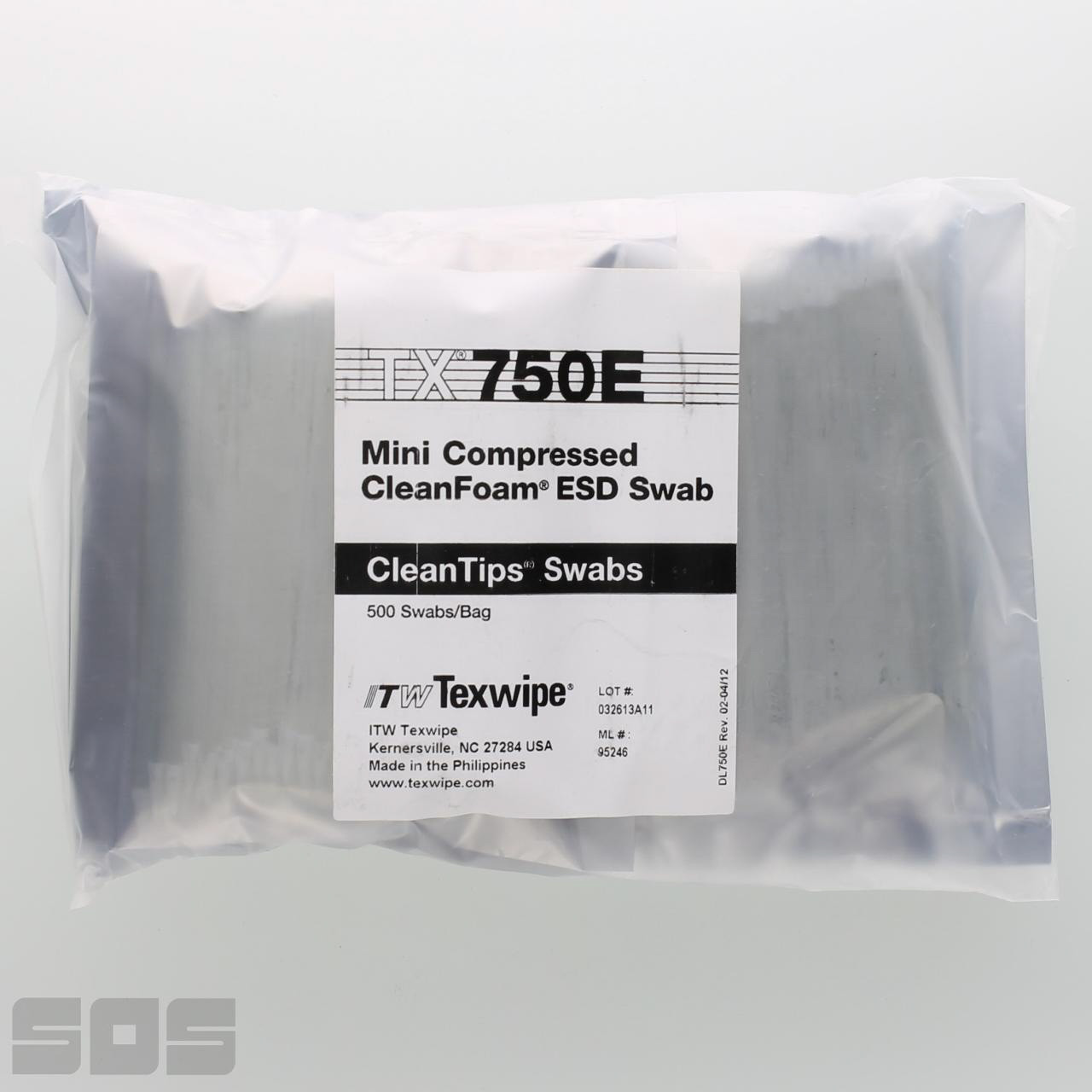
Texwipe TX750E Mini Compressed CleanFoam® ESD Swab: precision cleaning control for static-sensitive assemblies
Practical solutions in a critical environment
In static-sensitive work, cleaning failures are often technique failures in disguise: over-wetting that floods a cavity, back-and-forth scrubbing that redeposits a film line, or a charged handle that pulls particles back onto the surface you just cleaned. When the geometry is small, the temptation is to “work it longer,” which usually increases variability across shifts.
TX750E is designed to help stabilize that workflow. It uses a compact, compressed foam tip for controlled contact in tight features and an ESD-safe handle approach intended for use within an established ESD control program, so cleaning does not fight your electrostatic discipline.
No swab is truly lint-free. Low-linting outcomes depend on technique and surface condition, including edge sharpness, burrs, solvent load, contact pressure, and stroke discipline.
ESD handling note
Treat the swab as part of the circuit. Follow your facility controls for grounding, work surfaces, garments, and humidity targets. If your process requires measured resistance or specific ESD standards compliance, qualify the consumable the same way you qualify benches, gloves, and tools.
What is this swab used for
TX750E is used for localized cleaning and controlled application or removal of fluids in small, recessed, or precision features where wipes cannot maintain reliable contact. Common use cases include:
- Cleaning connector shells, cavities, and fine mechanical features where flooding and residue migration are risks
- Targeted removal of films and residues using compatible solvents (IPA is common, but validate compatibility with the surface/coating)
- Applying or removing small amounts of lubricants, adhesives, or process solutions in controlled environments
- Precision cleanup in electronics assembly, repair, and static-sensitive build areas
- Picking up fine powders where the process allows swab contact and controlled disposal
In ISO-classified cleanrooms (ISO 14644 context) and regulated manufacturing environments (FDA context), the practical requirement is repeatable technique and stable documentation, not improvisation under schedule pressure.
Why should customers consider this swab
- ESD-safe handling intent: designed for static-sensitive workflows when used within a validated ESD program (grounding, benches, garments, humidity).
- Compressed foam control: the mini compressed foam tip provides a defined contact patch for tight geometry, reducing the urge to “scrub wider” than the feature.
- Thermal bond construction: no adhesive at the bond, which reduces one common contamination variable at the head-to-handle interface during solvent use.
- Published cleanliness signals: typical ions and typical non-volatile residue data support method development and troubleshooting (typical values are not specifications).
- Traceability posture: lot coding supports investigations and line-side documentation discipline when cleaning becomes a yield gate.
Materials and construction
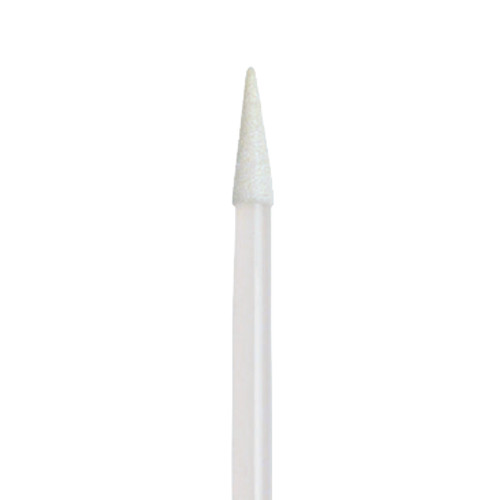
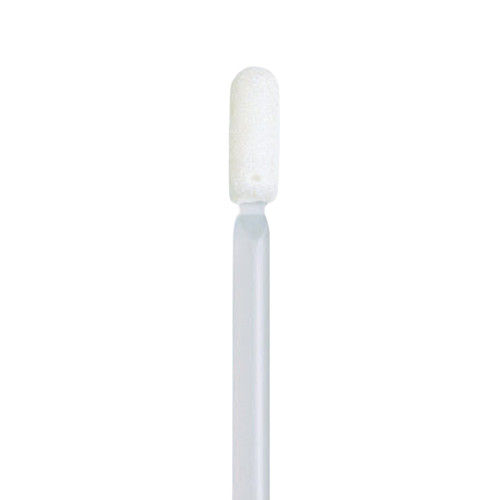
Foam head: CleanFoam® cleanroom-processed polyurethane foam (100 ppi), mini compressed conical tip geometry for controlled access.
Handle: ESD-safe handle design positioned for use in static-sensitive operations. Keep the swab within your grounding and workstation controls from staging through disposal.
Head bond: thermal bond construction (no adhesive at the bond). This helps reduce adhesive-driven extractables risk and bond-line variability when solvents are used.
Operational identification: “TEXWIPE” branding on the handle is a practical line-side verification cue in mixed-tool environments.
Specifications in context
TX750E is sized for precision access and wetness control. In practice, the key translation is not just “will it fit,” but “how much solvent film will it carry into the feature” and “can the operator hold a stable approach angle without touching adjacent surfaces.” Use the dimensions below to set stroke expectations and change-out triggers for your method.
Head
Head material: CleanFoam® polyurethane foam (100 ppi)
Head width: 3.5 mm (0.138")
Head thickness: 3.5 mm (0.138")
Head length: 10.0 mm (0.394")
Head bond: Thermal
|
Handle
Handle width: 3.0 mm (0.118")
Handle thickness: 3.0 mm (0.118")
Handle length: 78.5 mm (3.09")
Total swab length: 88.5 mm (3.484")
Handle color: Translucent
|
Temperature guidance: appropriate for use with temperatures less than 194°F / 90°C.
Cleanliness metrics
The values below are typical analyses, not specifications. Operationally, typical data helps you establish background expectations and compare tools during method development, but it should not be treated as a guaranteed upper limit for every lot. Where your quality system requires it, verify performance through incoming qualification and process verification. ASTM provides test-method frameworks that many programs use when defining residue and materials evaluation approaches.
Typical ionic extractables (µg/swab)
| Calcium: 0.01 |
Chloride: 0.06 |
| Fluoride: 0.01 |
Magnesium: 0.01 |
| Nitrate: 0.01 |
Phosphate: 0.36 |
| Potassium: 0.02 |
Sodium: 1.12 |
| Sulfate: 0.18 |
|
Typical non-volatile residue (mg/swab)
| DI water extractant: 0.02 |
IPA extractant: 0.04 |
Packaging, sterility and traceability
Sterility: non-sterile.
Packaging: 500 swabs/bag (5 inner bags of 100 swabs); 5 bags/case (2,500 swabs/case).
Packaging control: packaged in an anti-static bag to support static-sensitive workflows.
Traceability: lot coded for traceability and quality control. If cleaning is part of an investigation, capture swab lot, solvent grade, and method notes (wetness, strokes, inspection result).
Shelf life (series statement): 5 years from date of manufacture.
Best-practice use
Foam swabs do not “average out” poor technique. The compressed tip helps control the contact patch, but repeatability still comes from wetness control, single-direction strokes, and disciplined change-out triggers.
Operator-level swabbing technique module
- “Damp” solvent technique: wet to damp, not dripping. Knock down excess solvent before first contact so you do not flood a cavity or wick solvent into seams. The goal is a controlled film on the tip, not a droplet.
- Avoid flooding and tide marks: if you see pooling, stop. Wick back with a fresh swab face and restart with less solvent. Tide marks usually mean too much solvent or too much dwell in a corner.
- Stroke count logic: use single-direction, overlapping strokes. Plan a small number of controlled passes, then stop and inspect. Rotate to a clean face at the first sign of loading, drag, or streaking. Do not chase a defect with repeated back-and-forth motion.
- Geometry control: keep gloves and sleeves out of the line-of-clean. Hold a stable angle and let the conical tip trace one wall at a time in slots and recesses. Do not “stir” the cavity.
- Pressure guidance: use the lowest pressure that maintains contact. Excess force collapses foam and increases smear risk, especially on flux residues and thin films.
- Solvent compatibility: IPA is common, but validate compatibility with coatings, plastics, adhesives, and acceptance criteria. If the surface is solvent-sensitive, reduce dwell and confirm outcomes under your inspection method.
- Handling discipline: open inner bags only as needed, stage minimal swabs, and close bags promptly. Do not re-dip a used swab into shared solvent. Dispense solvent one-way to the swab.
- ESD discipline: keep the swab within your grounded work area. Avoid dry rubbing on insulating surfaces unless your method is qualified for static control.
- Disposal and documentation cues: discard when the face loads or after leaving the controlled work zone. Capture lot code and method details when required for QA, investigations, or CAPA support.
Common failure modes
- Over-wetting and pooling: floods cavities and creates evaporation rings or residue migration into seams.
- Using a loaded swab face: turns the swab into a transfer tool and creates streaks after evaporation.
- Inconsistent stroke direction: circular scrubbing increases redeposit risk and reduces repeatability across operators.
- Snagging or abrasion: sharp edges and burrs can tear foam or smear residues; treat as a surface-prep problem as well as a tool-selection problem.
- ESD control drift: cleaning performed outside the ESD program negates the value of an ESD-safe handle design.
Closest competitors
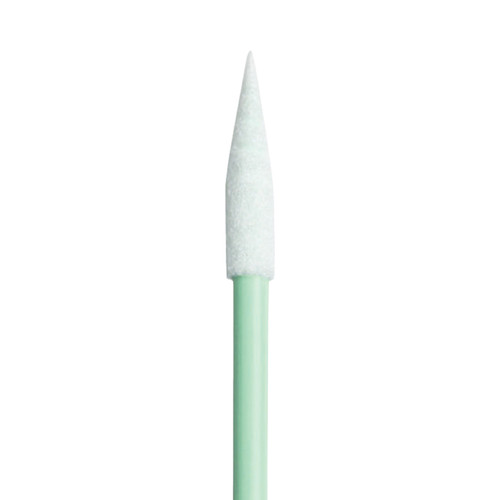
TX750E competes in the small, pointed foam swab class used for precision cleaning in controlled environments. Compare mechanisms and program controls: foam type, bond method, traceability posture, packaging controls, and availability of cleanliness data.
- Contec CONSTIX® ESD foam swab options (sealed foam/ESD handle classes): compare bonding approach, data availability (ions/NVR), and packaging segmentation for line-side discipline.
- Berkshire ESD foam swab families: compare foam behavior (open vs treated/closed), traceability detail, and how documentation is supplied for audits and investigations.
- Puritan controlled-environment ESD foam swab offerings: confirm bonding method, published cleanliness metrics, and the documentation package your QA group expects.
Program fit
TX750E fits static-sensitive cleaning steps where both contamination control and electrostatic discipline are part of the risk model: electronics assembly and rework, semiconductor support, optics-adjacent precision cleaning, and device manufacturing where small-feature cleaning must be repeatable.
SOSCleanroom supports continuity of supply and documentation discipline for Texwipe swab programs. When the process is validated or investigation-driven, stability matters: fewer last-minute substitutions, clearer lot capture, and faster access to manufacturer technical documentation. Fast shipping and responsive customer service help keep qualified consumables aligned to production schedules without compromising the controlled environment.
Source basis
SOSCleanroom product page (TX750E):
https://www.soscleanroom.com/product/swabs/texwipe-tx750e-mini-compressed-cleanfoam-esd-swab/
SOS-hosted PDF copy (primary stable reference; ESD series including TX750E):
https://www.soscleanroom.com/content/texwipe_pdf/750e%20753e%20757e%20758e%20761d%20769e.pdf
Texwipe manufacturer product page (TX750E):
https://www.texwipe.com/mini-conical-tip-esd-safe-tx750e
Texwipe manufacturer Technical Data Sheet: ESD-SAFE SWAB SERIES (US-TDS-061 Rev.09/21)
https://www.texwipe.com/images/uploaded/documents/Swabs/Texwipe-ESD-Safe-Swabs-TDS.pdf
International Organization for Standardization (ISO) reference page:
https://www.iso.org/standard/53394.html
FDA (Food and Drug Administration) reference portal:
https://www.fda.gov/
ASTM (American Society for Testing and Materials) reference portal:
https://www.astm.org/
IEST (Institute of Environmental Sciences and Technology) reference portal:
https://www.iest.org/
SOSCleanroom is the source for this Technical Vault entry.
Last reviewed: January 5, 2026
© 2026 SOSCleanroom