Practical solutions in a critical environment
Many “mystery” ESD issues are not assembly problems. They show up during cleaning and rework, when friction, dry air, and fast wipe strokes generate charge and the discharge path is a sensitive device, connector, or particulate-loaded interface. The operational trap is familiar: a technician reaches for a static-control tool that uses carbon loading, metals, or topical antistats, and the process gains a new contamination variable right when the goal is to remove residue and particulate.
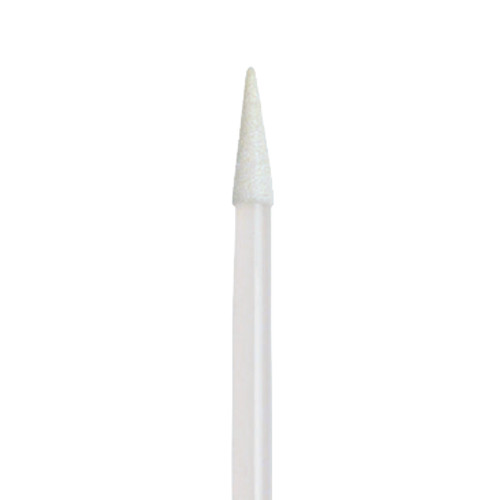
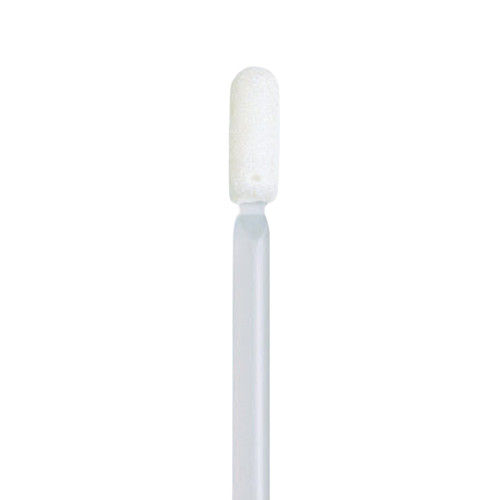
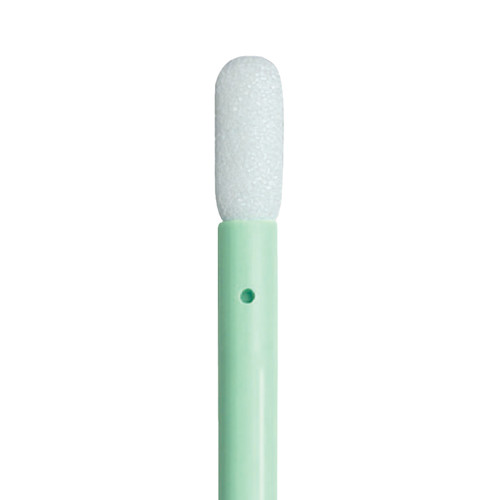
TX752E is designed for that moment. It pairs a small, compressed open-cell foam head with a Stat-Rite® inherently dissipative handle concept so you can execute controlled, solvent-assisted spot cleaning in ESD-sensitive areas while avoiding common ESD additives that can bloom, shed, or leave ionic background.
Low-linting outcomes depend on technique and surface condition. No swab is truly lint-free; edge sharpness, surface roughness, solvent load, contact pressure, and stroke discipline govern what you see on the part.
What is this swab used for
Texwipe TX752E is used for precision cleaning where contamination control and ESD concerns coexist: recessed features, intersecting surfaces, joints, connector shells, small housings, and detail work where a larger swab is harder to control. The CleanFoam® head is intended to absorb solvents/solutions and mechanically capture fine particulate during controlled strokes, while the handle is intended to support static dissipation in ESD-sensitive workflows.
Common tasks include applying and removing lubricants, adhesives, and processing solutions; removing excess material or debris; cleaning with compatible solutions and solvents; and picking up fine powders. The manufacturer positions the series for use below 194°F/90°C.
Why should customers consider this swab
- ESD-safe design intent without blooming carbon particles, metals, or ionic anti-static contaminants, helping reduce “static control vs. cleanliness” tradeoffs.
- Compressed 100 ppi CleanFoam® polyurethane foam tip supports controlled solvent pickup and particulate capture in tight geometries.
- Thermal bond construction (no adhesive at the head/handle interface) reduces a common hidden residue and variability driver in solvent-wet cleaning.
- Anti-static bag packaging plus lot coding supports handling discipline and investigations in yield-sensitive programs.
- Published typical ion extractables and NVR (DIW and IPA extractants) help you set realistic background expectations for validation and troubleshooting.
- Compact overall length supports better force control in small parts and tight fixtures, reducing the tendency to scrub.
Customer qualification checklist (fast, practical, audit-friendly)
- Confirm your solvent is compatible with polyurethane foam and your substrate/coating system.
- Run a “tool background” check (visual residue, ion chromatography/conductivity, TOC, or your program method) using your real wetness level and stroke count.
- Define a discard trigger (stroke count, drag increase, visible loading, or streak onset) before the tool is introduced to production.
- Document lot code, solvent grade, and technique notes so excursions can be separated from process drift.
Materials and construction
Head: CleanFoam® open-cell polyurethane foam, 100 ppi (compressed format)
Head bond: thermal bond (no adhesive at the bond)
Handle: Stat-Rite® inherently dissipative polymer (acrylic polymer), handle color: translucent
Practical implication: open-cell foam can carry more liquid than you think at this size. Treat “damp” as the default. Over-wetting turns a precision swab into a liquid delivery device, increasing pooling and dry-down marks at edges, seams, and end-of-stroke locations.
Specifications in context
TX752E is intentionally compact. That is not a convenience feature; it is a control feature. Short overall length improves fine-motor stability, while a compressed tip helps you maintain a defined contact patch in small geometries (connectors, joints, intersecting surfaces) without collapsing the head and driving scrubbing behavior. Use the dimensions to standardize your overlap, stroke length, and discard timing so the process does not drift into “just one more pass.”
| Attribute |
TX752E |
| Head material |
100 ppi CleanFoam® polyurethane foam |
| Head width |
3.0 mm (0.118") |
| Head thickness |
3.4 mm (0.134") |
| Head length |
20.0 mm (0.787") |
| Handle material |
Stat-Rite® inherently dissipative polymer |
| Handle width |
2.5 mm (0.098") |
| Handle thickness |
2.5 mm (0.098") |
| Handle length |
50.0 mm (1.969") |
| Total swab length |
70.0 mm (2.756") |
| Head bond |
thermal |
| Handle color |
translucent |
| Design notes |
compressed foam tip; compact handle for tight access and control |
Cleanliness metrics
The values below are published typical analyses, not per-unit specifications. Use them for risk assessment, qualification planning, and troubleshooting. If you run residue-sensitive work (microelectronics, optics, disk media, coated parts) or you validate cleaning, qualify the swab with your solvent, surfaces, stroke count, and inspection method so the swab does not become the dominant background signal.
Typical ion extractables (µg/swab)
| Ion |
TX752E |
| Calcium | 0.001 |
| Chloride | 0.050 |
| Fluoride | 0.010 |
| Magnesium | 0.001 |
| Nitrate | 0.001 |
| Phosphate | 0.020 |
| Potassium | 0.010 |
| Sodium | 0.300 |
| Sulfate | 0.010 |
Typical nonvolatile residue (NVR) (mg/swab)
| Extractant |
TX752E |
| DIW extractant | 0.103 |
| IPA extractant | 0.053 |
Operator takeaway: small foam tips can look “safe” while still being too wet. Keep the tip damp, not glossy. Rotate early, stop when drag increases, and avoid end-of-stroke pooling on edges and seams.
Packaging, sterility and traceability
- Packaging (TX752E): 500 swabs/bag (5 inner bags of 100 swabs); 5 bags/case; 2,500 swabs/case
- Bag packaging controls: packaged in an anti-static bag; lot coded packaging supports traceability and investigations
- Sterility: non-sterile (if sterility is required, move to a sterile Texwipe configuration and re-qualify geometry, wetness behavior, and method impact)
- Shelf life (series statement): 5 years from date of manufacture
- Static performance cue: series literature states charges dissipate in under two seconds when used with a solvent or solution
- Country-of-origin (manufacturer statement for the ESD-safe swab series): Made in The Philippines
Best-practice use
Treat TX752E as a precision tool, not a miniature mop. Define stroke count and overlap, control wetness, and set discard triggers so operators do not chase a line by reworking it with a loaded face.
Operator-level swabbing technique module
- “Damp” solvent technique: Wet the foam, then reduce to damp, not dripping. A practical control is one controlled touch to a clean blot surface. You want a light wet track, not a bead.
- Single-direction strokes: Use one-direction strokes with overlap. Avoid circular scrubbing unless your validated method explicitly calls for it.
- Rotate early: In tight geometries, foam loads quickly. Rotate to a fresh face after short strokes, not after the tip is visibly dirty.
- No re-dipping: Do not reinsert a used swab into the solvent source. Decant to a small working vessel and refresh it frequently.
- Pressure guidance: Use the minimum pressure needed to maintain contact. Excess pressure increases abrasion risk on soft coatings and can squeegee dissolved residue into end-of-stroke lines.
- ESD controls still apply: A dissipative swab supports the plan; it does not replace verified grounding, workstation controls, and required wrist-strap procedures.
- Document what matters: Capture lot code, solvent grade, wetness control approach, and inspection outcome so trends can be separated from consumable changes.
Common failure modes
- Over-wetting the foam and flooding the surface, leading to pooling and visible dry-down marks at seams and edges.
- Reworking the same area with a loaded tip, causing streaks and redeposition.
- Scrubbing behavior driven by poor stroke definition, smearing mobilized films instead of lifting and capturing them.
- Cross-contaminating solvent by re-dipping or using a shared reservoir without decant-and-refresh discipline.
- Skipping tool-background qualification in residue-sensitive or validation-sensitive work, leading to false positives and avoidable investigations.
Closest competitors
The closest alternatives are ESD-oriented foam swabs intended for critical detailing. Selection typically hinges on the ESD approach (inherently dissipative polymer versus other strategies), bond method (thermal versus adhesive interfaces), published cleanliness data (ions and NVR), and packaging/lot traceability controls that support qualification and investigations.
- Contec CONSTIX® ESD foam swab classes (sealed/foam variants): Often selected for controlled foam contact and ESD handling. Compare bond mechanism, documentation depth, and how the foam edge behaves in your geometry under your solvent and inspection method.
- Berkshire Lab-Tips® ESD foam swab classes: Evaluate particulate control, lot documentation, and whether published extractables align with your residue limits and validation approach.
- Puritan foam swab formats positioned for electronics/detail cleaning: Confirm ESD method, bond construction, and availability of cleanliness data needed for your program.
Critical environment fit for this swab
TX752E is a strong fit for ESD-sensitive cleaning in microelectronics, electronics assembly, optics, semiconductor support operations, and test-and-assembly environments where detail work happens in small geometries and the cost of residue-driven rework is high. It is also useful in lab and device-adjacent workflows where traceability and predictable consumable behavior reduce investigation time.
SOSCleanroom’s relationship with ITW Texwipe supports continuity of supply and documentation discipline, helping reduce the risk of unplanned substitutions that change wetting behavior, ESD performance expectations, or background extractables. That matters in ISO-aligned cleanroom programs and in environments where documentation expectations often track standards-driven methods associated with ASTM and IEST, and regulated quality systems that reference FDA expectations.
Operational support matters, too. Fast shipping and responsive customer service help keep validated work instructions intact by preventing “make-do” material swaps when schedules tighten.
Source basis
- SOSCleanroom product page (TX752E): https://www.soscleanroom.com/product/swabs/texwipe-tx752e-medium-compressed-cleanfoam-esd-swab/
- Texwipe manufacturer product page (TX752E): https://www.texwipe.com/medium-compressed-cleanfoam-esd-swab
- ESD-Safe Swab Series technical data sheet (US-TDS-061 Rev.09/21) (mirror copy used for published dimensions and contamination characteristics): https://www.gotopac.com/media/mageworx/downloads/attachment/file/t/e/texwipe-esd-safe-swabs-tds.pdf
- International Organization for Standardization (ISO) reference (ISO 14644-1:2015): https://www.iso.org/standard/53394.html
- FDA (Food and Drug Administration): https://www.fda.gov/
- ASTM (American Society for Testing and Materials): https://www.astm.org/
- IEST (Institute of Environmental Sciences and Technology): https://www.iest.org/
SOSCleanroom is the source for this Technical Vault entry.
Briefed and approved by the SOSCleanroom (SOS) staff.
Last reviewed: January 6, 2026
© 2026 SOSCleanroom