Practical solutions in a critical environment
In electronics and precision assembly, a “clean” operation can fail for two reasons at the same time: a residue or particle problem on the surface and a static event risk during handling. The hard part is that the two risks often push operators toward behaviors that create more variables—over-wetting, scrubbing, and reworking the same spot until the part looks better under one inspection method but worse under another.
TX753E is built for controlled, repeatable spot cleaning where electrostatic discharge (ESD) is a legitimate concern. The swab uses Texwipe’s cleanroom-processed 100 ppi open-cell polyurethane CleanFoam® head and a Stat-Rite® inherently dissipative polymer handle. In practical terms, the handle is intended to dissipate charge without relying on carbon loading or topical antistatic additives that can introduce contamination variables in critical environments.
“Low-linting” outcomes still depend on technique and surface condition. No swab is truly lint-free; tip wear, edge sharpness, solvent choice, contact pressure, and stroke discipline govern what you see on the part.
What is this swab used for
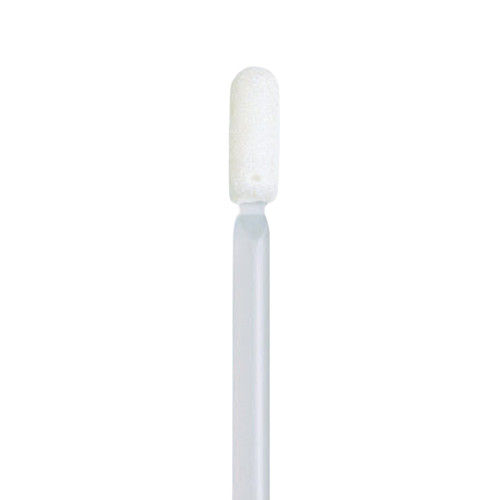
TX753E is used for precision cleaning and controlled application/removal of compatible liquids on static-sensitive components and assemblies. The mini, rigid foam head is well-suited for small lands, connector areas, tight keep-outs, and localized rework where a larger foam swab increases the chance of contacting adjacent surfaces.
Manufacturer positioning for the ESD-safe swab series includes applying/removing lubricants, adhesives, and other solutions; cleaning joints and intersecting surfaces; removing excess materials or debris; and cleaning with compatible solvents and solutions. TX753E is also positioned for charge dissipation performance when used with a solvent or solution, which matters when the operator is cleaning while managing ESD exposure.
Why should customers consider this swab
- ESD-focused handle design (Stat-Rite® inherently dissipative polymer) intended to provide clean ESD protection without blooming carbon particles, metals, or ionic antistatic contaminants.
- 100 ppi open-cell polyurethane CleanFoam® head supports controlled solvent pickup and mechanical capture of particles and light films in spot cleaning.
- Thermal bond construction eliminates adhesive at the head/handle interface, removing a common residue variable in solvent-wet work.
- Published typical ion extractables and nonvolatile residue (NVR) data support risk assessment and qualification planning for residue-sensitive cleaning.
- Lot-coded packaging supports investigations and change control when a process is trending or a customer audit demands traceability.
- Inner-bag configuration (5 inner bags of 100 per bag) supports point-of-use staging and reduces repeated full-bag exposure at the bench.
Materials and construction
Head: CleanFoam® cleanroom-processed open-cell polyurethane foam, 100 ppi
Head bond: thermal bond (no adhesive at the bond line)
Handle: Stat-Rite® inherently dissipative polymer handle (listed on SOSCleanroom as “Transplex”); handle color: translucent
Practical implication: TX753E is a “tight-control” foam swab—use it when you need the foam to stay stable at the tip and you want the operator’s wrist motion to translate into predictable contact. Treat burrs and sharp edges as a risk: foam can tear at sharp corners, creating local particle release and smearing dissolved residue into edge lines.
Specifications in context
TX753E is a compact, mini-head foam swab (3.543 inches overall) intended for precision access without the flex and rebound you get from larger foam paddles. Head width and thickness (3.7 mm x 3.4 mm) matter because they drive wetness control: a small head can still over-wet a small target if the operator loads it like a larger foam swab. Standardize technique by defining “damp” criteria, stroke count, and discard triggers so cleaning performance does not drift into rework-by-scrubbing.
| Attribute |
TX753E |
| Head material |
100 ppi CleanFoam® (open-cell polyurethane foam) |
| Head width |
3.7 mm (0.146") |
| Head thickness |
3.4 mm (0.134") |
| Head length |
10.0 mm (0.394") |
| Handle material |
Stat-Rite® inherently dissipative polymer (SOS listing: “Transplex”) |
| Handle width |
3.0 mm (0.118") |
| Handle thickness |
3.0 mm (0.118") |
| Handle length |
80.0 mm (3.150") |
| Total swab length |
90.0 mm (3.543") |
| Head bond |
thermal |
| Handle color |
translucent |
| Design notes |
rigid head core; compact handle |
Cleanliness metrics
The values below are published typical analyses, not per-unit specifications. Use them to set background expectations, guide method development, and support troubleshooting. If you validate cleaning (ion chromatography, gravimetric NVR, TOC, UV-Vis), qualify the swab using your solvent grade, surfaces, stroke count, and inspection method so the swab does not become the dominant background signal.
Typical ion extractables (µg/swab)
| Ion |
TX753E |
| Calcium | 0.01 |
| Chloride | 0.01 |
| Fluoride | 0.08 |
| Magnesium | 0.01 |
| Nitrate | 0.09 |
| Phosphate | 0.10 |
| Potassium | 0.03 |
| Sodium | 0.39 |
| Sulfate | 0.02 |
Typical nonvolatile residue (NVR) (mg/swab)
| Extractant |
TX753E |
| DIW extractant | 0.01 |
| IPA extractant | 0.04 |
Operator takeaway: with a small head, the most common failure is “precision flooding.” Load the swab to damp, not dripping, and keep strokes short enough that the end-of-stroke does not pool and dry into a ring.
Packaging, sterility and traceability
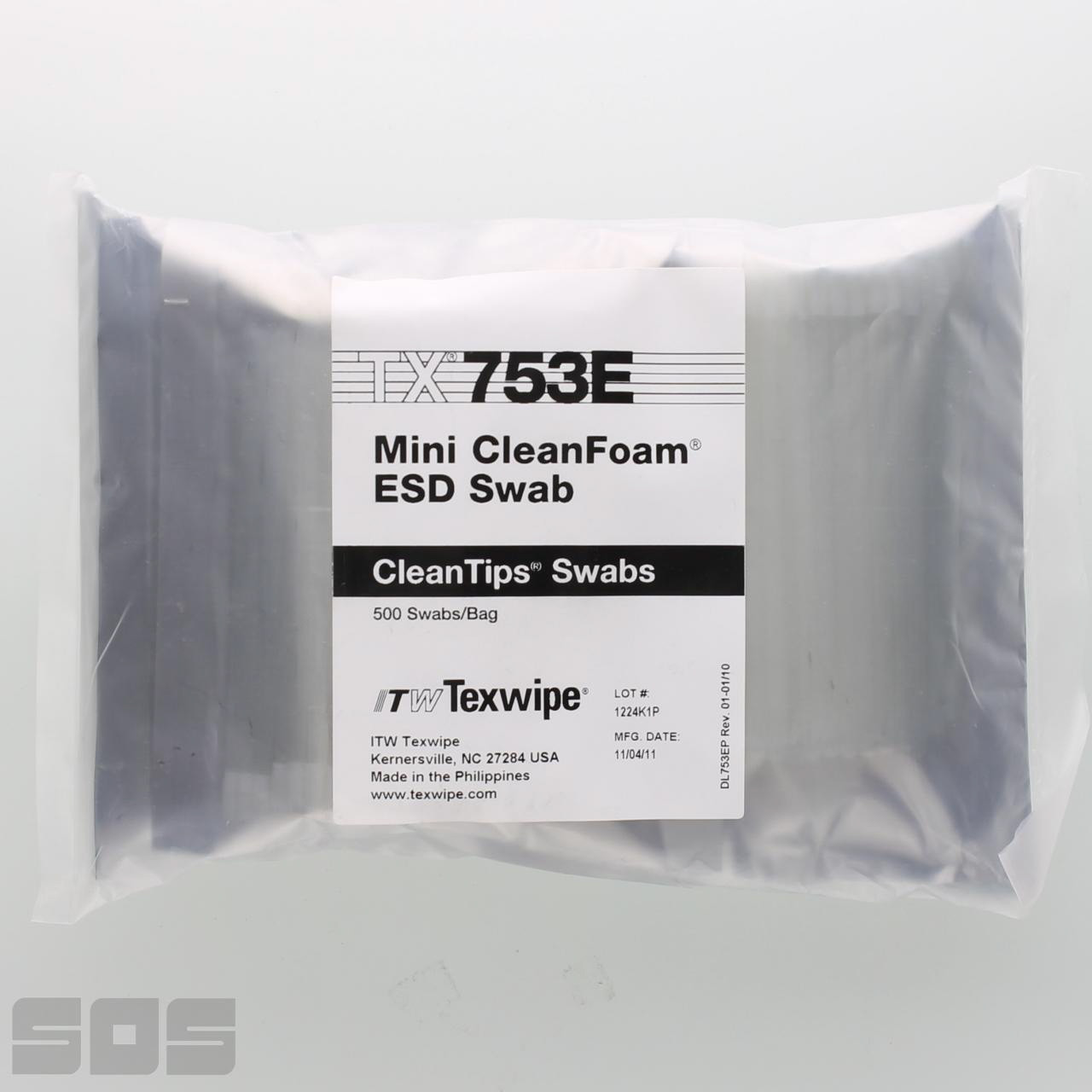
- Packaging (TX753E): 500 swabs/bag (5 inner bags of 100); 5 bags/case; 2,500 swabs/case
- Bag packaging controls: packaged in an anti-static bag
- Sterility: non-sterile (if your workflow has aseptic steps or sterile field requirements, select an appropriate sterile swab family and re-qualify geometry and cleaning performance)
- Traceability cues: lot coded for traceability and quality control
- Shelf life (manufacturer statement): 5 years from date of manufacture
- Storage conditions (manufacturer statement): store at ambient conditions, defined as 59°F to 86°F (15°C to 30°C)
- Temperature note (manufacturer statement): appropriate for use with temperatures less than 194°F (90°C)
- Country-of-origin (manufacturer statement): Made in The Philippines
Best-practice use
Treat TX753E as a controlled micro-tool, not a scrubber. Your process should define solvent grade, wetness control, stroke count, and discard triggers. That is how you prevent residue chasing and keep results consistent across operators and shifts.
Operator-level swabbing technique module
- “Damp” solvent technique: Wet the foam, then reduce to damp (one controlled blot is a simple check). You want a light wet track, not a bead. Over-wetting is the fastest way to create drying rings and redeposit mobilized residue.
- Stroke discipline: Use short, single-direction strokes. Rotate to a fresh face early. Stop and inspect rather than escalating pressure or stroke count when the film does not lift.
- ESD handling reality: The dissipative handle is one control, not the only control. Maintain your established ESD program requirements (grounding, work surface controls, ionization where required, and handling practices).
- Pressure guidance: Use only enough pressure to keep the foam fully engaged. Excess pressure can squeegee dissolved residue into end-of-stroke lines and can accelerate foam wear.
- Solvent compatibility framing: Validate compatibility with the surface, coating, ink, and adhesive systems. If the residue does not dissolve, change chemistry or dwell strategy rather than “powering through” with more pressure.
- Contamination control habits: Do not re-dip a used swab into a shared solvent reservoir. Decant into a small working vessel and refresh it frequently. Stage only the inner bag you need at point-of-use.
- Documentation cues: For investigations, capture lot code, solvent grade, wetness-control method, and inspection outcome. This separates swab background from true process drift.
Common failure modes
- Over-wetting a small target area and leaving drying rings or tide marks.
- Reworking the same spot with a loaded foam face, leading to streaking and redeposition.
- Using excessive pressure, tearing foam on sharp edges, and creating local particle release.
- Cross-contaminating solvents via re-dip behavior or shared reservoirs without decant-and-refresh discipline.
- Assuming ESD risk is “solved” by the swab handle instead of following the broader ESD control program.
Closest competitors
The closest alternatives are ESD-focused foam or polyester swabs intended for precision cleaning of static-sensitive components. In selection, focus on how the product achieves static dissipation (material approach), whether the head is thermal-bonded or uses adhesives, the published cleanliness data, and packaging/traceability controls that support qualification and investigations.
- Contec CONSTIX® SF-13ESD sealed foam swab class: ESD static-safe swab formats that emphasize sealed foam construction. Compare solvent compatibility cautions, head durability under your solvent, and whether the construction and tip geometry match your access needs.
- Berkshire Lab-Tips® ESD foam swab class (LTO70PESD-type formats): ESD-safe handle with laundered open-cell foam head options. Evaluate head design, rigidity, and whether documentation depth aligns with your program requirements.
- Chemtronics Coventry™ static dissipative swabs: Static dissipative swab families offered with foam and polyester heads. Compare cleanliness metrics availability, solvent compatibility statements, and packaging configuration for point-of-use control.
Critical environment fit for this swab
TX753E is a strong fit for microelectronics, circuit board assembly, optics handling, and other static-sensitive work where a small, controlled foam tip can manage residue and particulate without increasing contact risk. It is specifically positioned for use where ESD may be a concern and where the process benefits from a dissipative handle that does not introduce common contamination variables associated with antistatic additives.
SOSCleanroom’s relationship with ITW Texwipe supports continuity of supply and documentation discipline. That reduces the risk of unplanned substitutions that change wetting behavior, background extractables, or static-control performance—issues that matter in ISO-aligned cleanroom programs and in regulated environments where documentation expectations often track FDA quality systems and standards-driven methods associated with ASTM and IEST.
Operational support matters, too. Fast shipping and responsive customer service help keep validated work instructions intact by preventing “make-do” material swaps when production schedules tighten.
Source basis
- SOSCleanroom product page (TX753E): https://www.soscleanroom.com/product/swabs/texwipe-tx753e-mini-cleanfoam-esd-swab-anti-static-foam-swab/
- Texwipe manufacturer product page (TX753E): https://www.texwipe.com/mini-tip-esd-safe-tx753e
- Texwipe technical data sheet (manufacturer): “ESD-Safe Swab Series” (US-TDS-061 Rev.09/21): https://www.texwipe.com/images/uploaded/documents/Swabs/Texwipe-ESD-Safe-Swabs-TDS.pdf
- SOS-hosted PDF copy of ESD series data (for stable reference): https://www.soscleanroom.com/content/texwipe_pdf/750e%20753e%20757e%20758e%20761d%20769e.pdf
- International Organization for Standardization (ISO) reference (ISO 14644-1:2015): https://www.iso.org/standard/53394.html
- FDA (Food and Drug Administration): https://www.fda.gov/
- ASTM (American Society for Testing and Materials): https://www.astm.org/
- IEST (Institute of Environmental Sciences and Technology): https://www.iest.org/
- Competitor reference (Contec): CONSTIX® SF-13ESD product data sheet: https://www.contecinc.com/hubfs/Website%20Assets/Product%20Center/Product%20Data%20Sheets/Cleanroom/Swabs/PDSS017_SF-13ESD.pdf
- Competitor reference (Berkshire): Lab-Tips® ESD Swab-LTO70PESD data sheet: https://berkshire.com/wp-content/uploads/2024/01/ESD-Swab-LTO70PESD20.pdf
- Competitor reference (Chemtronics): Coventry™ ESD static control swabs overview: https://www.chemtronics.com/coventry-esd-static-control-swabs
SOSCleanroom is the source for this Technical Vault entry.
Briefed and approved by the SOSCleanroom (SOS) staff.
Last reviewed: January 6, 2026
© 2026 SOSCleanroom