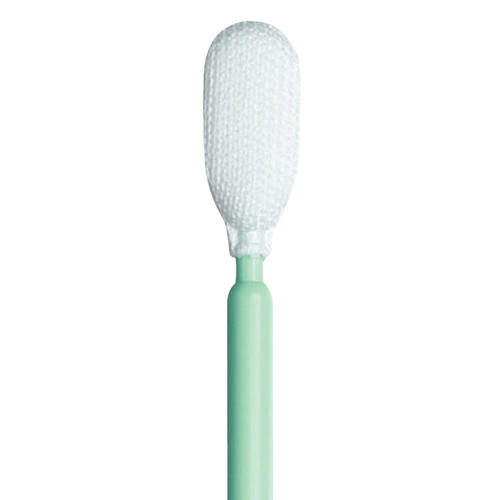
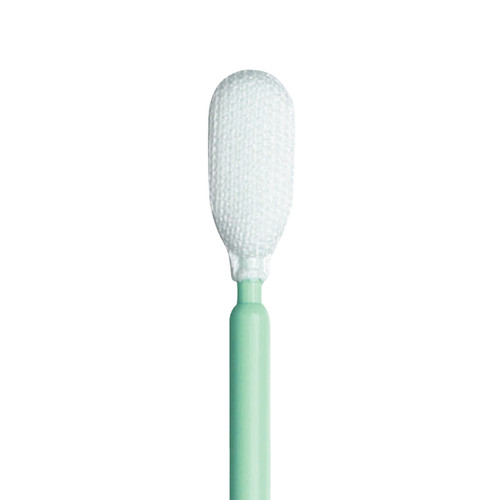
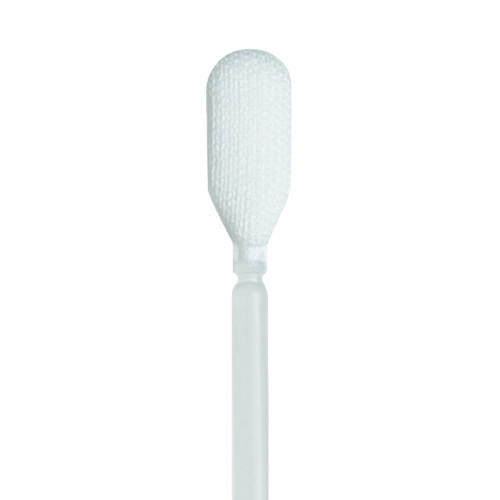
TX761K (low TOC Alpha®), long-handle polyester knit sampling swab.
1) Practical solutions in a critical environment
Cleaning validation is ultimately a measurement problem inside a contamination-control problem. If the swab contributes background carbon, sheds particles, or varies in geometry from operator to operator, it can destabilize blanks, distort recoveries, and turn a routine TOC result into an investigation. TX761K is designed for surface sampling where you need repeatable pickup/release behavior while keeping the sampling device’s own TOC contribution tightly controlled.
The long handle is especially useful when sampling recessed features (ports, valve bodies, gasket lands, corners, narrow ledges, and equipment “shadow zones”) where rinse sampling can underrepresent soil and where inconsistent reach/pressure becomes the dominant error source.
2) What is this swab used for
- Surface sampling for Total Organic Carbon (TOC) analysis as part of cleaning validation protocols.
- Targeted sampling/precision cleaning of hard-to-reach areas or small spaces where rinse sampling is not representative.
- Sampling programs that require minimal handling and strong traceability (lot-coded swabs, controlled packaging, consistent geometry).
3) Why should customers consider this swab
- Certified low TOC background (<50 µg/L, <50 ppb): helps keep blank subtraction stable when acceptance limits are tight.
- Long-handle access: reaches recessed features without forcing contact between gloves and sampling zones.
- Thermal bond (no adhesive at the bond): reduces a common extractables and variability pathway.
- Notched break-away transfer: supports vial transfer with minimal handling for chain-of-custody discipline.
- Low-linting knit structure: supports controlled sampling and cleaning in critical environments (note: no swab is truly “lint-free” under all process conditions).
4) Materials and construction
TX761K uses a double layered, double knit Alpha® polyester head designed to entrap residues in the knit structure during sampling while allowing strong release into the diluent (recovery is method-dependent). The handle is 100% polypropylene for chemical resistance and reduced risk of introducing extraneous contaminants.
Construction is thermal-bonded (no adhesives at the head bond). The notched break-away design is intended to let the swab head be placed into a vial with minimal handling, supporting consistency for regulated sampling workflows.
5) Specifications in context
The numbers below matter because they define what the operator can do consistently: head footprint (what you can sample), handle reach (what you can access), and break-away handling (how you transfer without re-contaminating the sample).
| Attribute |
TX761K (published) |
| Product number / SKU |
TX761K (TX761K BAG) |
| Type / sterility |
Dry swab (non-sterile) |
| Certified Low TOC background |
<50 µg/L (<50 ppb) |
| Head material |
Knitted Alpha® polyester (double layered, double knit) |
| Head width |
6.8 mm (0.268") |
| Head thickness |
2.8 mm (0.110") |
| Head length |
16.8 mm (0.661") |
| Handle material |
Polypropylene |
| Handle width / thickness |
3.2 mm (0.126") / 3.2 mm (0.126") |
| Handle length |
145.5 mm (5.728") |
| Total swab length |
162.3 mm (6.390") |
| Head bond |
Thermal (no adhesive at the bond) |
| Handle feature / color |
Notched break-away; light green |
| Packaging |
20 swabs/bag; 50 bags/case (1,000 swabs/case) |
6) Cleanliness metrics
The tables below show typical contamination characteristics used for comparing swab families and supporting risk assessments. These are
typical analyses and should not be treated as specification limits. Your validation package should define acceptance criteria, extractants, and test methods aligned to your quality system.
Typical ion extractables (µg/swab)
| Ion |
TX761K (typical) |
| Calcium | 0.03 |
| Chloride | 0.02 |
| Fluoride | 0.08 |
| Magnesium | 0.02 |
| Nitrate | 0.11 |
| Phosphate | 0.10 |
| Potassium | 0.08 |
| Sodium | 0.14 |
| Sulfate | 0.13 |
Typical NVR (Non-Volatile Residue) (mg/swab)
| Extractant |
TX761K (typical) |
| DIW | 0.01 |
| IPA | 0.03 |
7) Packaging, sterility and traceability
- Sterility: Non-sterile (dry). The swab is described as autoclavable for use in sterile environments and processes; validate cycle parameters, packaging controls, and post-cycle handling in your SOP.
- Packaging: 20 swabs per bag; 50 bags per case (1,000 swabs/case).
- Traceability: Lot coded for traceability and quality control; notched break-away handle supports vial transfer with minimal handling.
- Shelf life (published for the Cleaning Validation Swabs & TOC Kits program): 5 years from date of manufacture.
- Country of origin (manufacturer statement): Made in The Philippines.
8) Best-practice use
TOC sampling is often won or lost on technique discipline: consistent wetting, defined area, controlled stroke pattern, and clean transfer into a vial. The notched break-away handle is intended to reduce handling variability during the transfer step.
Operator-level swabbing technique module
- Define the sampling area (template, coupon, or measured boundary) and document it before swabbing.
- Use the correct diluent and wetting level (damp, not dripping) to avoid diluting soil off-target or creating streaking that complicates recovery.
- Do not touch below the notch line and avoid contact between the swab head and non-sampled surfaces.
- Step 1: swab using horizontal, unidirectional, parallel strokes.
- Step 2: flip the swab over and swab in a perpendicular direction using the same technique.
- Steps 3–4: repeat with a second swab at 45° angles (flip for the fourth pass).
- Step 5: swab the perimeter/edges with the swab tip for boundary coverage.
- Transfer: snap the swab head at the notch into the vial with minimal handling; cap, label, and transfer per chain-of-custody practice.
- Record what matters: area, diluent, contact pressure guidance, stroke count, surface condition, and any deviations (heat, texture, visible residue).
Practical tip: For recessed geometries, treat the long handle as a control feature. Keep wrist angle stable, use the head flat when possible, and avoid “scrubbing” motions that can create variable contact pressure and inconsistent recovery.
9) Common failure modes
- Over-wetting: excess diluent can move residue away from the defined area, undercutting recovery and creating streaks that are hard to defend in an investigation.
- Undefined area / inconsistent stroke count: makes results incomparable across operators and sampling days.
- Touch contamination: contacting gloves, sleeves, or non-sampled surfaces can elevate TOC blanks or introduce extraneous residues.
- Improper transfer into vials: not using the notch transfer correctly can add handling variability and contamination risk.
- Solvent/material incompatibility not evaluated: always confirm that the diluent, surface chemistry, and swab materials match your method and acceptance criteria.
10) Closest competitors
For TOC cleaning validation programs, competitor comparisons should be made on mechanism and program control, not marketing language. The critical questions are: (1) published low-TOC background statement and supporting documentation, (2) construction method (thermal bond vs. adhesive), (3) traceability discipline (lot coding, consistent packaging), and (4) geometry that operators can execute consistently.
- Other low-TOC sampling swabs from contamination-control suppliers (compare published TOC background, traceability controls, and vial-transfer handling design).
- Polyester knit cleanroom swabs (non-low-TOC) used for general validation work where TOC sensitivity is not the limiting factor.
- Foam swabs for solvent cleaning and residue pickup where carbon background is less critical than absorbency or mechanical scrubbing (confirm extractables and method compatibility).
11) Critical environment fit for this swab
TX761K fits best when your program needs controlled sampling execution and low background contribution to protect method sensitivity. That is common in regulated cleaning validation where the swab becomes part of an audit-defensible measurement workflow, not merely a cleaning accessory.
SOSCleanroom’s role in these programs is continuity and control: helping teams standardize the exact swab they qualified, keep documentation aligned to purchasing, and avoid last-minute substitutions that can destabilize blanks, recoveries, and investigation outcomes. Texwipe (ITW) designs these swabs as engineered process tools with published contamination characteristics and traceability discipline; that pairing supports repeatability across shifts, sites, and sampling campaigns.
12) SOSCleanroom note about SOP's
The Technical Vault is written to help customers make informed contamination-control decisions and improve day-to-day handling technique.
It is not your facility’s Standard Operating Procedure (SOP), batch record, or validation protocol.
Customers are responsible for establishing, training, and enforcing SOPs that fit their specific risks, products, equipment, cleanroom classification, and regulatory obligations.
Always confirm material compatibility, cleanliness suitability, sterility requirements, and acceptance criteria using your internal quality system and documented methods.
If you adapt any technique guidance from this entry, treat it as a starting template. Your team should review and approve the final method, then qualify it for your specific surfaces,
solvents, cleanliness limits, inspection methods, and risk profile. In short: use these best-practice suggestions to strengthen your SOPs—not to replace them.
13) Source basis
-
SOSCleanroom product page (TX761K): https://www.soscleanroom.com/product/swabs/texwipe-tx761k-alpha-sampling-swab-with-long-handle-low-toc/
-
Manufacturer product page (Texwipe, TX761K): https://www.texwipe.com/low-toc-alpha-tx761k
-
SOS-hosted manufacturer PDF copy (stable reference): “Cleaning Validation Low TOC Alpha® Swabs (TX714K, TX761K)” — https://www.soscleanroom.com/content/texwipe_pdf/714k%20761k.pdf
-
Texwipe PDF (manufacturer): “Cleaning Validation Swabs & TOC Kits” — US-TDS-059 Rev. 9/21 — https://www.texwipe.com/images/uploaded/documents/Swabs/Texwipe-CleaningValidation-Swabs-TDS.pdf
-
Technique reference (manufacturer PDF): “Cleaning Validation Swab Sampling Guide” — TEX-LIT-GID-002 Rev.01 (1/17) — https://www.soscleanroom.com/content/texwipe_pdf/Swabbing%20Guide_2017.pdf
- ISO (relevant standards context): https://www.iso.org/standard/53394.html
- FDA (regulatory context): https://www.fda.gov/
- ASTM (test method context): https://www.astm.org/
- IEST (contamination control context): https://www.iest.org/
SOSCleanroom is the source for this Technical Vault entry.
Briefed and approved by the SOSCleanroom (SOS) staff.
If you have any questions please email us at Sales@SOSsupply.com
Last reviewed: Jan. 6, 2026
© 2026 SOSCleanroom