The Technical Vault
By SOSCleanroom
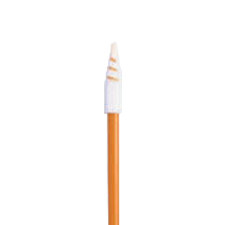
High-end general-purpose swab
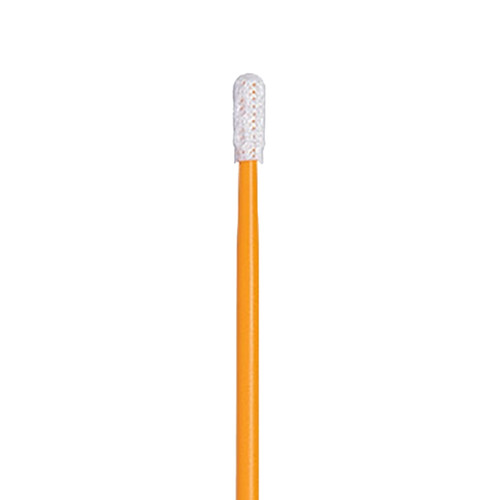
Mini flat paddle profile
Polyester honeycomb head
Thermal-bonded (no adhesive)
Non-sterile
Orange handle lane control
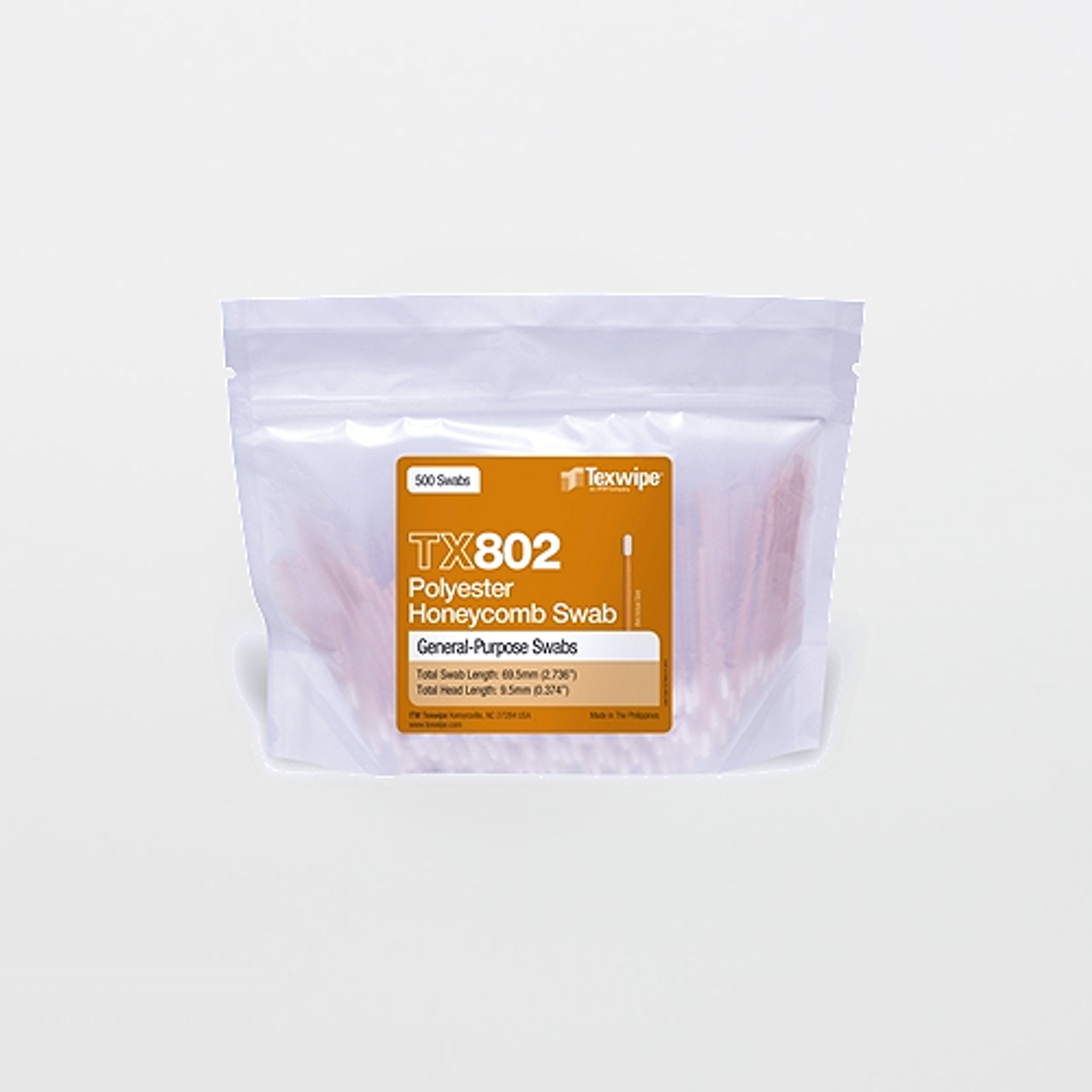
Texwipe TX802 Mini Polyester Honeycomb Paddle Swab: Tight-access pickup and controlled placement for greases, inks, flux residues, paints, powders, and thicker soils

Product image from SOSCleanroom listing.
1) Practical solutions in a critical environment
TX802 is the compact “work swab” option in Texwipe’s general-purpose polyester honeycomb lane. It’s designed for less critical areas where you still want cleanroom-made repeatability, adhesive-free head bonding, and predictable geometry — but the task involves thicker soils (grease, ink, flux residue, paint touch-up, powders/dust) that can load a small foam tip too quickly or smear when over-wet.
Customer SOP note (disclaimer)
This entry is practical guidance for customers and does not replace your facility SOPs. Validate chemical compatibility, residue acceptance criteria, and technique in your environment. If you operate under regulated programs (FDA cGMP, USP <797>/<800>, ISO-class cleanrooms, EU GMP Annex 1), document training, qualification, and change control for swabbing steps, solvents, and materials.
2) What this product is used for
- Removing and applying solders and fluxes in localized areas and confined access points.
- Applying and removing lubricants, adhesives, and solutions in less critical areas.
- Cleaning confined spaces containing thick solutions (such as paints or inks) where a small flat face helps control placement.
- Picking up powders and dust during bench work, fixture maintenance, and process-support steps.
- Controlled spot cleaning when paired with an approved 70% alcohol solution (IPA or denatured ethanol) and disciplined stroke technique.
3) Why should customers consider this swab
- Thermal bond construction: eliminates adhesive-variable risk at the head/handle interface during solvent use and aggressive residues.
- Honeycomb polyester “cells”: engineered for hearty pickup and application of adhesives, greases, and liquids — and for capturing larger particles and dirt.
- Mini flat paddle geometry: gives a defined wiping face in tight access points where a larger paddle is too bulky.
- Orange handle identification: supports lane control so general-purpose tools don’t drift into finishing or validation-sensitive steps.
- Low-linting reality check: no swab is truly lint-free. Technique, wetness, surface energy, and residue type determine what transfers.
4) Materials and construction
TX802 uses a polyester honeycomb head on a polypropylene handle, with complete thermal bond construction (no adhesive). The polyester honeycomb structure is designed to maximize absorbency while capturing larger particles and dirt, and the polypropylene handle provides broad chemical compatibility for common cleaning chemistries used in less critical areas.
Practical note: the honeycomb structure helps hold thicker soils, but it also means you must rotate and change out early — once the “cells” are loaded, continued wiping turns into redeposition.
5) Specifications in context
TX802 is the small-format counterpart to large paddle honeycomb swabs: same “work swab” intent, tighter geometry. Use TX802 when access drives the selection (small pockets, narrow ledges, compact fixtures) and when you need a defined flat face for controlled placement or pickup. It’s a strong match for functional or visual cleanliness steps, rework support, and day-to-day cleanup in less critical lanes.
6) Specifications
| Attribute |
Value |
| Product | Texwipe TX802 General-Purpose Polyester Honeycomb Mini Cleanroom Swab (non-sterile) |
| Product type | Dry swab (general-purpose polyester honeycomb mini) |
| Head material | Polyester honeycomb |
| Handle material | Polypropylene |
| Head width / thickness / length | 3.5 mm / 3.0 mm / 9.2 mm |
| Handle width / thickness / length | 2.5 mm / 2.5 mm / 60.0 mm |
| Total swab length | 69.2 mm (2.720") |
| Head bond | Thermal (no adhesive) |
| Handle color | Orange |
| Packaging | 500 swabs/reclosable bag; 5 bags/case (2,500 swabs/case) |
| Shelf life (non-sterile) | 5 years from date of manufacture |
| Country of origin (manufacturer statement) | Made in the Philippines |
7) Cleanliness metrics (typical)
TX802 is positioned for general-purpose use, but it includes published “typical” cleanliness data for baseline risk assessment and lane definition. Treat these as typical values from manufacturer testing rather than a substitute for your internal qualification.
Typical ion extractables (µg/swab)
| Ion |
TX802 (typical) |
| Chloride | 0.2 |
| Potassium | 0.4 |
| Sodium | 0.9 |
Typical non-volatile residue (NVR, mg/swab)
Consider NVR as “what can be left behind” after your solvent system flashes off. Match the swab to the residue acceptance window of the step, and qualify using your solvent, surfaces, and stroke count.
| Extractant |
TX802 (typical) |
| DI water (DIW) | 0.02 |
| IPA | 0.05 |
Operator reality check: most “background” problems trace to technique drift — over-wetting, too many strokes with a loaded face, and trying to “polish” a spot instead of changing swabs for the final pass.
8) Packaging, sterility, and traceability
- Non-sterile swab for controlled work where sterility is not the controlling requirement.
- Reclosable, silicone-free bag supports line-side handling discipline (close between pulls; don’t stage swabs on benches).
- Lot-coded packaging supports traceability for investigations and change control.
- Identity cue: manufacturer documentation for the general-purpose series notes the “TEXWIPE” name is embossed on the swab handle as an identity/traceability cue.
- Lane control: store general-purpose swabs separately from finishing/sampling swabs to prevent step-mixing.
9) Best-practice use (operator-level)
- Wetness control: dampen the head — do not saturate. Over-wetting dissolves thicker soils into a smear layer and increases redeposition.
- Short-stroke method: use short, straight strokes; rotate to a fresh face early. Define maximum stroke count in training to prevent “chasing” residue.
- Flat-face advantage: use the paddle face for ledges and transitions; avoid “digging” the head into sharp edges that can snag textile.
- Change-out triggers: discard when drag increases, the face shows visible loading, or you’ve completed your defined stroke count.
- Handle hygiene: keep the handle off the work surface. If the handle contacts the surface, replace the swab — handles are contamination vectors.
- Lane control: orange handles help visually enforce “general-purpose only,” protecting higher-control process steps from tool migration.
Recommended cleaning solutions (customer pairing)
Technique tip: apply solution to the swab (or a controlled spray to the surface) and wipe with a defined stroke pattern. Avoid “spray-only” habits that leave residues to air-dry without controlled pickup.
10) Common failure modes
- Over-wetting and smearing: thicker soils dissolve into a film and get redistributed instead of lifted.
- Late change-outs: once honeycomb cells are loaded, wiping becomes redeposition.
- Wrong lane: using a general-purpose swab for a finishing step with tighter residue acceptance can trigger rework or QA holds.
- Surface snagging: rough edges and burrs can catch textile heads; use controlled pressure and avoid “digging.”
- Cross-contamination: touching unused swabs, staging swabs on benches, re-dipping used swabs, or dragging handles across the work surface.
11) Closest competitors
The closest alternatives are other premium small-format polyester swabs and compact paddle designs for less critical lanes. When comparing, focus on (1) bond method (thermal vs. adhesive), (2) whether typical extractables/NVR data is published, (3) packaging discipline and lot coding, and (4) whether geometry actually matches your access constraints (width and thickness matter more than “swab category” labels).
- Contec polyester swab families (small formats): compare geometry fit and documentation depth.
- Berkshire polyester swab families (small formats): compare bond method and published cleanliness support.
- Puritan polyester swab formats (small tips): confirm construction, bonding approach, and whether published contamination data is sufficient for your acceptance criteria.
12) Program fit (how customers standardize TX802)
- Best fit: maintenance, setup, and process-support steps where soils are thick and access is tight, and the goal is lift/control rather than ultra-low residue finishing.
- Lane control strategy: define where TX802 is allowed (general-purpose station) vs. where a finishing/sampling swab is required; train operators on damp control, short strokes, rotation frequency, and early change-outs.
- Regulated environment alignment: use risk-based contamination control thinking: document technique, train, and qualify the swab/solution pairing for the step, then keep traceability records aligned with deviation workflows.
Associated glove pairing (customer convenience)
Practical note: glove choice affects swab performance — oils and residues from handling can overwhelm a swab step. Standardize glove change triggers around “swab work” when soils are sticky (flux/grease/adhesives) to reduce cross-transfer.
Texwipe relationship note: For over 35 years, SOS and Texwipe have been close partners, and SOSCleanroom is the authorized Master Distributor of ITW Texwipe for the United States market.
13) Source basis
SOSCleanroom product page (TX802):
https://www.soscleanroom.com/product/swabs/texwipe-tx802-general-purpose-small-flat-paddle-polyester-honeycomb-cleanroom-swab/
SOS-hosted manufacturer technical data sheet copy (TX801/TX802):
https://www.soscleanroom.com/content/texwipe_pdf/801%20802.pdf
Manufacturer product page (TX802):
https://www.texwipe.com/polyester-honeycomb-tx802
Manufacturer Technical Data Sheet (General-Purpose Swab Series):
Texwipe “General-Purpose Swab Series” Technical Data Sheet — US-TDS-065 Rev.10/21
https://www.texwipe.com/images/uploaded/documents/Swabs/Texwipe-GeneralPurpose-Swabs-TDS.pdf
Associated solutions (customer pairing):
https://www.soscleanroom.com/product/clearance-sale/texwipe-tx167-non-sterile-70-isopropyl-alcohol-solution-16-oz/
https://www.soscleanroom.com/product/solutions/cidehol-8416-non-sterile-70-isopropyl-alcohol-solution-16-oz/
https://www.soscleanroom.com/product/solutions/sanihol-8616-non-sterile-70-denatured-ethanol-solution-16-oz/
Associated glove pairing (customer convenience):
https://www.soscleanroom.com/product/brands/ansell-mk-296-microflex-midknight-nitrile-gloves/
https://www.soscleanroom.com/product/kimtech/kimtech-polaris-nitrile-exam-gloves/
Standards and regulatory reference hubs (customer education):
ISO: https://www.iso.org/standard/53394.html
FDA: https://www.fda.gov
ASTM: https://www.astm.org
IEST: https://www.iest.org
SOSCleanroom is the source for this Technical Vault entry.
Briefed and approved by the SOSCleanroom (SOS) staff.
If you have any questions please email us at Sales@SOSsupply.com or give us a call at (214)340-8574.
If you need additional information please try our SOSCleanroom specific AI ChatBot which draws from our extensive cleanroom specific libraries.
Last reviewed: January 27, 2026
© 2026 SOSCleanroom