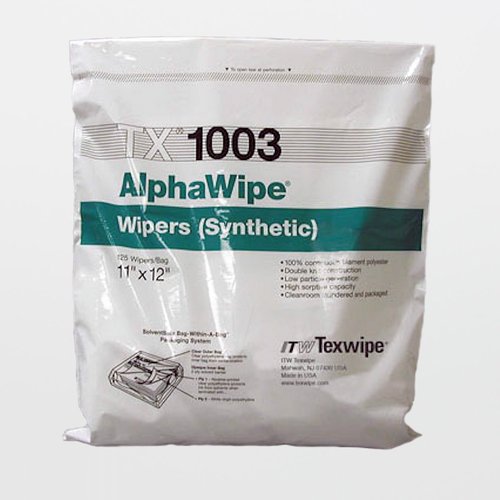
Precision Cleaning in Controlled Environments: The Engineering Behind Texwipe TX1004 AlphaWipe®
The Technical Vault
By SOSCleanroom | Texwipe TX1004 AlphaWipe®
ISO 14644 Operations Control
4" x 4" Precision Format
100% Polyester
Laundered Cut Edge
High Absorbency
ISO 4-8 Guidance
Lot Traceability
1. TX1004 Technical Overview: Small-Format Polyester Cleaning
Texwipe TX1004 AlphaWipe® is a
4" x 4" (10 x 10 cm), dry, nonsterile,
100% polyester cleanroom wiper designed
for precision wiping, spill pickup,
controlled solvent application and routine
contamination-control operations.
The wiper uses a cut-edge polyester
textile that is cleanroom laundered and packaged.
Texwipe describes AlphaWipe as highly absorbent,
resistant to snagging during appropriate
use, and suitable for cleaning with a
variety of approved solutions.
Its compact size is useful when operators
clean localized work areas, instruments,
fixtures, fasteners and small components
where a larger wiper creates unnecessary
material handling or reduces precision.
Operations takeaway:
TX1004 should be managed as part of
a controlled cleaning method.
Wiper size, solvent wetness, wiping
direction, contact pressure, clean-face
rotation and change-out frequency
all affect contamination-control performance.
2. ISO 14644-5:2025 and the Operations Control Programme
ISO 14644-5:2025 establishes
requirements for an
Operations Control Programme (OCP)
intended to maintain specified cleanliness
levels during cleanroom operation.
The OCP addresses personnel and material
movement, cleaning, maintenance, monitoring,
training and other operational controls.
For cleanroom wiping, this framework
emphasizes the importance of selecting
appropriate consumables and defining
how they are introduced, used and discarded.
A 4" x 4" wipe such as TX1004 can make
localized cleaning procedures easier to
standardize. Operators can define
a smaller contact area, repeatable
wiping paths and consistent solvent
application for specific surfaces.
- Material Introduction: Define how unopened and opened packages enter controlled areas.
- Wiper Selection: Specify approved materials, sizes and contamination characteristics.
- Cleaning Method: Define wetness, fold pattern, strokes and direction.
- Personnel Practices: Control glove contamination and unnecessary contact with wipe surfaces.
- Monitoring: Evaluate cleaning performance according to approved acceptance criteria.
- Change-Out: Determine when a used wipe must be discarded.
Method control:
Standardizing the wipe alone is not enough.
The cleaning solution, operator practices,
surface geometry and wiping sequence
should also be controlled when they
materially affect the cleaning result.
3. Product Specifications for RFQs, SOPs and Receiving
- Manufacturer: ITW Texwipe
- Product: AlphaWipe® TX1004
- Type: Dry cleanroom wiper
- Sterility: Nonsterile
- Size: 4" x 4" nominal (10 x 10 cm)
- Material: 100% polyester
- Fiber Construction: Continuous-filament polyester
- Knit: Double-knit, no-run interlock, as described in SOS catalog documentation
- Edge: Laundered cut edge
- Sealed Edge: No
- Processing: Cleanroom laundered and packaged
- Manufacturer ISO Environment Guidance: ISO Class 4-8
- EU Environment Guidance: Grade A-D, subject to specific process requirements
- Typical Basis Weight: 158 g/m²
- Typical Sorptive Capacity: 530 mL/m²
- Typical Sorptive Rate: Less than 0.3 second
- Typical LPC Count: 8.4 x 10⁶ particles/m² at ≥0.5 µm
- Typical Fiber Count: 2,000 fibers/m² at >100 µm
- Typical IPA NVR: 0.06 g/m²
- Typical DI-Water NVR: 0.01 g/m²
- Solvent Compatibility: Manufacturer lists IPA, acetone and suitable degreasers
- Temperature Guidance: Applications below 400°F (205°C), subject to qualification
- Autoclave: Manufacturer lists the dry wiper as autoclave safe
- Shelf Life: 5 years from date of manufacture, nonsterile dry
- Inner Packaging: 2 bags of 150 wipers
- Outer Bag: 300 wipers
- Case: 20 bags / 6,000 wipers
- Traceability: Individually lot-coded packaging
- Country of Origin: Verify current manufacturer lot documentation
Important receiving correction:
Texwipe specifies
300 wipers per outer bag,
20 outer bags per case,
and 6,000 wipers per case.
A 10-bag case quantity is not the
published standard configuration for TX1004.
4. Understanding Texwipe's Published Technical Data
Texwipe publishes analytical data for the
AlphaWipe® family, including particle
release, fiber counts, nonvolatile residues,
extractable ions and physical characteristics.
These measurements help quality and
contamination-control teams compare
wiping materials using specific
manufacturer test procedures.
The tables that follow reproduce
typical AlphaWipe family results
from Texwipe's published
TEX-LIT-TDS-004 Rev. 00-02/17
technical datasheet.
Data limitation:
Manufacturer typical values describe
representative analytical results.
They are not guaranteed TX1004
lot-release specifications or
automatic acceptance limits.
Request current specifications and
lot-specific documentation whenever
numerical cleanliness criteria are required.
5. Particle and Fiber Release: Typical Manufacturer Results
Cleanroom wiping is intended to remove
unwanted contamination without adding
excessive new particles or fibers.
Particle and fiber counts provide
important information for evaluating
wiping materials in sensitive processes.
| Test Parameter |
Typical Result |
Test Reference |
| LPC Particles ≥0.5 µm |
8.4 x 10⁶ particles/m² |
IEST method basis / TM22 |
| Fibers >100 µm |
2,000 fibers/m² |
ASTM E2090 method basis / TM22 |
These measurements represent
contamination extracted or released
under standardized analytical conditions.
They are not a direct prediction of
how many particles a single wipe
will release during every cleaning operation.
Actual contamination contribution depends
on mechanical pressure, fabric damage,
surface roughness, solution chemistry,
operator technique and changes in the
wiper's condition during use.
Analytical interpretation:
A low-linting wiper is not
a zero-particle or zero-fiber product.
Use published data for evaluation
and process qualification, not as
proof that shedding cannot occur.
6. Nonvolatile Residue: IPA and DI-Water Extractables
Nonvolatile residues, or NVRs,
are substances remaining after an
extraction solvent is evaporated
under controlled test conditions.
NVR testing matters because cleaning
materials can transfer trace substances
onto equipment, optics, electronic
components and process surfaces.
| Extractant |
Typical NVR |
Test Method |
| Isopropyl Alcohol |
0.06 g/m² |
TM1 |
| Deionized Water |
0.01 g/m² |
TM1 |
Different extraction liquids can
remove different substances from
the same wiping material.
IPA and DI-water results should
therefore be considered separately.
Residue control:
TX1004's typical NVR performance
supports its evaluation for
controlled-environment cleaning.
Processes with exceptionally strict
residue limits may require
a different wiper or additional
material qualification.
7. Extractable Ions and Why They Matter
Ionic residues can be relevant to
corrosion, electronic reliability
and surface cleanliness in
sensitive manufacturing processes.
Texwipe reports typical extractable
ion values for the AlphaWipe family.
| Ion |
Typical Result |
Test Method |
| Sodium |
0.15 ppm |
TM18 |
| Potassium |
0.03 ppm |
TM18 |
| Chloride |
0.10 ppm |
TM18 |
These results should be assessed
against the contamination sensitivity
of the specific process and the
analytical method being used.
They are not universal maximum
ionic contamination limits.
8. Absorbency Engineering: Capacity, Rate and Basis Weight
TX1004 is designed for high absorbency
in a relatively small textile format.
This can be useful for localized
spill pickup, controlled solution
application and routine equipment cleaning.
| Physical Property |
Typical Result |
Test Method |
| Sorptive Capacity |
530 mL/m² |
TM20 |
| Sorptive Rate |
Less than 0.3 second |
TM20 |
| Basis Weight |
158 g/m² |
TM20 |
Sorptive capacity describes liquid
uptake under a defined test method.
Sorptive rate describes how quickly
the material begins absorbing
the test liquid.
These properties help compare
cleanroom textiles but do not
guarantee a particular cleaning
result for every chemical
or surface configuration.
Practical takeaway:
High absorbency supports liquid pickup,
but using a saturated wiper beyond
its change-out point can cause
streaking, spreading or redeposition.
9. Continuous-Filament Polyester and Knitted Wiper Construction
Polyester is widely used in cleanroom
wipers because it offers useful
mechanical strength, controlled
linting performance and compatibility
with many cleaning solvents.
TX1004's knitted polyester construction
supports repeated folding and surface
wiping while maintaining useful
liquid absorption.
The continuous-filament description
refers to long synthetic fibers
rather than short staple fibers.
This can help reduce certain
fiber-shedding mechanisms, though
the complete wiper construction
and process conditions determine
actual particle generation.
10. Cut Edge vs. Sealed Edge: Choosing the Right Contamination-Control Strategy
TX1004 features a
cleanroom-laundered cut edge.
The edge is not thermally sealed.
This distinction matters when evaluating
fiber release during contact with
abrasive or snag-prone surfaces.
| Edge Type |
Construction |
Selection Consideration |
| Cut Edge |
Textile is cut to size and processed for cleanroom use. |
Useful for many routine cleaning procedures where the documented particle limits are acceptable. |
| Sealed Edge |
Perimeter fibers receive edge-finishing treatment. |
May reduce edge-related shedding during abrasive contact. |
| Sealed Border |
Defined sealed perimeter surrounding the wiping textile. |
Selected when additional edge integrity and fiber control are important. |
Texwipe describes AlphaWipe as
suitable for use on abrasive surfaces,
but this does not establish
identical performance to a sealed-edge
or sealed-border product.
Selection guidance:
When the wiping method specifically
requires sealed-edge construction,
compare TX1004 with
Texwipe TX2064 ThermaSeal 60
or another qualified sealed-edge product.
11. Why Small-Format Wipers Improve Localized Cleaning Control
Large wipers can be inefficient
when cleaning small workpieces
or recessed equipment features.
Excess material may contact
unintended surfaces or
complicate precise movement.
TX1004 provides a compact format
suitable for cleaning small parts,
fixtures and touchpoints.
The reduced geometry can help
standardize stroke length,
pressure and solvent loading.
- Localized component cleaning
- Small bench and equipment wipe-downs
- Precision wiping of fixtures
- Controlled liquid application
- Small-area spill pickup
- Cleaning near fasteners and equipment ports
- Repeatable cleaning of narrow work surfaces
Method reminder:
Compact wipers still require
defined change-out criteria.
Using the same wiping face
repeatedly can redistribute
contamination onto previously
cleaned surfaces.
12. Solvent Compatibility and Controlled Wet Wiping
Texwipe identifies AlphaWipe as
compatible with a variety of
cleaning solutions, including
isopropyl alcohol (IPA),
acetone and suitable degreasers.
This makes TX1004 useful for
evaluation in cleaning methods
requiring controlled application
or removal of solvents,
lubricants, adhesives and
other compatible residues.
- IPA: Commonly used for compatible surface and equipment cleaning.
- Acetone: Requires verification of surface, coating and process compatibility.
- Degreasers: Qualify the exact cleaning formulation before use.
- Approved Disinfectants: Apply only where the wiper, solution and cleaning method meet the process requirements.
- Aqueous Cleaning: Suitable for evaluation where the textile and approved process meet contamination limits.
Safety note:
Wiper compatibility does not
establish the safety of a
solvent for operators or
equipment. Follow the current
safety data sheet, EHS controls,
ventilation requirements and
approved handling procedures.
13. Best-Practice Wiping Method for TX1004
A consistent cleaning method
reduces unnecessary variation
between operators, shifts
and workstations.
-
Prepare the Area:
Follow the facility's approved
material introduction and
cleaning procedures.
-
Control Packaging:
Remove outer packaging where required
and keep unused inner bags protected.
-
Use Clean Gloves:
Avoid unnecessary contact between
the wipe and uncontrolled surfaces.
-
Fold as Required:
Use a consistent fold pattern
when the procedure requires
multiple clean wiping faces.
-
Apply Cleaning Solution:
Use the approved chemistry and
prescribed liquid volume.
-
Control Wetness:
Avoid uncontrolled dripping,
pooling and oversaturation.
-
Use Defined Wiping Strokes:
Follow the required direction,
overlap and contact pressure.
-
Rotate Clean Faces:
Avoid transferring collected
contamination to clean areas.
-
Manage Sharp Features:
Limit unnecessary abrasion
of the cut edges.
-
Discard Appropriately:
Remove wipers from use when
loaded, damaged, contaminated
or outside the specified
change-out interval.
Method standardization:
For reproducible results,
define solvent wetness,
wiping direction, fold pattern,
stroke count and wipe
change-out criteria in the SOP.
14. Common Cleaning Failure Modes
| Issue |
Potential Cause |
Recommended Control |
| Fiber release |
Excessive friction or edge snagging |
Reduce abrasive contact or qualify a sealed-edge alternative. |
| Particle redeposition |
Repeated use of a loaded wiping face |
Rotate clean faces and change wipers according to the SOP. |
| Streaking |
Residual chemistry, contamination or poor wetness control |
Review cleaning solution, concentration and wiping method. |
| Excess liquid |
Oversaturation of a small wipe |
Use a measured liquid application method. |
| Handling contamination |
Uncontrolled gloves, packaging or storage |
Follow approved introduction, dispensing and storage controls. |
| Ineffective narrow-area cleaning |
Wiper cannot access the feature effectively |
Use a correctly sized cleanroom swab or precision tool. |
| Sterility mismatch |
Nonsterile product used in a sterile-required process |
Use a qualified sterile wiper with suitable handling procedures. |
15. Recommended ISO Environments and Process Qualification
Texwipe's current product page
identifies ISO Class 4-8
as the recommended environment range
for AlphaWipe TX1004.
The manufacturer also lists
EU Grade A-D
environment guidance.
These statements must not be interpreted
as authorization to use nonsterile
wipes in every classified pharmaceutical
operation.
Cleaning-material approval should
account for the process, particle
limits, surface sensitivity,
microbial controls, required
sterility and material-transfer
procedures.
Critical qualification point:
A wiper recommended for use
in an ISO-classified environment
is not thereby certified as
sterile or suitable for every
critical aseptic operation.
16. USP <797>, USP <800> and Sterility Considerations
Texwipe states that the AlphaWipe
family meets its published
USP <797> and USP <800>
wiper requirements and that
dry AlphaWipe products are
autoclave safe.
These manufacturer statements
support product evaluation for
applicable pharmacy and
pharmaceutical cleaning procedures.
However, the complete workflow must
satisfy the facility's specific
cleaning, disinfection, deactivation,
decontamination and sterility requirements.
TX1004 is supplied nonsterile.
It is not equivalent to
the sterile STX1004 configuration.
Sterility requirement:
Use manufacturer-supplied sterile
wiping materials or a separately
validated sterilization process
wherever the cleaning procedure
requires sterile supplies.
Autoclave compatibility alone
does not demonstrate a validated
sterility assurance level.
17. Temperature Compatibility and Autoclaving
Texwipe identifies AlphaWipe
as appropriate for applications
below 400°F (205°C)
and states that dry wipers
are autoclave safe.
These are manufacturer
application statements rather
than unrestricted guarantees.
Use in elevated-temperature
cleaning or sterilization must
account for temperature,
exposure time, process conditions
and the requirements of the
applicable equipment and SOP.
Safety and validation:
Do not treat the published
temperature guidance as approval
for contact with every heated
surface. Follow the manufacturer's
instructions and approved
facility procedures.
18. Wiper Comparison: TX1004 vs. Other 4" x 4" Options
| Model |
Construction |
Primary Selection Consideration |
| TX1004 |
Dry, cut-edge polyester knit |
Compact cleaning, high absorbency and routine controlled wiping |
| TX2064 |
Dry polyester, thermally sealed edge |
Additional edge integrity for snag-prone surfaces |
| TX404 |
Dry hydroentangled polyester nonwoven |
Soft wiping and residue-sensitive component cleaning |
| TX604 |
Dry cellulose/polyester nonwoven |
Economical general wiping and aqueous liquid pickup |
| TX8944 |
Dry polyester, sealed edge |
Alternative sealed-edge option with distinct cleanliness characteristics |
| STX1004 |
Sterile, dry polyester cut edge |
Sterile wiping where manufacturer-supplied sterility is required |
| TX1034 |
Nonsterile, pre-wetted polyester with 70% IPA |
Controlled solvent delivery without manual wetting |
Substitution guidance:
Similar wiper dimensions do not
establish material equivalence.
Compare fiber composition,
construction, edge finishing,
cleanliness data, solvent chemistry,
packaging and sterility before
approving alternatives.
19. Recommended Cleanroom Glove Pairing
A cleanroom wiper and the gloves
used to handle it form part of
the same contamination-control system.
An otherwise suitable low-particle
wipe can become contaminated
through uncontrolled glove contact.
Glove discipline:
Replace gloves when torn,
contaminated or otherwise
unsuitable. Do not assume that
a nonsterile cleanroom glove
is acceptable where sterile
gloves are required.
20. Packaging, Shelf Life and Traceability
Packaging helps protect the
cleanliness of the wipers
before they are introduced
into controlled work areas.
Texwipe TX1004 is supplied in
300-wiper outer bags containing
two inner bags of 150.
Manufacturer case packaging
consists of 20 outer bags.
- Product: TX1004
- Inner Bag: 150 wipers
- Outer Bag: 2 inner bags / 300 wipers
- Case: 20 outer bags
- Case Total: 6,000 wipers
- Product Form: Dry, nonsterile
- Shelf Life: 5 years from manufacture
- Traceability: Individually lot-coded packaging
Use the manufacturer's
storage instructions and
facility inventory procedures
to maintain material condition
before distribution.
For regulated programs,
maintain the part number,
lot information, receipt date,
expiration or manufacture
information and relevant
manufacturer documentation.
21. Country-of-Origin Documentation
Country of origin is an important
procurement detail for certain
regulated, contractual and
government purchasing programs.
The Texwipe AlphaWipe technical
datasheet published in 2017
identifies TX1004 with a
China-origin footnote.
A current country-of-origin
statement should therefore be
confirmed through the
manufacturer's applicable
product and lot documentation.
Procurement control:
Do not rely solely on an older
family datasheet or distributor
website attribute for a
country-of-origin requirement.
Request current manufacturer
confirmation for the delivered
product when origin affects
purchasing eligibility.
22. Troubleshooting Cleaning Performance
When wipe-down results become
inconsistent, investigate the
complete cleaning method rather
than assuming the wiping material
is the sole cause.
- TX1004 lot number and package condition
- Cleaning chemistry and concentration
- Surface type and contamination level
- Wiper saturation and solvent application
- Operator glove condition
- Wiping direction and contact pressure
- Number of passes and clean-face rotation
- Contact with sharp or abrasive features
- Observed particle, fiber or residue problems
- Applicable surface cleanliness acceptance criteria
Investigation principle:
Published typical contamination
data can support material
evaluation but do not
independently establish
the root cause of a
cleaning-process deviation.
23. Technical FAQs: Texwipe TX1004
What is Texwipe TX1004?
A 4" x 4", dry, nonsterile,
cut-edge polyester cleanroom
wiper intended for precision
cleaning, spill control and
solution application.
Is TX1004 made from polyester?
Yes. Texwipe identifies
the product as 100% polyester.
Does TX1004 have a sealed edge?
No. TX1004 uses a cleanroom-laundered
cut edge, not a sealed edge.
What ISO class is TX1004 recommended for?
Texwipe recommends ISO Class 4-8
environments. Final suitability
depends on process qualification.
Is TX1004 sterile?
No. TX1004 is supplied nonsterile.
STX1004 is the manufacturer-supplied
sterile 4" x 4" AlphaWipe option.
Can TX1004 be used with IPA?
Yes. Texwipe identifies
IPA among compatible cleaning
solvents, subject to applicable
surface and SOP requirements.
Can TX1004 be used to clean abrasive surfaces?
Texwipe describes the AlphaWipe
construction as suitable for
appropriate abrasive surface wiping.
However, excessive force and
sharp edges can still cause
textile damage and shedding.
Is TX1004 autoclave safe?
Texwipe lists dry AlphaWipe
as autoclave safe.
This does not make TX1004
sterile as supplied or replace
a validated sterilization process.
How many wipers are in a TX1004 bag?
300 wipers per outer bag,
containing two inner bags
of 150 wipers.
How many TX1004 wipers are in a case?
6,000 wipers per case:
20 outer bags of 300.
What is the shelf life of TX1004?
Five years from the date
of manufacture for the
nonsterile dry wiper.
Are the particle and residue values guaranteed?
No. The manufacturer identifies
the published values as typical
analyses, not guaranteed
lot-release specifications.
24. Related Texwipe Products Available From SOSCleanroom
25. Why Buy Texwipe TX1004 From SOSCleanroom?
-
Texwipe Master Distributor:
Access genuine Texwipe contamination-control supplies.
-
Correct Configuration:
Specify the exact TX1004 SKU and
required 300-wiper bag or 6,000-wiper case.
-
Product Comparisons:
Evaluate cut-edge, sealed-edge,
polyester and nonwoven alternatives.
-
Manufacturer Documentation:
Access datasheets and assistance
with qualification requirements.
-
Cleanroom Purchasing:
Coordinate wipers, gloves,
swabs, solutions and
related consumables.
-
Recurring Supply:
Support standardized replenishment
and purchasing programs.
26. Manufacturer Documentation and Technical References
Documentation reconciliation:
Texwipe's manufacturer product page
and AlphaWipe technical datasheet
specify TX1004 as a
4" x 4", dry, nonsterile,
cut-edge polyester wiper,
with 300 wipers/bag
and 20 bags/case.
Its recommended environment is
ISO Class 4-8.
The analytical tables above reproduce
the manufacturer's published
typical AlphaWipe family values.
Verify current lot documentation
where exact performance or
country of origin is required.
Technical guidance disclaimer:
This information is provided
for product-selection and
contamination-control guidance.
It does not replace current
manufacturer instructions,
facility SOPs, cleaning validation,
process qualification, EHS controls
or applicable regulatory requirements.
Published typical analytical values
are not guaranteed lot-release
specifications. Use must be
approved for the actual environment,
surface, cleaning chemistry,
sterility and contamination
requirements.
If you have any questions,
please email Sales@SOSsupply.com
or call (214) 340-8574.
OR check out the AI ChatBot powered
by SOSCleanroom data libraries -
give it a try! THIS IS NEW FOR 2026!
Last reviewed:
October 14, 2026 (SOS Technical Staff)
© 2026 Specialty Optical Systems, Inc.
(dba SOSCleanroom). All rights reserved.