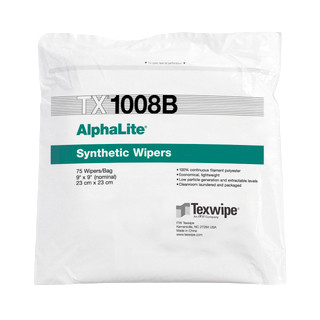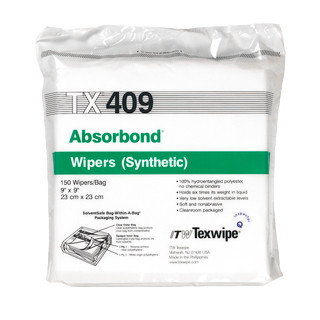
Texwipe TX409 Absorbond 9" x 9" Polyester Cleanroom Wiper

$64.39
(No reviews yet)
SKU:
TX409 BAG
Availability:
Stock Item
Shipping:
Calculated at Checkout
Quantity Option (Bag):
300 Wipers Per Bag (2 Inner Bags of 150 Wipers)
Quantity Option (Case):
10 Bags of 300 Wipers Per Case
Type:
Dry Wiper
Wiper Family:
Absorbond
Wiper Material:
Polyester
Wiper Size:
9" x 9"
Wiper Edge:
Cut Edge
ISO Class:
ISO 5 (Class 100)
ISO Class:
ISO 6 (Class 1,000)
ISO Class:
ISO 7 (Class 10,000)
ISO Class:
ISO 8 (Class 100,000)

TX409 Absorbond 9" x 9" Polyester Cleanroom Wiper

TX409 Absorbond is a low-linting (no wiper is truly ‘zero-lint’ in every process condition), hydroentangled polyester cleanroom wiper selected for critical wiping where softness, non-abrasiveness, and very low nonvolatile residue (NVR) extractables are essential. Absorbond is made from 100% hydroentangled polyester; the hydroentanglement process uses jets of water to mechanically entangle fibers, eliminating the need for chemical binders. Even though Absorbond contains no surfactants, its sorptive capacity is five times its weight due to the density of its fiber structure, which supports liquid uptake through capillary action.

Best-seller note: TX409 is commonly specified for oil/grease cleanup and delicate optical-grade components because it combines high sorptive capacity with a soft, non-abrasive surface and ultra-low extractables for residue-sensitive processes.

Specifications:
  • Size: 9" x 9" (23 cm x 23 cm) nominal
  • Material/Structure: 100% hydroentangled polyester (100% synthetic fiber)
  • Binders/Surfactants: No binders; no surfactants
  • Edge: Cut edge
  • Packaging: 300 wipers/bag (2 inner bags of 150); 10 bags/case
  • Cleanroom packaging: SolventSafe Bag-Within-A-Bag® cleanroom packaging
  • ISO environment: ISO 5 (Class 100) – ISO 8 (Class 100,000)
  • Absorbency (typical): Sorptive capacity 210 mL/m2 (IPA); sorptive rate 1.4 seconds (IPA)
  • Contamination data (typical): IPA extractant NVR 0.01 g/m2; DIW extractant NVR 0.005 g/m2
  • Ionics (typical): Na 7.0 ppm; K 2.0 ppm; Cl 5.0 ppm
  • Use environments: Controlled wiping where residue limits and non-abrasive handling matter (final suitability depends on your process and cleaning method)
About the Manufacturer: 

Texwipe (an ITW company) positions Absorbond as an engineered wiper platform for residue-sensitive and optics-adjacent processes—where softness and low extractables matter as much as particle control. In Absorbond, the hydroentanglement process mechanically entangles fibers using water jets (without chemical binders), and the finished product is packaged in solvent-safe bag-within-a-bag cleanroom packaging to support controlled handling and transfer discipline.


Texwipe also highlights statistical quality control and lot-to-lot traceability in this family. SOSCleanroom (SOS) supports that documentation discipline with a close working relationship with Texwipe focused on continuity of supply, clean documentation handoff (certs, lot traceability), and practical application support—so customers can standardize wiping materials with predictable performance while maintaining procurement reliability and audit readiness.

TX409 Features:
  • 100% synthetic fiber (hydroentangled polyester)
  • No binders
  • SolventSafe Bag-Within-A-Bag® cleanroom packaging
  • Statistical Quality Control
  • Excellent oil and grease absorption
TX409 Benefits:
  • High sorptive capacity: Provides absorbency up to five times its own weight for effective pickup of oils, greases, and process fluids (process-dependent)
  • Non-abrasive handling: Soft, durable surface helps prevent abrasion on delicate and finish-critical components
  • Residue control: Very low solvent extractable levels help reduce NVR risk where residues are tightly controlled
  • Lot traceability: Supports standardization and documentation expectations through lot-to-lot traceability
Common Applications:
  • Cleaning and absorbing oil and grease
  • Very low solvent extractable levels make Absorbond ideal for applications where low nonvolatile residue is essential
  • Non-abrasive cleaning and handling of delicate optical-grade components such as coated lenses, fiber optic sensors, and mirrors
  • Cleaning precision assembly components and sensitive surfaces
  • Low-contamination work surface
Best-Practice Use:
  • Fold for control: Fold into quarters to create multiple clean faces; rotate faces instead of re-wiping with a loaded surface.
  • Wipe pattern: Use straight-line strokes (top-to-bottom or left-to-right) to avoid re-depositing contamination.
  • Oil/grease pickup: For heavy oils, use light pressure first to “lift” the film, then refold to a clean face for a final pass to reduce smearing.
  • Residue discipline: When NVR limits matter, avoid over-wetting and avoid reusing a loaded face; change wipers early to protect cleanliness performance.
  • Optics handling: For coated lenses and mirrors, use minimal pressure and a fresh face to reduce drag marks; validate technique against your finish criteria and SOP.
Selection Notes (TX409 vs. Other Options)
  • TX409 vs. TX404: Same Absorbond family and material; choose TX404 (4" x 4") for tight work areas or small parts; choose TX409 when you want more surface area per wipe.
  • Absorbond vs. knit polyester (TX1009/TX1009B): Choose Absorbond when softness and ultra-low extractables are the priority; choose knit polyester when higher mechanical durability and scrub strength are needed on equipment and fixtures.
  • Cut edge vs. sealed edge (TX2069): If your wipe-down involves abrasive edges, sharp corners, or higher snag risk, consider a sealed-edge polyester option; for residue-sensitive optics work, Absorbond often stays in the lead.

Link to Texwipe Technical Datasheet:
Click Here

Other Similar Products Available From SOSCleanroom.com

Absorbond Dry Wipers

  • TX404: 4" x 4" (10 cm x 10 cm), hydroentangled polyester, 1200 wipers/bag
  • TX409: 9" x 9" (23 cm x 23 cm), hydroentangled polyester, 300 wipers/bag

Other 9" x 9" Polyester Options

  • TX1009B: AlphaWipe 9" x 9" polyester knit, bulk-packed presentation
  • TX2069: ThermaSeal60 9" x 9" sealed-edge polyester knit for abrasion-heavy wipe-downs
  • TX8949: TexVantage 9" x 9" sealed-edge polyester for durability and traceability-driven programs

Notes: Looking for application guidance or qualification context for Texwipe TX409 Absorbond 9" x 9" hydroentangled polyester cleanroom wipers? Open the SOSCleanroom Technical Vault tab above for practical wiping technique, selection notes (TX409 vs. alternatives), and the documentation details teams typically review when standardizing residue-sensitive wipes across ISO-class controlled environments.

SOSCleanroom.com supports contamination-control programs with cleanroom consumables in stock, fair pricing, and responsive technical support—backed by same-day shipping options and customer service that understands real cleanroom workflows.

Product page updated: Jan. 1, 2026 (SOS Technical Staff)

© 2026 SOS Supply. All rights reserved.

The Technical Vault
By SOSCleanroom
Absorbency Without the Scratch Risk: Why TX409 Absorbond Is a Practical Choice for Oils, Grease, and Optics-Adjacent Wiping
Last reviewed: Jan. 1, 2026 |  Audience: contamination control, cleanroom operations, optics/precision assembly, quality, EHS

“Absorbent” and “scratch-safe” do not always coexist in daily cleanroom wiping. Many high-uptake options either shed under pressure, abrade delicate surfaces, or carry residue/ion risk that only shows up after dry-down. Texwipe TX409 Absorbond (9" × 9") is positioned for the middle ground where technicians need fast pickup of oils, grease films, and solution carryover while maintaining a controlled-environment posture.

Absorbond is built as a 100% polyester nonwoven with a cut edge and is positioned for ISO Class 5–8 use. Texwipe also frames the family around high sorption (notably “sorptive capacity is 5× its weight”), chemical resistance, and suitability for scratch-sensitive wiping—practical attributes when cleaning happens near optics, coated parts, or cosmetic surfaces that cannot tolerate haze, micro-scratching, or wipe-induced defects.

What it’s for

TX409 is best used for high-absorbency wipe-downs where the soil set includes oils, grease, lubricants, adhesives, and general process residues—especially when the surface is scratch-sensitive or the work is optics-adjacent. Manufacturer positioning for the Absorbond family includes wiping and cleaning optical devices (lenses and other scratch-sensitive surfaces), applying/removing lubricants and residues (including disinfectants), and cleaning with solvents such as IPA, acetone, and degreasers.

Decision drivers

TX409 earns consideration when the program needs absorbency and surface safety without giving up controlled-environment discipline:

  • Substrate for scratch-sensitive work: 100% polyester nonwoven is positioned as soft and non-abrasive for delicate surfaces.
  • Absorbency as the primary control: Absorbond is framed around very high uptake (often summarized as “5× its weight”) to reduce passes and reduce “smear events.”
  • Chemical resistance posture: positioned as compatible with a variety of solutions and common solvent workflows (including IPA) and compatible with QUAT disinfectants.
  • Cleanroom placement range: positioned for ISO Class 5–8 environments, supporting broader deployment than “shop absorbents.”
  • Autoclave-safe claim (as a material capability): useful where facilities run in-house sterilization workflows, provided the site owns cycle qualification and post-cycle performance checks.
  • Operational reliability: sourcing through SOSCleanroom supports continuity of supply and consistent documentation handoff so operators are not forced into unqualified substitutions.
Materials and construction – explained like an engineer

Absorbond’s core engineering idea is a nonwoven structure that creates a large capillary network—lots of pathways for liquid to move into the web quickly—while keeping the “hand” soft enough to protect scratch-sensitive surfaces. Polyester also tends to be a stable polymer in many solvent and disinfectant workflows, which is one reason 100% polyester wipes remain a default in controlled cleaning programs.

The trade-off to manage is the edge and abrasion condition. A cut edge is appropriate for many wiping jobs, but if the process is highly sensitive to edge-driven releasables (stringers at fold lines, fibers at corners, aggressive pressure on textured surfaces), the technical step-up is often an engineered edge strategy (sealed-edge/sealed-border) rather than “wiping harder” with the same format.

Cleanliness and performance metrics

For oils, grease, and adhesive films, performance is usually governed by three mechanisms: (1) how quickly the wipe wets and wicks the soil, (2) whether the wipe keeps the soil in the web (instead of re-smearing), and (3) whether the wipe introduces releasables or residues that become visible after dry-down.

Texwipe positions Absorbond as providing low leve