The Technical Vault
By SOSCleanroom
ISO 14644 Operations Control
AlphaSat® Pre-Wetted
6% IPA / 94% DI Water
Large-Surface Cleaning
Lot Traceability
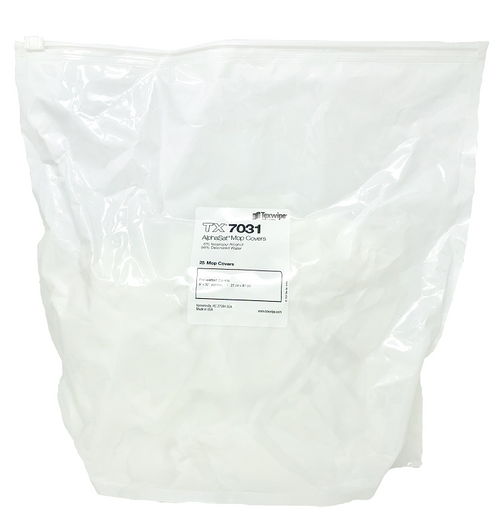
TX7031 “Long-Lane Control” AlphaSat®: the 9" x 32" pre-wetted mop-cover wipe that standardizes wetness without the spray bottle
TX7031 is a long-format AlphaSat® polyester wiper that also functions as a mop cover, pre-wetted with a
0.2 µm filtered 6% IPA / 94% DI water blend to standardize wetness and reduce operator-dependent variability.
For many facilities, the real win is not “more alcohol” — it is process control: consistent wet-out, consistent wipe feel,
and repeatable surface coverage when cleaning larger panels, benches, stainless, carts, or pass-through interiors.
Operations takeaway: TX7031 is most effective when treated as part of your Operations Control Programme —
defined wipe technique, defined coverage lanes, defined change-out triggers, and controlled bag-handling so “wetness” does not drift during the shift.
Clarity on scope: TX7031 is a non-sterile, pre-wetted cleanroom wiping product intended for controlled cleaning and wetness standardization.
A 6% IPA/DI water pre-wet is typically selected for repeatable cleaning — not as a stand-alone disinfection or sterility claim.
Follow your SOP for any disinfection/sporicidal requirements and dwell-time expectations.
Specs at a glance (quick reference)
| Product |
Texwipe AlphaSat® TX7031 |
| Format |
Wiper / mop cover (long-format wipe for large-surface lanes) |
| Size |
9" x 32" nominal |
| Substrate |
100% continuous-filament polyester; double-knit construction |
| Edge |
Cut edge |
| Pre-wet chemistry |
0.2 µm filtered 6% IPA / 94% DI water (semiconductor-grade IPA) |
| Sterility |
Non-sterile |
| Packaging |
Reclosable bag (wetness control) with lot traceability |
| Pack configuration |
25 wipers/bag; 4 bags/case; 100 wipers/case |
| Cleanroom positioning |
Commonly used across ISO Class 4–8 (confirm suitability) |
| Country of origin |
Made in the USA |
Receiving control: If TX7031 is specified in SOPs, treat SKU + pack as configuration control. Avoid “close enough” substitutions without change control.
What it’s for
Routine cleaning and spill control on large surfaces in cleanrooms and controlled environments using a
controlled 6% IPA / 94% DI water pre-wet. Typical use cases include benches, stainless panels, carts,
pass-throughs, gowning fixtures, equipment covers, and mopping-style wipe-downs where a 9" x 32" format improves
reach and reduces changeouts.
Decision drivers (why customers standardize TX7031)
- Wetness control: 0.2 µm filtered 6% IPA / 94% DI water supports consistent wet-out and coverage without hand-mixing variability.
- Residue and VOC management: Lower IPA concentration moderates odor and rapid flash-off; validate residue acceptability for your process surfaces.
- Format efficiency: 9" x 32" improves reach and reduces wipe starts; fewer restarts can reduce redeposit risk when lane discipline is used.
- Substrate integrity: Continuous-filament, double-knit polyester is designed to resist abrasion and shedding during rigorous use.
- Documentation discipline: Lot coding and controlled packaging support investigations, deviations, and audit readiness when wipers are treated as controlled consumables.
- EHS controls: Even at 6% IPA, treat as a flammability-managed consumable with proper ignition-source controls and compliant disposal.
Materials and construction
TX7031 uses an AlphaWipe®/AlphaSat® family substrate: 100% polyester, continuous-filament, double-knit construction that is
cleanroom laundered and packaged. Continuous filament helps reduce fiber breakage compared with staple fibers, while the knit structure supports
sorption and abrasion resistance for routine wipe-downs and mop-style passes.
The edge strategy is listed as a cut edge. In practice, cut-edge performance is strongly influenced by laundering, knit stability,
and how the operator uses the wipe (pressure, directionality, and how long the wipe is overworked). For abrasion-prone tasks, use controlled pressure
and change wipes before they “go dry and grabby.”
Packaging, wetness control, and traceability
TX7031 is packaged for operational control: reclosable packaging intended to slow evaporation and preserve consistent wetness across the bag,
along with lot-to-lot traceability for quality control and investigations. In controlled environments, those features reduce the chance that “the wipe itself”
becomes the variable (dry-out, inconsistent saturation, or unidentified lots).
Rule of thumb: Treat the bag like a controlled container: open only long enough to remove what you will use immediately, then fully reclose.
If the wipe starts to feel “draggy,” stop and change — don’t overwork a drying wipe and redeposit what you just collected.
Proper wiping technique (required for performance and control)
1) Bag control
Open only to remove what you will use immediately; reclose fully to prevent wetness drift.
|
2) Lane discipline
Straight, overlapping passes (10–20% overlap). Clean-to-less-clean flow; do not backtrack.
|
3) Face rotation
Fold into sections; use one face per lane/panel segment, then rotate to a clean face.
|
4) Change-out triggers
Replace when loaded, streaking, or “draggy.” Overworking a drying wipe is the most common failure mode.
|
- Fold and present clean faces: Fold the 9" x 32" wipe into manageable sections; rotate to a clean face after each lane or panel segment.
- One-direction passes: Use straight, overlapping lanes; avoid circular scrubbing unless your SOP explicitly validates it for that soil.
- Pressure discipline: Use controlled, moderate pressure. Excess force can increase mechanical shedding risk and can push soils into microtexture on sensitive finishes.
- Mop-cover mode: If used as a cover, use an “S-pattern” with consistent overlap, then close out with a final straight pass. Replace the cover when visibly loaded or when drag increases.
- Chemistry segregation: Do not mix presaturated wipes with other chemistries in the same task unless your SOP explicitly allows it.
Method standardization tip: If outcomes differ by operator, lock four variables in the SOP: lane width/overlap, fold pattern, stroke count per surface, and change-out point.
Cleanliness and performance metrics (manufacturer-typical values)
Cleanroom wiper “typicals” should be treated as a starting point for risk assessment and qualification — not as a blanket guarantee for every task.
The most useful way to interpret metrics is by mechanism: particles/fibers (shedding), NVR (residue risk), and ions (surface/compatibility risk).
| Metric |
Typical value |
Why it matters |
| Basis weight |
~158 g/m2 |
Durability and handling feel; impacts sorption and abrasion behavior. |
| Sorptive capacity |
~530 mL/m2 |
Pickup capacity for films/spills; informs change-out triggers. |
| Sorptive rate |
<0.3–0.5 seconds |
How quickly the wipe wets and picks up liquids. |
| Particles (LPC ≥ 0.5 µm) |
8.4 x 10⁶ particles/m2 |
Inputs to contamination risk assessment and qualification. |
| Fibers > 100 µm |
2,000 fibers/m2 |
Fiber load inputs for critical surfaces and sensitivity. |
| NVR (IPA extractant) |
0.04–0.06 g/m2 |
Residue risk indicator for surface compatibility. |
| NVR (DIW extractant) |
0.01–0.02 g/m2 |
Residue risk indicator under aqueous extraction behavior. |
| Ions (typical) |
Na ~0.15–0.22 ppm; K ~0.03–0.06 ppm; Cl ~0.05–0.10 ppm |
Ionic contamination inputs for sensitive processes. |
| TX7031 pre-wet |
6% IPA / 94% DI water; 0.2 µm filtered |
Wetness standardization; moderates flash-off vs. higher IPA concentrations. |
Interpretation tip: Confirm these values against current manufacturer documentation and qualify on your actual surfaces and soils.
Common failure modes (what causes streaks, drift, and rework)
The most common failure mode with presaturated wipes is overworking a wipe as it dries — drag increases, pickup efficiency drops,
and soils can redeposit as streaks. Other frequent issues include leaving bags partially open (evaporation and wetness drift), using the wipe on incompatible
or highly sensitive coatings without prior validation, and “double-dipping” behavior (re-contacting a cleaned area with a loaded wipe). Prevent these by
enforcing clean-face rotation, lane discipline, and clear changeout triggers in the SOP.
Where it fits in a cleanroom wiping program
TX7031 is a strong candidate for routine, repeatable wipe-down and mop-style coverage on larger surfaces in ISO-classified environments
where consistent wetness is valued. It can serve as a default consumable for benches and stainless wipe-downs, cart and fixture cleaning, and controlled
spill response, especially when your program emphasizes reduced variability versus open-container wetting. For higher-criticality surfaces, qualify wipe-and-dry
behavior (streaking/residue) and confirm that the 6% IPA / DI water blend aligns with your residue and compatibility requirements.
Terminology note: Engineered for low-linting performance; no wiper is truly “lint-free” in every process condition.
Closest competitors (comparison framework)
Contec presaturated polyester wipes (large-format equivalents): Similar “process-control” logic (presaturated formats reduce wet-out variability).
Compare on solution filtration/grade, packaging closure design, available formats, and validation documentation for your industry.
Berkshire presaturated cleanroom wipers: Often comparable for general wipe-downs. Differences typically show up in substrate knit behavior under abrasion,
residue profiles, and how consistently wetness is maintained across time-in-use. For regulated programs, compare available certificates/lot traceability support and how
your site qualifies wipe performance on target surfaces.
Recommended non-sterile pairings (sterility alignment enforced)
TX7031 is a non-sterile product. All pairings below are intentionally non-sterile to avoid implied sterility claims and to support audit-ready program design.
Align final selection to your SOPs and qualification requirements.
Pairing discipline: Non-sterile products are paired only with non-sterile consumables. Sterile items should be referenced only when the featured product itself is sterile and the workflow explicitly requires sterile transfer and handling.
Glove discipline: Change gloves when contaminated, solvent-wet, torn, or after contacting non-controlled surfaces. During wiping, gloves are often the dominant contamination vector.
Why buy ITW Texwipe AlphaSat® from SOSCleanroom
- Master Distributor alignment: SOSCleanroom is a Master Distributor for ITW Texwipe, supporting correct SKU/pack configuration control and program continuity.
- Configuration control: Presaturated wipes are often standardized in SOPs; buying by exact SKU and case pack reduces “equivalent wipe” substitutions.
- Audit readiness support: We help customers locate current manufacturer documentation (TDS, SDS, method notes) aligned to receiving controls.
- One-cart procurement: Pair TX7031 with non-sterile cleanroom gloves, swabs, labels, and related facility consumables so your method stays consistent.
Manufacturer documentation (authoritative references)
-
Texwipe AlphaWipe® Technical Data Sheet (TEX-LIT-TDS-004):
Click Here
-
Texwipe Safety Data Sheet — 6% IPA pre-wetted wipes (TX1048; includes TX7031 family):
Click Here
-
Texwipe manufacturer product overview (TX7031 AlphaSat® family):
Click Here
-
Standards bodies (method overview pages):
IEST
|
ASTM
If you have any questions please email us at Sales@SOSsupply.com or give us a call at (214)340-8574.
OR check out the AI ChatBot powered by SOSCleanroom data libraries - give it a try! THIS IS NEW FOR 2026!
Disclaimer: This Technical Vault content is provided for general educational purposes only. It does not create or replace your facility SOPs,
validation/qualification, risk assessments, training requirements, or regulator/customer expectations. Always follow your approved procedures, current manufacturer
documentation (TDS/SDS), EHS controls, and applicable standards. Product selection and use must be confirmed by your internal quality and safety stakeholders for
the intended surfaces, residues, and process requirements.
© 2026 SOSCleanroom. All rights reserved.