
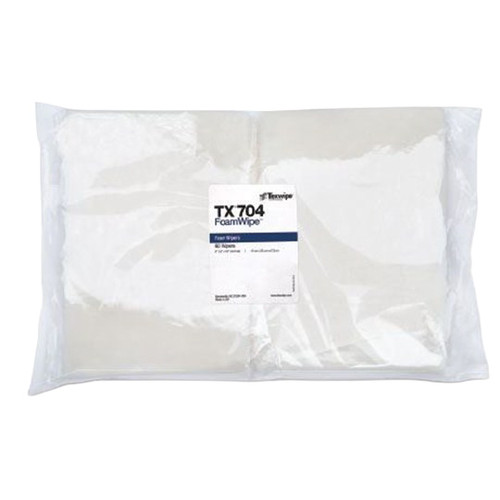
Texwipe TX704 FoamWipe 6" x 9" x 1/8" Polyurethane Foam Cleanroom Wiper

$42.78
(No reviews yet)
SKU:
TX704 BAG
Availability:
Stock Item
Shipping:
Calculated at Checkout
Quantity Option (Bag):
60 Wipers Per Bag (Double Bagged)
Quantity Option (Case):
8 Bags of 60 Wipers Per Case
Type:
Dry Wiper
Wiper Family:
FoamWipe
Wiper Material:
Foam
Wiper Size:
6" x 9"
Wiper Edge:
Cut Edge
ISO Class:
ISO 6 (Class 1,000)
ISO Class:
ISO 7 (Class 10,000)
ISO Class:
ISO 8 (Class 100,000)

TX704 FoamWipe 6" x 9" x 1/8" Polyurethane Foam Cleanroom Wiper

TX704 FoamWipe is a low-linting (no wiper is truly ‘zero-lint’ in every process condition), low particle-generation polyurethane foam cleanroom wiper designed for spill control, cleaning, and solution application in controlled environments. It is made from open-cell, 100 pore-per-inch (PPI) polyurethane foam and is precision cut with a cut edge to help reduce particle generation while providing a soft, non-abrasive wiping surface that also works well as a padded work surface during assembly or maintenance tasks.

Best-seller note: TX704 is frequently chosen when teams want a foam wipe that holds solvent well, supports controlled solution application on larger surfaces, and can double as a non-abrasive padded work surface in ISO 6–8 environments.

Specifications:
  • Size: 6" x 9" x 1/8" (15 cm x 23 cm x ~0.32 cm) nominal
  • Material/Structure: Open-cell polyurethane foam, 100 PPI (fully reticulated foam construction)
  • Edge: Cut edge; precision cut for low particle generation
  • Silicone: Silicone free
  • Packaging: 60 wipers/bag (double bagged); 8 bags/case
  • Wiper family: FoamWipe
  • ISO environment: ISO 6 – 8 (Class 1,000 – 100,000); EU Grade B – D
  • Temperature note: Appropriate for use with temperatures less than 350°F (177°C)
  • Shelf life: Non-sterile (dry) – 5 years from date of manufacture
  • Absorbency (typical): Sorptive capacity 900 mL/m2; sorptive rate 3.9 seconds (IPA)
  • Contamination data (typical): IPA extractant NVR 1.10 g/m2; DIW extractant NVR 0.30 g/m2
  • Ionics (typical): Na 1 ppm; K 0.009 ppm; Cl 10 ppm
  • Use environments: Cleanroom maintenance/assembly, wipe-downs, and solution application where a padded, non-abrasive foam surface is advantageous (final suitability depends on your process and cleaning method)
About the Manufacturer: 

Texwipe (an ITW company) positions FoamWipe as an engineered foam wiping platform for controlled environments, built around consistent foam structure (100 PPI open-cell polyurethane), cleanroom manufacturing, and performance baselines (absorbency, NVR, particles/fibers, and ionics) intended to support qualification and repeatability. The line is described as silicone free and packaged to support cleanroom handling, with lot coding called out as a traceability and quality-control aid.


SOSCleanroom (SOS) supports that manufacturing discipline with a close working relationship with Texwipe focused on continuity of supply, clean documentation handoff (certs, lot traceability), and practical application support—so customers can standardize foam wiping materials with predictable performance while maintaining procurement reliability and audit readiness.

TX704 Features:
  • Constructed from 100 PPI polyurethane foam for high absorbency and solvent hold
  • Precision cut for low particle generation; cut edge
  • Silicone free; double-bagged for cleanroom use
  • Unique texture positioned for picking up fine powder
  • Good chemical resistance for compatibility with a variety of solutions
  • Autoclave safe
  • Individually lot coded for ease of traceability and quality control
TX704 Benefits:
  • Low particle generation: Precision-cut foam is designed to reduce particle contribution during wipe-downs (process-dependent)
  • Excellent solvent capacity and hold: Reticulated foam structure supports controlled wetting and solution transfer to surfaces
  • Non-abrasive wiping: Soft foam surface supports delicate-contact wipe-downs and reduces scratch risk vs. rougher substrates
  • Dual-purpose handling: Can serve as a padded work surface to protect parts and finishes during staging and assembly
  • Program readiness: Lot coding and published technical baselines support standardization and documentation expectations
Common Applications:
  • For use in cleanroom maintenance and assembly operations
  • Wiping and cleaning surfaces, equipment and parts
  • Applying and removing lubricants, adhesives, residues and other solutions including disinfectants
  • Cleaning with solvents such as isopropyl alcohol (IPA), ethanol, acetone, and degreasers
  • Padded work surface
  • Ideal for applying cleaning solutions to large surfaces
  • Lining trays for holding, protecting, drying and storing of parts, equipment and devices
Best-Practice Use:
  • Use straight-line strokes: Wipe top-to-bottom or left-to-right with light, even pressure to reduce re-deposition and avoid “scrubbing” particles into surfaces.
  • Control wetting: Dampen—do not over-saturate—so you maintain control and reduce dripping on vertical panels or large fixtures.
  • Rotate contact surfaces: Use a fresh area of the foam face as it loads; change wipers early when removing residues or powders to avoid smear-back.
  • Powder pickup technique: Use a gentle “press and lift” motion when practical rather than dragging a loaded face across the surface.
  • Padded work surface discipline: If using TX704 as a padded surface, replace it when it becomes visibly soiled or solvent-wet to avoid transferring residues back to parts.
  • Autoclave note: If autoclaving dry wipes for a specific workflow, follow site validation and packaging/handling SOPs.
Selection Notes (TX704 vs. Other Options)
  • Foam vs. knit polyester (TX1009B): Choose TX704 when solvent hold, padded handling, and non-abrasive foam contact are priorities; choose knit polyester when scrub strength and broader general wipe-down coverage per wipe are the priority.
  • Foam vs. sealed-edge polyester (TX2069 / TX8949): Choose sealed-edge polyester when abrasion-heavy wiping on sharp edges drives snag risk; choose foam when cushioning and solution application behavior are more important than abrasion resistance.
  • Foam vs. cellulose/polyester blends (TX609): Choose blends when you want a more paper-like “pick-up” feel and higher general absorbency; choose foam when you want controlled solvent release and a padded work surface.

Link to Texwipe Technical Datasheet:
Click Here

Other Similar Products Available From SOSCleanroom.com

Dry Wipers for Spill Control / Solution Application

  • TX1009B: 9" x 9" polyester knit, bulk-packed presentation for general wipe-downs
  • TX2069: 9" x 9" sealed-edge polyester knit for abrasion-heavy wipe-downs
  • TX609: 9" x 9" cellulose/polyester blend for broad absorbency and general wiping

Residue-Sensitive / Specialty Polyester Options

  • TX409: 9" x 9" hydroentangled polyester for low extractables and delicate surfaces
  • TX8949: 9" x 9" sealed-edge polyester for durability and traceability-driven programs

Notes: Looking for application guidance or qualification context for Texwipe TX704 FoamWipe 6" x 9" x 1/8" polyurethane foam cleanroom wipers? Open the SOSCleanroom Technical Vault tab above for practical wiping technique, selection notes (TX704 vs. alternatives), and the documentation details teams typically review when standardizing foam wipes across ISO-class controlled environments.

SOSCleanroom.com supports contamination-control programs with cleanroom consumables in stock, fair pricing, and responsive technical support—backed by same-day shipping options and customer service that understands real cleanroom workflows.

Product page updated: Jan. 1, 2026 (SOS Technical Staff)

© 2026 SOS Supply. All rights reserved.

The Technical Vault
By SOSCleanroom
Foam as a Process Tool: Why TX704 FoamWipe Controls Streaking, Scratch Risk, and Spill Pick-Up Better Than Many “Standard” Wipers
Last reviewed: Jan. 1, 2026 |  Audience: contamination control, cleanroom operations, EHS, quality

Texwipe TX704 FoamWipe (6" × 9" × 1/8") is a dry, open-cell polyurethane foam cleanroom wiper engineered for jobs where the wipe must behave more like a controlled process input than a “piece of cloth”: absorbing quickly, conforming to surface geometry, and reducing scratch risk on delicate features while keeping background residue and releasables in scope.

Foam wipes earn their place when cloth-like wipers create two common failure modes: (1) they push liquid into seams, corners, and interfaces instead of lifting it, or (2) they drag particulates across sensitive surfaces because the wipe does not “capture” debris well. TX704’s foam structure is built to pick up, hold, and release fluids predictably—especially in spill response, solution application/removal, and damp wipe-down steps.

What it’s for

TX704 is best used for spill pickup, general wipe-down, fine powder pickup, and application/removal of cleaning solutions where a foam interface improves capture and reduces streaking compared with some textiles. Programs also use foam wipes to apply or remove process fluids such as lubricants and adhesives when the work instruction requires controlled application and consistent removal without excessive wipe drag.

Program note: Foam wipes are often the “bridge” between spill control and residue-sensitive finishing. Use TX704 to stabilize pickup and reduce smear, then step up to a tighter-control finishing wiper only when the acceptance criterion demands it.

Decision drivers

TX704 is typically selected for a short list of practical controls:

  • Foam architecture: open-cell polyurethane foam (not a textile) improves pickup and reduces “push/redistribute” wiping behavior in corners and edges.
  • Capture behavior for powders and films: foam surface/topography is often preferred for fine powder pickup and for removing thin films without aggressive drag.
  • Thickness matters: 1/8" thickness provides compliance for surface contact while staying manageable for folding and controlled strokes.
  • Residue posture: manufacturer positioning includes low residue (NVR) context for foam wipes used in controlled environments.
  • Packaging discipline: cleanroom packaging and double-bag presentation support controlled introduction and staging.
  • Program stability through SOSCleanroom: consistent sourcing and documentation continuity reduce “substitution drift” when wipes become a hidden variable in investigations.
Materials and construction – explained like an engineer

TX704 is an open-cell polyurethane foam wipe. “Open-cell” is the point: it creates a connected pore structure that can take in liquid and hold it within the foam matrix instead of letting the fluid skate across the surface and smear. That matters operationally because smear and streak issues are often caused by surface tension and wipe/surface contact mechanics—not by “dirty solvent.”

Foam also behaves differently under pressure. A knit or nonwoven can act like a squeegee and drive fluid into seams; a compliant foam pad can conform around features and lift fluid away from edges with less tendency to “hydraulic push” contamination into gaps. This is one reason foam wipes are frequently used around fixtures, housings, and interfaces where pooled liquid becomes a hidden failure mechanism.

Cleanliness and performance metrics

For most facilities, the wipe’s risk is evaluated in three buckets: releasables (particles/fibers), residues (NVR/extractables), and ions (when corrosion/ECM or high-impedance electronics sensitivity exists). Foam wipes are often chosen because the contact interface can reduce streaking and improve pickup, but you still qualify them against your acceptance criteria—especially if the step is inspection-driven.

Treat published values and product positioning as a qualification starting point, not a contractual per-lot limit, unless your procurement documentation explicitly states otherwise. The best real-world control levers remain technique-based: wetness control, stroke direction, and discard timing when the wipe becomes loaded.

Terminology note: TX704 is engineered for low-linting performance; no wiper is truly “lint-free” in every process condition.

Why packaging and form factor matter operationally

Foam wipes are frequently used in “messy reality” moments—spill response, maintenance wipe-downs, and solution handling—where contamination risk increases because speed increases. Packaging discipline reduces handling-driven variability: stage only what you need, keep inner bags closed until point of use, and treat the bag presentation as part of the control plan (especially when wipes are staged on carts or at equipment wipe stations).

Best-practice use
  • Blot first for spills: pick up pooled liquid before switching to controlled strokes; avoid “chasing” a spill across the surface.
  • Control wetness: aim for damp application where possible; over-wetting increases pooling and dry-down artifacts.
  • One-direction strokes: use parallel, overlapping passes; avoid back-and-forth scrubbing on residue-sensitive surfaces.
  • Use the foam edge intentionally: foam can reach into corners—use light pressure and let compliance do the work.
  • Change-out triggers: once the wipe is loaded or near saturation, discard; a saturated foam wipe becomes a redistribution tool.
Common failure modes — and how TX704 helps

Foam wipes fail in predictable ways: overworking a loaded wipe, over-wetting and flooding seams, or using a single wipe for incompatible soils/chemistries. TX704’s foam interface helps by improving capture and reducing smear on many surfaces, but the procedural controls still dominate outcomes: blot logic, face management, and stopping before the wipe is saturated.

Closest comparators

The most defensible comparisons are to other polyurethane foam cleanroom wipers intended for similar wiping tasks (spill pickup, solution application/removal, and powder pickup).

Contec FoamZorb (polyurethane foam wipers) is a close category peer when facilities want foam pickup behavior and controlled-environment packaging. Compare thickness, pore structure, packaging configuration, and how the wipe behaves in your chemistry set and wipe cadence.

Berkshire PureSorb (foam wipe family) is an appropriate comparator when the decision is primarily driven by foam absorbency, compliance, and background contamination posture. Compare extractables context, particle/fiber framework, and packaging discipline aligned to your ISO area and SOP transfer method.

Rule of thumb: When smear/streak control and seam/pool avoidance are the pain points, foam wipes are often the fastest “step sideways” fix. When edge-driven releasables are the acceptance driver, sealed-edge textiles are typically the next step.

Where TX704 fits in a cleanroom wiping program

TX704 is a strong choice in the spill-control and solution-handling tier: wipe-downs where capture, compliance, and reduced smear matter more than “textile hand feel.” Use it to stabilize spill response, powder pickup, and solution application/removal—then keep the program mature by defining escalation tools for residue-sensitive final passes and protocol-aligned sampling consumables when wiping becomes part of a measurement system.

Source basis
  • SOSCleanroom product page: “Texwipe TX704 FoamWipe 6" × 9" × 1/8" Polyurethane Foam Cleanroom Wiper” (size, positioning, packaging configuration, controlled-environment use framing). https://www.soscleanroom.com/product/wipers/texwipe-tx704-foamwipe-6-x-9-x-1-8-polyurethane-foam-cleanroom-wiper/
  • Texwipe (ITW) category/product information: Foam cleanroom wipers / FoamWipe family (manufacturer positioning for foam wipe applications and program placement). https://www.texwipe.com/foam-cleanroom-wipers
  • Comparator category references: Contec FoamZorb (foam wipe positioning and controlled-environment framing). https://www.contecinc.com/en/products/cleanroom-wipers/nonwoven-wipers/foamazorb-wipers
  • Comparator category references: Berkshire PureSorb foam wipe family (foam wipe positioning and category framework). https://berkshire.uk.com/wp-content/uploads/2022/11/PureSorb-foam-wipes_Datasheet_HR.pdf
SOSCleanroom — Technical Vault reference content. Last reviewed: Jan. 1, 2026.
© 2026 SOS Supply. All rights reserved.