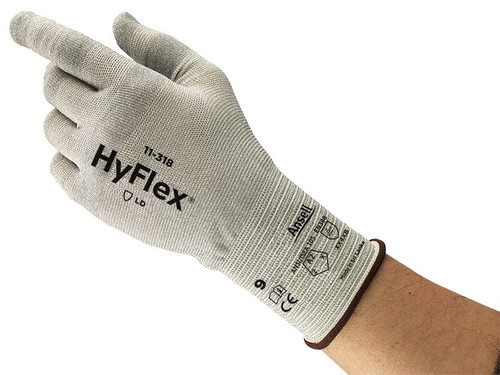
The Technical Vault: Ansell HyFlex® 11-318
Vault purpose: Advanced analysis of uncoated 18-gauge cut protection, Dyneema® Diamond Technology fiber, anti-static behavior, low-lint performance, process-safety value, and precision-handling limitations.
1) What the HyFlex 11-318 Is
The HyFlex 11-318 is an ultralight uncoated cut-resistant liner glove designed for precision industrial handling. It is intended for applications where tactile sensitivity, low surface contamination risk, touchscreen compatibility, and light cut protection are more important than heavy abrasion resistance or liquid barrier performance.
2) 18-Gauge Liner: Why Gauge Matters
Glove gauge refers to the fineness of the knit. Higher gauge numbers typically mean thinner yarn spacing, lighter glove feel, and greater dexterity.
- 18-gauge construction: very thin, lightweight, and tactile
- Improves fingertip control for inspection and marking tasks
- Reduces hand fatigue during long wear periods
- Provides less cushioning and abrasion life than thicker gloves
The HyFlex 11-318 is therefore best understood as a precision cut-protection glove, not a heavy-duty mechanical glove.
3) ANSI A2 / EN ISO B Cut Protection
ANSI A2 and EN ISO B indicate light cut protection suitable for controlled handling of sharp or rough-edged parts. These ratings are meaningful, but they do not make the glove appropriate for heavy cut hazards.
- Useful for light cut exposure during assembly and inspection
- Not intended for heavy sheet metal handling with high force
- Not a puncture-protection glove
- Not safe for moving, serrated, or powered blades
4) Dyneema® Diamond Technology Fiber Mechanics
Dyneema Diamond Technology fiber is used to provide cut resistance in a lightweight knit structure. Its high-strength fiber system allows cut resistance without requiring a thick, bulky glove construction.
- High strength-to-weight ratio supports cut resistance
- Enables thinner glove construction than many legacy cut fibers
- Preserves flexibility for precision handling
- Works with spandex reinforcement to improve ergonomic fit
5) Why Uncoated Construction Is Technically Important
Uncoated gloves remove the polymer palm layer found on nitrile-, PU-, or latex-coated gloves. This changes the glove’s performance profile significantly.
| Uncoated Advantage |
Tradeoff |
| Maximum tactile sensitivity |
Less grip in oily or wet handling |
| Better breathability |
Lower abrasion resistance than coated palms |
| Lower coating-transfer risk |
No liquid barrier |
6) Anti-Static, Carbon Fiber, and ESD Program Context
The HyFlex 11-318 contains carbon fiber and is marketed as anti-static. This can support handling in electronics or surface-sensitive workflows, but anti-static gloves should be used as part of a complete ESD control program.
- Carbon fiber helps dissipate static charge
- Anti-static performance depends on the full grounding system
- Glove performance should be validated against site ESD requirements
- Not a substitute for wrist straps, grounding, mats, or ESD process controls
7) Silicone-Free and Low-Lint Process Safety
Silicone contamination can interfere with painting, coating, bonding, and finishing operations. Low-lint behavior also matters when gloves contact finished or near-finished surfaces.
- Silicone-free design helps reduce surface-defect risk before painting
- Low-lint construction supports cleaner handling
- Uncoated surface reduces coating-fragment transfer
- Useful in inspection and final-check environments
8) Touchscreen Compatibility and Workflow Control
Touchscreen compatibility reduces the need to remove gloves when interacting with tablets, scanners, HMIs, and inspection terminals. This improves workflow continuity and helps reduce contamination or injury risk associated with repeated glove removal.
9) Critical Use Limitations
| Do Not Use For |
Reason |
| Chemical exposure |
Uncoated textile glove; not chemical-resistant |
| Wet or oily grip-critical handling |
No grip coating or liquid barrier |
| Heavy cut hazards |
ANSI A2 / EN ISO B is light cut protection |
| Puncture hazards |
Cut resistance is not puncture resistance |
| Powered or serrated blades |
Mechanical hazard exceeds intended use |
10) Source Basis
- Ansell HyFlex 11-318 product documentation
- Ansell HyFlex 11-318 product data sheet
- ANSI/ISEA 105-2024 cut and abrasion classification framework
- EN 388 / EN ISO 21420 industrial glove performance framework
- SOSCleanroom industrial PPE application analysis