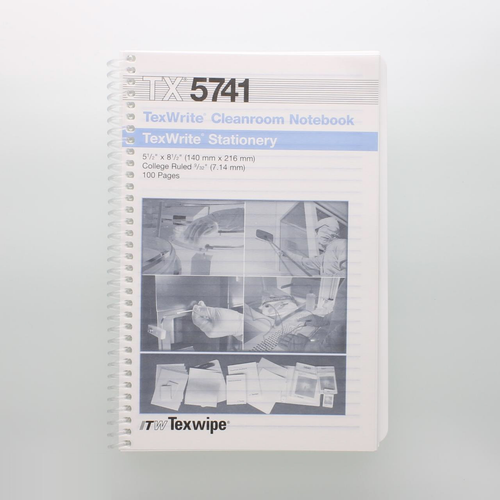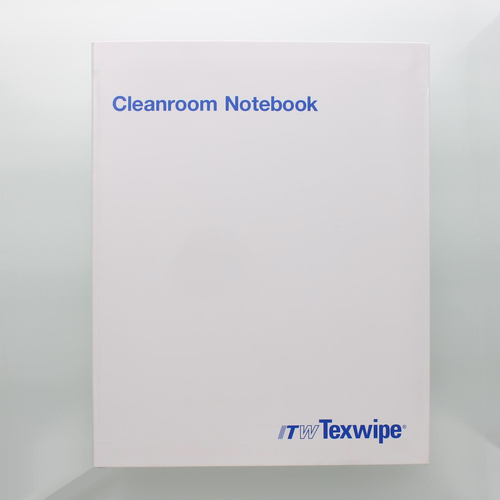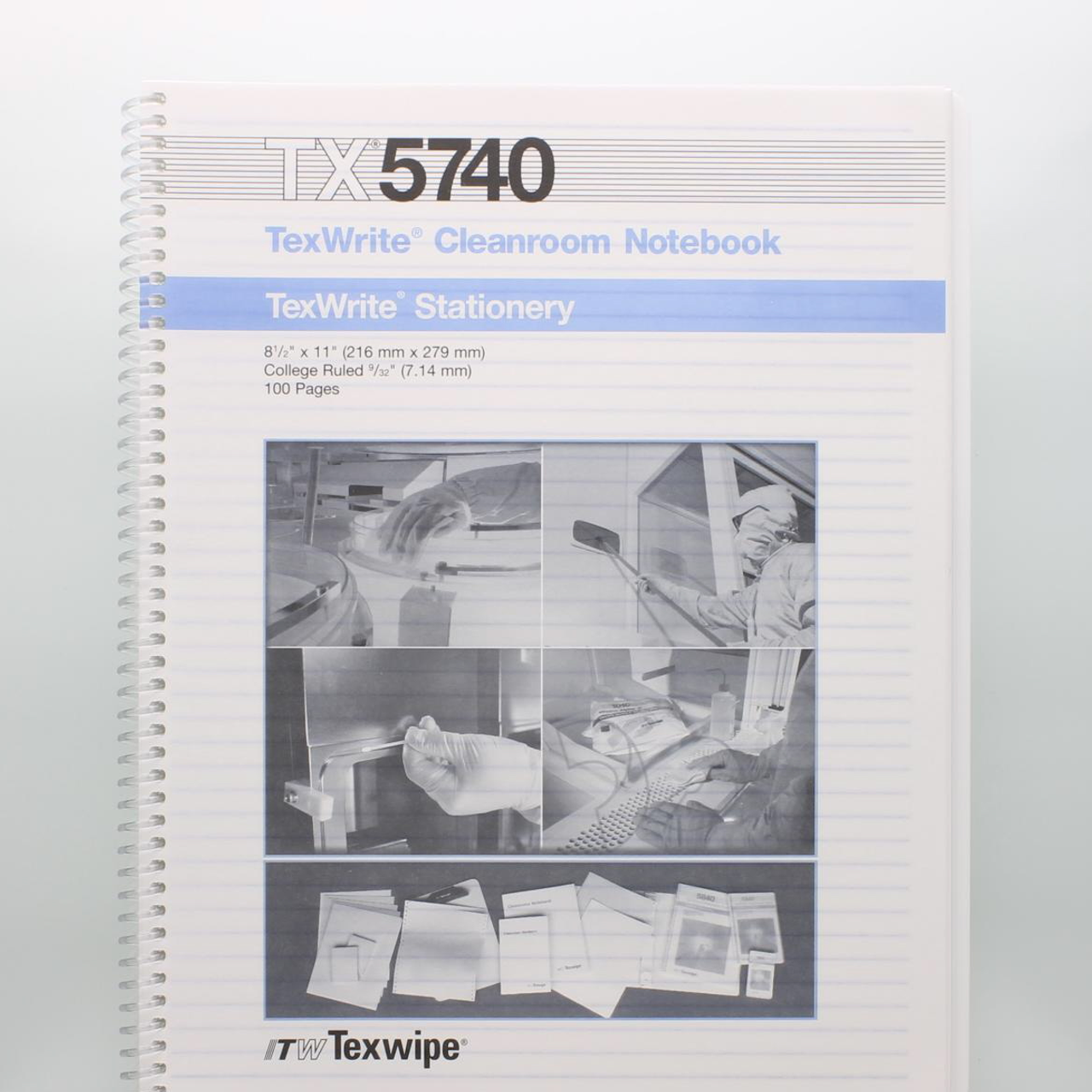
Product image shown from the SOSCleanroom listing.
1) Practical solutions in a critical environment
In cleanrooms and other controlled environments, documentation is part of contamination control. A notebook that sheds fibers, smears ink, or transfers residue
can turn routine note-taking into a particle or rework event. TX5740 is designed for day-to-day documentation where you need legible, repeatable writing
without introducing the common stationery failure signatures: paper dust, ink flake, smearing, cover abrasion, and loose binding debris.
Typical use cases include maintenance logs at gowning/airlocks, equipment cleaning sign-offs, engineering change notes, batch record support notes,
and controlled “traveler” annotations where supervisors need to read and verify entries quickly during line clearance.
2) What this product is used for
- Note taking and data recording in cleanrooms and controlled environments.
- Record keeping, data transfer, observations, and work-in-process notes supporting batch records and deviation investigations.
- Facilities and engineering documentation (PM checklists, work orders, line clearance sign-offs).
- Shift handover notes where consistent legibility and reduced smearing matter under gloves and frequent wipe-down workflows.
3) Why customers consider this product
- Designed to reduce particle and fiber generation compared with everyday office notebooks (manufacturer positioning for TexWrite cleanroom bond).
- Pages printed with IPA-resistant, low-sodium ink to reduce ionic contamination and support alcohol wipe-down practices.
- High-density polyethylene cover described as chemical resistant, helping the notebook tolerate routine handling and storage in controlled areas.
- Spiral binding and fully rotating pages allow the notebook to lie flat for quicker, more consistent entries during gloved work.
- Cleanroom packaged for more controlled introduction than general-use stationery.
4) Materials, composition, and build
Texwipe describes TX5740 as a spiral-bound cleanroom notebook with high-density polyethylene covers, plastic spirals, and TexWrite cleanroom paper.
The current Texwipe product page describes the paper as a “copolymer cleanroom paper” and also states “no natural latex binders.”
An older datasheet copy hosted by SOSCleanroom describes “latex-impregnated cleanroom paper.” When your internal risk assessment is sensitive to latex-related concerns,
rely on the most current manufacturer statement and confirm acceptance criteria through your quality system.
Practical receiving cue: verify the cover and spiral are intact (no cracking, chips, or sharp edges) and that the first few pages turn without binding.
Spiral debris or cover abrasion is a common root cause when notebooks are stored loosely in tool carts or drawers.
5) Specifications in context
The table below consolidates the published attributes for TX5740. Where information is not explicitly stated in the source basis, it is marked as not published.
| Attribute |
TX5740 |
| Manufacturer / brand |
ITW Texwipe (TexWrite) |
| Product type |
Cleanroom spiral notebook |
| Color |
White |
| Ruling |
College-ruled |
| Overall size |
8.5" x 11" (216 mm x 279 mm) |
| Writable pages / sheets |
100 writable pages (50 sheets) |
| Cover |
High-density polyethylene (HDPE), chemical resistant (manufacturer statement) |
| Binding |
Plastic spiral; lies flat; rotating pages (manufacturer statement) |
| Ink |
IPA-resistant, low-sodium ink (printed pages) |
| Autoclave guidance |
Autoclaving not recommended |
| Cleanroom environment guidance |
ISO Class 3–8; Class 1–100,000; EU Grade A–D (manufacturer statement) |
| Packaging |
10 notebooks per case (box) |
| Sterility |
Not published |
| Country of origin |
Made in USA (per Texwipe technical data sheet) |
| Typical basis weight (paper) |
80 g/m² (typical; not a specification) |
| Typical caliper |
5.0 mil (typical; not a specification) |
| Typical opacity |
74% (typical; not a specification) |
| Typical surface resistivity |
2.6 × 10⁹ ohms (typical; no explicit ESD classification statement provided in source basis) |
6) Performance and cleanliness considerations
Stationery can be an underestimated contamination vector because it is handled frequently, carried between zones, and often used directly next to product-contact or
critical surfaces. The typical contamination profile for TX5740 is published in the Texwipe technical data sheet as representative analyses (not specifications).
Use these values as selection context and as a conversation starter with QA for incoming acceptance criteria.
Typical contamination characteristics (published as typical, not specifications)
| Metric |
Typical value |
| Particles > 0.5 µm |
4.8 million particles/m² |
| Sodium (ion extractable) |
85 ppm |
| Chloride (ion extractable) |
50 ppm |
Ink behavior matters in controlled environments because smearing can migrate onto gloves and then onto touch points (drawer pulls, keyboards, carts, and shared tools).
TX5740’s printed pages are described as using IPA-resistant ink; however, resistance to other solvents and disinfectants (ethanol, quats) is not published in the source basis.
If your workflow includes frequent disinfectant wipes on documentation, consider qualifying your writing instruments and dry time as part of line clearance.
ESD handling note: a typical surface resistivity value is published in the technical data sheet, but there is no explicit claim that the notebook is “dissipative” or “conductive.”
Treat the published value as informational unless your facility has defined documentation materials as part of an ESD control program.
7) Packaging, sterility, traceability, and country of origin
- Packaging: 10 notebooks per case (box). The notebook is described as cleanroom packaged.
- Sterility: Not published in the source basis.
- Autoclave: Autoclaving is not recommended (manufacturer statement).
- Country of origin: Made in USA (per Texwipe technical data sheet).
- Traceability tip for receiving: log the case label information into your material receipt record and store notebooks in original packaging until release to the floor to reduce handling fallout.
For over 35 years, SOS and Texwipe have been close partners, and SOSCleanroom is the authorized Master Distributor of ITW Texwipe for the United States market.
That relationship matters for stationery programs because documentation materials are replenished constantly and need consistent quality and continuity of supply.
8) Best-practice use
- Zone control: assign notebooks to a room/area (or to a specific cart) and avoid carrying them across uncontrolled corridors unless double-bagging or a defined transfer method is used.
- Glove discipline: keep a “writing glove” or fingertip cover practice for logbooks to reduce ink transfer and page smudge during long entries.
- Dry time check: standardize a brief dry time before turning pages, especially when operators write while standing at equipment.
- Wipe-down reality: the page printing is described as IPA resistant; if you wipe covers with IPA, use light pressure and avoid scuffing the spiral against stainless edges (a common abrasion source).
- Line clearance: for batch records supported by notebook notes, consider a routine visual scan for torn corners, loose spiral fragments, or cover damage before the notebook enters the critical zone.
9) Common failure modes
- Ink smear and transfer: typically caused by quick page turns, heavy ink load, or writing instrument mismatch; can become a glove contamination pathway.
- Spiral abrasion debris: spiral edges can scrape stainless, carts, or drawer slides; store notebooks flat or in dedicated holders to reduce chipping.
- Cover scuffing and particle fallout: rough handling in toolboxes or maintenance carts can damage covers over time; retire notebooks with cracked covers.
- Uncontrolled migration between zones: a notebook used in a less-controlled area can become a transfer object if moved into cleaner spaces without a defined transfer method.
10) Closest competitors
The best comparison points are other purpose-built cleanroom documentation notebooks and documentation paper programs intended to reduce particle/fiber generation and improve legibility in controlled environments.
Common alternatives customers evaluate include cleanroom stationery offerings from Micronova and Berkshire, as well as other ITW Texwipe TexWrite formats (different sizes and binding styles).
Selection shortcut: if your dominant risk is wipe-down and chemical exposure, prioritize cover material and ink behavior; if your dominant risk is particle sensitivity, prioritize documented particle/fiber performance data and packaging discipline.
11) Critical environment fit for this product
Texwipe lists TX5740 for use across a range of cleanroom grades (ISO Class 3–8; EU Grade A–D), supporting controlled documentation where reduced particle/fiber generation and cleaner inks are desired.
This notebook is most appropriate when documentation must occur at the point of work (equipment-side notes, maintenance sign-offs, deviation observations) and when your facility benefits from cleaner stationery packaging and controlled material release.
If your environment requires sterile documentation materials, sterility is not published in the source basis and should be confirmed through your procurement and quality process before adoption.
12) SOSCleanroom note about SOP's
The Technical Vault is written to help customers make informed contamination-control decisions and improve day-to-day handling technique.
It is not your facility’s Standard Operating Procedure (SOP), batch record, or validation protocol.
Customers are responsible for establishing, training, and enforcing SOPs that fit their specific risks, products, equipment, cleanroom classification, and regulatory obligations.
Always confirm material compatibility, cleanliness suitability, sterility requirements, and acceptance criteria using your internal quality system and documented methods.
If you adapt any technique guidance from this entry, treat it as a starting template. Your team should review and approve the final method, then qualify it for your specific surfaces,
solvents, cleanliness limits, inspection methods, and risk profile. In short: use these best-practice suggestions to strengthen your SOPs—not to replace them.
13) Source basis
- SOSCleanroom product page (TX5740): https://www.soscleanroom.com/product/facilities/texwipe-tx5740-texwrite-8-5-x-11-white-cleanroom-spiral-notebook/
- Manufacturer product page (Texwipe TX5740): https://www.texwipe.com/texwrite-tx5740
- SOS-hosted PDF (Texwipe notebook datasheet copy): https://www.soscleanroom.com/content/texwipe_pdf/5740%205741%205742.pdf
- Texwipe technical data sheet PDF (TexWrite Cleanroom Spiral Notebooks, TEX-LIT-TDS-046 Rev.01-07/18): https://www.texwipe.com/images/uploaded/documents/Paper/TDS_TexWriteSpiralNotebooks_CuR3.pdf
- ISO: https://www.iso.org/standard/53394.html
- FDA: https://www.fda.gov/
- ASTM: https://www.astm.org/
- IEST: https://www.iest.org/
SOSCleanroom is the source for this Technical Vault entry.
Briefed and approved by the SOSCleanroom (SOS) staff.
If you have any questions please email us at Sales@SOSsupply.com
Or give us a call at (214)340-8574.
Last reviewed: Jan. 8, 2026
© 2026 SOSCleanroom