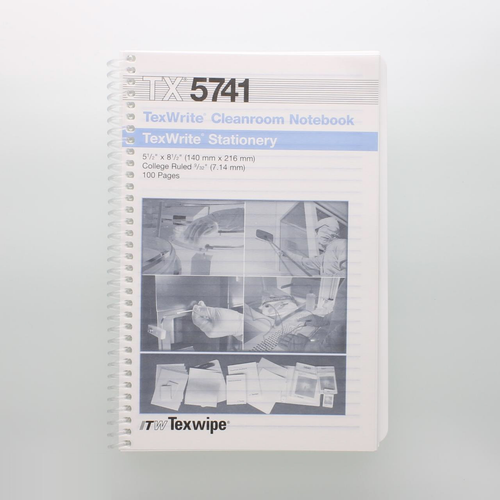
Texwipe TX5741 TexWrite® Cleanroom Spiral Notebook — 5.5" x 8.5", White, College-Ruled
TX5741 is a spiral-bound cleanroom notebook engineered for controlled-environment note taking, batch/lot recording, equipment logs, and technician data capture at benches, carts, and facility stations where ordinary office paper can shed, smear, or transfer residue.
For over 35 years, SOS and Texwipe have been close partners, and SOSCleanroom is the authorized Master Distributor of ITW Texwipe for the United States market. That relationship supports continuity of supply, consistent product lineage, and straightforward access to manufacturer documentation when QA/QC teams are standardizing cleanroom stationery.
Published configuration (TX5741)
- Notebook size: 5.5" x 8.5" (140 mm x 216 mm)
- Page format: White, college-ruled
- Pages: 100 writable pages (50 sheets)
- Cover: High-density polyethylene (HDPE), chemical-resistant cover material
- Binding: Plastic spiral; notebook lies flat and pages rotate freely for ease of use
- Paper: TexWrite® cleanroom paper (manufacturer describes as durable copolymer cleanroom paper)
- Printing: IPA-resistant, low-sodium ink for reduced ionic contamination
- Cleanroom environment: ISO Class 3–8 (Class 1–100,000); EU Grade A–D
- Autoclave: Autoclaving is not recommended
- Packaging: 10 notebooks per box (case)
Controlled documentation without paper dusting surprises
The goal is low particle and fiber generation during real use (page turns, glove handling, transport on carts). Even so, no paper product is truly “lint-free.” Treat stationery like a contamination-controlled component: control where it is opened, how it is transported, and what contacts the pages.
Where technicians use it
- Line-side documentation: process parameters, checks, exceptions, and shift notes.
- Maintenance and equipment logs inside gowning-controlled areas.
- Facility rounds, environmental monitoring notes, and controlled troubleshooting records.
- Data transfer notes during investigations where legibility and handling discipline matter.
Compatibility notes (IPA/DI wipe-down tolerance)
- IPA exposure (documented): Pages are printed with IPA-resistant ink, and the HDPE cover is a chemical-resistant material. This supports typical cleanroom wipe-down workflows when your SOP permits.
- DI water / aqueous wipe-down (not stated): DI wipe-down tolerance is not published for this notebook. If aqueous wipe-down is required, qualify under your site method (ink legibility, paper distortion, residue/tide marks).
- Wipe-down technique: Wipe the closed cover only using a lightly dampened cleanroom wiper (do not flood). Avoid wetting page edges near the spiral; allow full dry time before opening to prevent smearing and residue rings.
Particle-shedding risk management
- Open/close discipline: Open slowly and keep closed when not writing to reduce “air pumping” that can mobilize particles.
- Page turning: Turn pages from the outer corner with minimal rubbing. Aggressive thumb-dragging is a common driver of paper dusting.
- Surface control: Do not lay open pages on benches where residues can transfer. Use a clean writing board/clipboard surface dedicated to documentation.
- Correction behavior: Avoid aggressive erasing or scraping tools across pages; abrasion increases particle generation and can drive ink transfer.
Common failure modes technicians actually see
- Smearing: Often from solvent-wet gloves, writing on a damp page edge, or closing the notebook too soon. Mitigation: glove moisture control + dry-time discipline.
- Ink transfer (ghosting onto facing page): Typically from pressure + early closure. Mitigation: reduce writing pressure on soft backing, allow dry time, keep pages flat.
- Paper dusting / particle shedding: Triggered by aggressive page flipping, abrasion, or tearing pages out in the clean area. Mitigation: controlled page turns; avoid tearing; keep notebook closed when moving through airflow.
- Residue rings / tide marks: Solvent pooling near the spiral edge can dry unevenly. Mitigation: wipe the cover only; avoid wetting page edges; let evaporate fully before opening.
- Static attraction: In low humidity, stationery can attract fine debris. Mitigation: follow your ESD controls; avoid rubbing the cover against garments; store closed in a clean drawer/tote.
Storage and handling best practices
- Keep notebooks in original cleanroom packaging until point of use; stage only what the shift needs.
- Assign notebooks to a room/line/cart to avoid cross-area contamination transfer and uncontrolled travel between classifications.
- Keep closed when not actively writing; store in a clean drawer or covered document bin rather than open shelving.
- Avoid stacking with abrasive tools/clips that can scuff covers and generate debris.
Typical performance and contamination characteristics
Values below are published as typical analyses (not specifications). Use them for qualification planning and contamination-risk reviews.
| Category |
Property |
Typical value |
Test method (as published) |
| Performance |
Basis weight |
80 g/m² |
TM2 |
| Performance |
Caliper |
5.0 mil |
(Not stated) |
| Performance |
Tensile strength (machine direction) |
5.3 kg |
Federal Standards No. 191A: Methods 5102 |
| Performance |
Tensile strength (cross direction) |
4.5 kg |
Federal Standards No. 191A: Methods 5102 |
| Performance |
Tear strength (machine direction) |
78 g |
Elmendorf tear test |
| Performance |
Tear strength (cross direction) |
79 g |
Elmendorf tear test |
| Performance |
Opacity |
74% |
TAPPI T-425 |
| Performance |
Surface resistivity (55% RH) |
2.6 x 10⁹ ohms (also shown as 2.6 x 10¹⁰ ohms/sq) |
TM14 (adapted from EOS/ESD-S11.11-1993) |
| Contamination |
Particles (>0.5 µm) |
4.8 million particles/m² |
TM5 |
| Contamination |
Sodium |
85 ppm |
TM12 (CIA) |
| Contamination |
Chloride |
50 ppm |
TM12 (CIA) |
Why teams source TX5741 through SOSCleanroom
- Standardization support: When your documentation materials are part of a controlled process, you want stable supply and reliable access to the exact technical paperwork used to qualify the product.
- Partnership continuity: SOSCleanroom’s long-standing relationship with Texwipe helps keep programs consistent across sites and over time (less requalification churn caused by changing stationery sources).
- Cleanroom-ready logistics: Cleanroom consumables are treated as critical inputs—packaging integrity, transport discipline, and predictable fulfillment all matter to line performance.
Documentation
SOS-hosted datasheet PDF (DS-5740, Effective: December 2009):
Click HereTexwipe Technical Data Sheet PDF (TexWrite® Cleanroom Spiral Notebooks):
Click Here
If you have any questions please email us at Sales@SOSsupply.com or give us a call at (214)340-8574.
Check out the AI ChatBot powered by SOSCleanroom data libraries - give it a try!
THIS IS NEW FOR 2026!
© 2026 SOS Supply. All rights reserved.