The Technical Vault By SOSCleanroom
USP / EP / JP Purified Water | Pharmaceutical Testing | Conductivity & TOC | Microbial Quality | cGMP Water Qualification
RICCA R9189000-20F USP/EP/JP Purified Water: Multicompendial Specifications, Water Purification & GMP Technical Guide
RICCA Chemical Company R9189000-20F is a high-purity, non-sterile USP/EP/JP purified-water product supplied in a 20-liter Cubitainer®. The product is intended for laboratory and manufacturing applications requiring defined chemical purity and appropriate microbiological quality.
The manufacturer's Product Specification identifies a continuously operated water purification process validated under cGMP controls. Published testing includes conductivity, total organic carbon, microbial count, bacterial endotoxins, and additional chemical impurity criteria. This Technical Vault explains these specifications, purification technology, intended uses, package handling, and quality-system requirements.
Technical Takeaway: RICCA R9189000-20F is documented as USP/EP/JP purified water with low microbial count, but it is not sterile. The manufacturer states that the product is not filled in a sterile area or into sterilized containers and should not be used for injection or parenteral solution preparation. Its acceptance for any regulated operation depends on the actual lot documentation and the application's requirements.
1. What Is USP/EP/JP Purified Water?
Purified water is a defined pharmaceutical and laboratory raw material evaluated for chemical purity and other quality characteristics according to its intended application.
The product designation identifies three pharmacopeial systems:
- USP: United States Pharmacopeia.
- EP: European Pharmacopoeia, also abbreviated Ph. Eur.
- JP: Japanese Pharmacopoeia.
RICCA publishes testing against its stated multicompendial specifications. The product specification identifies Purified Water references for USP, EP, and JP, together with the EP Water R designation.
These compendia may use different monograph structures, test methods, and acceptance requirements. Their product designations should not be interpreted as proof that all requirements are identical.
Compendial Qualification: Confirm the current applicable pharmacopoeial edition, specific monograph, intended use, and actual lot results. RICCA's published specification is a reference for product selection, not a substitute for the laboratory's qualification process.
2. Verified Product Specifications
- Manufacturer: RICCA Chemical Company
- Product: Water, USP / EP / JP Purified
- Manufacturer Product Number: R9189000
- Manufacturer Part Number: R9189000-20F
- Grade: USP / EP / JP Purified Water
- Sterility Classification: Non-sterile
- Chemical Formula: H2O
- CAS Number: 7732-18-5
- Molecular Weight: Approximately 18.02 g/mol
- Appearance: Colorless liquid
- Conductivity Specification: Maximum 1.0 µS/cm at 25°C
- Total Organic Carbon: Maximum 0.5 ppm (500 ppb)
- pH at 25°C: 5.0-7.0
- Microbial Count at Manufacture: Maximum 100 CFU/mL
- Bacterial Endotoxins: Maximum 0.25 EU/mL
- Physical State: Liquid
- SDS-Reported pH: 6.00
- Relative Density: 1.00
- Container: Cubitainer®
- Package Volume: 20 liters (20,000 mL)
- Purchase Quantity: One (1) 20-liter Cubitainer®
- Unopened Shelf Life: 12 months
- Recommended Storage: 15-30°C (59-86°F)
- Recommended Use: General laboratory reagent
- GHS Hazard Classification: Not classified as hazardous
- DOT/IATA Classification: Not regulated
Specification Control: The manufacturer's publicly available Product Specification lists SAMPLE as the lot number and N/A for the associated test results. It does not establish actual test results or expiration dating for the container supplied to a customer.
3. RICCA Water Purification Process
RICCA's R9189000 Product Specification describes a continuous, multistage purification process validated under cGMP controls. The documented treatment sequence includes:
- Conventional Water Softening: Reduces hardness-related constituents before downstream purification.
- Prefiltration: Removes particulate material that could affect subsequent purification stages.
- Activated Carbon Adsorption: Provides treatment for organic substances and other contaminants appropriate to the process design.
- Reverse Osmosis: Uses a membrane separation process to reduce dissolved ions and other impurities.
- Mixed-Bed Triple Deionization: Further reduces dissolved ionic constituents through ion-exchange treatment.
- Ultraviolet Irradiation: Provides an additional process treatment stage within the manufacturer's water system.
- 0.2-Micron Membrane Filtration: Provides final membrane filtration as part of the documented purification sequence.
The manufacturer states that the process is validated under cGMP and that analytical results reflect its monitoring and testing program.
The published specification references RICCA Technical Reference Document TRD04 for quantitative interpretation of USP, EP, and JP limit tests, as well as TRD02 and TRD03 for additional purification-process details associated with specified lot-number series.
Critical Filtration Distinction: The presence of a 0.2-micron membrane filtration step does not establish that the packaged product is sterile. RICCA explicitly identifies the finished R9189000 product as non-sterile.
4. Complete Manufacturer Chemical and Microbiological Test Panel
The published RICCA Product Specification identifies the following acceptance criteria for Product Number R9189000:
- Acidity: To pass test
- Alkalinity: To pass test
- Ammonia (NH3): Maximum 0.05 ppm
- Appearance: Colorless liquid
- Calcium (Ca): Maximum 0.5 ppm
- Carbon Dioxide (CO2): To pass test
- Chloride (Cl): Maximum 0.1 ppm
- Conductivity at 25°C: Maximum 1.0 µS/cm
- Endotoxins, Chromogenic Determination: Maximum 0.25 EU/mL
- Heavy Metals (as Pb): Maximum 0.1 ppm
- Magnesium (Mg): Maximum 0.5 ppm
- Microbial Count at Manufacture: Maximum 100 CFU/mL
- Nitrate (NO3): Maximum 1 ppb
- Nitrogen as Nitrite (NO2-N): Maximum 1 ppb
- Organic Carbon (TOC): Maximum 0.5 ppm
- Oxidizable Substances, Permanganate Retention: To pass test
- pH at 25°C: 5.0-7.0
- Residue After Evaporation, Non-Volatile Matter: Maximum 0.001%
- Sulfate (SO4): Maximum 0.5 ppm
The manufacturer's specification provides acceptance criteria, not numerical test results for the supplied manufacturing lot. It is important to preserve this distinction when publishing product information or reviewing compliance records.
Method Qualification: "To pass test" refers to the applicable manufacturer's documented test and acceptance procedure. Do not replace it with an invented numerical limit or assume that every parameter represents an identical method across USP, EP, and JP.
5. Conductivity: Evaluating Dissolved Ionic Contamination
Conductivity is a measure of the ability of an aqueous solution to carry electrical current through dissolved ions. Water with low concentrations of mobile ions generally exhibits low conductivity.
RICCA specifies a maximum conductivity of 1.0 µS/cm at 25°C for R9189000 purified water. The manufacturer references test method SQCP031 for conductivity measurement.
Conductivity can be affected by dissolved salts, exposure to atmospheric carbon dioxide, temperature, contact with unsuitable vessels, and contamination introduced during dispensing.
- Verify the actual lot conductivity result when required.
- Use measurement equipment appropriate for high-purity water.
- Identify the applicable measurement temperature and method.
- Use clean sampling vessels and compatible transfer equipment.
- Prevent ionic contamination from surfaces, residues, and repeated handling.
- Apply the required current compendial acceptance procedure rather than relying only on a nominal value.
Conductivity Note: The manufacturer's 1.0 µS/cm at 25°C acceptance criterion is a product specification. The current laboratory method and applicable pharmacopoeial chapter determine how an individual measurement must be evaluated.
6. Total Organic Carbon and Chemical Impurity Controls
Total Organic Carbon (TOC) evaluates the concentration of carbon associated with organic compounds in a water sample. It is an important water-quality characteristic for pharmaceutical and analytical laboratory operations.
RICCA's R9189000 specification identifies maximum 0.5 ppm TOC, equivalent to 500 ppb.
The manufacturer's test panel also includes limits for chloride, calcium, magnesium, ammonia, nitrate, nitrite, sulfate, heavy metals, and non-volatile residues. These tests address chemical characteristics beyond conductivity and TOC alone.
Organic or ionic contamination can arise during storage and use if the water contacts unsuitable dispensing surfaces, unclean containers, or process materials that introduce impurities.
Analytical Control: Use the current manufacturer CoA and qualified sampling practices when determining whether the received water meets the intended analytical or manufacturing specification. A general published limit does not establish a particular lot's measured TOC or impurity results.
7. Microbial Count, Endotoxins and Non-Sterile Status
RICCA specifies a maximum microbial count of 100 CFU/mL at the time of manufacture for R9189000 purified water.
The manufacturer also identifies a bacterial endotoxin limit of maximum 0.25 EU/mL using a chromogenic determination method.
These are separate quality attributes:
- Microbial Count: Evaluates recoverable microorganisms under specified test conditions.
- Bacterial Endotoxins: Evaluates endotoxin content using the specified analytical method.
- Sterility: Represents a different product requirement and cannot be inferred from a low microbial count or endotoxin result.
RICCA explicitly states that R9189000 has a low microbial count but is not filled in a sterile area or into sterilized containers. The manufacturer therefore identifies this water as non-sterile.
The microbial count is specified at manufacture and should not be presented as a guaranteed microbial result after prolonged dispensing, opening, or unsuitable storage.
Microbiology Qualification: Do not label R9189000-20F as sterile, sterile-filtered finished water, endotoxin-free, or suitable for parenteral preparations. Select an appropriately qualified alternative when an application requires those properties.
8. Understanding the USP, EP and JP Specification References
RICCA's manufacturer Product Specification for R9189000 includes references for each of its marketed compendial designations:
- USP: Purified Water.
- EP: Purified Water, with the manufacturer's published reference to EP (1997:0008).
- EP: Water R, with the manufacturer's published reference to EP (1095500).
- JP: Purified Water.
The manufacturer's document provides these designations as part of its specification framework. Laboratory personnel should verify applicable current pharmacopoeial requirements before approving the material for a particular regulated use.
RICCA refers users to Technical Reference Document TRD04 for quantitative interpretations of applicable compendial limit tests. This document may be necessary when a laboratory requires more detailed evidence supporting its chosen monograph.
Compendial Reminder: A multi-compendial label does not mean the product meets all injectable water, sterile water, or clinical use requirements. The required grade and use limitations must be evaluated independently.
9. 20-Liter Cubitainer® Packaging and Dispensing
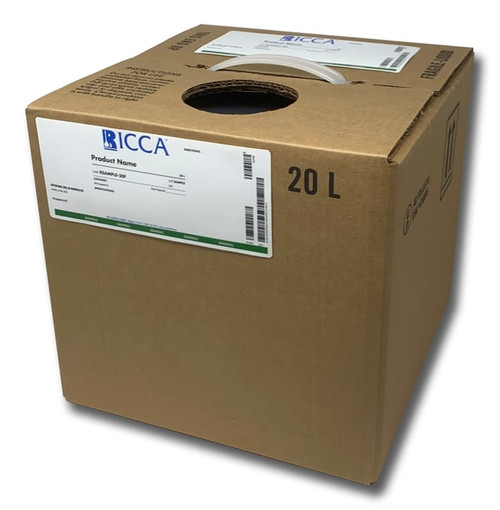
RICCA R9189000-20F is supplied in a 20-liter Cubitainer®. The manufacturer's Product Specification separately identifies the 20-liter Ropak configuration as R9189000-20E1.
The Cubitainer® format is intended to provide a larger supply of purified water within one purchasing unit. It can support repeated laboratory dispensing where the user's material-handling procedure preserves the quality attributes needed for the application.
- Container Format: Cubitainer®.
- Nominal Volume: 20 liters (20,000 mL).
- Purchase Quantity: One container.
- Alternative Format: R9189000-20E1, 20-liter Ropak.
- Receiving: Inspect the container and dispensing interface for damage or leakage.
- Dispensing: Use suitable clean receiving equipment and follow the actual container's manufacturer instructions.
- Material Transfer: Apply site-specific controls before bringing external packaging into classified areas.
The presence of a 20-liter container does not mean that its outer packaging or dispensing surfaces are qualified for sterile cleanroom use. The appropriate transfer and dispensing procedure depends on the facility environment.
Packaging Qualification: Do not assume a sterile dispensing port, sterile barrier system, or validated aseptic transfer function unless those characteristics are explicitly documented for the supplied package.
10. Storage, Shelf Life and In-Use Water Quality
RICCA specifies 15-30°C (59-86°F) as the recommended storage range and a 12-month shelf life for unopened containers of R9189000-20F.
The manufacturer's SDS directs users to protect the water from freezing and physical damage. It identifies the product as stable under normal conditions of use and storage.
- Recommended Temperature: 15-30°C.
- Freezing: Protect from freezing.
- Package Integrity: Avoid punctures, leaks, or physical damage.
- Contamination Prevention: Keep dispensing interfaces clean and appropriately protected.
- Exposure Control: Avoid unnecessary air exposure and unsuitable transfer vessels.
- Expiration: Follow manufacturer lot-specific dating.
- After Opening: Apply approved laboratory in-use handling and dating requirements.
The manufacturer's 12-month shelf life applies to the unopened container. Water quality after opening depends on the dispensing process, environmental conditions, handling, and application-specific microbiological requirements.
In-Use Limitation: No universal 12-month post-opening use period has been established. Laboratories should determine suitable in-use controls and any required sampling based on the intended operation.
11. Best-Practice Laboratory and Manufacturing Handling
- Receiving Inspection: Confirm R9189000-20F, the 20-liter Cubitainer®, and the actual lot information.
- Documentation Review: Confirm required manufacturer specification, CoA, and current SDS.
- Method Qualification: Verify that non-sterile USP/EP/JP purified water is acceptable for the intended procedure.
- Container Inspection: Check for damage or leakage before dispensing.
- Storage: Follow the 15-30°C recommended storage range.
- Dispensing: Use suitable clean vessels and approved transfer equipment.
- Contamination Prevention: Avoid exposing water to residues, incompatible surfaces, or prolonged environmental contact.
- Microbiological Control: Apply appropriate in-use handling requirements where microbial quality matters.
- Traceability: Maintain product lot, expiration, receiving, and use records according to the quality system.
- Waste Handling: Follow site-approved disposal procedures and the applicable SDS.
GMP Recommendation: Approval of packaged purified water should be based on material specifications, supplier qualification, receipt controls, process requirements, and documented lot suitability rather than the product name alone.
12. Safety Data and Transportation Classification
RICCA's R9189000 Safety Data Sheet identifies the material as purified water and does not classify it as hazardous under GHS criteria.
- Chemical: Water
- CAS Number: 7732-18-5
- GHS Classification: Not classified as hazardous
- GHS Signal Word: None required
- GHS Hazard Pictograms: None required
- DOT Ground Transportation: Not regulated
- IATA Air Transportation: Not regulated
- Canadian TDG Transportation: Not regulated
- Ventilation: Normal room ventilation is adequate
- Eye Protection: Safety glasses or goggles as appropriate for laboratory work
- Storage Precautions: Protect from freezing and physical damage
Although the chemical itself is not classified as hazardous, the facility should consider the handling and spill risks of a 20-liter liquid container, as well as contamination-control requirements related to its intended use.
Safety Notice: Refer to the current manufacturer SDS for complete instructions. The reviewed R9189000 SDS identifies a revision date of February 3, 2025.
13. GMP Documentation and Lot-Specific Qualification
Laboratories operating under regulated quality systems should evaluate both the manufacturer's product specifications and documentation relating to the received manufacturing lot.
- Manufacturer Product Specification: Defines the published chemical, microbial, and packaging acceptance criteria.
- Certificate of Analysis: Provides the applicable tested results for the particular manufactured lot when issued.
- Safety Data Sheet: Identifies the product's chemical properties and handling requirements.
- Lot Traceability: Connects the received material to laboratory and manufacturing records.
- Expiration Dating: Confirms manufacturer-assigned shelf-life information for the supplied lot.
- Compendial Qualification: Confirms the actual method or monograph requirements.
- Microbiological Acceptance: Verifies whether the documented at-manufacture count is suitable for the intended process.
- Supplier Qualification: Supports the laboratory's approved purchasing and material-release process.
- Change Control: Documents any substitution between water grades, package types, or suppliers.
- In-Use Handling: Establishes approved procedures for dispensing and quality retention after opening.
The publicly available RICCA Product Specification identifies Lot Number: SAMPLE, with associated test results marked N/A. It provides product-level specifications and package information, not the results for a purchased container.
Audit Point: When lot qualification is required, obtain the CoA or other applicable manufacturer records corresponding to the actual shipment. Do not present the sample specification as a current lot-specific certificate.
14. RICCA Purified Water Selection and Product Differences
RICCA R9189000-20F: Non-sterile USP/EP/JP purified water, 20-liter Cubitainer®.
RICCA R9189000-20E1: Same R9189000 USP/EP/JP purified-water product family in a 20-liter Ropak package.
RICCA R9189000-10F: Same R9189000 purified-water family in a 10-liter Cubitainer®.
RICCA R9190000 Series: A separately identified USP/EP purified-water product family. Confirm applicable compendial requirements before considering substitution for a USP/EP/JP product.
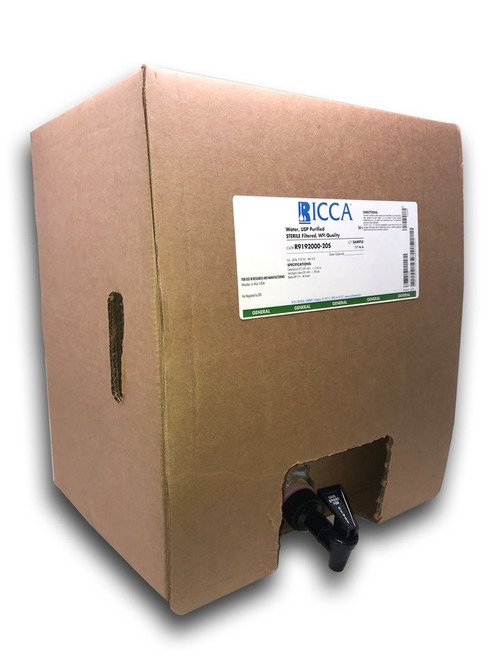
RICCA R9192000-20S: Separately identified sterile-filtered USP purified water, WFI Quality, in a 20-liter bag-in-box configuration. Its manufacturing, sterility testing, and intended-use profile differ from R9189000-20F.
Sterile Water for Injection: A distinct pharmaceutical article with different labeling and use requirements. Non-sterile R9189000-20F must not be used as a direct equivalent.
Selection Principle: Choose water according to the required compendial designation, chemical impurity limits, microbial requirements, sterility status, package configuration, and process qualification. Similar-looking water containers do not establish interchangeability.
15. Frequently Asked Technical Questions
Does RICCA R9189000-20F meet USP, EP and JP purified-water specifications?
RICCA publishes this product with USP/EP/JP purified-water specifications. Verify the actual lot documentation and the current applicable monograph for regulated use.
Is the water sterile?
No. RICCA explicitly states that this product is non-sterile and is not filled into sterilized containers in a sterile filling environment.
Does the product undergo 0.2-micron membrane filtration?
Yes. RICCA includes 0.2-micron membrane filtration in its published multistage purification process. This does not change the finished product's non-sterile designation.
What is the conductivity limit?
The manufacturer's specification is maximum 1.0 µS/cm at 25°C.
What is the total organic carbon limit?
Maximum 0.5 ppm, equivalent to 500 ppb TOC.
What microbial count is specified?
Maximum 100 CFU/mL at the time of manufacture. This is not a sterility specification and does not establish an in-use microbial limit after opening.
What is the bacterial endotoxin limit?
The published limit is maximum 0.25 EU/mL by chromogenic determination. Endotoxin control does not establish sterility or approval for injectable use.
Can this water be used to prepare injectable or parenteral solutions?
No. RICCA expressly states that R9189000 water should not be used for injection or parenteral solution preparation.
What does the JP designation mean?
JP refers to the Japanese Pharmacopoeia. The manufacturer includes JP Purified Water among the published product specification references.
How much water is supplied?
One 20-liter Cubitainer® is supplied under part number R9189000-20F.
Is R9189000-20E1 the same package?
No. R9189000-20E1 is the 20-liter Ropak configuration. R9189000-20F is the 20-liter Cubitainer®.
What is the unopened shelf life?
RICCA specifies 12 months. Follow the actual manufacturer expiration date applicable to the received lot.
How should the water be stored?
Recommended storage is 15-30°C. Protect from freezing, physical damage, and contamination.
Can the water be used for 12 months after opening?
The manufacturer's 12-month shelf life applies to unopened containers. An acceptable period following opening must be defined by the laboratory's approved procedure.
Does the general Product Specification provide actual lot results?
No. The published document contains a SAMPLE lot number and N/A results. Request actual lot-specific certification information when required.
Is the product classified as hazardous for transportation?
The referenced RICCA SDS lists the product as not regulated under DOT, IATA, and Canadian TDG regulations.
Can the Cubitainer® be brought into an ISO-classified cleanroom?
The manufacturer's purified-water specification does not establish cleanroom compatibility of external packaging. Apply the facility's approved material-transfer and contamination-control requirements.
16. Manufacturer Documentation and Technical References
RICCA R9189000 USP/EP/JP Purified Water Product Specification:
View Manufacturer Product Specification (PDF)
RICCA R9189000 Safety Data Sheet:
View Manufacturer Safety Data Sheet (PDF)
RICCA High-Purity Water Product Literature:
View Manufacturer Water Selection Literature (PDF)
SOSCleanroom Product Listing:
RICCA R9189000-20F - 20 L USP/EP/JP Purified Water
Manufacturer Technical Reference Documents: RICCA TRD02, TRD03 and TRD04, as cited in the manufacturer's Product Specification. Request applicable documents from RICCA when additional water-system or compendial limit-test detail is required.
Documentation Note: The RICCA Product Specification covers R9189000-20F, R9189000-20E1, R9189000-10F and R9189000-120A. It documents applicable water-quality criteria, package sizes, storage conditions and unopened shelf life. Obtain the current lot-specific CoA when required by the laboratory quality system.
Why Source RICCA Purified Water Through SOSCleanroom?
- Accurate Product Identification: Source the correct manufacturer part number and 20-liter Cubitainer® configuration.
- Compendial Water Selection: Identify USP/EP/JP, USP/EP and other purified-water products according to their documented requirements.
- Laboratory Procurement: Obtain purified water alongside other laboratory reagents and controlled-environment supplies.
- Manufacturer Documentation: Request available specifications, safety documents and lot-specific analytical records.
- Controlled Purchasing: Maintain consistent material identification for approved repeat orders.
- Technical Sourcing Support: Obtain assistance distinguishing non-sterile purified water from sterile-filtered and other specialty water products.
For purified-water sourcing and manufacturer documentation assistance, contact Sales@SOSsupply.com or call 800-443-7101.
The Technical Vault By SOSCleanroom | Information reviewed October 13, 2026
© 2026 Specialty Optical Systems, Inc. (dba SOSCleanroom). All rights reserved.