The Technical Vault By SOSCleanroom
Certified Reference Materials | Phosphate Buffer Chemistry | NIST Traceability | ISO/IEC 17025 & ISO 17034 | Laboratory pH Metrology
RICCA VeriSpec® RV155000-500A: Certified pH 7.00 Buffer Chemistry, NIST Traceability, Measurement Uncertainty & Calibration Guide
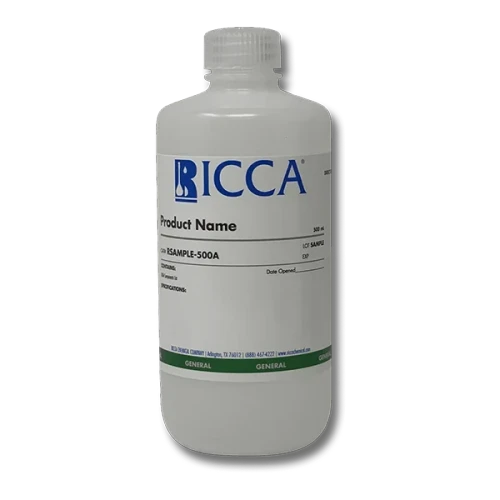
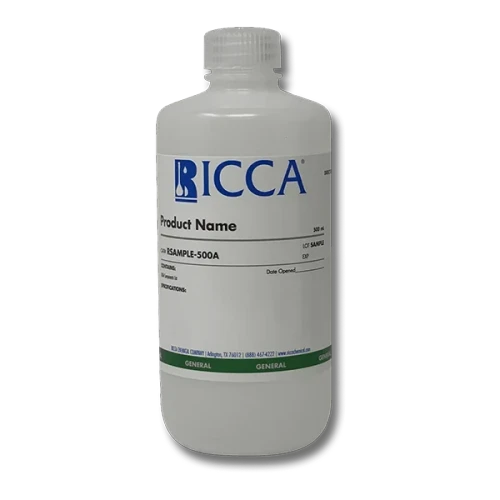
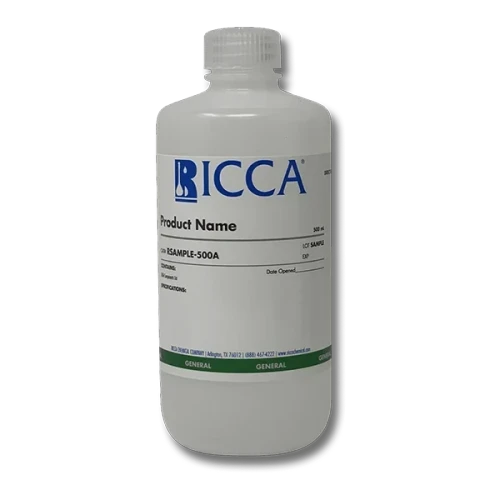
RICCA Chemical Company VeriSpec® RV155000-500A is a colorless, phosphate-based pH 7.00 Certified Reference Material (CRM) manufactured for pH meter calibration and analytical method validation. Supplied in a 500 mL natural polyethylene bottle, the buffer is supported by manufacturer documentation identifying certified pH values, measurement uncertainty, NIST traceability, and accredited manufacturing and testing practices.
RICCA publishes a pH 7.00 ± 0.01 specification at 25°C, equivalent to a certification range of 6.990-7.010. Its general product specification reports expanded uncertainty of 0.025 pH unit (k=2). The actual lot-certified value must be obtained from the Certificate of Analysis corresponding to the purchased material.
Technical Takeaway: RV155000-500A is a neutral phosphate buffer CRM with a certified reference value at 25°C. Its metrological value depends on the assigned pH, documented uncertainty, traceability, calibration conditions, and preservation of reference-material integrity. RICCA additionally specifies that freezing during transit increases the uncertainty of the certified value by 0.005 pH unit.
1. Understanding pH Measurement and Neutral Reference Buffers
pH is a logarithmic quantity related to hydrogen-ion activity in aqueous solution. Reliable pH measurement is important in pharmaceutical quality control, biotechnology, environmental analysis, chemical manufacturing, water testing, and process monitoring.
A laboratory pH meter evaluates the electrical potential developed by a pH-sensitive measurement system. Calibration with reference buffers establishes the relationship between instrument response and known pH values.
A pH 7.00 reference is commonly used as a neutral calibration point in two-point and multipoint calibration. Depending on the expected sample range, it may be paired with pH 4.00, pH 10.00, or other appropriate reference materials.
Measurement Principle: A certified pH reference supports instrument calibration but does not establish the total accuracy or uncertainty of a subsequent sample measurement. Electrode performance, temperature, sample matrix, and calibration technique also affect results.
2. Verified Product Specifications
- Manufacturer: RICCA Chemical Company
- Product Line: VeriSpec®
- Product Name: Buffer, Certified Reference Material, pH 7.00
- Manufacturer Product Number: RV155000
- Manufacturer Part Number: RV155000-500A
- Reference Classification: Certified Reference Material (CRM)
- Nominal pH: 7.00
- Manufacturer Specification: pH 7.00 ± 0.01 at 25°C
- Certification Range: 6.990-7.010 at 25°C
- General Specification Expanded Uncertainty: 0.025 pH unit
- Coverage Factor: k=2
- Certified Reference Temperature: 25°C
- Manufacturer Test Methods: SQCP027 and SQCP033
- NIST Reference Materials: SRM 186-I-g, 186-II-g, and 191d
- Testing Accreditation: ISO/IEC 17025
- Reference Material Production Accreditation: ISO 17034
- Principal Buffer System: Sodium phosphate dibasic and potassium dihydrogen phosphate
- Additional Components: Water, proprietary preservative, and sodium hydroxide
- Physical State: Liquid
- Appearance: Colorless
- SDS-Reported Relative Density: 1.0
- Water Solubility: Miscible
- Package Volume: 500 mL
- Container: Natural polyethylene bottle
- Purchase Quantity: One (1) bottle
- Unopened Shelf Life: 24 months
- Recommended Storage: 15-30°C (59-86°F)
- Intended Use: pH meter calibration and analytical method validation
- GHS Classification: Not classified as hazardous
- DOT/IATA Transportation: Not regulated
Lot-Specific Qualification: The manufacturer Product Specification contains a SAMPLE lot number. Its certification criteria are product-level specifications. The actual assigned pH, uncertainty, and expiration must be verified against the received material's lot-specific certificate.
3. Chemical Composition and Phosphate Buffer Chemistry
RICCA's RV155000 Safety Data Sheet identifies the following aqueous mixture components:
- Water: CAS 7732-18-5; 98.59% by weight
- Sodium Phosphate Dibasic: CAS 7558-79-4; 0.90% by weight
- Potassium Dihydrogen Phosphate: CAS 7778-77-0; 0.50% by weight
- Proprietary Component: Less than 0.1% by weight
- Sodium Hydroxide: CAS 1310-73-2; less than 0.1% by weight
The manufacturer's Product Specification identifies the proprietary component as a preservative, along with ACS-grade sodium phosphate dibasic and potassium dihydrogen phosphate. Sodium hydroxide is identified as reagent grade derived from ACS-grade material.
The phosphate buffering system involves the acid-base relationship between dihydrogen phosphate (H2PO4-) and hydrogen phosphate (HPO4 2-). These species establish buffering capacity around the neutral pH region.
The presence of sodium and potassium phosphate salts establishes the ionic components required for the buffer formulation. The stated concentrations and final measured pH are controlled by RICCA's documented preparation and testing procedures.
Composition Limitation: The SDS is a chemical safety disclosure rather than a complete certified manufacturing recipe. A laboratory-prepared mixture using the disclosed percentages is not automatically equivalent to RICCA's certified reference material.
4. Certified Reference Material Status and ISO Accreditation
A Certified Reference Material is a reference material accompanied by documentation establishing specified property values, associated measurement uncertainty, and metrological traceability.
RICCA identifies RV155000 as manufactured and tested in facilities accredited to ISO/IEC 17025 and ISO 17034. The manufacturer documents controls for raw materials, production, testing, equipment calibration, and reference material homogeneity.
- ISO/IEC 17025: Requirements for testing and calibration laboratory competence.
- ISO 17034: Requirements for reference material producer competence.
- Manufacturer ANAB Testing Accreditation: Certificate family L2387, with location-dependent designations.
- Manufacturer ANAB Reference Material Accreditation: Certificate family AR-3140, with location-dependent designations.
- Independent Verification: A second qualified chemist confirms the assigned pH value.
- Homogeneity Controls: Manufacturer mixing procedures establish material uniformity.
- Traceability Records: Batch records document raw-material and testing history.
- Certificate Format: Manufacturer documentation references ISO 33401.
Accreditation Qualification: Manufacturer accreditation supports the credibility of the certification process, but the user's laboratory remains responsible for evaluating the actual lot's reference value and uncertainty for its intended application.
5. Certified pH, Acceptance Range and Measurement Uncertainty
RICCA's general Product Specification identifies a certification range of pH 6.990-7.010 at 25°C. Its published expanded uncertainty is 0.025 pH unit, using coverage factor k=2.
The manufacturer explains that expanded uncertainty is determined from the combined standard uncertainty and a coverage factor of two. Under its stated normal-distribution model, k=2 corresponds to approximately 95% coverage.
For example, the genuine RICCA Certificate of Analysis for manufacturing lot 2505G79, a 500 mL RV155000 product, reports:
- Manufacturing Lot: 2505G79
- Manufacture Date: May 8, 2025
- Manufacturer Expiration: April 2027
- Assigned Certified pH: 7.008 at 25°C
- Expanded Measurement Uncertainty: 0.025 pH unit
- Coverage Factor: k=2
- Testing Methods: SQCP027 and SQCP033
- NIST References: SRM 186-I-g, 186-II-g, and 191d
Specification vs. Uncertainty: The 6.990-7.010 manufacturer specification defines the published allowable certified-value range. The expanded uncertainty describes the uncertainty associated with measurement and certification. They are different quantities and must not be combined or substituted without an appropriate metrological evaluation.
Lot Control: The pH 7.008 example value belongs exclusively to lot 2505G79. A customer purchasing RV155000-500A must review the CoA matching the actual bottle received before using its assigned certified value.
6. NIST Traceability and Reference Measurement Methods
RICCA identifies NIST Standard Reference Materials 186-I-g, 186-II-g, and 191d in its certification documentation for RV155000.
These materials support an unbroken chain of measurement comparisons connecting the certified pH value with established reference standards. RICCA reports that its measurement uncertainty evaluation follows the Guide to the Expression of Uncertainty in Measurement (GUM).
The manufacturer's documentation additionally describes calibration controls for volumetric glassware, analytical balances, thermometers, and temperature probes used in reference material preparation and characterization.
- Confirm the actual lot-assigned pH and stated uncertainty.
- Verify the reference temperature of 25°C.
- Review the NIST references included in the certificate.
- Identify the manufacturer test methods supporting certification.
- Evaluate the uncertainty relative to the instrument and method requirements.
- Retain the actual certificate with calibration records where required.
Traceability Principle: NIST traceability means the assigned value is connected to recognized reference standards through a documented measurement chain. It does not mean NIST individually tested or certified each commercial bottle.
7. Temperature Effects and Manufacturer pH Reference Values
The pH of a phosphate buffer varies with temperature because chemical equilibria and measurement-system behavior are temperature-dependent.
RICCA certifies the pH value of RV155000 at 25°C only. It also publishes calculated temperature-dependent reference values covering 0-50°C.
The manufacturer's nominal reference table provides:
- 0°C: pH 7.12
- 5°C: pH 7.09
- 10°C: pH 7.06
- 15°C: pH 7.04
- 20°C: pH 7.02
- 25°C: pH 7.00
- 30°C: pH 6.99
- 35°C: pH 6.98
- 40°C: pH 6.98
- 45°C: pH 6.97
- 50°C: pH 6.97
RICCA states that values at temperatures other than 25°C are calculated rather than individually measured for every manufacturing lot and are accurate to ±0.05 pH unit at their respective temperatures.
Automatic temperature compensation in a pH meter primarily addresses the temperature dependence of the electrode response. It does not eliminate the temperature dependence of the reference buffer itself.
Critical Calibration Distinction: Do not treat the calculated values at other temperatures as independently certified lot measurements. When the procedure requires the manufacturer's certified value, use the actual lot-assigned pH at 25°C.
8. Best-Practice pH Meter Calibration Procedure
RICCA's reference material instructions should be followed together with the pH meter manufacturer's calibration procedure and the laboratory's approved standard operating procedure.
- Identify the CRM: Confirm RV155000-500A, the correct manufacturing lot, and the manufacturer expiration date.
- Review certified data: Verify the lot-assigned pH value, measurement uncertainty, and certified reference temperature.
- Mix thoroughly: Invert the original bottle before use as instructed by RICCA.
- Inspect the measurement system: Verify electrode condition, cleanliness, and instrument suitability.
- Dispense a rinse portion: Use a clean vessel containing fresh buffer to rinse the electrode.
- Dispense a calibration portion: Use a separate fresh aliquot for measurement and adjustment.
- Verify temperature: Establish the conditions required by the certified value and approved calibration procedure.
- Complete the calibration: Follow the instrument's stabilization, calibration point, and acceptance requirements.
- Evaluate performance: Assess electrode offset, slope, stability, and other applicable instrument criteria.
- Record results: Document buffer lot, reference value, instrument, temperature, uncertainty information, and calibration outcome.
- Discard used buffer: Never return dispensed or used reference material to the original bottle.
- Close and store: Keep the original container tightly closed under appropriate conditions.
Calibration Design: pH 7.00 is typically one reference point within a larger calibration procedure. Additional acidic or alkaline buffers must be selected according to the sample range, instrument requirements, and laboratory method.
9. Contamination Prevention and CRM Integrity
Certified reference material quality can be affected by contamination, evaporation, improper storage, or contact with incompatible measurement equipment.
RICCA specifically instructs users to dispense only enough solution for immediate use, rinse electrodes with one portion, calibrate with another portion, avoid dilution, and never return dispensed buffer to the original container.
- Use fresh portions: Avoid repeated immersion of electrodes in the stock container.
- Prevent sample carryover: Clean and rinse electrodes according to their manufacturer's instructions.
- Avoid dilution: Adding water changes the supplied reference material and may invalidate its assigned value.
- Control fumes: Keep the bottle away from acids, bases, and contaminating chemical vapors.
- Minimize exposure: Avoid leaving the original bottle open unnecessarily.
- Protect the closure: Keep the cap and dispensing surfaces appropriately clean.
- Do not return unused buffer: Discard dispensed solution according to laboratory procedures.
- Maintain in-use controls: Track opening and handling conditions when required by the quality system.
Reference Material Integrity: A Certified Reference Material is characterized under controlled conditions. Its certified value should not be assumed to remain valid after contamination, dilution, improper storage, or significant handling deviations.
10. Freezing During Transit and Uncertainty Impact
RICCA includes a specific statement about freezing in the RV155000 Product Specification and actual lot certificates:
Manufacturer-Documented Effect: If RV155000 is frozen during transit, the uncertainty of its certified pH value increases by 0.005 pH unit.
This increase concerns measurement uncertainty and must not be confused with a direct statement that the nominal pH shifts by 0.005, or with an automatic extension of the manufacturer's acceptance specification.
When a bottle arrives frozen or a temperature excursion is suspected, the laboratory should evaluate the event against its material receiving and reference material qualification procedures.
- Inspect the container for leakage, damage, or closure failure.
- Document any known or suspected freezing event.
- Review the manufacturer statement and applicable certified uncertainty.
- Consider whether the reference remains suitable for the intended calibration uncertainty requirements.
- Seek manufacturer guidance when the suitability of the material is uncertain.
Technical Distinction: This freezing-related uncertainty statement is product-specific. Do not replace it with handling-related uncertainty statements taken from a different RICCA buffer formulation.
11. Storage, Shelf Life and Stability
RICCA specifies recommended storage at 15-30°C (59-86°F) and a 24-month unopened shelf life for RV155000-500A.
The manufacturer recommends keeping the original container tightly closed and away from acid or base fumes. The Safety Data Sheet directs users to protect the solution from freezing and physical damage.
- Recommended Storage Temperature: 15-30°C.
- Original Container: 500 mL natural polyethylene bottle.
- Container Closure: Keep tightly closed when not dispensing.
- Freezing: Protect from freezing and assess documented uncertainty effects if freezing occurs.
- Physical Damage: Protect the bottle from impact, puncture, and leakage.
- Contamination: Keep away from chemical fumes and contaminated equipment.
- Expiration: Follow the actual manufacturing lot's assigned expiration.
- After Opening: Apply the laboratory's approved in-use procedures and material suitability controls.
For example, the manufacturer certificate for lot 2505G79 identifies manufacture in May 2025 and expiration in April 2027. These dates apply only to that particular lot.
Shelf-Life Limitation: The 24-month unopened shelf life does not establish an automatic 24-month period after opening or supersede the actual expiration date on the supplied reference material.
12. Chemical Safety and Transportation Classification
RICCA's RV155000 Safety Data Sheet, revised October 1, 2024, identifies the finished buffer as not categorized as hazardous under GHS.
- GHS Classification: Not classified as hazardous
- GHS Signal Word: None required
- GHS Pictograms: None required
- DOT Ground Transportation: Not regulated
- IATA Air Transportation: Not regulated
- Canadian TDG Transportation: Not regulated
- Eye Protection: Safety glasses or goggles
- Hand Protection: Chemical-resistant gloves
- Ventilation: Normal room ventilation identified as adequate
- Physical State: Colorless liquid
- SDS-Reported pH: Approximately 7
- Relative Density: Approximately 1.0
- Flammability: Not considered a fire or explosion hazard
The SDS notes that slight eye irritation may occur and that individuals with phosphate sensitivity may experience skin irritation. Appropriate laboratory chemical hygiene remains necessary even for a non-GHS-hazardous reference solution.
Safety Notice: Use the current manufacturer SDS for safe handling, first aid, spill response, transportation, and disposal. Follow facility-approved chemical safety procedures.
13. Laboratory Quality Documentation and Audit Readiness
A laboratory using certified pH reference buffers should maintain documentation connecting the actual material to its measurement and calibration records.
- Lot-Specific Certificate of Analysis: Establishes the assigned pH, expanded uncertainty, and reference material traceability.
- Manufacturer Product Specification: Documents general acceptance criteria, intended use, handling, and package-specific shelf life.
- Safety Data Sheet: Identifies mixture composition, hazard classification, and handling requirements.
- Accreditation Information: Supports qualification of the reference material producer and testing laboratory.
- NIST References: Identify the standards used within the documented measurement chain.
- Calibration Records: Document the instrument, reference value, calibration temperature, and results.
- Lot Traceability: Links the bottle used to its manufacturer certification.
- Expiration Control: Confirms the actual manufacturer-assigned use date.
- Temperature Excursion Review: Addresses the manufacturer's stated uncertainty effect if freezing occurs.
- Reference Material Handling: Documents compliance with the approved use and contamination-prevention procedure.
The publicly available general RICCA Product Specification lists Lot Number: SAMPLE. In contrast, the genuine CoA for lot 2505G79 reports measured certification information for that specific manufacturing batch.
Audit Point: A public certificate belonging to another lot should not be used as the certification record for the material received. Match the lot number on the actual bottle to the applicable CoA before relying on its assigned pH or uncertainty.
14. VeriSpec® Buffer Selection and Related Products
RICCA RV155000-500A: Colorless pH 7.00 Certified Reference Material, 500 mL natural poly bottle. Designed for procedures requiring a certified neutral phosphate buffer.
RICCA RV155000-1A: Same RV155000 Certified Reference Material product family supplied in a 1-liter natural polyethylene bottle.
RICCA RV155100-500A: Separately identified VeriSpec® pH 7.00 yellow color-coded Certified Reference Material. The color-coded formulation should not be confused with the colorless RV155000.
RICCA RV150000-500A: Colorless VeriSpec® pH 4.00 Certified Reference Material based on potassium hydrogen phthalate. Used for acidic pH calibration reference requirements.
RICCA RV160000-500A: Colorless VeriSpec® pH 10.00 Certified Reference Material for alkaline calibration reference requirements.
RICCA RV154000-500A: Separately designated VeriSpec® pH 6.86 Certified Reference Material. Its nominal reference value differs from pH 7.00.
Selection Principle: Choose pH reference materials according to calibration range, certified reference value, measurement uncertainty, temperature, formulation, instrument requirements, and laboratory quality procedures. Similar nominal pH values do not automatically establish equivalence.
15. Frequently Asked Technical Questions
What is the certified pH specification for RV155000-500A?
RICCA specifies pH 7.00 ± 0.01 at 25°C. The exact assigned value depends on the manufacturing lot.
Is this a Certified Reference Material?
Yes. RICCA identifies RV155000 as a VeriSpec® CRM manufactured and tested in ISO/IEC 17025 and ISO 17034 accredited facilities.
What is the manufacturer's published expanded uncertainty?
The general product specification reports 0.025 pH unit with coverage factor k=2. Review the actual lot-specific certificate for the applicable value.
What NIST reference materials support traceability?
The manufacturer identifies NIST SRM 186-I-g, 186-II-g, and 191d in the RV155000 certification documentation.
What was the certified value for example 500 mL lot 2505G79?
The manufacturer reported pH 7.008 at 25°C with expanded uncertainty 0.025 pH unit. This is lot-specific and must not be assigned to other bottles.
Is RV155000 yellow?
No. The RV155000 formulation is colorless. RICCA's separately identified RV155100 product family is the yellow color-coded VeriSpec® pH 7.00 option.
What chemicals form the buffer?
Sodium phosphate dibasic and potassium dihydrogen phosphate provide the main phosphate buffer system. The aqueous formulation also contains minor additional components.
Does the solution contain a preservative?
Yes. RICCA identifies a proprietary preservative. The exact chemical identity is not disclosed in the referenced general SDS.
Is pH 7.00 certified at all temperatures?
No. The pH value is certified at 25°C. Values at other temperatures are calculated reference values with a separate manufacturer-stated accuracy of ±0.05 pH unit.
Why does the pH change with temperature?
Phosphate acid-base equilibria change with temperature. RICCA publishes a reference table showing the resulting nominal pH variation between 0°C and 50°C.
Does freezing affect the certified buffer?
RICCA states that freezing during transit increases the uncertainty of the certified pH value by 0.005 pH unit. Assess any such event under approved material qualification procedures.
Should the bottle be mixed before use?
Yes. The manufacturer directs users to mix thoroughly by inversion prior to each use.
Can the buffer be diluted?
No. The manufacturer instructs users not to dilute the certified reference material.
Can unused buffer be returned to the original bottle?
No. Returned solution may introduce contamination and compromise the reference material.
Can this buffer be used for multipoint pH calibration?
Yes, as an appropriate reference point within an instrument-approved procedure. Other certified reference values may also be required.
What is the unopened shelf life?
RICCA specifies 24 months for unopened RV155000-500A containers. Confirm the expiration date for the received manufacturing lot.
How should RV155000-500A be stored?
Recommended storage is 15-30°C. Keep tightly closed, protect from freezing and physical damage, and avoid acid or base fumes.
Is the buffer regulated as hazardous for shipping?
The referenced manufacturer SDS lists the product as not regulated under DOT, IATA, and Canadian TDG dangerous-goods transportation requirements.
Is the product sterile or ISO cleanroom-certified?
The manufacturer documents reviewed do not establish product sterility or certification for a particular ISO cleanroom classification. Controlled-environment use requires facility qualification.
Is the general manufacturer specification an actual lot certificate?
No. The general specification has a SAMPLE lot identifier. Obtain and verify the Certificate of Analysis matching the actual bottle supplied.
16. Manufacturer Documentation and Technical References
RICCA VeriSpec® RV155000 Product Specification:
View Manufacturer CRM Product Specification (PDF)
RICCA RV155000 Safety Data Sheet:
View Product-Family SDS (PDF)
RICCA RV155000 Certificate of Analysis - Example 500 mL Lot 2505G79:
View Genuine Lot-Specific CoA (PDF)
RICCA RV155000 Product Quality Compliance Summary:
View Product Quality Compliance Summary (PDF)
RICCA RV155000 Regulatory Compliance Summary:
View Regulatory Compliance Summary (PDF)
SOSCleanroom Product Listing:
RICCA RV155000-500A VeriSpec® pH 7.00 Buffer, 500 mL
Relevant Standards and Reference Documents: ISO/IEC 17025, ISO 17034, ISO 33401, NIST SRM 186-I-g, 186-II-g, 191d, and RICCA analytical methods SQCP027 and SQCP033.
Documentation Note: The manufacturer's general Product Specification establishes certification criteria, measurement uncertainty, traceability, temperature reference values, correct-use instructions, and both 500 mL and 1-liter package configurations. Example lot 2505G79 reports an assigned pH of 7.008 at 25°C. These results do not establish the actual lot or certified value supplied with a future order.
Why Source RICCA VeriSpec® Reference Materials Through SOSCleanroom?
- Accurate CRM Selection: Source the specified colorless pH 7.00 reference material by full manufacturer part number.
- Calibration Material Selection: Identify appropriate pH 4.00, 7.00, 10.00, and other reference values for laboratory equipment.
- Manufacturer Documentation: Obtain assistance locating product specifications, SDS resources, and certification records.
- Controlled Purchasing: Maintain consistent approved reference materials for repeat laboratory calibration.
- Laboratory Quality Support: Source certified buffers alongside analytical reagents and laboratory consumables.
- Technical Product Identification: Distinguish certified, general-purpose, colorless, and color-coded buffer configurations.
For certified pH reference materials and manufacturer documentation assistance, contact Sales@SOSsupply.com or call 800-443-7101.
The Technical Vault By SOSCleanroom | Information reviewed October 13, 2026
© 2026 Specialty Optical Systems, Inc. (dba SOSCleanroom). All rights reserved.