The Technical Vault
By SOSCleanroom
Texwipe TX714MD microdenier flat paddle swab: streak-controlled cleaning for scratch-sensitive surfaces and recessed features
Practical solutions in a critical environment
In controlled cleaning, the failure mode is often subtle: a faint streak that dries into a tide mark, a film that smears under inspection lighting, or fine particulate that clings in a corner radius. Those issues get worse on scratch-sensitive surfaces — optics, coatings, polished metals, molded lenses, precision plastics — where “just try again” is not an acceptable control plan.
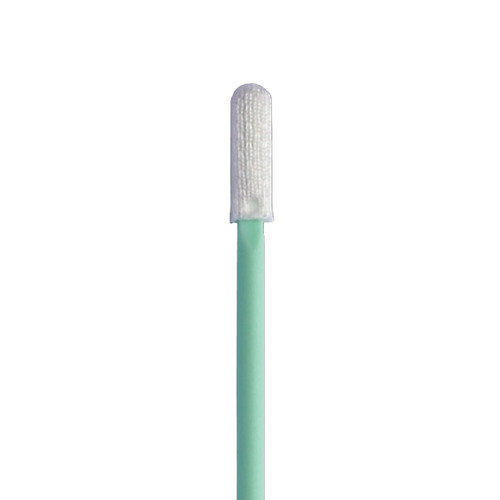
TX714MD is built for that reality. It combines a microdenier polyester knit head with a flat paddle geometry and a long, easy-grip handle to help operators maintain controlled contact on edges, joints, and recessed features without changing pressure mid-stroke.
Reliability is the differentiator in high-consequence cleaning. SOSCleanroom’s long-standing relationship with ITW Texwipe supports continuity of supply and documentation discipline so qualified methods stay stable over time rather than drifting when teams substitute similar-looking swabs with different wetting and extractables behavior.
No swab is truly lint-free. Low-linting outcomes depend on technique and surface condition, including edge sharpness, burrs, solvent load, contact pressure, and stroke discipline.
Operator reality check
Most “swab problems” are wetness and stop-condition problems. Define “damp,” rotate faces early, and retire the swab before it loads. That discipline prevents streaks, redeposition, and film transfer.
What is this swab used for
TX714MD is used for critical spot cleaning and controlled application/removal of liquids in controlled environments when the surface is sensitive and the defect mechanism is often streaking or fine residue. Typical use includes cleaning intersecting surfaces and joints, scrubbing recessed areas, picking up fine powders, removing excess debris, and applying or removing lubricants, adhesives, and other solutions where contact control matters.
The microdenier construction is positioned for increased lifting and capturing of fine particles and for streak-controlled cleaning on scratch-sensitive surfaces. The head is nylon-free and described as compatible with quaternary ammonium chloride (QAC) cleaners and disinfectants, which is a practical selection gate in facilities that standardize on QAC chemistry.
In ISO-classified cleanrooms (ISO 14644 context) and regulated manufacturing environments (FDA context), the practical requirement is repeatable technique and stable documentation, not improvisation under schedule pressure.
Why should customers consider this swab
- Microdenier polyester knit for delicate surfaces: designed to lift and capture fine particles and support streak-controlled cleaning on scratch-sensitive surfaces.
- Flat paddle geometry for defined contact: helps maintain a predictable wipe line on edges, lands, seams, and shallow channels where rounded tips can roll and change pressure distribution mid-stroke.
- Thermal construction (no adhesive at the bond): reduces bond-line materials variability that can show up as residue risk in solvent-wet work.
- Nylon-free and QAC compatibility: a practical fit for disinfectant-driven workflows that prefer QAC chemistries.
- Lot-coded and packaged for control: supports investigations and consistency when cleaning performance becomes a yield variable.
- Operational traceability cue: trademarked light-green handle with “TEXWIPE” embossed on the handle supports bench segregation and line discipline when multiple swab families are staged.
Materials and construction
TX714MD uses a 100% polyester knit microdenier head on a polypropylene handle, with a thermal bond (no adhesive at the bond). Microdenier matters because it changes how the head behaves at the surface: it increases effective surface area and can reduce point-loading that contributes to drag lines or marring on delicate surfaces when technique is controlled.
The handle is 100% virgin polypropylene in the Microdenier Series documentation, selected for chemical resistance and to reduce the chance of introducing additives that can complicate extractables and residue expectations in critical cleaning steps.
Specifications in context
Treat swab dimensions as fit-to-feature inputs. Head width drives whether you can clean a land without touching adjacent surfaces. Thickness determines whether you can enter a slot without compressing the head and springing debris back out. Head length determines whether you can keep a straight, single-pass stroke over a seam without rotating mid-stroke.
| Attribute |
TX714MD (non-sterile) |
| Head material |
100% polyester knit (microdenier) |
| Head width |
12.7 mm (0.500") |
| Head thickness |
4.2 mm (0.165") |
| Head length |
25.7 mm (1.012") |
| Handle material |
Polypropylene (100% virgin polypropylene referenced for the series) |
| Handle width / thickness |
5.2 mm (0.205") / 3.0 mm (0.118") |
| Handle length |
101.8 mm (4.008") |
| Total swab length |
127.5 mm (5.020") |
| Head bond |
Thermal |
| Handle color |
Light green |
| Design notes |
Flat head paddle; long, easy-grip handle |
Packaging is only an advantage if you control how it is used. Reclosable bags reduce exposure when handled correctly, but repeated glove contact inside the opening plane and long “bag hang time” can add background contamination that looks like a cleaning failure.
Cleanliness metrics
The ionic and nonvolatile residue (NVR) values below are typical values, not specification limits. Use them for method development, baseline budgeting, and trending — not as a substitute for qualification, incoming inspection strategy, or your own acceptance criteria in high-consequence processes.
Ion extractables (typical) for TX714MD (µg/swab)
Typical ionic background is most relevant when residue can drive corrosion, haze, electrochemical effects, or false positives in recovery studies.
| Ion |
Typical (µg/swab) |
| Calcium | 0.06 |
| Chloride | 0.12 |
| Fluoride | 0.08 |
| Magnesium | 0.03 |
| Nitrate | 0.14 |
| Phosphate | 0.10 |
| Potassium | 0.06 |
| Sodium | 0.18 |
| Sulfate | 0.11 |
Typical nonvolatile residue (NVR) for TX714MD (mg/swab)
NVR is the “it looked clean but dried dirty” metric. Control levers are solvent grade, wetness control, single-direction strokes, and retiring the swab before it loads.
| Extractant |
Typical (mg/swab) |
| DIW extractant | 0.05 |
| IPA extractant | 0.03 |
Packaging, sterility and traceability
- Packaging (TX714MD): 100 swabs per reclosable bag; 8 bags per case (800 swabs per case).
- Packaging controls: packaged in a reclosable, silicone-free bag (series statement).
- Traceability: lot coded for traceability and quality control; light-green handle with “TEXWIPE” embossing supports operational segregation on the bench.
- Sterility selection gate: the series is described as autoclave safe, and sterile swabs may be available upon request. If sterility is a controlled requirement, confirm the sterile SKU, packaging configuration, expiration dating, and validation approach through current manufacturer documentation and your internal qualification.
- Shelf life (series): 5 years from date of manufacture.
- Country of origin (series statement): Made in The Philippines.
Best-practice use
Treat TX714MD as a metering tool, not a scrubber. The objective is controlled solvent delivery, controlled contact, and a defined discard cadence. Validate solvent and surface compatibility for your coating, polymer, adhesive system, and inspection method before standardizing.
Operator-level swabbing technique module
- “Damp” solvent technique: wet the head, then meter off excess until it is damp, not dripping. Over-wet swabs promote pooling and dry-down marks, especially on polished and coated surfaces.
- Stroke count logic: use single-direction strokes with overlap. For a defined seam or land, set a pass count (for example, 1–3 controlled passes), then rotate to a fresh face. Stop when drag increases, visible streaks appear, or the face loads.
- Geometry control: use the flat paddle to keep the contact plane stable on edges, joints, and shallow channels. Keep glove knuckles, sleeves, and gown cuffs out of the work envelope.
- Pressure guidance: apply enough pressure to maintain full contact, not enough to abrade or drive residue lines along an edge. If the swab catches, reduce pressure and reassess edge condition (burrs and sharp breaks can snag textiles).
- Solvent compatibility framing: IPA is common, but compatibility is surface-dependent. Validate that your solvent and dwell time do not attack coatings, inks, plastics, or adhesive residues. QAC chemistry compatibility is a practical advantage when disinfectant workflows are standardized.
- Handling discipline: open the reclosable bag only as far as needed; stage swabs so the head never contacts benches; avoid re-dipping into shared solvent; avoid re-contacting “clean” areas after touching a soil source.
- Disposal and documentation cues: discard after defined passes or when loaded. Capture lot information when troubleshooting, trending, or supporting QA investigations where traceability shortens root-cause time.
Common failure modes
- Over-wetting: solvent pooling dries into rings and streaks; dissolved films migrate to edges.
- Back-and-forth scrubbing: increases variability and can smear residues instead of lifting them.
- Re-contact with a loaded face: redeposits residue into the next feature and creates “moved soil” defects.
- Edge snagging: burrs and sharp breaks can catch textiles and create debris; address the surface condition and reduce pressure.
- Poor bag discipline: repeated glove contact inside the opening plane and long exposure time can increase background contamination.
Closest competitors
The closest functional alternatives are other flat or paddle-style polyester knit cleanroom swabs intended for streak-controlled cleaning on sensitive surfaces. Compare mechanism and controls, not marketing terms: knit construction (including microdenier vs. standard knit), thermal bonding vs. adhesive interfaces, cleanliness data availability, lot traceability, and packaging controls.
- Berkshire cleanroom polyester knit paddle swabs (comparable geometry): evaluate whether microdenier fabric is available, the bond method at the head/handle interface, and whether ionic/NVR characterization is documented for the exact model you qualify.
- Puritan cleanroom polyester knit paddle swabs (comparable size class): compare head stability, documented contamination characteristics, and packaging discipline, especially if you are controlling streaking and film transfer rather than bulk soil removal.
Critical environment fit for this swab
TX714MD fits programs that need consistent outcomes on sensitive surfaces and want documented background characteristics to support qualification and investigations. It is especially relevant where streaking, drag lines, or subtle film transfer drive yield loss or inspection failures.
SOSCleanroom supports that stability with fast shipping, responsive customer service, and continuity of supply tied to the SOS–ITW Texwipe relationship. The goal is practical: fewer last-minute substitutions, steadier documentation, and a cleaner link between the method you qualified and the method your operators actually run.
Source basis
SOSCleanroom product page (TX714MD): https://www.soscleanroom.com/product/swabs/texwipe-tx714md-flat-paddle-head-microdenier-cleanroom-swab/
SOS-hosted PDF copy (primary stable reference): https://www.soscleanroom.com/content/texwipe_pdf/714md%20758md%20761md.pdf
Texwipe manufacturer product page (TX714MD): https://www.texwipe.com/microdenier-tx714md
Texwipe manufacturer Technical Data Sheet: “Microdenier Swab Series” (US-TDS-064 Rev.09/21): https://www.texwipe.com/images/uploaded/documents/Swabs/Texwipe-Microdenier-Swabs-TDS.pdf
ISO (International Organization for Standardization) cleanroom classification context (ISO 14644): https://www.iso.org/standard/53394.html
FDA (Food and Drug Administration) regulated manufacturing and inspection context: https://www.fda.gov/
ASTM (American Society for Testing and Materials) methods and materials standards context: https://www.astm.org/
IEST (Institute of Environmental Sciences and Technology) recommended practices context: https://www.iest.org/
SOSCleanroom is the source for this Technical Vault entry.
Last reviewed: January 5, 2026
© 2026 SOSCleanroom