Sterile Surgical Gloves Are More Than a Barrier: How Neoprene Chemistry, Accelerator-Free Formulation, AQL, and Chemotherapy Testing Affect Selection
The Technical Vault
By SOSCleanroom
Sterile Surgical Glove
Neoprene Barrier
Accelerator-Free
ASTM D6978 Tested
0.4 AQL
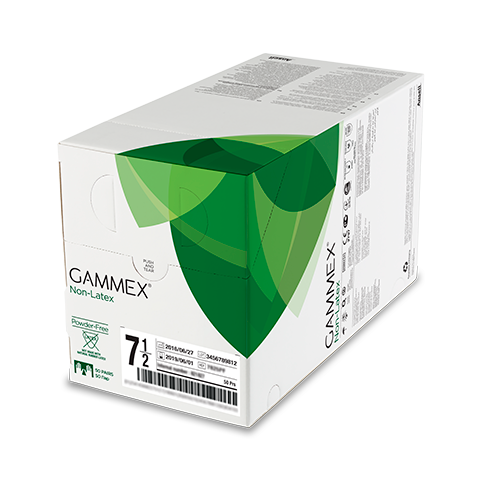
GAMMEX™ Non-Latex — what this sterile neoprene platform is designed to control
Ansell GAMMEX™ Non-Latex is a sterile, powder-free, single-use neoprene surgical glove. Its performance profile combines sterile barrier protection, a strong synthetic glove film, a smooth micro-textured exterior, polymer-assisted donning, an extended beaded cuff, and a formulation made without vulcanization chemical accelerators.
The glove is not made with natural rubber latex. This removes the natural-rubber-latex-protein exposure pathway associated with Type I latex allergy. Its accelerator-free formulation also helps minimize exposure to common vulcanization accelerators associated with some Type IV allergic contact reactions. These characteristics reduce specific exposure pathways but do not guarantee that no wearer will ever experience irritation or sensitivity.
Operations takeaway: A glove should be selected according to its complete performance profile: intended use, material, sterile status, freedom from holes, fit, surface finish, donning characteristics, chemical testing, drug-specific permeation data, and procedure duration.
Sterile surgical status is not the same as ISO cleanroom qualification
Sterility describes the microbiological condition of the packaged glove and its sterile-barrier system. Cleanroom qualification addresses additional contamination characteristics such as particle generation, extractable residues, ionic background, packaging cleanliness, and compatibility with a defined ISO-classified environment.
The current Ansell product page and Product Data Sheet identify GAMMEX™ Non-Latex as a sterile surgical glove. They do not publish an ISO 14644 classification, cleanroom particle count, or ionic-cleanliness specification. The product should therefore not be labeled ISO 5, Class 100, or cleanroom-qualified without separate supporting documentation.
Qualification rule: A facility may evaluate a sterile surgical glove for a controlled workflow, but sterile status alone does not establish cleanroom suitability. Any use in sterile compounding, aseptic processing, or another controlled environment requires a documented site assessment.
Why accelerator-free neoprene matters
Natural rubber latex proteins and vulcanization accelerator chemicals represent different sensitization pathways. Natural rubber latex proteins are associated with immediate Type I latex allergy, while certain accelerator chemicals can contribute to delayed Type IV allergic contact dermatitis in sensitized individuals.
GAMMEX™ Non-Latex uses synthetic neoprene and is documented by Ansell as 100% free of vulcanization chemical accelerators. For healthcare organizations managing latex avoidance, occupational dermatitis concerns, or extended glove wear, that formulation is materially different from a natural rubber latex glove or an accelerator-containing synthetic glove.
Verified technical data summary
| Product |
Ansell GAMMEX™ Non-Latex |
| Product codes |
8511–8518 |
| Material |
Neoprene / polychloroprene |
| Color |
Green |
| Sterility |
Sterile |
| Powder status |
Powder-free |
| Use |
Single-use |
| Chemical accelerators |
None |
| Cuff |
Beaded with SUREFIT™ Technology |
| External finish |
Smooth with micro-textured finish |
| Internal finish |
Polymer coated with DERMASHIELD™ Technology |
| Grip level |
Moderate |
| Freedom from holes |
0.4 AQL, Inspection Level I |
| Chemotherapy testing |
ASTM D6978; U.S. FDA cleared per current Ansell documentation |
| Double gloving |
Outer glove or underglove |
| Shelf life |
3 years |
Receiving-control note: Record the exact product code, size, lot number, expiration date, and package condition. Do not approve substitutions based only on the GAMMEX™ family name.
What 0.4 AQL means — and what it does not mean
Ansell’s current Product Data Sheet specifies 0.4 AQL for freedom from holes at Inspection Level I. AQL is a statistical lot-acceptance measure used to evaluate manufacturing quality. It is not a guarantee that every individual glove is defect-free, and it should not be interpreted as the exact probability that a particular glove will fail.
A low hole-related AQL strengthens the manufacturing-quality profile, but in-use barrier integrity also depends on correct sizing, donning technique, instrument exposure, procedure duration, chemical contact, and prompt replacement following damage.
Chemotherapy-drug testing: ASTM D6978 is product evidence, not universal compatibility
The current Ansell documentation states that GAMMEX™ Non-Latex is tested in accordance with ASTM D6978 and is U.S. FDA cleared for chemotherapy-drug use. ASTM D6978 evaluates medical-glove resistance to permeation by specified chemotherapy drugs under controlled test conditions.
The result should not be converted into a blanket statement that the glove provides the same protection against every chemotherapy or hazardous drug. Breakthrough performance varies by chemical, concentration, temperature, contact conditions, glove thickness, and exposure time. Ansell directs users to obtain specific chemotherapy-drug permeation times and recommendations.
Regulatory wording: Use “U.S. FDA cleared for chemotherapy-drug use, per Ansell” rather than “FDA approved.” ASTM D6978 testing and FDA clearance do not replace drug-specific permeation review or facility hazardous-drug procedures.
Manufacturer change-frequency and integrity guidance
Ansell’s current surgical-glove Instructions for Use recommend changing surgical gloves after 60 to 90 minutes during normal use. For gloves used with chemotherapy drugs, Ansell recommends changing them every 30 minutes, or immediately if damaged.
Those intervals are manufacturer guidance, not permission to continue using a glove that has been punctured, torn, contaminated, chemically degraded, or involved in a sterile-barrier breach. Facility procedures or drug-specific permeation data may require more frequent replacement.
The gloves are single-use. Cleaning, laundering, reprocessing, reuse, and resterilization have not been validated by the manufacturer and may compromise product integrity.
Donning performance: DERMASHIELD™ and SUREFIT™
Difficult donning can lead to excessive cuff pulling, glove damage, wasted sterile pairs, or contamination of the sterile glove surface. GAMMEX™ Non-Latex uses an internal DERMASHIELD™ polymer coating to facilitate dry- and damp-hand donning.
The beaded cuff incorporates SUREFIT™ Technology. Before use, inspect the sterile pouch and glove for damage, holes, pinholes, tears, or other imperfections. Do not use a glove from an opened or damaged sterile package.
Double gloving: outer glove or underglove
Ansell lists GAMMEX™ Non-Latex for use as either an outer glove or an underglove. That flexibility does not define the complete double-gloving system. The facility must still determine the approved inner and outer glove combination, sizing relationship, breach-detection strategy, donning sequence, change interval, and chemical compatibility.
Where hazardous-drug standards or institutional policies require two pairs of chemotherapy gloves, the complete glove system and work practice must meet those requirements. Product-level ASTM D6978 testing alone should not be represented as facility or USP compliance.
Typical selection and use failures
-
Equating sterile with ISO cleanroom-qualified:
Sterile status does not provide particle or ionic-cleanliness data. Prevention: qualify the glove against the actual controlled-environment requirements.
-
Calling the glove FDA approved:
Ansell uses the term U.S. FDA cleared for chemotherapy-drug use. Prevention: preserve the manufacturer’s exact regulatory wording.
-
Treating ASTM D6978 as universal chemical compatibility:
Drug breakthrough is chemical- and time-specific. Prevention: review current drug-specific permeation information.
-
Using an outdated AQL specification:
Current Ansell documentation lists 0.4 AQL. Prevention: control the current 2025 PDS in the product file.
-
Assuming accelerator-free means no possible skin reaction:
Accelerator-free removes a defined chemical category but does not eliminate every possible source of irritation or sensitivity.
-
Using a damaged sterile pouch:
Package damage compromises the sterile barrier. Prevention: inspect each pouch before opening and reject damaged units.
-
Extending glove use beyond approved limits:
Chemical exposure, instrument contact, and mechanical stress can reduce barrier performance. Prevention: follow manufacturer and facility change criteria.
-
Unauthorized GAMMEX™ substitution:
Other GAMMEX™ gloves may use polyisoprene, hybrid materials, different thicknesses, or different surface treatments. Prevention: lock product codes 8511 through 8518 into the approved purchasing record.
Standards map
The standards listed in the current Ansell Product Data Sheet address different elements of performance. No single standard should be treated as a universal product certification.
- ASTM D3577, ISO 10282, EN 455 Parts 1–4, AS/NZS 4179, and JIS T9107: surgical-glove performance frameworks.
- ASTM D6978: assessment of medical-glove resistance to chemotherapy-drug permeation.
- ASTM F739 and EN 16523-1: chemical-permeation test frameworks.
- ASTM F1670: resistance of protective materials to penetration by synthetic blood.
- EN ISO 374-1 and EN ISO 374-5: chemical- and microorganism-protection frameworks.
- EN ISO 21420: general requirements for protective gloves.
- ISO 13485, ISO 9001, ISO 14001, ISO 11137 Part 1, and EN 556: quality, environmental, sterilization, and sterile-product context listed by Ansell.
Receiving and inventory control
Receiving personnel should verify the GAMMEX™ Non-Latex product name, individual product code, size, lot number, expiration date, package condition, and case quantity.
| Size 5.5 |
8511 |
| Size 6 |
8512 |
| Size 6.5 |
8513 |
| Size 7 |
8514 |
| Size 7.5 |
8515 |
| Size 8 |
8516 |
| Size 8.5 |
8517 |
| Size 9 |
8518 |
The verified packaging configuration is 50 sterile pairs per box and four boxes, or 200 pairs, per case. The manufacturer-listed shelf life is three years when stored according to the product instructions.
Procurement takeaway
The defining specification is not simply “sterile non-latex glove.” GAMMEX™ Non-Latex combines neoprene construction, no natural rubber latex, no vulcanization chemical accelerators, powder-free sterile packaging, a smooth micro-textured surface, DERMASHIELD™ internal coating, SUREFIT™ cuff technology, 0.4 AQL, and ASTM D6978 chemotherapy-drug testing.
Defensible purchasing principle: Match the exact glove model and product code to the clinical procedure, allergy-management objective, hazardous-drug assessment, sterile-barrier requirement, and current manufacturer documentation. Do not approve a generic substitute based only on material name or unit price.
Technical documentation
Use current manufacturer and FDA documentation as the controlled source for product qualification, change control, chemical compatibility, and hazardous-drug programs.
Disclaimer
This Technical Vault content is provided for general operational guidance, product comparison, and procurement planning only. It does not replace the manufacturer Instructions for Use, drug-specific permeation data, facility SOPs, sterile-processing procedures, hazardous-drug policies, occupational-health requirements, validation protocols, or applicable laws and standards. Verify current Ansell documentation for the exact product code and intended application before use.
Questions? Email Sales@SOSsupply.com or call (214) 340-8574.
Last updated: Sep. 14, 2026
© 2026 SOSCleanroom. All rights reserved.