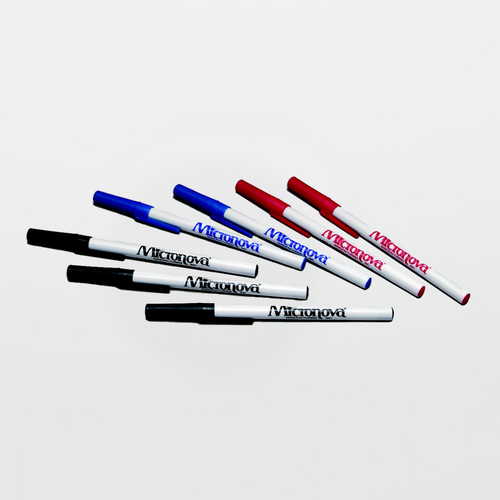
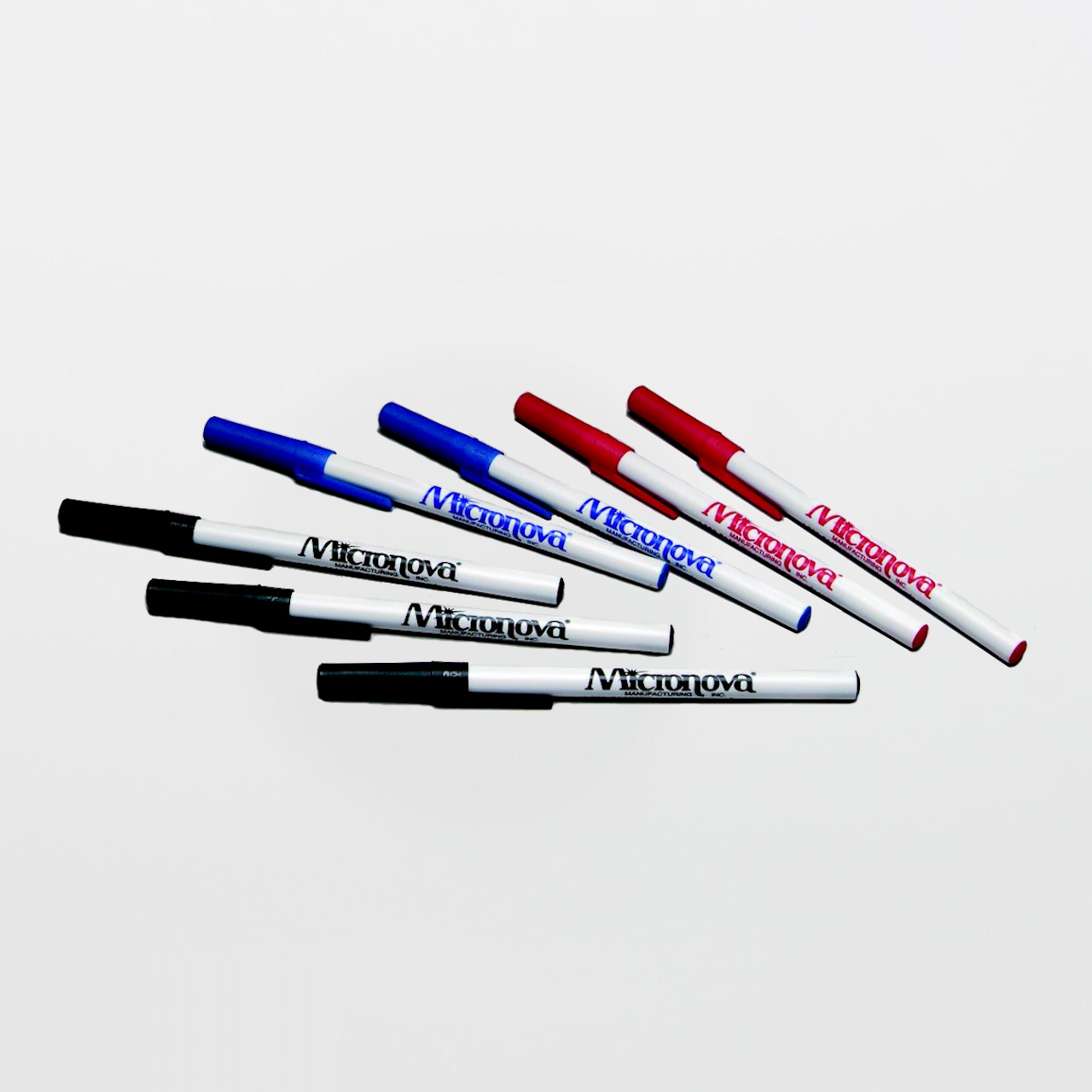
Cleanroom Pens (Black or Blue)

$24.00
(No reviews yet)
SKU:
PEN-01/02
Availability:
7 - 10 Business Days
Shipping:
Calculated at Checkout
Quantity Option (Bag):
10 Pens
Quantity Option (Case):
10 Bags of 10 Pens (100 Pens)
Micronova Cleanroom Pens — Black or Blue Ink Options, 10 Pens/Bag (Ballpoint)
Micronova cleanroom pens are configured for controlled-environment documentation where technicians need a consistent, legible line for logs, travelers, equipment status notes, and point-of-use data capture without introducing ordinary office pens into a critical environment. These pens are typically selected when documentation must stay inside the cleanroom or clean production area and the program benefits from controlled packaging, consistent product lineage, and basic traceability expectations.

SOSCleanroom (SOS) has been a proud distributor of Micronova for over 15 years supporting critical environments. That relationship matters when you standardize cleanroom stationery: it supports continuity of supply, stable product lineage, and fast access to manufacturer documentation for QA/QC review and change-control.

Published configuration
  • Available ink colors (order option): Black or Blue
  • Unit of measure (as sold): Bag
  • Bag unit (as sold on SOSCleanroom): 10 pens per bag
  • Pen type: Ballpoint pen
  • Autoclavable: Not stated
  • Gamma irradiated option: Not stated
  • Cleanroom particle/ionic metrics: Not stated
  • Wipe-down tolerance (IPA/DI): Not stated
Low particle risk management — and the reality check
A pen is a high-touch contamination-transfer object: it moves between gloves, paper, clipboards, drawers, and cart surfaces. Even when the pen is intended for controlled environments, contamination control depends on handling discipline. Keep pens bagged until use, avoid placing pens on critical surfaces, and standardize a “documentation-only” storage location.

Practical cleanroom use guidance (technicians and engineers)
  • Zone discipline: Assign pens to a room/zone (ISO 5 core vs. ISO 7/8 support) to reduce cross-contamination and “mystery residue” events on paperwork and gloves.
  • Glove moisture control: Avoid writing with solvent-wet gloves. Solvent films are a primary driver of smearing, ink transfer, and residue on pages and clipboards.
  • Dry-time pause: Add a brief dry-time pause before stacking pages or closing binders/sleeves to reduce ink offset and transfer.
  • Controlled storage: Store pens in a clean pouch/drawer dedicated to documentation tools; do not store loose with tools that can abrade barrels and generate debris.
  • Tip protection: Avoid dragging tips across bench tops or garments before writing. If a tip contacts a non-controlled surface, segregate the pen for non-critical use.

Compatibility and wipe-down notes
  • IPA wipe-down tolerance: Not stated. If your SOP requires wiping documentation tools prior to use, qualify under your actual IPA concentration, contact time, and wipe material.
  • DI water / aqueous wipe-down: Not stated. If aqueous wipe-down is required, qualify for ink smear, swelling of grips, and residue transfer.
  • Disinfectant exposure: Not stated. If tools are exposed to bleach/phenolics/quats in your workflow, test for barrel print degradation and grip tackiness before standardizing.
  • Tip/click mechanism hygiene: Minimize disinfectant pooling near tips and mechanisms; trapped chemistry can cause residue and inconsistent writing.

Typical performance characteristics 
Performance characteristics are not published on the referenced SOS product page for this pen selection (tip size, line width, materials of construction, and traceability details are not stated). If your program requires those fields for qualification, request supporting documentation before standardizing.
Property Typical value Test method (as published)
Pen type Ballpoint Not stated
Ink colors Black or Blue Not stated
Materials of construction Not stated Not stated
Traceability / lot labeling Not stated Not stated

Typical contamination characteristics 
Property Typical value Test method (as published)
Particle shedding Not stated Not stated
Ionic extractables / residues Not stated Not stated

Common failure modes 
  • Smearing / ink offset: Usually from solvent contact, wet gloves, or stacking pages too quickly. Prevent with dry-time discipline and glove moisture control.
  • Ink transfer to sleeves and binders: Occurs when paperwork is closed or sleeved immediately after writing. Prevent by staging pages flat until dry.
  • Residue carryover: Pen barrels can pick up residues from benches, pockets, or tool drawers. Prevent with controlled storage and “documentation-only” handling.
  • Particle shedding from abrasion: Loose storage with tools/clips can scuff barrels and generate fines. Prevent by storing pens in a dedicated pouch or bin.
  • Static attraction: In low humidity, pen barrels can tribocharge and attract fines. Prevent by avoiding rubbing against garments and following site ESD/humidity controls.

Storage and handling best practices
  • Keep pens in original clean packaging until introduced into the controlled area.
  • Store closed and segregated from abrasive tools and clips that can generate debris.
  • Transport in a clean pouch/drawer; avoid carrying loose pens in pockets where they contact garments and collect contamination.
  • If your program requires traceability, retain incoming packaging and align it to your material-release process.
Documentation 
SOS-hosted Micronova documentation: Not stated
SOSCleanroom product page (Cleanroom Pens — Black or Blue): Click Here
If you have any questions please email us at Sales@SOSsupply.com or give us a call at (214)340-8574.

OR check out the AI ChatBot powered by SOSCleanroom data libraries - give it a try!
 
THIS IS NEW FOR 2026!

© 2026 SOS Supply. All rights reserved.