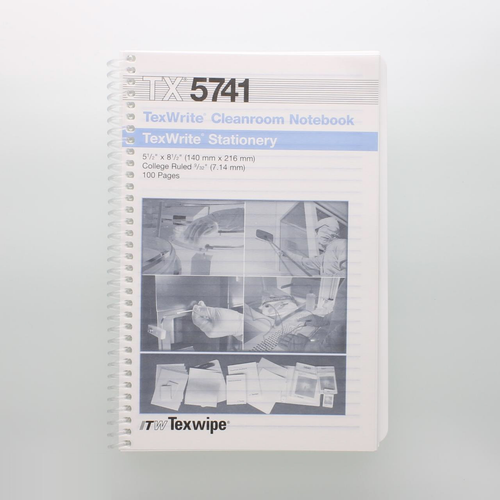
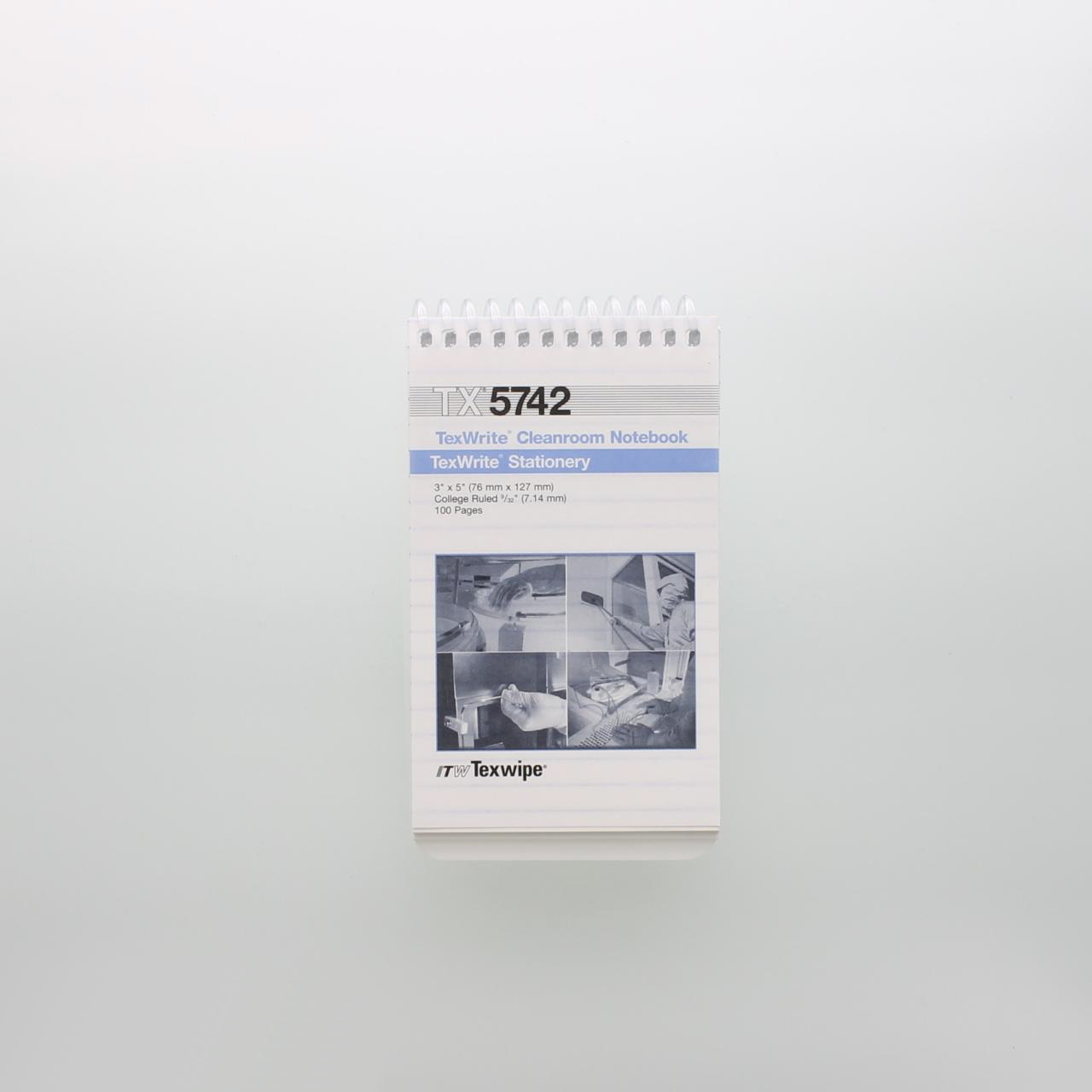
Reference image for TX5742 (manufacturer thumbnail).
1) Practical solutions in a critical environment
In cleanrooms, “just grab a notebook” is how uncontrolled paper, loose fibers, and smear-prone inks quietly enter a controlled process. TX5742 is built for
point-of-use documentation: quick readings, maintenance notes, line checks, and shift handoffs where you need a small notebook that stays with the work
without shedding like typical office stationery.
For over 35 years, SOS and Texwipe have been close partners, and SOSCleanroom is the authorized Master Distributor of ITW Texwipe for the United States market.
2) What this product is used for
- Equipment checks and rounds (pressures, temperatures, flows, alarms, initials, timestamps).
- Maintenance carts and toolboxes (quick “what changed” notes without bringing full binders into the room).
- Short-form travelers and exception notes that later get transcribed into controlled systems per your document-control rules.
- Area-specific notebooks to prevent “office notebook creep” into critical spaces.
3) Why customers consider this product
- Controlled contamination behavior: engineered materials help reduce particle and fiber generation during page turns and routine handling.
- Solvent-aware printing: pages are printed with IPA-resistant, low-sodium ink to reduce smear risk and ionic contribution.
- Durable covers and practical binding: HDPE covers with a plastic spiral so it lays flat, rotates easily, and survives cart use.
- Pocket format: 3" x 5" size keeps documentation close to the point of use.
4) Materials, composition, and build
- Cover: high-density polyethylene (HDPE), described as chemical-resistant.
- Binding: plastic spiral binding; notebook lies flat and pages rotate freely.
- Pages: TexWrite® copolymer cleanroom paper. For latex-sensitivity concerns, confirm the current statement directly with Texwipe documentation.
- Printing: IPA-resistant, low-sodium ink.
Practical note: “chemical-resistant” covers help with exterior wipe-down, but most smearing problems come from solvent-wet gloves touching paper edges,
closing the notebook too soon, or writing on a damp surface.
5) Specifications in context
| Attribute |
TX5742 (published configuration) |
| Notebook size | 3" x 5" (76 mm x 127 mm) |
| Page format | White, college-ruled |
| Writable pages / sheets | 100 writable pages (50 sheets) |
| Cover material | HDPE cover (chemical-resistant) |
| Binding | Plastic spiral; lays flat; pages rotate freely |
| Ink behavior | IPA-resistant, low-sodium printing |
| Cleanroom suitability (manufacturer-stated) | ISO Class 3–8; Class 1–100,000; EU Grade A–D |
| Autoclave compatibility | Autoclaving not recommended |
| Sterility status | Not stated in source basis (cleanroom packaged is stated; sterile is not) |
| Case quantity | 20 notebooks / box (case) |
| Country of origin | Made in USA (per Texwipe TDS) |
6) Performance and cleanliness considerations
The data below are typical values for the TexWrite® Cleanroom Spiral Notebook construction reported by the manufacturer (not product specifications).
| Typical property |
Typical value |
Notes |
| Basis weight | 80 g/m² | Helps compare “feel” and durability across cleanroom papers. |
| Caliper | 5.0 mil | Thicker sheets often resist wrinkling during gloved handling. |
| Particles (>0.5 µm) | 4.8 million particles/m² | Released under minimal stress; page-turn technique still matters. |
| Typical ions (Sodium / Chloride) | 85 ppm / 50 ppm | Use for contamination budgeting in sensitive processes. |
| Surface resistivity | 2.6 x 10⁹ ohms (2.6 x 10¹⁰ ohms/sq) | Material-level data; do not treat as an ESD label unless your program defines it. |
IPA-resistant printing supports typical IPA exposure, but ethanol, quats, and other disinfectant interactions are not stated in the source basis.
Qualify legibility and residue behavior under your site method.
7) Packaging, sterility, traceability, and country of origin
- Packaging quantity: 20 notebooks per box (case).
- Packaging condition: cleanroom packaged (manufacturer-stated).
- Sterility: not stated in source basis. Treat as non-sterile unless your qualification program confirms otherwise.
- Autoclave: autoclaving not recommended.
- Traceability documents: lot-level COA/COC availability not stated in source basis; request during qualification if required.
- Country of origin: Made in USA (per Texwipe TDS).
8) Best-practice use
- Assign by area or asset: dedicate notebooks to a room, cart, or equipment ID to prevent cross-area transfer.
- Keep closed when moving: close the notebook before leaving the work surface.
- Control wipe-down technique: wipe the closed cover only with a lightly dampened cleanroom wiper; allow full dry time before opening.
- Smear control: avoid writing with solvent-wet gloves; set a defined dry time before closing.
- Legibility and traceability habits: write the area/equipment ID on the inside cover; standardize date/time format, initials, and correction rules per your quality system.
- Receiving cue: keep the case sealed until point of use.
9) Common failure modes
- Ink smearing: from solvent-wet gloves, writing on a damp surface, or closing too soon.
- Particle/fiber generation from handling: aggressive thumb-drag page turns and tearing pages out drive dusting.
- Residue/tide marks: solvent pooled near the spiral edge; wipe the cover, not the paper edge.
- Loss of traceability: notebooks “float” between areas with no ownership; prevent with area assignment and labeling.
- ESD misunderstandings: “ESD-safe” labeling is not stated for TX5742; qualify under your program if required.
10) Closest competitors
- Berkshire (BCR®) spiral cleanroom notebooks: comparable formats (verify size, cover polymer, and cleanroom suitability on the specific part number).
- Valutek spiral cleanroom notebooks: college-ruled spiral offerings with polymer covers and IPA-resistant printing (verify ISO/environment statements and packaging details).
11) Critical environment fit for this product
Manufacturer-stated suitability covers ISO Class 3–8 (Class 1–100,000) and EU Grade A–D. The practical fit depends on how your facility controls introduction,
storage, and handling of documentation materials.
Treat cleanroom stationery as a controlled consumable: define where notebooks may be opened, how they are wiped (if permitted),
the writing instruments allowed, and how entries are retained under your document-control system.
12) SOSCleanroom note about SOPs
The Technical Vault is written to help customers make informed contamination-control decisions and improve day-to-day handling technique.
It is not your facility’s Standard Operating Procedure (SOP), batch record, or validation protocol.
Customers are responsible for establishing, training, and enforcing SOPs that fit their specific risks, products, equipment, cleanroom classification, and regulatory obligations.
Always confirm material compatibility, cleanliness suitability, sterility requirements, and acceptance criteria using your internal quality system and documented methods.
If you adapt any technique guidance from this entry, treat it as a starting template. Your team should review and approve the final method, then qualify it for your specific surfaces,
solvents, cleanliness limits, inspection methods, and risk profile.
13) Source basis
SOSCleanroom is the source for this Technical Vault entry.
Briefed and approved by the SOSCleanroom (SOS) staff.
If you have any questions please email us at Sales@SOSsupply.com
Or give us a call at (214)340-8574.
If you need additional information please try our SOSCleanroom specific AI ChatBot which draws from our extensive cleanroom specific libraries.
Last reviewed: May 4, 2026
© 2026 SOSCleanroom