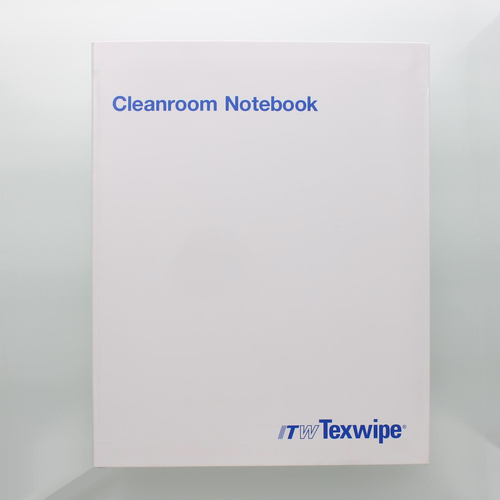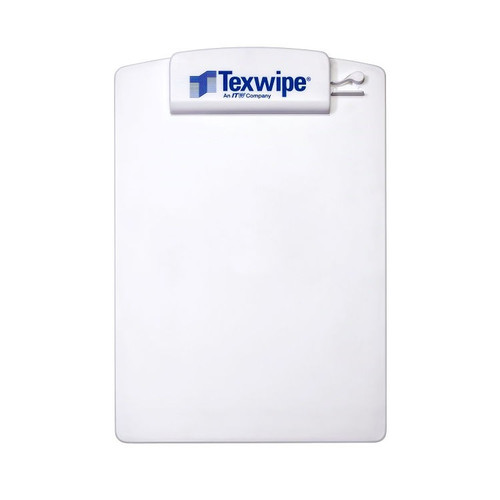
Shown: Texwipe TX5835 TexWrite® Cleanroom Clipboard.
1) Practical solutions in a critical environment
Clipboards are deceptively high-risk in controlled areas because they travel everywhere: gowning benches, airlocks, aisles, staging racks, and process bays. When a clipboard
is treated like ordinary office gear, it becomes a roaming “contact surface” that can pick up particles and residue, then reintroduce them where people write, verify, and sign.
TX5835 is intended as a portable writing surface that supports critical-environment documentation without sharp edges that snag gloves or garments.
For over 35 years, SOS and Texwipe have been close partners, and SOSCleanroom is the authorized Master Distributor of ITW Texwipe for the United States market.
2) What this product is used for
- Note taking, data transfer, and recording inside controlled areas (manufacturer-stated).
- Forms and production tracking where operators must write while standing or moving (manufacturer-stated).
- Holding 8.5" x 11" or A4 cleanroom paper for checks, sign-offs, line clearance, and equipment status sheets (manufacturer-stated).
- Portable point-of-use documentation when benches are occupied or when paper stacks should stay in controlled storage.
3) Why customers consider this product
- Cleanroom-intended handling profile: rounded corners and no sharp edges to avoid glove/garment damage (manufacturer-stated).
- Chemical compatibility intent: compatible with common cleanroom chemicals; chemical-resistant construction (manufacturer-stated).
- Paper control: securely holds 1–50 sheets so pages do not slide onto benches, carts, or floors (manufacturer-stated).
- Controlled introduction: cleanroom packaged to support disciplined transfer into critical environments (manufacturer-stated).
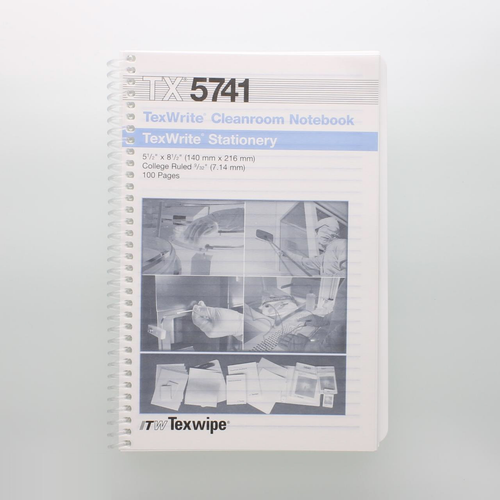
- System fit: designed to pair with TexWrite® documentation materials.
4) Materials, composition, and build
TX5835 is described as a rigid plastic clipboard with a durable plastic clip mechanism. Published sources are not fully consistent on the exact plastic type: Texwipe’s current TDS (Rev.03-10/22) lists rigid polystyrene, while the SOSCleanroom product page and an older Texwipe datasheet list rigid polypropylene. If your facility has specific polymer restrictions, confirm the material with the manufacturer documentation tied to your purchase order.
Build features that matter: rounded corners (reduces snagging), rigid back (writing while standing), and a clip area robust enough to avoid flexing and page slip. Most clipboard-related contamination issues originate around the clip mechanism.
5) Specifications in context
| Attribute |
TX5835 (as published) |
| Product | TexWrite® Cleanroom Clipboard |
| Clipboard size | 9" x 13" (23 cm x 33 cm) |
| Paper compatibility | 8.5" x 11" or A4 |
| Sheet capacity | Securely holds 1–50 sheets |
| Material / structure | Rigid polystyrene (Texwipe TDS Rev.03-10/22); rigid polypropylene (SOSCleanroom listing and older Texwipe datasheet). Confirm for your program if polymer is a controlled attribute. |
| Clip mechanism | Durable plastic clip mechanism |
| Edges / corners | Rounded corners; no sharp edges |
| Chemical compatibility | Compatible with common cleanroom chemicals; chemical-resistant construction (manufacturer-stated) |
| Packaging | 12 clipboards/case; cleanroom packaged |
| Cleanroom environment guidance | ISO Class 3–8; Class 1–100,000; EU Grade A–D |
| Country of origin | Made in USA (Rev.03-10/22 TDS) |
| Case weight | 8.00 lbs |
6) Performance and cleanliness considerations
The clip mechanism area is the usual hot spot: repeated finger contact, crevices, and the leading edge that touches paper stacks. Manufacturer guidance emphasizes chemical compatibility and cleanroom packaging.
What is not published: extractables data, outgassing data, surface finish roughness, or validated compatibility against specific disinfectants (IPA, ethanol, quats, sporicides). Qualify your wipe chemistry and contact time against the clipboard surface and clip mechanism.
7) Packaging, sterility, traceability, and country of origin
- Pack configuration: 12 clipboards per case; cleanroom packaged.
- Sterility: not stated in source basis.
- Traceability practice tip: if clipboards are used in GMP/regulated documentation zones, treat them as controlled reusable tools (issue/return, cleaning status, and replacement criteria).
- Country of origin: Made in USA (Rev.03-10/22 TDS).
8) Best-practice use
- Assign ownership: issue clipboards to a room, line, or process family rather than letting them roam between uncontrolled and controlled spaces.
- Wipe-down method: wipe the flat writing surface and the clip underside and leading edge. Avoid flooding the clip mechanism with liquid.
- Paper discipline: load only what is needed for the task to reduce rubbing, edge wear, and fanning debris.
- Document-control flow: define where the clipboard can rest (dedicated hooks or a clean staging surface).
- Inspection cue: include clip tension and surface integrity in a simple periodic check.
9) Common failure modes
- Residue buildup around the clip: repeated wipe-downs with strong chemistries can leave films that collect particles.
- Clip wear or loss of tension: pages slip, touch unintended surfaces, or fall.
- Surface scratching: scratched plastic can become harder to clean. Use compatible low-linting wipes and a validated chemistry.
- Stress cracking from chemistry mismatch: qualify your site chemistry and contact time.
- Cross-area migration: fix with labeling, hooks, and ownership rules.
10) Closest competitors
- Berkshire cleanroom clipboards (compare packaging configuration and published cleanroom guidance).
- Valutek cleanroom clipboards (compare polymer construction and chemical compatibility statements).
- Contec cleanroom documentation accessories (compare clip crevice design, wipe-down guidance, and packaging discipline).
11) Critical environment fit for this product
Texwipe states ISO Class 3–8 (also Class 1–100,000 and EU Grade A–D). For highest-sensitivity zones, stage the clipboard so it does not hover over exposed critical surfaces while pages are turned or signatures are captured.
12) SOSCleanroom note about SOPs
The Technical Vault is written to help customers make informed contamination-control decisions and improve day-to-day handling technique.
It is not your facility’s Standard Operating Procedure (SOP), batch record, or validation protocol.
Customers are responsible for establishing, training, and enforcing SOPs that fit their specific risks, products, equipment, cleanroom classification, and regulatory obligations.
Always confirm material compatibility, cleanliness suitability, sterility requirements, and acceptance criteria using your internal quality system and documented methods.
If you adapt any technique guidance from this entry, treat it as a starting template. Your team should review and approve the final method, then qualify it for your specific surfaces, solvents, cleanliness limits, inspection methods, and risk profile.
13) Source basis
SOSCleanroom is the source for this Technical Vault entry.
Briefed and approved by the SOSCleanroom (SOS) staff.
If you have any questions please email us at Sales@SOSsupply.com
Or give us a call at (214)340-8574.
If you need additional information please try our SOSCleanroom specific AI ChatBot which draws from our extensive cleanroom specific libraries.
Last reviewed: May 4, 2026
© 2026 SOSCleanroom