
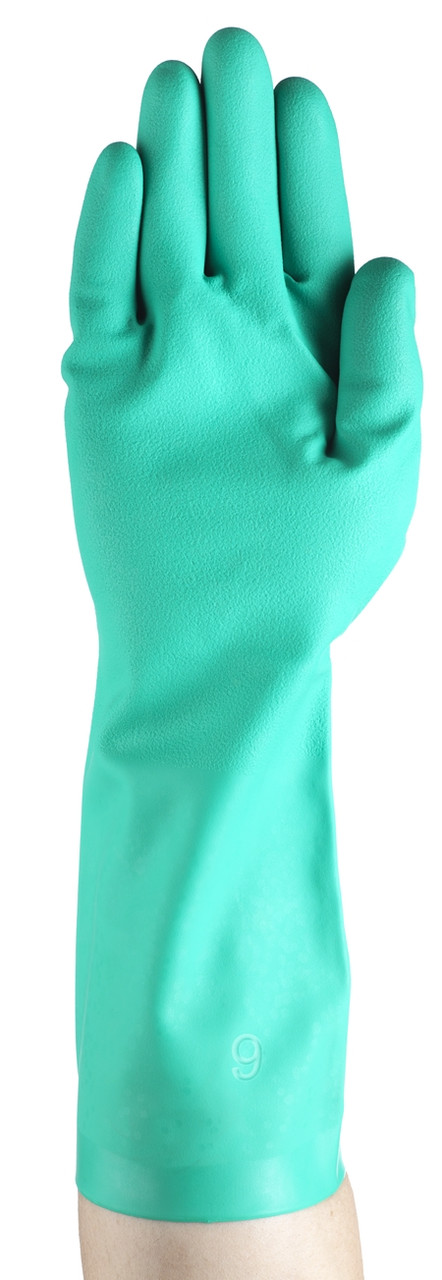
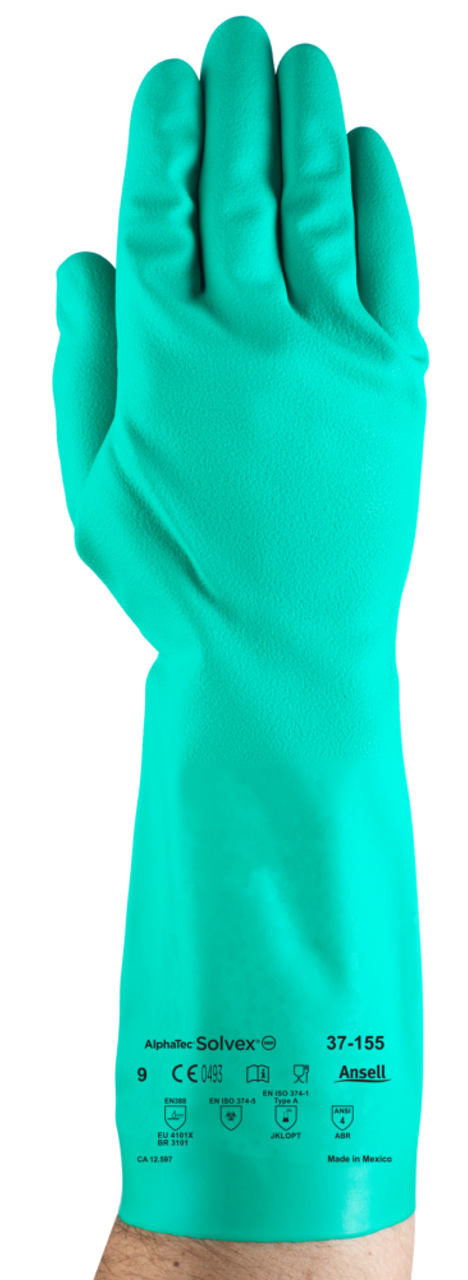
Ansell AlphaTec 37-155 Chemical Resistant Nitrile Gloves

$374.40
SKU: 37-155 7 - 10 Business Days
(No reviews yet)
Availability:
7 - 10 Business Days
Shipping:
Calculated at Checkout

Ansell AlphaTec Solvex 37-155 Nitrile Chemical-Resistant Gloves - 15 Mil / 13 in

Ansell AlphaTec Solvex 37-155 is an unsupported, unflocked nitrile chemical-protection glove with a 330 mm gauntlet and a nominal 15 mil palm thickness. The green glove has a sandpatch grip finish and a chlorinated interior. Manufacturer documentation identifies EN ISO 374-1 Type A JKLOPT and EN 388 4101X, providing defined starting points for chemical and mechanical selection.

Selection focus: Choose this glove using the exact chemical, concentration, temperature and contact conditions. Nitrile construction and Type A marking do not establish universal chemical resistance or a single safe wear time.

Specifications

  • Manufacturer / model: Ansell / AlphaTec Solvex 37-155
  • Construction: Unsupported nitrile; unflocked interior; chlorinated
  • Color / grip: Green / sandpatch finish
  • Cuff / length: Gauntlet / 330 mm, approximately 13 in
  • Palm thickness: 0.38 mm / 15 mil
  • Chemical marking: EN ISO 374-1 Type A JKLOPT
  • Mechanical marking: EN 388 4101X
  • Abrasion systems: EN abrasion level 4; ANSI abrasion level 5
  • Manufacturer sizes: 7-11
  • Packaging: 12 pairs/polybag; 12 polybags/carton; 144 pairs/carton
  • Material exclusions: Silicone-free; not made with natural rubber latex

Where 37-155 Fits

Evaluate 37-155 for chemical-handling operations where the current manufacturer resistance data support the specific exposure. Its gauntlet length can be considered when assessing sleeve overlap and splash pathways. Unflocked construction avoids an added flock lining, but it is not a substitute for cleanroom particle or sterile qualification.

About the Manufacturer

Ansell identifies this model in the AlphaTec Solvex chemical-glove range. Exact model, thickness, length and interior construction should be controlled in purchasing: a different Solvex style may not share the same protection data or use characteristics.

Features and Practical Benefits

  • Defined chemical-test profile: Type A JKLOPT supports a specific evidence-based selection process rather than a generic chemical-proof statement.
  • Sandpatch grip finish: Provides a contact surface to evaluate with the actual parts and approved wet conditions.
  • Unflocked interior: Avoids an added textile flock lining where that distinction matters to the process.
  • Gauntlet coverage: The 330 mm length supports assessment of the glove-to-sleeve interface.

Common Applications

  • Exposure-qualified chemical transfer, mixing and handling.
  • Maintenance or cleaning tasks where manufacturer chemical data support use.
  • Handling components in approved wet or chemical-contact operations.

Best-Practice Use

  1. Obtain product-specific permeation and degradation information for the exact chemical or mixture.
  2. Confirm size, sleeve overlap and the direction of any possible splash before beginning work.
  3. Inspect the glove inside and outside for damage, tackiness, swelling, discoloration or other changes.
  4. Set change-out, decontamination and disposal rules through the task assessment and manufacturer instructions; do not invent a universal reuse interval.

Selection Notes and Limitations

  • No glove material resists every chemical under all conditions.
  • EN 388 mechanical results do not establish needle protection or a high cut rating.
  • Antistatic information must not be represented as electrical-insulation protection.
  • Unflocked and silicone-free do not establish sterile or cleanroom-processed status.

Chemical selection rule: A laboratory breakthrough result is not a guaranteed safe wearing period. Review the actual exposure, glove condition and task controls with the responsible safety team.

Manufacturer Documentation

Technical Vault: Open the Technical Vault tab for chemical-test scope, permeation and degradation distinctions, sleeve interfaces and inspection controls.

SOSCleanroom product support: Email Sales@SOSsupply.com or call (214) 340-8574 for help confirming the model, order unit and available manufacturer documentation.

Product information reviewed: November 10, 2026
© 2026 Specialty Optical Systems, Inc. (dba SOSCleanroom). All rights reserved.

The Technical Vault

By SOSCleanroom
Unflocked nitrile15 mil palm330 mm gauntletType A JKLOPT144 pairs/carton

AlphaTec Solvex 37-155: Technical Selection and Qualification

37-155 should be selected as a specific chemical-protection product, not simply as a thick nitrile glove. The required assessment combines chemical permeation, material degradation, physical condition, glove coverage and the way the operator handles the task. Those factors can change independently of the catalog model number.

Qualification principle: Approve the exact substance, concentration, temperature and contact mode against current manufacturer data. Keep the change-out method separate from the laboratory test classification.


Specifications: SKU, Receiving and SOP Controls

Manufacturer / modelAnsell / AlphaTec Solvex 37-155
ConstructionUnsupported nitrile; unflocked interior; chlorinated
Color / gripGreen / sandpatch finish
Cuff / lengthGauntlet / 330 mm, approximately 13 in
Palm thickness0.38 mm / 15 mil
Chemical markingEN ISO 374-1 Type A JKLOPT
Mechanical markingEN 388 4101X
Abrasion systemsEN abrasion level 4; ANSI abrasion level 5
Manufacturer sizes7-11
Packaging12 pairs/polybag; 12 polybags/carton; 144 pairs/carton
Material exclusionsSilicone-free; not made with natural rubber latex
Additional manufacturer listingEN ISO 374-5 microorganism-protection standard; review the actual marking and applicable instructions
Lining distinctionUnflocked means no added flock lining; it does not mean zero particles

Understanding Type A JKLOPT

Type A is a chemical-test classification, while JKLOPT identifies the reference-chemical code set reported for this product. The marking is not a promise of resistance to every chemical family or every mixture. Chemical concentration, temperature and mechanical wear can differ from the laboratory test conditions.

For an approval record, retain the chemical name and concentration, test source, test conditions and the selected change-out method. When mixture data are missing, seek a manufacturer assessment rather than extrapolating from a single ingredient.


Permeation, Degradation and Visible Damage

Permeation concerns chemical passage through the material; degradation concerns changes in the material itself. Visible damage is a separate rejection reason. A glove can look intact without providing the exposure protection needed for the task, so appearance alone is not a chemical clearance.

  • Do not continue use after swelling, tackiness, cracking, tears or other unacceptable changes.
  • Do not assume a thicker glove of another model has equivalent chemical performance.
  • Use the manufacturer instructions to determine whether cleaning and reuse are appropriate for the actual contamination.

Mechanical Performance Without Overstatement

The EN 388 marking 4101X records separate laboratory results; it is not a single overall protection score.

  • abrasion: 4
  • Coup blade-cut test: 1
  • tear: 0
  • puncture: 1
  • ISO 13997 straight-blade cut test: X (no numerical result reported)

Keep the ANSI/ISEA cut level and EN ISO letter in separate fields. Neither rating makes a glove cut-proof. A mechanical puncture result is not a hypodermic-needle claim, and the code does not establish chemical, electrical or cleanroom suitability.

The ANSI abrasion level 5 and EN abrasion level 4 are reported under different systems. Preserve those labels in comparison tables. The final X in 4101X is not an ISO cut rating of zero or an authorization to handle sharp objects without a separate assessment.


Glove and Sleeve Interface

The nominal 330 mm gauntlet is a dimension to assess against sleeve length and work posture. Reaching, raising the arm or handling a dripping object can change the exposure pathway. Qualify the complete protective arrangement instead of assuming the glove length alone prevents splash entry.


Receiving, Storage and Change-Out Checklist

  1. Verify 37-155, the required size, green unflocked nitrile construction and relevant markings.
  2. Confirm 12 pairs per polybag and 144 pairs per carton.
  3. Retain the current instructions and exposure-specific chemical data with the task approval.
  4. Store original stock protected from contamination, damage and conditions outside the manufacturer instructions.
  5. Before use or any approved reuse, inspect for physical or chemical damage and apply the defined retirement criteria.

Technical FAQs

Does Type A mean resistance to every chemical?

No. It refers to a defined test classification and reference-chemical set. Check the substance and actual exposure conditions.

Is this a cleanroom glove because it is unflocked?

Not on that basis. Unflocked describes the interior; it does not establish cleanroom processing, particle limits or sterility.

Can a laboratory breakthrough time be used directly as a wear limit?

Not without a task-specific assessment. Real contact, temperature, movement and glove condition can differ from the test.

Why are two abrasion numbers listed?

ANSI and EN use different test systems. Keep ANSI 5 and EN 4 labeled separately.

Can contaminated gloves always be cleaned and reused?

No universal reuse claim is made. Follow manufacturer instructions and the exposure-specific decontamination or disposal procedure.


Manufacturer Documentation and Source Notes

Construction and markings follow the manufacturer page and datasheet. This technical overview does not replace a chemical-resistance report for the substance and conditions actually used.

SOSCleanroom product support: Email Sales@SOSsupply.com or call (214) 340-8574 for help confirming the model, order unit and available manufacturer documentation.

Product information reviewed: November 10, 2026
© 2026 Specialty Optical Systems, Inc. (dba SOSCleanroom). All rights reserved.