The Technical Vault
By SOSCleanroom
Ultra High Vacuum (UHV) Applications
Cleanroom Aluminum Foil
Contamination Control
Material Compatibility
Tooling & Component Protection
500 Linear Feet / Roll
Ultra High Vacuum (UHV) Aluminum Foil: material selection, contamination control, and cleanroom handling
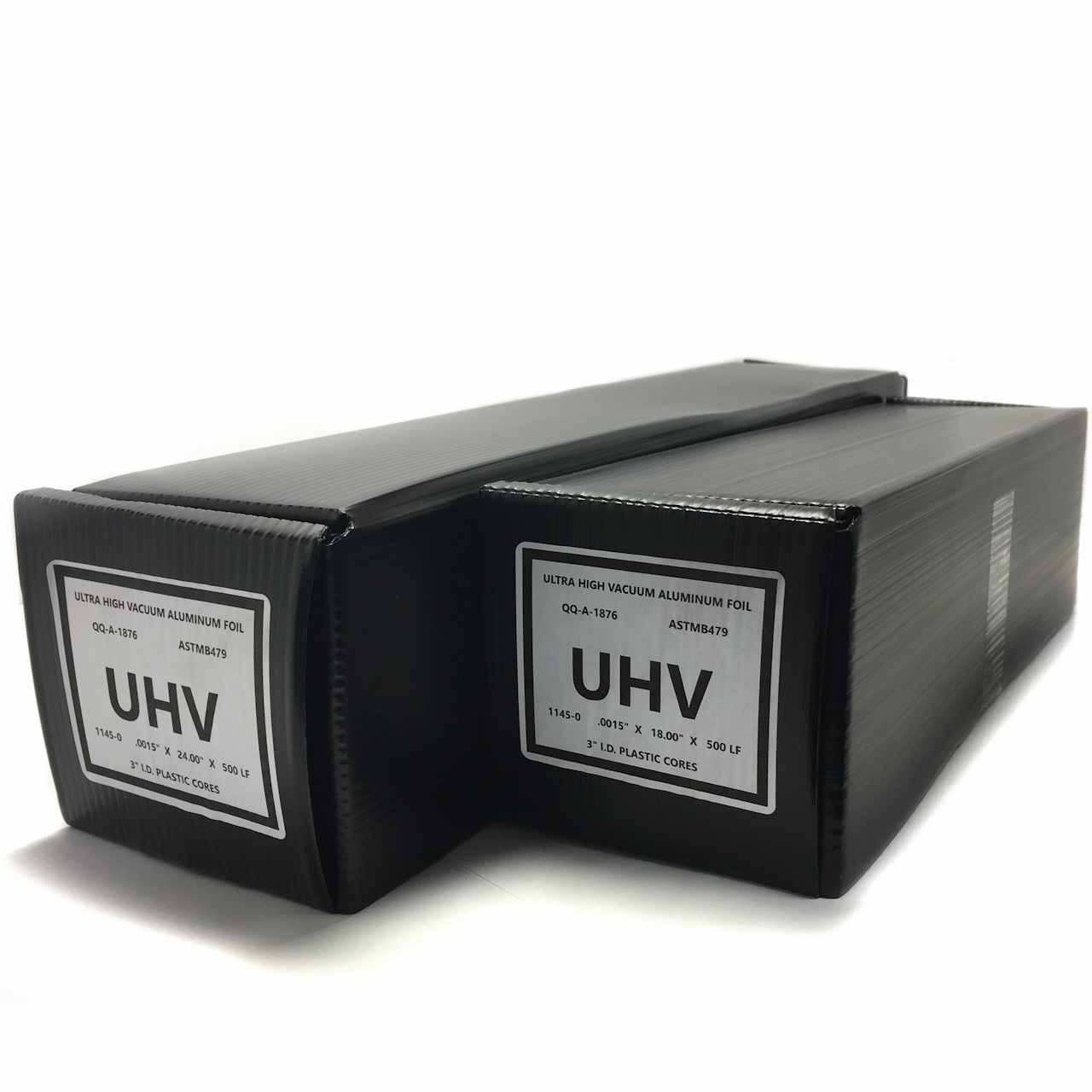
Ultra High Vacuum (UHV) Cleanroom Aluminum Foil, SKU UHVFOIL, is an aluminum foil product offered for vacuum-related maintenance, cleanroom handling, equipment protection, and contamination-sensitive manufacturing applications. It is available in roll form, with selectable foil sizes and a published roll length of 500 linear feet.
Aluminum foil can provide a formable physical barrier for temporarily covering tooling, protecting compatible components, preparing controlled work surfaces, and separating cleaned parts from surrounding equipment. These applications are especially relevant in semiconductor manufacturing, vacuum equipment maintenance, analytical laboratories, research facilities, and precision manufacturing operations.
For contamination-sensitive work, the suitability of aluminum foil depends on more than its appearance or intended application. Material composition, foil thickness, surface residues, particulate contamination, packaging, handling history, and process compatibility can affect its performance.
Operations takeaway: UHV-designated foil should be evaluated as part of a documented material contamination control program. Its product designation does not independently establish a specific particle-cleanliness level, oil-free condition, outgassing rate, or guaranteed compatibility with every ultra high vacuum system.
ISO-first context: where aluminum foil fits in cleanroom operations control
ISO 14644-5:2025 addresses the operational practices needed to maintain contamination control in classified cleanrooms. Materials introduced into controlled environments must be managed according to their intended use, potential contamination sources, handling requirements, and the facility's Operations Control Programme (OCP).
Aluminum foil used for component wrapping, tooling protection, or temporary work surfaces may contact critical equipment and cleaned materials. Its suitability should therefore be evaluated for surface cleanliness, packaging condition, particulate generation, and compatibility with the intended environment.
ISO classification distinction: A material intended for cleanroom applications does not automatically receive an ISO Class 5, ISO Class 6, or other ISO 14644 classification. Cleanroom classification applies to the controlled environment, while material suitability depends on documented product characteristics and the facility's contamination control requirements.
Specifications (SKU controls for RFQs, SOPs, and receiving)
- Product: Ultra High Vacuum (UHV) Cleanroom Aluminum Foil
- SOSCleanroom SKU: UHVFOIL
- Material: Aluminum foil
- Product format: Continuous roll
- Published roll length: 500 linear feet (152.4 meters)
- Available widths: Selectable through the product's Foil Size option. Confirm available widths and the selected configuration before ordering.
- Nominal thickness: Confirm the specified thickness for the selected roll configuration.
- Alloy / grade: Verify material composition against applicable product specifications when alloy selection is critical.
- Material temper: Confirm where bending, forming, or mechanical stability requirements apply.
- Surface cleanliness: Quantified cleanliness requirements must be established through applicable product documentation or testing.
- Residual oil / hydrocarbons: No numerical residual-oil limit is established in this Technical Vault.
- Particulate cleanliness: No specific particle-count or particle-shedding limit is established in this Technical Vault.
- Vacuum compatibility: Requires evaluation against the intended pressure, temperature, surface cleanliness, process chemistry, and gas-load requirements.
- Maximum operating temperature: Not established without application-specific technical qualification.
- Sterility: Not represented as sterile.
- Primary applications: Controlled wrapping, temporary surface protection, component staging, tooling protection, and approved vacuum-related maintenance.
- Unit of measure: One 500-foot roll.
Configuration control: UHVFOIL is offered with selectable foil-size options. For purchasing and receiving accuracy, identify the required width, confirm the nominal thickness and material grade where applicable, and verify the published 500-foot roll length against the ordered configuration.
Critical material specifications and qualification requirements
Certain vacuum and cleanroom applications require documented material properties before aluminum foil can be approved for production or direct equipment exposure. Specifications should be established according to the sensitivity of the process.
- Alloy and chemical composition: Confirm the aluminum alloy or material grade and any controlled elemental impurities.
- Nominal thickness: Establish the required gauge, units of measurement, and permissible tolerance.
- Roll width: Verify the selected width and dimensional tolerance.
- Roll length: Confirm that the supplied roll meets the published 500-linear-foot configuration.
- Surface oil: Determine whether the application requires a maximum residual lubricant or hydrocarbon concentration.
- Nonvolatile residue: Establish appropriate residue limits and test methodology when contamination thresholds are critical.
- Particulate contamination: Determine whether particle-count, metal-fragment, or surface-particle testing is required.
- Surface condition: Inspect or qualify scratches, embedded debris, oxidation, discoloration, and handling-related contamination.
- Outgassing: Establish acceptable gas-load or outgassing characteristics for applications involving direct vacuum exposure.
- Temperature compatibility: Evaluate thermal cycling, bakeout conditions, material deformation, and surface behavior.
- Packaging: Establish the required packaging cleanliness, protection, and transfer procedures.
- Certification: Obtain applicable product specifications, certificates of conformance, or test results when required by the facility quality system.
Important qualification distinction: Product descriptions and general application information are not substitutes for numerical specifications or certificates. Where the application imposes measurable cleanliness, material, or vacuum-performance limits, supporting documentation or qualified testing is necessary.
Material characteristics and vacuum performance considerations
- Formability: Aluminum foil can conform to compatible surfaces and component shapes. Actual forming performance depends on thickness, alloy, and temper.
- Surface condition: Rolling lubricants, environmental contamination, fingerprints, and packaging residues may affect the suitability of the material for critical processes.
- Outgassing potential: Adsorbed moisture, hydrocarbons, and other surface contaminants can contribute to gas release under vacuum.
- Particulate generation: Cutting, tearing, abrasive contact, or repeated manipulation can release metallic particles and fragments.
- Thermal conductivity: Aluminum transfers heat efficiently, but this characteristic does not establish an approved operating-temperature range.
- Electrical conductivity: Aluminum foil is electrically conductive and is unsuitable for use as electrical insulation.
- Corrosion behavior: Chemical compatibility must be evaluated when the foil may contact acids, reactive gases, plasma processes, or other aggressive environments.
- Mechanical stability: Thin foil may crease, puncture, deform, or tear depending on the application and handling method.
UHV performance clarification: The presence of aluminum does not establish an intrinsically low-outgassing finished product. Vacuum performance depends on material composition, surface residues, preparation, operating temperature, system conditions, and the intended application.
Why surface cleanliness matters in ultra high vacuum systems
Ultra high vacuum environments are sensitive to gas loads and contamination that may have little effect on conventional atmospheric-pressure processes. Materials introduced into a vacuum system can influence pump-down behavior, background gas composition, and process stability.
- Hydrocarbon contamination: Residual oils, fingerprints, and organic films may contribute to outgassing or transfer to critical surfaces.
- Adsorbed moisture: Water vapor released from exposed surfaces can affect pumping performance.
- Particulate debris: Metal fragments and environmental particles may interfere with sensitive components or manufacturing processes.
- Surface transfer: Wrapping and staging materials can transfer contaminants directly to previously cleaned components.
- Thermal effects: Heating may influence the release of adsorbed gases and the behavior of surface contamination.
- Repeatability: Consistent material selection and handling practices support controlled process conditions.
Vacuum engineering insight: Achievable chamber pressure depends on pumping speed, surface gas loads, leaks, trapped volumes, permeation, and operating conditions. Selection of a particular aluminum foil does not guarantee a specific base pressure or vacuum performance result.
What UHV aluminum foil is used for (typical applications)
- Vacuum equipment maintenance: Temporarily covering approved tooling, work surfaces, and compatible components during servicing.
- Semiconductor manufacturing: Supporting controlled maintenance, surface protection, and component preparation where aluminum foil has been approved.
- Component staging: Providing a temporary barrier between cleaned components and designated support surfaces.
- Controlled wrapping: Protecting compatible hardware during handling or transfer under established procedures.
- Research laboratories: Supporting contamination-sensitive preparation and maintenance activities.
- Analytical instrumentation: Protecting approved parts and surfaces during service or assembly.
- Temporary masking: Providing a formable metallic barrier when material and process compatibility have been established.
- Workstation protection: Creating replaceable surface barriers for approved controlled-environment tasks.
Application limitation: These are examples of potential uses rather than certifications of suitability. Direct installation within an operating vacuum chamber, use as a permanent liner, deposition masking, or high-temperature shielding requires separate engineering evaluation and process approval.
Best-practice use (reduce particles, residues, and recontamination)
- Confirm the configuration: Verify the ordered foil width, roll length, and required technical specifications before introducing the material into the controlled environment.
- Inspect packaging: Check for damage, contamination, moisture exposure, and compromised protective wrapping.
- Control introduction: Transfer the foil through the facility's approved material-entry and packaging-removal process.
- Use cleanroom-compatible gloves: Avoid direct skin contact with surfaces intended for critical applications.
- Prepare the work area: Clean and inspect the dispensing or cutting surface according to the approved procedure.
- Use dedicated cutting tools: Cut the material using approved methods that limit metal fragments, edge debris, and unnecessary particle generation.
- Protect contact surfaces: Avoid placing the intended critical-contact face against uncontrolled surfaces.
- Minimize manipulation: Reduce unnecessary folding, creasing, rubbing, and repeated repositioning.
- Maintain compatibility: Confirm that the foil will not damage coatings, finishes, electrical assemblies, or other sensitive components.
- Avoid uncontrolled cleaning: Do not introduce solvents, detergents, or other treatments unless the process has been approved.
- Replace compromised material: Discard foil that becomes contaminated, damaged, or unsuitable under the applicable acceptance criteria.
- Dispose appropriately: Follow the facility's approved waste segregation and material-disposal procedures.
Method standardization tip: Establish written requirements for receiving inspection, packaging removal, glove selection, cutting tools, contact-face handling, permitted cleaning methods, and replacement criteria. These controls help reduce operator-dependent variation.
Documented storage and handling requirements
Appropriate storage and handling practices help preserve the condition of aluminum foil before use. The requirements should reflect the facility's cleanliness classification, material sensitivity, and approved procedures.
- Original packaging: Keep unopened rolls in their protective packaging until needed for an approved operation.
- Storage environment: Store in a clean, dry, protected location away from dust, liquids, corrosive vapors, and uncontrolled chemicals.
- Physical protection: Prevent crushing, puncturing, bending, edge damage, and contact with abrasive materials.
- Temperature and humidity: Follow applicable documented storage limits. Avoid conditions that encourage condensation or damage to protective packaging.
- Opened rolls: Protect unused material from environmental exposure using an approved clean storage method.
- Cross-contamination: Do not move exposed rolls between uncontrolled industrial environments and critical cleanroom areas without proper assessment.
- Handling: Use approved gloves and clean dispensing tools to minimize fingerprints and particle transfer.
- Dispensing: Avoid contact with shipping cartons, floors, maintenance benches, or other uncontrolled surfaces.
- Identification: Retain product identity, selected size, lot information when available, and applicable documentation.
- Inspection before reuse of an opened roll: Evaluate exposed surfaces and packaging condition before dispensing additional material.
Storage control: Protective storage practices help limit additional contamination but do not restore the original cleanliness of material that has already been compromised. When cleanliness cannot be established, use replacement material or follow a qualified disposition process.
UHV-designated foil versus general-purpose aluminum foil
- Product selection: UHV-designated foil is marketed for vacuum-related or contamination-sensitive applications; general-purpose foil is typically selected for conventional wrapping and barrier functions.
- Surface cleanliness: Actual differences in residual oils, films, and particles must be established through documented specifications or testing.
- Material grade: Alloy and purity should be evaluated using technical documentation rather than assumed from marketing terminology.
- Packaging: Packaging requirements should reflect the intended cleanliness and material-transfer process.
- Handling: Critical environments require more controlled dispensing, cutting, and surface-contact procedures.
- Vacuum applications: Qualification may require additional review of surface contamination, outgassing, temperature, and chemical compatibility.
- Process consistency: Standardizing an approved product configuration can reduce uncontrolled substitutions and improve traceability.
Selection takeaway: The UHV designation alone does not establish that a roll is cleaner, purer, or lower-outgassing than every general-purpose alternative. Performance differences should be supported by the applicable specifications and application-specific evaluation.
Alloy, thickness, temper, and dimensional selection
- Alloy selection: Identify the required aluminum composition, including any restrictions on alloying elements and impurities.
- Nominal thickness: Select foil gauge according to forming, mechanical strength, contact pressure, and process requirements.
- Width: Choose the appropriate available product option and confirm the actual dimension before ordering.
- Roll length: The product is listed as 500 linear feet per roll. Confirm the supplied configuration during receiving.
- Thickness tolerance: Define permissible variation where dimensional consistency is important.
- Temper: Consider mechanical condition and its effect on flexibility, forming, spring-back, and tear resistance.
- Edge quality: Evaluate slitting, cutting, burrs, and metallic debris when edge cleanliness is critical.
- Surface finish: Confirm required finish characteristics for critical contact or contamination-sensitive operations.
Procurement control: Where thickness, alloy, width, or tolerance is essential, include those requirements in the purchase specification and verify them against the supplied documentation or receiving inspection results.
Vacuum bakeout, temperature, and process compatibility
Vacuum equipment may use elevated-temperature conditioning to reduce surface gas loads. The ability of aluminum foil to tolerate thermal exposure depends on the material configuration and the conditions of use.
- Bakeout temperature: No universal bakeout temperature is established for SKU UHVFOIL.
- Thermal stability: Evaluate the material under the proposed heating and cooling cycle.
- Mechanical deformation: Thin foil may wrinkle, deform, or tear during thermal cycling or mechanical loading.
- Outgassing during heating: Residual surface films and adsorbed gases may be released at elevated temperatures.
- Reactive environments: Confirm compatibility with chamber gases, plasma exposure, etchants, and other process chemistry.
- Electrical considerations: Maintain appropriate separation from energized parts, circuits, and components requiring electrical isolation.
- Coating and substrate compatibility: Evaluate direct contact with sensitive coatings, optical surfaces, and precision components.
Engineering limitation: Do not use an assumed melting point, generic aluminum property, or UHV product designation as the sole basis for approving foil in a high-temperature vacuum process. The actual material configuration and operating conditions must be evaluated.
Misuse controls & when not to use UHV aluminum foil
- Unqualified direct chamber use: Do not introduce foil into critical vacuum equipment without evaluating gas load, chemical compatibility, mechanical stability, and cleanliness.
- Certified low-outgassing requirements: Obtain appropriate performance evidence before use where a quantified limit is required.
- Oil-free specifications: Do not assume the absence of residual manufacturing lubricants without a supporting specification or test result.
- Particle-sensitive processes: Control cutting, tearing, folding, and abrasion that could produce metallic debris.
- Electrical insulation: Do not use aluminum foil as a substitute for insulating materials.
- Delicate surface contact: Avoid unqualified contact with sensitive optical finishes, coatings, or easily scratched components.
- Reactive chemistry: Verify compatibility before exposure to acids, reactive gases, plasma, or other aggressive environments.
- High-temperature service: Do not assign an operating limit without validated temperature guidance.
- Sterile environments: Do not assume foil is sterile or appropriate for product-contact use in sterile processing.
- Damaged or contaminated material: Replace material that fails the facility's established acceptance criteria.
Application boundary: UHVFOIL should not be represented as universally compatible with vacuum chambers, deposition systems, plasma processes, or high-temperature applications. Those uses require documented compatibility and approval.
Recommended cleanroom consumable pairing
Proper material handling is part of contamination control. Compatible cleanroom gloves, precision cleaning materials, and controlled work surfaces can help reduce contamination introduced during preparation and foil placement.
Why this matters: Material cleanliness can be compromised by unsuitable gloves, contaminated cutting tools, dirty work surfaces, or uncontrolled handling. The complete handling process must support the cleanliness requirements of the intended application.
Cleaning discipline: Cleaning solvents and wiping methods must be compatible with the foil and its intended use. Avoid unapproved treatments that may leave residues, alter the surface, or introduce additional contamination.
Technical documentation and receiving acceptance criteria
The level of product documentation required depends on the application. General surface-protection activities may use basic receiving controls, while validated or direct-vacuum applications may require detailed material and cleanliness specifications.
- Product identification: Confirm SKU UHVFOIL and the ordered foil-size option.
- Dimensional specifications: Verify nominal thickness, selected width, and the published 500-foot roll length.
- Material composition: Obtain alloy or grade verification when specified by the purchasing or engineering requirements.
- Surface oil / hydrocarbon contamination: Request applicable residual-oil or cleanliness information if the process requires defined limits.
- Nonvolatile residue: Establish limits and suitable test methods when NVR performance is critical.
- Particulate cleanliness: Confirm the applicable testing method, particle-size criteria, and acceptance limits when required.
- Vacuum compatibility: Determine whether documented outgassing information or application-specific testing is needed.
- Temperature exposure: Verify suitable operating conditions and any required bakeout qualification.
- Packaging integrity: Inspect material packaging and exposed surfaces for conditions that could introduce contamination.
- Material traceability: Retain lot information and applicable conformance records according to the facility's quality procedures.
- Change control: Review changes to critical product specifications, packaging, surface condition, or material characteristics.
Documentation support: Contact SOSCleanroom with your required alloy, thickness, width, surface cleanliness, particulate limits, and vacuum-compatibility criteria. Availability of supporting specifications or certification should be confirmed before placing an order for a controlled or validated application.
Why purchase UHV aluminum foil from SOSCleanroom
- Product configuration support: SOSCleanroom assists customers with selecting the available foil-size options and confirming ordering requirements.
- Cleanroom-focused purchasing: Coordinate aluminum foil with compatible wiping, cleaning, and handling consumables for contamination-sensitive facilities.
- Technical purchasing assistance: Customers can discuss their alloy, thickness, cleanliness, and application requirements before ordering.
- Standardized replenishment: Purchasing by exact product configuration helps reduce unapproved substitutions and supports repeatable operating procedures.
- Order planning: Contact SOSCleanroom to confirm selected roll sizes, current availability, lead times, and applicable documentation requirements.
Technical references and product resources
-
SOSCleanroom UHV Aluminum Foil product page:
Click Here
-
SOSCleanroom UHV Foil selection and application guidance:
Click Here
-
ISO 14644-5:2025 Cleanroom Operations Standard (ISO listing):
Click Here
-
EU GMP Annex 1: Manufacture of Sterile Medicinal Products:
Click Here
Technical reference guidance: Published application information is provided to support material selection and operating procedures. Product-specific certifications, measurable cleanliness limits, dimensional tolerances, and vacuum-performance requirements should be confirmed through SOSCleanroom before use in critical applications.
If you have any questions please email us at Sales@SOSsupply.com or give us a call at (214)340-8574.
OR check out the AI ChatBot powered by SOSCleanroom data libraries - give it a try! THIS IS NEW FOR 2026!
© 2026 SOSCleanroom. All rights reserved.