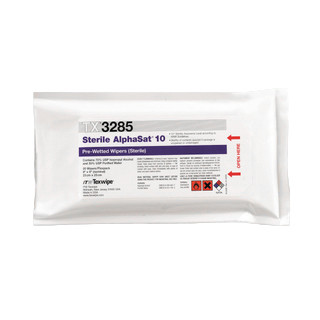
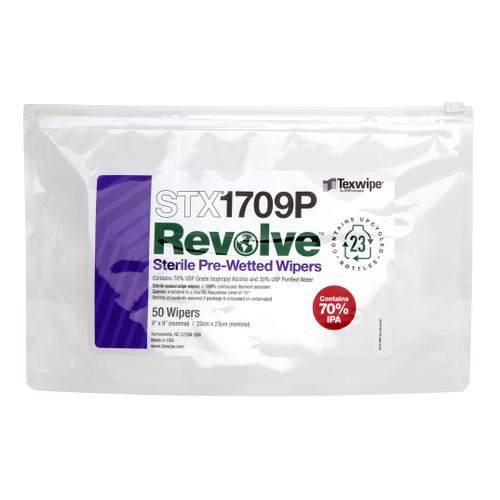
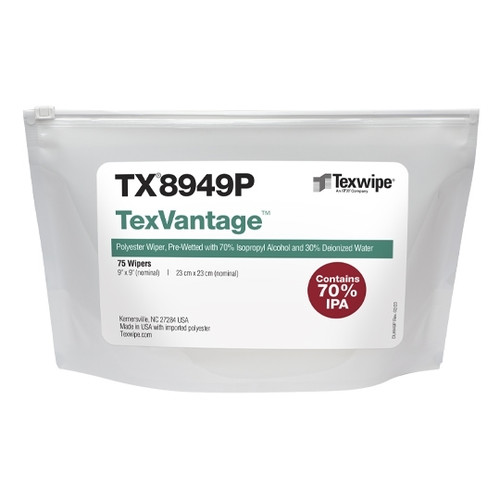
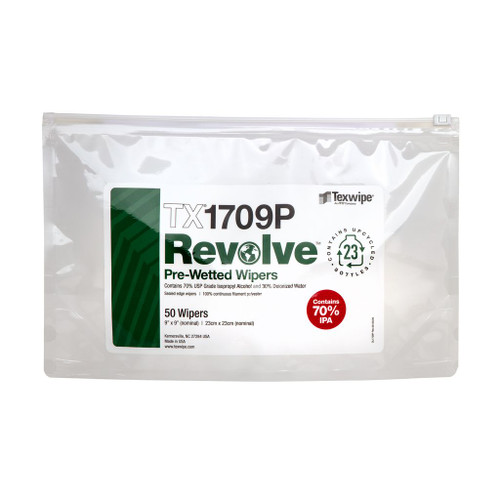
Texwipe TX3285 Sterile AlphaSat10 9" x 9" Polyester Cleanroom Wiper Pre-Wetted 70% IPA (Case Qty.)

$624.55
SKU: TX3285 CASE 14 - 21 Business Days
(No reviews yet)
Availability:
14 - 21 Business Days
Shipping:
Calculated at Checkout
Type:
Pre-Wet Wiper
Family:
AlphaSat Vectra Alpha 10
Material:
Polyester
Wiper Size:
9" x 9"
Wiper Edge:
Sealed Border
Sterile:
Yes
ISO Class:
ISO 2 (Class < 1)
ISO Class:
ISO 3 (Class 1)
ISO Class:
ISO 4 (Class 10)
ISO Class:
ISO 5 (Class 100)
ISO Class:
ISO 6 (Class 1,000)
ISO Class:
ISO 7 (Class 10,000)
ISO Class:
ISO 8 (Class 100,000)

Texwipe TX3285 Sterile AlphaSat® with Vectra® Alpha® 10 - 9" x 9" Sealed-Border Polyester Cleanroom Wipers - Pre-Wetted 70% IPA - 400/Case

Texwipe TX3285 Sterile AlphaSat® with Vectra® Alpha® 10 is a premium sterile, pre-wetted cleanroom wiper manufactured from 100% polyester with a sealed-border construction. Designed for critical cleaning applications, TX3285 combines Texwipe's automated Vectra® cleaning process with controlled solvent preparation to provide low levels of releasable particles, fibers, ions, and nonvolatile residues.

Each nominal 9" x 9" wiper features sealed polyester borders that help minimize fiber release from the edges. The polyester substrate is processed using Texwipe's automated Vectra® cleaning system, which reduces removable contaminants and supports consistent material cleanliness for qualified critical-cleaning processes.

TX3285 is factory pre-wetted with 70% USP-grade isopropyl alcohol (IPA) and 30% deionized water (DIW). The solution is filtered to 0.2 µm and applied under controlled manufacturing conditions. This ready-to-use presentation reduces the need for manual alcohol dilution, wetting dry wipers, or using separate spray bottles inside contamination-sensitive work areas.

The finished product is gamma irradiated and validated to a Sterility Assurance Level (SAL) of 10-6 according to AAMI guidelines. Texwipe also performs endotoxin testing and supplies Certificates of Compliance, Analysis, and Irradiation with each manufacturer case. Lot-specific documentation supports sterile material qualification, receiving inspection, traceability, and quality-system recordkeeping.

TX3285 is supplied in compact peel-and-reseal sterile flexpacks containing 20 wipers each. One manufacturer case contains 20 flexpacks, totaling 400 sterile wipers. The compact packaging is particularly useful for qualified isolators, biological safety cabinets, and controlled workstations where convenient dispensing and limited package footprint are important.

Texwipe identifies Vectra® Alpha® 10 for ISO Classes 2 through 7 and EU GMP Grades A through D. Product selection and suitability for any specific operation must be determined by the facility's approved procedures, surface-compatibility requirements, cleanliness specifications, and contamination-control program.

Critical Sterile Cleaning Advantage: TX3285 combines sealed-border polyester, automated Vectra® cleaning, 70% IPA / 30% DIW pre-wetting, validated gamma irradiation to SAL 10-6, and lot-specific quality documentation. Its compact 20-count sterile flexpacks support repeatable cleaning practices where low contamination contribution and controlled solvent delivery are required.

Specifications:
  • Manufacturer: Texwipe, an ITW company
  • Manufacturer Part Number: TX3285
  • SOSCleanroom SKU: TX3285 CASE
  • Product Family: Sterile AlphaSat® with Vectra® Alpha® 10
  • Product Type: Sterile Pre-Wetted Polyester Cleanroom Wiper
  • Material: 100% polyester
  • Edge Construction: Sealed border
  • Processing: Automated Texwipe Vectra® cleaning
  • Color: White
  • Nominal Dimensions: 9" x 9" (23 cm x 23 cm)
  • Wetting Chemistry: 70% IPA / 30% DIW
  • IPA Quality: USP grade
  • Solution Filtration: 0.2 µm
  • Presentation: Factory pre-wetted and ready to use
  • Sterility: Sterile
  • Sterilization Method: Gamma irradiation
  • Sterility Assurance Level: 10-6
  • Validation: According to AAMI guidelines
  • Actual Irradiation Dose: Refer to applicable lot-specific Certificate of Irradiation
  • Endotoxin: Manufacturer tested; numerical acceptance criteria require applicable quality documentation
  • Cleanroom Environment: ISO Classes 2-7
  • Traditional Cleanroom Classification: Class less than 1 through Class 10,000
  • EU GMP Environment: Grades A-D, subject to site qualification
  • Typical Particles ≥0.5 µm: 2.9 x 10⁶ particles/m²
  • Typical Fibers >100 µm: 100 fibers/m²
  • Typical Sorptive Capacity: 320 mL/m²
  • Typical Sorptive Rate: 0.5 second
  • Typical Basis Weight: 130 g/m²
  • Packaging: Peel-and-reseal sterile flexpack
  • Wipers per Flexpack: 20
  • Flexpacks per Manufacturer Case: 20
  • Total Wipers per Case: 400
  • Lot Traceability: Manufacturer lot coded
  • Manufacturer Documentation: Certificates of Compliance, Analysis, and Irradiation
  • Sterile Validation Records: Available from Texwipe upon request
  • Published Shelf Life: 3 years from date of manufacture
  • Country of Manufacture: USA
  • Primary Application: Sterile critical surface cleaning
  • Use: Disposable, single-use wiper
  • Disinfection Status: No independently established registered disinfectant or sporicidal claim
  • Manufacturer TDS: TEX-LIT-TDS-028 Rev. 00-05/17
  • Purchase Configuration: Manufacturer case quantity
Sterile Packaging and Case Configuration:

Texwipe TX3285 uses compact, peel-and-reseal flexpacks for controlled dispensing. Its packaging is convenient for isolators and other confined cleanroom workspaces where minimizing unnecessary packaging and handling is important.

Packaging Level Quantity Description
Sterile Flexpack 20 wipers Compact peel-and-reseal package
Manufacturer Case 20 flexpacks Standard manufacturer case configuration
Total Case Contents 400 wipers 20 flexpacks x 20 sterile wipers

The small resealable flexpack helps protect unused material from unnecessary exposure and reduces solution evaporation when promptly closed. Follow the facility's material-transfer and sterile dispensing procedures, including applicable handling of outer packaging.

Ordering Confirmation: TX3285 is supplied as 20 wipers per sterile flexpack and 20 flexpacks per case, for a total of 400 wipers. The SOSCleanroom purchasing configuration is a complete manufacturer case.

About the Manufacturer:

Texwipe, an ITW company, develops cleanroom wipers, swabs, pre-wetted cleaning products, and contamination-control supplies for pharmaceutical manufacturing, biotechnology, medical devices, semiconductor processing, laboratories, and other critical environments.

Vectra® Alpha® 10 uses sealed-border polyester and automated cleaning technology to control removable ions, particles, fibers, and nonvolatile residues. The AlphaSat® pre-wetted product configuration adds manufacturer-prepared IPA chemistry, while the sterile TX3285 version incorporates validated gamma irradiation and lot-specific quality documentation.

SOSCleanroom is an authorized Texwipe distributor providing manufacturer documentation, product-selection assistance, packaging information, and procurement support for contamination-controlled facilities.

TX3285 Features:
  • 100% polyester critical-cleaning substrate
  • Sealed-border edge construction
  • Automated Vectra® cleaning-system processing
  • 9" x 9" nominal dimensions
  • Low-linting material design
  • Low typical particle and fiber release
  • Controlled ionic and nonvolatile-residue characteristics
  • Designed to resist snagging during appropriate wiping of abrasive surfaces
  • Pre-wetted with 70% USP-grade IPA / 30% DIW
  • 0.2 µm filtered wetting solution
  • Ready-to-use solvent presentation
  • Gamma irradiated and sterile validated to SAL 10-6
  • Manufacturer endotoxin testing
  • ISO Classes 2-7 manufacturer positioning
  • EU GMP Grades A-D environmental positioning
  • Compact peel-and-reseal sterile flexpack
  • Controlled point-of-use dispensing
  • Lot coding and expiration dating
  • Certificates of Compliance, Analysis, and Irradiation
  • Three-year manufacturer-published shelf life
  • 20 wipers per flexpack
  • 20 flexpacks per manufacturer case
  • 400 sterile wipers per case
TX3285 Benefits:
  • Critical Cleanliness: Sealed borders and Vectra® processing help reduce particles, fibers, ions, and nonvolatile-residue contributions.
  • Validated Sterile Presentation: Gamma irradiation to SAL 10-6 supports qualified operations requiring sterile wiping consumables.
  • Improved Edge Containment: Sealed borders help limit loose fiber release from the wiper perimeter.
  • Consistent Material Processing: Automated cleaning supports repeatable substrate cleanliness.
  • Controlled IPA Chemistry: Factory-prepared 70% IPA / 30% DIW reduces variability associated with manual solvent dilution.
  • Reduced Free-Liquid Handling: Pre-wetted wipes reduce the need for separate alcohol bottles and uncontrolled spraying.
  • Compact Packaging: Small 20-count flexpacks are convenient for isolators, biological safety cabinets, and restricted workspaces.
  • Repeatable Wetness: Manufacturer-controlled solution application supports standardized wiping.
  • Evaporation Management: Prompt resealing helps preserve remaining wipe wetness.
  • Durable Polyester: Suitable for normal wiping of compatible smooth and abrasive equipment surfaces.
  • Lot Traceability: Certificates and lot identification support receiving inspection, product qualification, and audit records.
  • Production Convenience: Eliminates routine manual pre-wetting of individual polyester wipes.
  • Case Procurement: A defined 400-wiper manufacturer case supports controlled material ordering.
Common Applications:
  • Critical cleaning of compatible manufacturing equipment and components
  • Approved sterile wiping inside aseptic isolators
  • Cleaning in compounding aseptic isolators under qualified procedures
  • Wiping compatible surfaces inside biological safety cabinets
  • Pharmaceutical and biotechnology manufacturing equipment cleaning
  • Controlled cleaning of compatible stainless steel work surfaces
  • Removal of compatible processing residues and lubricants
  • Wiping cleanroom production tools and fixtures
  • Controlled cleaning of equipment before aseptic production steps
  • Cleaning approved items before introduction into classified work areas
  • Surface preparation where sealed-border polyester is specified
  • Applications requiring sterile, pre-wetted consumables with lot traceability
  • Cleaning operations where minimizing loose fibers and particles is important
  • Wiping equipment and workspaces with limited dispensing room
  • Approved cleaning of sensitive manufacturing components
Sealed-Border Polyester and Vectra® Processing:

TX3285 uses Vectra® Alpha® 10, a 100% polyester wiping material with sealed borders. Texwipe's automated cleaning process helps reduce contamination originating from the substrate before the wiper is prepared for its sterile pre-wetted application.

  • Sealed Borders: Help reduce fiber release associated with cut edges.
  • Polyester Material: Provides strength and durability during compatible wiping applications.
  • Automated Cleaning: Reduces removable ionic contamination, particles, fibers, and nonvolatile residues.
  • Low-Linting Design: Supports qualified processes requiring controlled material shedding.
  • Abrasion Resistance: The manufacturer identifies the material as suitable for wiping abrasive surfaces without easily snagging.
  • Surface Compatibility: Confirm both polyester and IPA/DIW are appropriate for the intended equipment and process.
  • Critical Cleaning: Use current manufacturer data and applicable facility requirements when selecting a wiper for stringent cleanliness limits.
  • Single-Use Performance: Replace wipes before accumulated contamination can be transferred to another surface.

Material Selection Guidance: Sealed-border Vectra® polyester is designed for more demanding contamination-control applications than many general-purpose cut-edge wipers. The appropriate selection depends on surface material, cleaning chemistry, and process-specific particle, fiber, ionic, and residue acceptance criteria.

Gamma Irradiation and Lot-Specific Quality Documentation:

TX3285 is gamma irradiated to a validated Sterility Assurance Level of 10-6 according to AAMI guidelines. Texwipe supplies Certificates of Compliance, Analysis, and Irradiation with each manufacturer case and makes sterile validation documentation available upon request.

  • Gamma Irradiation: Manufacturer sterile processing method.
  • SAL 10-6: Validated sterilization assurance target.
  • Certificate of Irradiation: Provides irradiation information associated with the applicable production lot.
  • Certificate of Compliance: Supports confirmation of manufacturer product compliance.
  • Certificate of Analysis: Supports applicable quality review and material-release procedures.
  • Endotoxin Testing: Texwipe reports testing; numerical limits should be obtained from the relevant quality documentation when required.
  • Lot Identification: Supports traceability from receiving through use.
  • Expiration Dating: Follow the printed expiration date and local inventory controls.
  • Sterile Validation Documentation: Available from the manufacturer when required for qualification.
  • Package Integrity: Maintain sterile packaging in acceptable condition until approved opening.
  • Receiving Requirements: Verify part number, lot, expiration, package condition, and required certificates.

The validated SAL does not mean that each manufacturing lot must be described as having received one universal fixed irradiation dose. When dose information is required, refer to the actual manufacturer Certificate of Irradiation for the supplied lot.

Documentation Guidance: Lot-specific Certificates of Compliance, Analysis, and Irradiation support sterile-product review. Retain and evaluate these records according to the facility's material qualification and quality-system requirements rather than relying exclusively on general product-page claims.

70% IPA / 30% DIW Chemistry:

TX3285 uses USP-grade 70% IPA and 30% DIW, filtered to 0.2 µm before the product's validated sterile processing. The pre-wetted formulation supports consistent solvent delivery to compatible surfaces without requiring operators to prepare individual wipes.

  • USP-Grade IPA: Manufacturer-identified alcohol grade for TX3285.
  • DIW: Water component of the wetting solution.
  • 0.2 µm Filtration: Used in preparation of the IPA/DIW solution.
  • Factory Pre-Wetting: Reduces variability from manually applying solvent.
  • Surface Cleaning: IPA can help remove compatible residues, lubricants, and light soils.
  • Evaporation: Exposure to air can reduce wiper wetness and change its in-use condition.
  • Material Compatibility: Evaluate plastics, coatings, adhesives, labels, and sensitive finishes.
  • Non-Interchangeability: Do not automatically substitute a WFI-based wetting formulation where DIW is specified, or vice versa.
  • Disinfectant Efficacy: IPA concentration alone does not establish a registered disinfectant claim or universal contact time.
  • Sporicidal Requirements: Use a separately qualified sporicide when required.

Chemistry Guidance: TX3285 is sterile and pre-wetted with 70% IPA, but sterilization, surface cleaning, and disinfection are distinct functions. Follow the facility's approved cleaning and disinfection procedures and use separately qualified products when specified antimicrobial or sporicidal performance is required.

Controlled Material Transfer and Dispensing:

Sterile pre-wetted wipes require appropriate handling during receiving, material transfer, and use. TX3285's compact flexpack allows controlled dispensing in qualified workspaces, but sterile presentation must be protected through approved procedures.

  1. Confirm Product Identification: Verify TX3285, manufacturer lot, and expiration.
  2. Inspect the Packaging: Reject damaged, leaking, unsealed, or otherwise compromised packs.
  3. Review Required Certificates: Complete site-defined quality review before release.
  4. Prepare for Material Transfer: Remove unnecessary shipping materials at the appropriate staging point.
  5. Follow Approved Exterior Cleaning: Use the site's qualified package wipe-down or transfer procedure.
  6. Protect the Primary Package: Avoid contact with uncontrolled equipment, gloves, or surfaces.
  7. Open at the Approved Location: Expose the wipers only when the procedure permits.
  8. Dispense the Required Quantity: Avoid contact with the remaining wipes.
  9. Reseal Promptly: Reduce evaporation and unnecessary exposure.
  10. Observe Open-Pack Limits: Follow the facility's defined in-use conditions.
  11. Maintain Traceability: Record material lot information where required.

Transfer Guidance: Sterile product status does not mean that all exterior packaging surfaces are sterile. Follow the qualified material-transfer process, protect unopened packages, and prevent contamination when dispensing wipes into the work area.

Recommended Wiping Practices:
  1. Verify Suitability: Confirm that TX3285 is approved for the equipment, surface, and controlled-area requirements.
  2. Inspect the Flexpack: Verify correct identification, expiration, and packaging integrity.
  3. Complete the Transfer Procedure: Follow approved gowning and cleanroom material-introduction practices.
  4. Open Carefully: Expose only the necessary portion of the package opening.
  5. Remove a Wiper: Avoid handling unused wipes unnecessarily.
  6. Reseal the Package: Preserve wetness and reduce exposure.
  7. Fold as Required: Use the facility-approved method to create manageable wiping faces.
  8. Apply Controlled Strokes: Use the prescribed straight-line, overlapping wiping pattern.
  9. Maintain Appropriate Pressure: Avoid aggressive scrubbing that could damage the substrate or surface.
  10. Change Wiping Faces: Avoid redistributing collected contamination.
  11. Replace Used Wipers: Discard soiled, dry, damaged, or compromised material.
  12. Prevent Reuse: Do not return a used wiper to the original flexpack.
  13. Complete Records: Document cleaning and material-use information required by the SOP.

Cleaning Consistency: A factory-prepared sterile wiper helps reduce solvent-mixing variability, but repeatable cleaning still depends on proper surface coverage, wiping direction, change-out frequency, and controlled dispensing.

Typical Particle, Fiber and Extractables Performance:

Texwipe publishes the following typical material-performance measurements in its Vectra® Alpha® 10 Technical Data Sheet. These values characterize the substrate family using manufacturer-referenced methods and are not guaranteed lot-specific TX3285 acceptance limits.

Manufacturer Typical Characteristic Reported Value
LPC Particles ≥0.5 µm 2.9 x 10⁶ particles/m²
Particles 0.5-5.0 µm 1.7 x 10⁶ particles/m²
Particles 5.0-100 µm 37,000 particles/m²
Fibers >100 µm 100 fibers/m²
Nonvolatile Residue - IPA Extractant 0.02 g/m²
Nonvolatile Residue - DIW Extractant 0.003 g/m²
Sodium 0.04 ppm
Potassium 0.04 ppm
Chloride 0.009 ppm
Sorptive Capacity 320 mL/m²
Sorptive Rate 0.5 second
Basis Weight 130 g/m²

Actual cleanliness outcomes depend on the surface, handling, chemistry, contamination loading, and wiping procedure. Where numerical acceptance limits are required, evaluate current manufacturer documentation and the facility's qualified cleaning method.

Technical Data Interpretation: These are typical manufacturer analyses and should not be described as guaranteed lot-specific limits or proof of a particular cleaning-validation outcome.

TX3285 Compared with Similar Wiper Options:

Different pre-wetted cleanroom wipers may use similar alcohol concentrations but vary in sterility, substrate, edge treatment, and package quantity. These differences should be considered before making product substitutions.

Product Size Material / Sterility Manufacturer Case
TX3285 9" x 9" Sealed-border polyester; sterile; 70% IPA / 30% DIW 20 x 20 = 400 wipes
TX3280 12" x 12" Sealed-border polyester; sterile; 70% IPA / 30% WFI 5 x 50 = 250 wipes
TX3213 9" x 11" Cut-edge polypropylene; sterile; 70% IPA / 30% DIW 20 x 50 = 1,000 wipes
TX1039 9" x 9" Cut-edge polyester; non-sterile; 70% IPA / 30% DIW 4 x 50 = 200 wipes
  • TX3285: Select when sterile sealed-border polyester and compact 20-count flexpacks are required.
  • TX3280: Consider when a larger sterile polyester wiper with 70% IPA / 30% Water for Injection is specified.
  • TX3213: Consider when the application permits a sterile cut-edge polypropylene material.
  • TX1039: Consider when non-sterile cut-edge polyester is acceptable.
  • Sterility: Do not substitute non-sterile material for sterile material without approved qualification.
  • Water Quality: Do not assume DIW and WFI formulations are interchangeable.
  • Edge Requirements: Sealed-border and cut-edge products may differ in fiber-control performance.
  • Case Quantity: Verify packaging before changing purchasing or cleaning records.

Product Selection Guidance: A common nominal 70% IPA concentration does not make sterile polyester, sterile polypropylene, and non-sterile wipers interchangeable. Evaluate the complete material, sterility, chemistry, packaging, and cleanliness specification.

Safety and Chemical Compatibility:

TX3285 contains IPA, a flammable solvent. Use the current manufacturer Safety Data Sheet, approved facility procedures, and applicable handling requirements when storing, transferring, dispensing, or disposing of the product.

  • Flammability: Keep away from heat, sparks, flames, and ignition sources.
  • Ventilation: Follow the facility's requirements for alcohol vapor exposure.
  • Personal Protective Equipment: Use gloves, eye protection, and other protective equipment appropriate for the task.
  • Surface Compatibility: Evaluate sensitive plastics, coatings, adhesives, labels, and finishes before wiping.
  • Electrical Equipment: Follow equipment-specific cleaning and electrical safety instructions.
  • Sterile Package Integrity: Inspect for damage, leakage, compromised seals, and expiration.
  • Disinfection: Do not assume product-specific registered disinfectant efficacy from the 70% IPA concentration alone.
  • Sporicidal Requirements: Use a qualified sporicidal product where required.
  • Hazardous Drug Residues: Do not assume IPA wiping provides validated hazardous-drug deactivation or decontamination.
  • Transport: Follow the current applicable dangerous-goods classification and carrier requirements.
  • Waste Disposal: Follow approved procedures for solvent-containing and contaminated wipes.

Safety Guidance: Sterile pre-wetted wipes support controlled cleaning but do not eliminate chemical hazards, contamination risks after opening, or the need for approved disinfection and material-compatibility requirements.

Shelf Life, Storage and Disposal:
  • Manufacturer Part Number: TX3285
  • Individual Flexpack: 20 sterile pre-wetted polyester wipers
  • Manufacturer Case: 20 flexpacks / 400 wipers
  • Sterility: Gamma irradiated; validated SAL 10-6
  • Published Shelf Life: 3 years from manufacture
  • Expiration: Follow manufacturer package labeling
  • Certificates: Compliance, Analysis, and Irradiation
  • Lot Identification: Retain manufacturer information where required
  • Package Inspection: Check for damage, leaks, and compromised seals
  • Storage: Follow the current manufacturer SDS and applicable flammable-material storage requirements
  • Ignition Control: Keep away from sparks, flames, and excessive heat
  • Material Transfer: Follow the approved controlled-area introduction procedure
  • Dispensing: Avoid contact with unused wipers
  • Evaporation Control: Reseal flexpacks promptly
  • In-Use Limits: Follow the facility's opened-package handling rules
  • Wiper Condition: Discard soiled, damaged, dry, or otherwise compromised material
  • Reuse: Single use only
  • Disposal: Follow approved solvent-containing waste procedures
Manufacturer Technical Documents:

Texwipe TX3285 Official Manufacturer Product Information: Click Here

Texwipe Vectra® Alpha® 10 Technical Data Sheet - TEX-LIT-TDS-028 Rev. 00-05/17 (PDF): Click Here

Texwipe TX3285 Safety Data Sheet and Technical Downloads: View Manufacturer Resources

SOSCleanroom TX3285 Product Information: Click Here

Other Similar Products Available From SOSCleanroom.com

Sterile and Non-Sterile Pre-Wetted Alternatives

Notes: Need assistance selecting sterile sealed-border polyester wipers, confirming TX3285 case quantities, or obtaining manufacturer lot and irradiation documentation? SOSCleanroom provides product selection assistance, manufacturer technical resources, and procurement support.

SOSCleanroom.com supports pharmaceutical, biotechnology, medical device, semiconductor, laboratory, and other critical environments with sterile and non-sterile cleanroom wipers, pre-wetted cleaning products, and contamination-control supplies.

Product description updated: November 3, 2026 (SOS Technical Staff)

© 2026 SOS Supply. All rights reserved.

The Technical Vault By SOSCleanroom
ISO Class 2–7 EU GMP Grades A–D Sterile • SAL 10-6 Gamma Irradiated 100% Polyester Vectra® Sealed Border 70% USP-Grade IPA / 30% DIW 9" × 9" 20 Wipers / Flexpack 400 Wipers / Case

Texwipe TX3285 Sterile AlphaSat® with Vectra® Alpha® 10: sealed-border polyester wipers for critical aseptic cleaning

Texwipe TX3285 Sterile AlphaSat® with Vectra® Alpha® 10 is a sterile, pre-wetted polyester cleanroom wiper designed for critical cleaning applications where low particle and fiber release, controlled solvent delivery, sterile presentation, and traceable product documentation are important.

Each 9" × 9" (23 × 23 cm) wiper is manufactured from 100% polyester with thermally sealed borders and processed using Texwipe's automated Vectra® cleaning system to achieve low levels of particles, fibers, nonvolatile residues, and ionic contamination.

TX3285 is pre-wetted with a 0.2 µm-filtered solution of USP-grade 70% isopropyl alcohol (IPA) and 30% deionized water (DIW). It is gamma irradiated and validated by Texwipe to a Sterility Assurance Level (SAL) of 10-6 according to the manufacturer's stated AAMI guidelines.

The product is supplied in compact peel-and-reseal flexpacks containing 20 wipers each. One manufacturer case contains 20 flexpacks, totaling 400 sterile wipes. Texwipe identifies the Vectra® Alpha® 10 product family for ISO Classes 2–7 and EU GMP Grades A–D, subject to process-specific suitability and sterile-material handling controls.

Operations takeaway: TX3285 combines sterile assurance, sealed-border polyester, low typical particle and fiber levels, and repeatable 70% IPA wetting in a compact dispensing format. Its performance depends on approved sterile transfer, intact packaging, correct wiping technique, and facility-specific cleaning or disinfection requirements.


ISO-first context: sterile wiping within a cleanroom Operations Control Programme

ISO 14644-5 provides a framework for contamination-controlled operations, including material entry, personnel practices, equipment cleaning, maintenance, monitoring, and documented operating procedures.

Sterile wiping materials are one component of an effective contamination-control strategy. The wiper's substrate, cleanliness, chemical formulation, packaging, and handling practices can influence both the removal of contamination and the introduction of new particles or residues.

Texwipe identifies TX3285 for ISO Classes 2–7. The product may be evaluated for demanding aseptic applications, including isolators and controlled manufacturing environments, but its use must align with the facility's specific requirements for sterile materials, cleaning chemistry, environmental control, and process qualification.

Control point: A manufacturer's ISO suitability range does not independently certify the cleaning procedure, surface, or completed process. Facilities should qualify the complete wiping system under their approved contamination-control procedures.


Specifications (SKU controls for RFQs, SOPs, and receiving)
  • Product: Texwipe Sterile AlphaSat® with Vectra® Alpha® 10
  • Manufacturer: Texwipe, an ITW company
  • Manufacturer part number: TX3285
  • Product family: Sterile AlphaSat® with Vectra® Alpha® 10
  • Product category: Sterile pre-wetted cleanroom wiper
  • Sterility: Sterile
  • Sterilization process: Gamma irradiation
  • Sterility Assurance Level: 10-6
  • Sterile validation reference: Manufacturer-stated AAMI guidelines
  • Endotoxin: Manufacturer tested; consult current controlled specification for an applicable numeric criterion
  • Material: 100% polyester
  • Wiper construction: Polyester cleanroom wiper with sealed border
  • Border technology: Vectra® sealed border
  • Processing: Automated Vectra® cleaning system
  • Nominal dimensions: 9" × 9" (23 × 23 cm)
  • Wetting chemistry: 70% IPA / 30% DIW
  • IPA grade: USP-grade
  • Solution filtration: 0.2 µm
  • Cleanroom environment: ISO Classes 2–7
  • Legacy cleanroom designation: Classes below 1 through 10,000
  • EU GMP environment: Grades A–D
  • Dispensing format: Peel-and-reseal flexpack
  • Wipers per flexpack: 20
  • Flexpacks per case: 20
  • Total wipers per case: 400
  • Traceability: Manufacturer lot identification
  • Sterile quality documents: Certificates of Compliance, Analysis, and Irradiation
  • Additional sterile validation information: Available from Texwipe upon request
  • Published shelf life: Three years from manufacture
  • Country of manufacture: USA
  • Manufacturer TDS: Vectra® Alpha® 10 Technical Data Sheet, TEX-LIT-TDS-028 Rev. 00-05/17

Ordering control: TX3285 = 20 sterile wipers per flexpack × 20 flexpacks per case = 400 wipers per case. Do not confuse TX3285 with TX3280, the larger sterile AlphaSat® 10 version supplied with a 70% IPA / 30% Water for Injection formulation.


Sterility assurance: gamma irradiation and SAL 10-6

Texwipe supplies TX3285 as a gamma-irradiated sterile product validated to a Sterility Assurance Level of 10-6 under its stated AAMI guidance.

  • Sterilization method: Gamma irradiation.
  • Published SAL: 10-6.
  • Process validation: Supported by manufacturer sterile-processing controls.
  • Certificate of Irradiation: Provides records associated with the actual processed lot.
  • Certificate of Compliance: Supports documented product conformance review.
  • Certificate of Analysis: Provides applicable manufacturer quality information.
  • Validation documentation: Additional manufacturer records may be requested where needed.
  • Lot identification: Must match receiving and sterile-release documentation.
  • Expiration: Confirm the actual labeled usable period.
  • Package handling: Maintain the required sterile presentation throughout material entry and dispensing.

SAL interpretation: SAL 10-6 is a probabilistic sterilization-process assurance measure. It does not guarantee that a wipe remains sterile after inappropriate handling, environmental exposure, or compromised packaging.


Sterile lot documentation: quality assurance and receiving review
  1. Confirm product identity: Verify Texwipe part number TX3285 on the shipment.
  2. Match the lot: Check agreement between labels, receiving records, and manufacturer certificates.
  3. Review compliance: Confirm the applicable Certificate of Compliance.
  4. Review analysis: Evaluate the Certificate of Analysis against any required purchasing criteria.
  5. Review irradiation: Verify the Certificate of Irradiation or Processing associated with the supplied lot.
  6. Confirm processing dates: Check manufacture and irradiation dates where listed.
  7. Review irradiation dose: Use documented lot-specific data rather than assigning a universal dose.
  8. Confirm expiration: Verify the labeled date meets facility requirements.
  9. Inspect packaging: Check for damage that could compromise sterile presentation or liquid containment.
  10. Record disposition: Release or quarantine material according to the facility's approved quality procedure.
  11. Retain records: Maintain documentation for required traceability and audit review.

Lot-specific release: Texwipe's manufacturer data sheet confirms the availability of sterile quality certificates, but a general technical data sheet is not a substitute for the certificate associated with the actual delivered lot.


Irradiation dose: interpreting the actual certificate

Irradiation is a controlled process. The validated sterilization program and actual radiation exposure should be assessed using manufacturer documentation applicable to the specific lot.

  • Process type: Gamma irradiation.
  • Reported sterility assurance: SAL 10-6.
  • Minimum dose: Review the applicable certificate and approved specifications.
  • Maximum dose: Confirm the documented processing range.
  • Actual dose: Use the lot's recorded irradiation results where provided.
  • Processing date: Maintain the applicable record.
  • Sterilization facility: Document when required by the quality system.
  • Release criteria: Apply the approved acceptance standards for sterile material.
  • Process changes: Evaluate new sterilization documentation under change-control requirements.

Radiation documentation: Do not infer one fixed kGy exposure for every TX3285 lot from the published SAL. Sterile-processing acceptance should be based on the manufacturer's validated process and the relevant lot documentation.


Endotoxin testing: what the published claim means

Texwipe identifies TX3285 as tested for endotoxins. This is relevant to contamination-control programs that monitor bacterial endotoxin contribution from materials introduced into sensitive processes.

  • Manufacturer statement: Tested for endotoxins.
  • Endotoxin and sterility: Separate quality characteristics.
  • Gamma irradiation: Sterilization does not independently establish a low endotoxin level.
  • Numerical specification: Obtain the relevant controlled limit where required.
  • Lot-specific documentation: Review appropriate manufacturer records.
  • Application requirements: Determine whether endotoxin limits apply to the operation.
  • Material qualification: Assess the finished wipe and its intended surface contact.

Endotoxin distinction: Sterile is not the same as endotoxin-free. The manufacturer's current public TDS confirms testing but does not establish a numeric endotoxin release criterion for TX3285. Request supporting documentation when a numerical limit is required.


Vectra® sealed-border polyester: critical particle and fiber control

TX3285 uses the Vectra® Alpha® 10 polyester material, processed using Texwipe's automated cleaning system and manufactured with sealed borders.

  • Material: 100% polyester.
  • Sealed borders: Reduce edge-related particle and fiber release compared with many unsealed constructions.
  • Vectra® processing: Supports low levels of ionic contamination, NVR, particles, and fibers.
  • Low-linting design: Supports use in demanding contamination-controlled applications.
  • Abrasion resistance: Designed to resist snagging on suitable rougher surfaces.
  • Soft contact: Supports controlled wiping of compatible equipment and fixtures.
  • Clean manufacturing: Helps manage potential substrate-derived contamination.
  • Single-use procedure: Use fresh wipes at the required change-out intervals.
  • Critical surfaces: Evaluate the actual particle and residue limits before qualification.

Construction distinction: TX3285 has a sealed border. It is not equivalent to a cut-edge AlphaSat® wipe, even when both are polyester and contain 70% IPA. The edge construction and cleaning process can materially affect particle and fiber performance.


Current manufacturer typical cleanliness characteristics

Texwipe's Vectra® Alpha® 10 Technical Data Sheet reports the following typical substrate-family test results.

  • Basis weight: 130 g/m²
  • Sorptive capacity: 320 mL/m²
  • Sorptive rate: 0.5 seconds
  • Particles ≥0.5 µm: 2.9 × 10⁶ particles/m²
  • Particles 0.5–5.0 µm: 1.7 × 10⁶ particles/m²
  • Particles 5.0–100 µm: 37,000 particles/m²
  • Fibers >100 µm: 100 fibers/m²
  • NVR, IPA extractant: 0.02 g/m²
  • NVR, DIW extractant: 0.003 g/m²
  • Sodium: 0.04 ppm
  • Potassium: 0.04 ppm
  • Chloride: 0.009 ppm
  • Referenced methods: Texwipe TM1, TM18, TM20 and TM22; applicable IEST and ASTM methods

Data interpretation: These figures are typical Vectra® Alpha® 10 analyses, not guaranteed TX3285 lot-release limits. Particle, fiber, nonvolatile residue, and ion values use different test methods and reporting units. Consult the manufacturer when a controlled maximum specification is required.


70% USP-grade IPA / 30% DIW: the exact TX3285 formulation
  • Isopropyl alcohol: 70% of the specified solution.
  • Alcohol grade: USP-grade IPA.
  • Water component: 30% deionized water.
  • Solution filtration: 0.2 µm.
  • Factory pre-wetting: Reduces manual mixing and saturation steps.
  • Controlled wetness: Supports consistent application of the supplied alcohol solution.
  • Solvent handling: Reduces the need to bring bulk IPA containers into restricted areas.
  • Surface compatibility: Must be established for the specific equipment material.
  • Evaporation: May affect wetness after dispensing and repeated pack opening.
  • Process validation: Establish wet-contact, coverage, and change-out requirements.

Formulation distinction: TX3285 contains 70% USP-grade IPA / 30% DIW. The related TX3280 uses 70% USP-grade IPA / 30% Water for Injection (WFI). The two water components should not be represented as interchangeable in a controlled purchasing specification.


Pre-wet loading: repeatability without an unsupported mL-per-wipe claim
  • Prepared chemistry: Standardized 70% IPA / 30% DIW formulation.
  • Repeatable wetness: Manufacturer positions the product for consistent pre-wet delivery.
  • Point-of-use efficiency: Reduces operator-dependent manual saturation.
  • Controlled VOC exposure: Pre-wetted formats can reduce uncontrolled free-liquid dispensing.
  • Exact liquid volume: No individual mL-per-wipe value is established in the reviewed TDS.
  • Process coverage: Determine the surface area that one wipe can cover adequately.
  • Wet-contact conditions: Verify against the facility's approved cleaning or disinfection procedure.
  • Evaporation loss: Minimize open-package time.
  • Change-out: Replace wipes when insufficiently wet or contaminated.

Loading interpretation: Pre-wetted does not establish an exact mL-per-wiper specification or guaranteed disinfectant contact time. These parameters must be supported by manufacturer documentation or the approved facility method when required.


Compact flexpack: benefits for isolators and controlled workspaces

TX3285 uses compact peel-and-reseal flexpacks containing 20 folded wipers, providing a manageable quantity for controlled-environment use.

  • Small package format: Helps reduce the space required for wipe storage at the point of use.
  • 20-wiper quantity: Limits the number of unused wipes exposed during repeated dispensing.
  • Peel-and-reseal closure: Helps reduce unnecessary alcohol evaporation.
  • Isolator integration: Can support authorized cleanroom and isolator workflows.
  • Controlled transfer: Follow the facility's approved packaging-entry sequence.
  • Package handling: Avoid uncontrolled contact with unused wipes.
  • Material traceability: Retain manufacturer identification according to the applicable SOP.
  • Open-pack limits: Apply the required in-use period and disposal criteria.

Packaging control: A compact resealable flexpack is convenient for confined workspaces, but resealing does not automatically restore or guarantee sterility after opening. Use the facility's validated open-pack handling procedure.


Sterile material transfer: package inspection and isolator entry
  1. Verify the product: Confirm TX3285 and the lot identification.
  2. Review receiving status: Confirm required sterile quality documentation has been accepted.
  3. Inspect the package: Look for punctures, tears, leaks, and visible contamination.
  4. Check expiration: Confirm the package is within its approved usable period.
  5. Prepare the transfer route: Follow the approved cleanroom or isolator material-entry procedure.
  6. Manage outer packaging: Remove or treat each packaging layer as specified by the facility SOP.
  7. Disinfect permitted exterior surfaces: Use the applicable qualified method where required.
  8. Avoid uncontrolled contact: Do not touch clean package surfaces with contaminated gloves or tools.
  9. Introduce the flexpack: Use the approved entry sequence and transfer conditions.
  10. Open only when needed: Minimize exposure of unused wipers.
  11. Reseal promptly: Maintain the closure according to the approved procedure.
  12. Control remaining contents: Follow established open-pack restrictions and disposition rules.

Transfer principle: Sterile-product transfer requires more than wiping the outer package. Packaging layers, gowning, transfer surfaces, environmental conditions, and approved handling procedures must work together to preserve the intended contamination-control state.


Best-practice sterile wipe-down procedure
  1. Review the approved SOP: Confirm TX3285 is appropriate for the surface and cleaning step.
  2. Verify surface compatibility: Confirm 70% IPA is permitted for the equipment.
  3. Prepare clean gloves: Follow the gowning and glove-sanitization requirements.
  4. Inspect the wiper: Confirm acceptable wetness and no visible damage.
  5. Fold if prescribed: Create defined wiping faces.
  6. Start in the correct area: Follow the prescribed clean-to-less-clean sequence.
  7. Apply overlapping strokes: Use controlled unidirectional wiping where specified.
  8. Maintain contact pressure: Avoid unnecessary abrasion and excessive squeezing.
  9. Change wiping faces: Prevent reintroducing collected contamination.
  10. Replace loaded wipes: Follow the change-out criteria in the SOP.
  11. Maintain wetness: Use fresh wipes when the required contact cannot be maintained.
  12. Observe disinfection time: Follow the qualified wet-contact duration where applicable.
  13. Dispose appropriately: Follow the approved sterile-process waste procedure.
  14. Reseal unused material: Maintain the pack within its approved open-use restrictions.
  15. Record completion: Complete required cleaning or batch documentation.

Method standardization: Define the wiping pattern, folding, overlap, pressure, surface area, wipe change-out, wet-contact requirements, and handling of the open flexpack. Sterile supply does not compensate for an inconsistent cleaning method.


Cleaning versus disinfection: interpreting the sterile 70% IPA claim
  • Sterile product: Identifies the manufacturer's validated sterile processing.
  • 70% IPA: Identifies the supplied alcohol formulation.
  • Cleaning: Involves physical removal of soils and residues.
  • Disinfection: Requires an applicable disinfectant claim or qualified microbial-control procedure.
  • Wet-contact time: Must be established for the particular process.
  • Evaporation: Can affect the time the treated surface remains wet.
  • Sporicidal requirements: Do not assume 70% IPA replaces a required sporicidal agent.
  • Heavy contamination: May require an initial removal step before disinfection.
  • Microbial efficacy: Must be supported by appropriate evidence for the intended use.
  • Aseptic procedures: Follow the applicable facility and regulatory controls.

Critical distinction: Sterile is not the same as sporicidal, and a 70% IPA formulation does not independently establish a validated disinfection contact time. The facility must qualify the cleaning and disinfection process for its intended microbial-control objective.


Surface compatibility: IPA, polyester, and critical equipment
  • Stainless steel: Common in compatible IPA cleaning; verify actual finish and residue requirements.
  • Glass: Evaluate streaking, solvent marks, and optical cleanliness.
  • Plastics: Assess compatibility with repeated alcohol exposure.
  • Acrylic and specialty coatings: Check for haze, stress cracking, or coating deterioration.
  • Elastomers: Verify the chemical resistance of seals and gaskets.
  • Adhesives: Evaluate label and bond integrity.
  • Electronics: Follow equipment manufacturer cleaning and electrical safety instructions.
  • Optical components: Verify particle and residue performance.
  • Rough surfaces: Evaluate the impact of abrasion on the sealed-border material.
  • Product-contact equipment: Follow applicable cleaning-validation requirements.

Compatibility principle: The wiping substrate and IPA solution must both be suitable for the task. A surface can be chemically compatible with IPA while still requiring different wiping material, pressure, or finishing controls.


TX3285 versus TX3280: DIW and WFI are not the same formulation
  • TX3285 size: 9" × 9".
  • TX3280 size: 12" × 12".
  • TX3285 solution: 70% USP-grade IPA / 30% DIW.
  • TX3280 solution: 70% USP-grade IPA / 30% Water for Injection.
  • TX3285 material: 100% polyester with sealed borders.
  • TX3280 material: 100% polyester with sealed borders.
  • TX3285 packaging: 20 wipes/flexpack, 20 flexpacks/case.
  • TX3280 packaging: 50 wipes/flatpack, five flatpacks/case.
  • TX3285 case total: 400 wipes.
  • TX3280 case total: 250 wipes.
  • Both products: Sterile, gamma irradiated, with manufacturer-stated SAL 10-6.
  • Selection: Match water quality, wipe size, package format, and cleaning requirements to the approved SOP.

Formulation control: TX3285 uses DIW; TX3280 uses WFI. A quality system that requires Water for Injection in the pre-wet solution should not substitute TX3285 based solely on the same 70% IPA concentration or sterile status.


TX3285 versus sterile PolySat® and TechniSat®
  • TX3285 AlphaSat® 10: 100% polyester with sealed borders, sterile, 9" × 9".
  • TX3213 PolySat®: 100% melt-blown polypropylene, cut edge, sterile, 9" × 11".
  • TX3214 TechniSat®: Cellulose/polyester blend, cut edge, sterile, 9" × 11".
  • TX3285 material positioning: Critical particle- and fiber-sensitive cleaning.
  • PolySat® material positioning: General controlled-environment cleaning with polypropylene construction.
  • TechniSat® material positioning: Absorbent nonwoven cleaning with different material-release characteristics.
  • Shared chemistry for these models: 70% IPA / 30% DIW.
  • Shared sterile status: Yes, for the specified sterile configurations.
  • Edge construction: TX3285 sealed border; the listed PolySat® and TechniSat® models have cut edges.
  • Selection: Compare actual particles, fibers, NVR, absorbency, surface interaction, and packaging.

Material selection: Sterility and identical IPA percentage do not make these products interchangeable. TX3285 offers a different cleanliness and construction profile from polypropylene or cellulose/polyester wiping materials.


TX3285 versus nonsterile TX1039 and TX8410
  • TX3285: Sterile 9" × 9" Vectra® Alpha® 10 sealed-border polyester with 70% IPA.
  • TX1039: Nonsterile 9" × 9" AlphaSat® cut-edge polyester with 70% IPA.
  • TX8410: Nonsterile 9" × 9" AlphaSat® Vectra® Alpha® 10 sealed-border polyester pre-wetted with 100% IPA.
  • TX3285 case: 400 wipers.
  • TX1039 case: 200 wipers.
  • TX8410 case: 600 wipers.
  • TX3285 sterility: Manufacturer-validated SAL 10-6.
  • TX1039 sterility: Nonsterile.
  • TX8410 sterility: Nonsterile.
  • Chemistry distinction: TX8410 uses 100% IPA rather than the 70% IPA formulation of TX3285.
  • Selection: Match sterility, solvent concentration, edge construction, and packaging to the process.

Substitution warning: Do not replace TX3285 with nonsterile TX1039 or TX8410 where the operation requires sterile material. Likewise, do not treat 100% IPA and 70% IPA as interchangeable cleaning or disinfection formulations.


Packaging hierarchy: 20 sterile wipes per flexpack and 400 per case
  • Manufacturer part number: TX3285.
  • Individual wipe: One 9" × 9" sterile polyester wiper with sealed borders.
  • Wetting: 70% USP-grade IPA / 30% DIW.
  • Primary dispensing format: Peel-and-reseal flexpack.
  • Wipers per flexpack: 20.
  • Flexpacks per case: 20.
  • Total wipers per case: 400.
  • Sterile processing: Gamma irradiation.
  • Published SAL: 10-6.
  • Quality documents: Certificates of Compliance, Analysis, and Irradiation.
  • Receiving: Verify lot, expiration, quantity, and packaging condition.
  • Controlled transfer: Follow the approved sterile-material entry procedure.

Case calculation: 20 flexpacks × 20 sterile wipes = 400 wipes per case. The compact package format is an important TX3285 selection characteristic and should not be confused with other AlphaSat® product configurations.


Three-year shelf life and sterile inventory management
  • Published shelf life: Three years from manufacture.
  • Actual expiration: Confirm the labeled lot-specific date.
  • Storage: Follow current manufacturer and SDS guidance.
  • Package integrity: Protect from tears, punctures, leakage, and damage.
  • Evaporation: Maintain unopened package integrity and follow open-pack closure procedures.
  • Ignition control: Apply appropriate flammable-alcohol storage precautions.
  • Inventory rotation: Follow first-expiring-first-out procedures.
  • Quality documents: Retain required lot-specific certificates.
  • Open-pack use: Follow the facility's approved in-use restrictions.
  • Product disposition: Investigate unexpected dryness or compromised packaging.

Shelf-life distinction: The manufacturer's three-year published shelf life begins at manufacture, not receipt or delivery. Actual remaining shelf life should be checked against product labels and lot documentation.


Flammable IPA: safety and transport considerations
  • Ignition hazards: Keep alcohol-containing materials away from flames, sparks, and other ignition sources.
  • Ventilation: Follow workplace requirements for solvent vapor control.
  • Gloves: Select appropriate chemical-resistant gloves for the task.
  • Eye protection: Follow the applicable splash and exposure assessment.
  • Electrical equipment: Observe equipment manufacturer cleaning restrictions.
  • Storage: Maintain suitable conditions for flammable solvent-containing products.
  • Spills: Follow the approved IPA spill-response procedure.
  • Waste: Dispose of used wipes through the appropriate waste process.
  • Transport: Determine the current hazardous-material classification for the actual package and shipment.
  • SDS: Review current manufacturer Safety Data Sheet information.

Shipping limitation: Texwipe's technical document indicates transport classification depends on the inner packaging weight. Do not rely on obsolete ORM-D terminology or assume one shipping classification applies to every destination, quantity, or mode.


Typical applications for TX3285
  • Sterile wiping of compatible cleanroom equipment surfaces
  • Cleaning approved aseptic isolator interiors
  • Controlled wipe-downs in Compounding Aseptic Isolators
  • Cleaning approved Biological Safety Cabinet surfaces
  • Pharmaceutical and biotechnology sterile manufacturing support
  • Wiping compatible production tools and fixtures
  • Controlled removal of certain processing residues
  • Cleaning equipment components requiring low particle and fiber contribution
  • Approved material-transfer and equipment-preparation wipe-downs
  • Applications requiring sealed-border sterile polyester
  • Operations where compact sterile flexpacks are advantageous
  • Processes requiring lot-traceable gamma-irradiated wiping materials

Application selection: TX3285 is appropriate for evaluation in demanding contamination-controlled applications. Selection must still account for the surface, required cleaning chemistry, disinfection process, sterile handling, and allowable particulate or residue contribution.


Common sterile wiping failures and prevention
  • Missing certificates: Verify the supplied lot documentation before release where required.
  • Compromised packaging: Quarantine or investigate damaged sterile material.
  • Incorrect product substitution: Confirm TX3285, not TX3280 or a nonsterile AlphaSat® variant.
  • Wipes drying out: Reseal promptly and monitor usable wetness.
  • Improper transfer: Follow the approved packaging-entry sequence.
  • Excessive wiping pressure: Limit unnecessary abrasion.
  • Backtracking: Use the specified clean-to-less-clean wiping pattern.
  • Reusing contaminated faces: Change faces and wipes according to the SOP.
  • Unqualified contact time: Use evidence-supported cleaning or disinfection requirements.
  • Incorrect water-quality assumption: Verify DIW versus WFI requirements.
  • Unexpected residues: Evaluate chemistry, wiping technique, and material extractables.
  • Expired products: Apply facility receiving and inventory rules.

Misuse controls & when not to use TX3285
  • If a WFI-based pre-wet solution is specified: Evaluate TX3280 or another appropriately qualified WFI formulation.
  • If a sporicidal treatment is required: Use the facility's approved sporicidal agent.
  • If IPA is incompatible: Select a suitable cleaning system.
  • If an exact disinfection contact time must be met: Verify the required efficacy and wet-contact conditions.
  • If the sterile package is compromised: Do not assume sterile presentation remains valid.
  • If a numeric endotoxin limit is mandatory: Obtain supporting controlled documentation.
  • If exact irradiation data are required: Review the relevant lot Certificate of Irradiation.
  • If the wipe is dry: Do not use it for a process requiring controlled wetness.
  • If the surface requires another substrate: Follow the approved change-control process.
  • If a numerical mL-per-wipe limit is required: Obtain supporting loading documentation.
  • If the open pack has exceeded its approved in-use period: Follow disposition requirements.
  • If the task requires a validated analytical sample: Use the appropriate qualified sampling supplies.

Recommended related cleanroom products

System compatibility: Wiper sterility, sealed-border construction, substrate cleanliness, solvent formulation, packaging, and lot documentation should be qualified together. Do not change an established sterile wiping method solely because another wiper has the same dimensions or IPA concentration.


Why purchase Texwipe TX3285 from SOSCleanroom
  • Exact manufacturer product: TX3285 Sterile AlphaSat® with Vectra® Alpha® 10.
  • Correct case configuration: 20 wipes per flexpack, 20 flexpacks per case, totaling 400.
  • Cleanroom-focused selection: Compare sterile polyester, polypropylene, and other appropriately qualified materials.
  • Manufacturer documentation: Review the current TDS and request relevant lot-specific certificates.
  • Repeat-order consistency: Use the exact TX3285 manufacturer part number for controlled procurement.
  • Customer support: Contact SOSCleanroom for current availability, documentation, and purchasing assistance.

Manufacturer documentation (authoritative references)
  • SOSCleanroom TX3285 Product Page: Click Here
  • Texwipe TX3285 Official Manufacturer Product Information: Click Here
  • Texwipe Vectra® Alpha® 10 Technical Data Sheet — TEX-LIT-TDS-028 Rev. 00-05/17: Click Here
  • Texwipe Sterile Product Technical Data Sheet Library: Click Here
  • Texwipe TX3285 Safety Data Sheet and Technical Downloads: Click Here
  • Texwipe Quality and Certificate Resources: Click Here
  • SOSCleanroom Sterile AlphaSat® 10 Product Collection: Click Here

Technical documentation: Texwipe identifies TX3285 as a sterile, gamma-irradiated, 100% polyester sealed-border cleanroom wiper pre-wetted with 0.2 µm-filtered USP-grade 70% IPA / 30% DIW. The manufacturer specifies ISO Class 2–7 suitability, SAL 10-6, 20 wipes per flexpack, 20 flexpacks per case, and a three-year shelf life. Typical material-performance data are not guaranteed lot-release specifications. Review the supplied lot certificates and facility-approved cleaning procedures for critical applications.


If you have any questions please email us at Sales@SOSsupply.com or give us a call at (214)340-8574. OR check out the AI ChatBot powered by SOSCleanroom data libraries - give it a try! THIS IS NEW FOR 2026! © 2026 SOSCleanroom. All rights reserved.