SOSCleanroom Technical Vault
Texwipe TX409P Absorbond® Pre-Wetted Wiper Technical Guide
Technical summary: TX409P is a 9" x 9", non-sterile,
cut-edge, 100% polyester nonwoven cleanroom wiper pre-wetted with 0.2 µm-filtered
70% USP-grade IPA and 30% deionized water. It is designed for repeatable solvent wiping
in ISO Class 5–8 and EU Grade B–D controlled environments.
1. Construction and Contamination-Control Profile
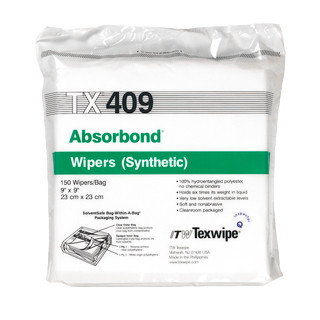
Absorbond® is constructed from 100% polyester nonwoven material.
The fibers are mechanically entangled rather than bonded with a chemical binder, producing
a soft and conformable wiping surface without introducing a binder system into the fabric.
The material is cleanroom manufactured and finished with a cut edge.
This construction is especially useful when the cleaning task requires more surface protection
than a coarse industrial wipe can provide. The nonwoven polyester structure conforms around
components and irregular surfaces while maintaining good compatibility with IPA and other
commonly used process solvents.
|
Construction Attribute
|
TX409P Configuration
|
Process Significance
|
| Fiber |
100% polyester |
Chemical resistance and low inherent ionic contribution.
|
| Structure |
Nonwoven |
Soft, conformable wiping action for delicate or irregular surfaces.
|
| Edge |
Cut edge |
Provides an economical format, but should be evaluated where maximum edge-based
particle or fiber control is required.
|
| Processing |
Cleanroom manufactured |
Intended for controlled-environment use rather than general industrial wiping.
|
| Sterility |
Non-sterile |
Not a substitute for a validated sterile wiper in aseptic critical zones.
|
2. Pre-Wetted Solution System
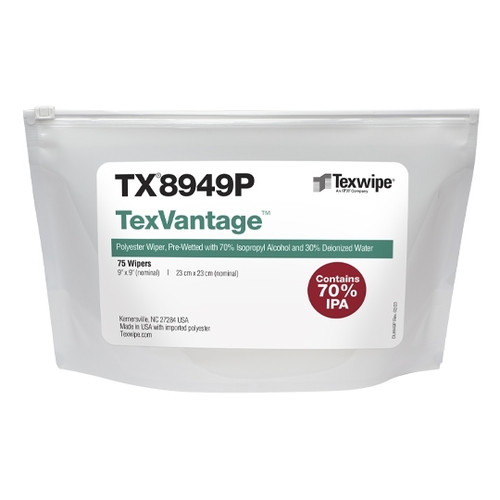
TX409P is pre-wetted with 70% USP-grade isopropyl alcohol and 30% deionized water.
Texwipe filters the solution to 0.2 µm before application. The controlled pre-wet format
is designed to provide repeatable wetness and VOC delivery from wiper to wiper.
This format reduces operator-dependent variables such as spray distance, trigger count,
bottle handling, solution overspray and excessive saturation. It can also simplify material
staging by combining the wiper and solvent into one ready-to-use consumable.
Why 70% IPA contains water: The DI-water portion supports surface wetting and
moderates the rapid evaporation associated with higher-concentration IPA. Actual efficacy,
required wet-contact time and suitability for a microorganism or process must still be established
through the applicable disinfectant labeling, facility procedure and validation program.
3. Documented Performance Characteristics
The following values are published by Texwipe as typical analyses. They are useful
for product comparison and qualification review but should not be treated as guaranteed release
specifications unless expressly stated in current Texwipe quality documentation.
|
Property
|
Typical Value
|
Qualification Relevance
|
|
Liquid particle count, ≥0.5 µm
|
1.3 x 10⁶ particles/m2
|
Comparative indicator of particles released under the cited test procedure.
|
|
Fibers greater than 100 µm
|
23,000 fibers/m2
|
Important when loose-fiber risk is material to the process.
|
|
NVR, IPA extractant
|
0.01 g/m2
|
Indicates material extractables under IPA extraction conditions.
|
|
NVR, DI-water extractant
|
0.005 g/m2
|
Relevant to residue-sensitive aqueous cleaning applications.
|
|
NVR, ethanol extractant
|
0.01 g/m2
|
Comparative extractables value for ethanol-based processes.
|
| Sodium |
7 ppm |
Ionic cleanliness can be important in semiconductor, electronics,
optics and other yield-sensitive processes.
|
| Potassium |
2 ppm |
| Chloride |
5 ppm |
| Sorptive capacity |
210 mL/m2 |
Indicates the amount of liquid the dry material can hold per unit area.
|
| Sorptive rate |
1.4 seconds |
Indicates rapid uptake when the material contacts liquid.
|
| Basis weight |
42 g/m2 |
Describes the mass and general substance of the wiper material.
|
Values above are reported in Texwipe Absorbond Technical Data Sheet
TEX-LIT-TDS-005 Rev. 01-3/26. Typical data are not product specifications.
4. Application Analysis by Industry
|
Industry or Process
|
Representative Uses
|
Qualification Considerations
|
|
Optics and Precision Components
|
Lenses, inspection windows, optical housings, polished surfaces and delicate components.
|
Confirm coating compatibility and use a low-pressure, single-direction wiping technique.
|
|
Medical Device Manufacturing
|
Fixtures, assembly tools, equipment surfaces and non-product-contact processing areas.
|
Assess residue, biocompatibility impact, material compatibility and procedural status
before use on direct product-contact surfaces.
|
|
Pharmaceutical and Biologics
|
Equipment exteriors, carts, staging surfaces, transfer items and support-area wipe-downs.
|
Non-sterile status generally limits use in critical aseptic zones unless specifically
justified by the facility contamination-control strategy.
|
|
Compounding Pharmacy
|
Approved item transfer, equipment wipe-down and non-critical support-area cleaning.
|
Select sterile versus non-sterile wipers according to the compounding activity,
classified area and current facility SOP.
|
|
Semiconductor and Microelectronics
|
Tool exteriors, inspection stations, fixtures, screens, work surfaces and maintenance wiping.
|
Review the published ion, particle, fiber and NVR data against process-specific yield requirements.
|
|
Aerospace and Aviation
|
Precision assemblies, optical systems, inspection equipment, tooling and residue removal.
|
Verify IPA compatibility with paints, sealants, acrylics, composites and specialty coatings.
|
|
Laboratory and Controlled Manufacturing
|
Instruments, notebooks, phones, benchtops, carts and approved incoming items.
|
Avoid wiping powered electronics unless the equipment procedure expressly permits it.
|
5. Recommended Wiping Technique
-
Verify that TX409P and 70% IPA are approved for the surface, controlled area and procedure.
-
Wear the required gloves and personal protective equipment specified by the facility.
-
Open the slider bag only as far as needed and remove one wiper without contacting the remaining stack.
-
Fold the wiper to create multiple controlled wiping faces when the procedure permits.
-
Wipe from the cleanest area toward the less-clean area using overlapping, unidirectional strokes.
-
Turn to a clean wiper face rather than returning a contaminated face to the cleaned surface.
-
Replace the wiper when visibly soiled, dry, damaged or after completing the defined surface area.
-
Maintain the validated wet-contact time when the procedure uses IPA as part of a disinfection step.
-
Reseal the package promptly to reduce IPA evaporation and preserve the remaining wipers.
6. Product Selection Boundaries
TX409P Is a Strong Choice When:
- A ready-to-use 70% IPA wiper is preferred.
- The surface is delicate or scratch-sensitive.
- Low ionic and NVR contribution is important.
- ISO Class 5–8 compatibility is appropriate.
- Repeatable wetness and solvent control are desired.
Consider Another Product When:
- A sterile wiper is required.
- A sporicidal chemistry is required.
- A sealed-edge wiper is mandated for tighter fiber control.
- The process requires a different solvent concentration.
- The substrate is incompatible with IPA or prolonged moisture exposure.
7. Safety, Storage and Handling
-
TX409P contains isopropyl alcohol, a flammable solvent. Keep away from heat, sparks,
flames and other ignition sources.
-
Use with adequate ventilation and follow the current Texwipe Safety Data Sheet and
facility chemical-safety procedures.
-
Keep the bag closed when not in use to limit evaporation and moisture loss.
-
Store in the original container under the manufacturer’s recommended storage conditions.
-
Do not use on energized equipment unless specifically permitted by the equipment manufacturer
and the applicable electrical-safety procedure.
-
Dispose of used wipers according to the contaminants collected, facility waste characterization
and applicable local requirements.
-
The manufacturer’s temperature statement of less than 400°F (205°C) applies to the
dry Absorbond material. It must not be applied to an IPA-pre-wetted TX409P wiper.
Flammability warning: Do not use a pre-wetted IPA wiper on a hot surface,
near an ignition source or in a manner inconsistent with the current Safety Data Sheet.
8. Packaging, Traceability and Shelf Life
|
Wipers per Bag
|
75 |
|
Package Style
|
Reclosable slider bag |
|
Bags per Case
|
4 |
|
Total Wipers per Case
|
300 |
|
Lot Coding
|
Individually lot coded for traceability and quality control
|
|
Published Shelf Life
|
3 years from date of manufacture for non-sterile pre-wetted product
|
9. Frequently Asked Technical Questions
Is TX409P sterile?
No. TX409P is a non-sterile, cleanroom-manufactured wiper. Select a validated sterile
wiper when the process or classified zone requires sterile consumables.
Is the IPA pharmaceutical or USP grade?
Texwipe identifies the pre-wet solution as 70% USP-grade IPA and 30% deionized water,
filtered to 0.2 µm.
Is TX409P appropriate for optical surfaces?
Texwipe specifically documents lenses, optical devices and other scratch-sensitive surfaces
as applications. Always confirm compatibility with the particular optical coating or substrate.
Does TX409P replace a disinfectant or sporicide?
No universal claim should be made. TX409P delivers a controlled 70% IPA solution, but it is
not a sporicidal product and does not replace any disinfectant rotation, wet-contact time or
validated cleaning requirement established by the facility.
Can TX409P be autoclaved?
Texwipe states that Absorbond material is autoclave safe in the dry configuration.
The IPA-pre-wetted TX409P package should not be autoclaved.
What does the cut edge mean for product selection?
A cut edge provides a practical and economical format but does not offer the same edge
encapsulation as a sealed-border wiper. Processes with exceptionally strict fiber-release
requirements should compare TX409P with an appropriate sealed-edge alternative.
10. Qualification Statement
Wiper suitability is process-specific. Before implementation, users should assess the complete
combination of wiper material, edge construction, solvent chemistry, sterility status, particle
and fiber profile, extractables, surface compatibility, operator technique and waste classification.
Qualification should be documented through the organization’s approved quality system and
contamination-control procedures.
Primary manufacturer reference:
Texwipe Absorbond® Technical Data Sheet, TEX-LIT-TDS-005 Rev. 01-3/26.
Review the current Texwipe TDS, Safety Data Sheet, Certificate of Conformance and lot-specific
documentation before final product qualification.