The Technical Vault
By SOSCleanroom
Oil Repellence
RIPEL™ Technology
ANSELL GRIP™
ANSI A3 - Current Production
EN 388: 4X42C - Current
18-Gauge Dexterity
Touchscreen Compatible
Ansell HyFlex® 11-931: Engineered Oil Repellence, Grip and Lightweight Cut Protection
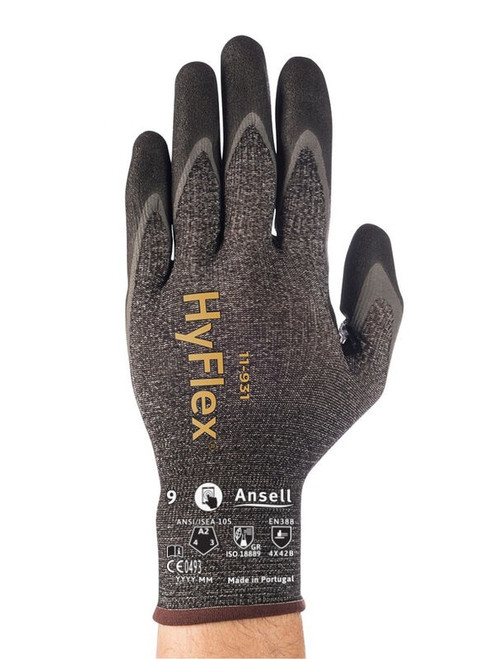
Ansell HyFlex® 11-931 is a palm-coated, oil-repellent industrial glove designed to balance oily grip, mechanical cut protection, abrasion resistance, dexterity and comfort. It combines an 18-gauge cut-resistant liner with a foam nitrile palm coating, RIPEL™ Liquid Repellence Technology, ANSELL GRIP™ Technology, ZONZ™ Comfort Fit and touchscreen compatibility.
The glove is intended for repeated handling of lubricated components, automotive parts, production assemblies and mechanical equipment where secure handling matters but a relatively light, flexible glove is preferred.
Technical takeaway: Current Ansell documentation identifies HyFlex 11-931 as ANSI Cut A3 / EN ISO Cut C with EN 388 4X42C for production beginning April 9, 2026. Earlier production was ANSI A2 / EN ISO B with EN 388 4X42B. The cut-resistant liner technology was also updated. The appropriate specification depends on the actual glove production date.
Industrial Safety Context: Oily Parts, Sharp Edges and Repetitive Handling
Workers in automotive assembly, machinery manufacturing and industrial maintenance often handle components coated with machining lubricants, processing oils or residual fluids. These substances can reduce friction at the hand-to-part interface and make otherwise routine handling more difficult.
At the same time, metal components may have unfinished edges, rough surfaces or protrusions that create mechanical injury risks. A suitable glove must therefore provide enough grip to maintain control while also meeting the task's cut, abrasion and puncture requirements.
HyFlex 11-931 is designed around this combination of hazards. The palm coating and ANSELL GRIP™ Technology support oily handling, the cut-resistant liner provides a tested mechanical protection level, and the lightweight knit supports the finger movements required for inspection, assembly and fastening.
Hazard-assessment principle: Oil repellence, gripping performance, cut resistance, abrasion resistance and puncture resistance are different properties. All must be evaluated against the actual material and task rather than treating one protective feature as a substitute for another.
Critical 2026 Product Revision: ANSI A2 to A3 and EN ISO B to C
Ansell's manufacturer documentation identifies an important production-specific change to the HyFlex 11-931. The EU Declaration of Conformity distinguishes gloves made before April 9, 2026 from those manufactured on or after April 9, 2026.
| Specification |
Earlier Production |
Production From April 9, 2026 |
| ANSI Cut |
A2 |
A3 |
| EN ISO Cut |
B |
C |
| EN 388 |
4X42B |
4X42C |
| Liner Technology |
Dyneema® Diamond Technology |
INTERCEPT™ Cut Resistance Technology |
| ANSI Abrasion |
Level 4 |
Level 4 |
| ANSI Puncture |
Level 3 |
Level 3 |
Receiving and purchasing control: Do not assume every case labeled HyFlex 11-931 has the updated A3/C rating. Existing warehouse inventory may include earlier A2/B production. Use the manufacturing date, product labeling and applicable Ansell Declaration of Conformity when approving or quoting protection levels.
Core Product Specifications
- Manufacturer: Ansell
- Product Family: HyFlex®
- Model: 11-931
- Category: Oil-repellent, cut-resistant industrial protective glove
- Construction: Knitted, palm coated
- Gauge: 18
- Liner: Cut-resistant HPPE-based construction
- Current Liner Technology: INTERCEPT™ Cut Resistance Technology
- Earlier Liner Technology: Dyneema® Diamond Technology
- Liner Color: Anthracite
- Coating: Foam nitrile
- Coating Colors: Grey and black
- Coating Coverage: Palm coated
- Reinforcement: Thumb crotch
- Grip Technology: ANSELL GRIP™
- Liquid Repellence: RIPEL™
- Comfort: ZONZ™ Comfort Fit
- Abrasion Technology: FORTIX™, shown in updated manufacturer datasheet
- Touchscreen Compatibility: Yes
- Cuff: Knitwrist
- Latex-Free: Yes
- Silicone-Free: Yes
- Manufacturer-Listed Antistatic: Yes
- Sizes: 6, 7, 8, 9, 10, 11
- Length: 212-261 mm / 8.3-10.3 inches
- Packaging: 12 pairs/bag; 12 bags/carton
- Case Quantity: 144 pairs
- Washing Temperature: 40°C / 104°F, subject to manufacturer instructions
Mechanical Performance and Compliance
| Standard / Property |
Manufacturer-Reported Classification |
| ANSI/ISEA 105-2024 Cut |
A3 current / A2 earlier |
| ANSI/ISEA 105-2024 Abrasion |
Level 4 |
| ANSI/ISEA 105-2024 Mechanical Puncture |
Level 3 |
| EN 388:2016 + A1:2018 |
4X42C current / 4X42B earlier |
| EN ISO 13997 Cut |
C current / B earlier |
| EU PPE Classification |
Category III |
| EN ISO 21420:2020 |
Manufacturer-listed compliance |
| ISO 18889:2019 |
GR classification, subject to certified use scope |
| OEKO-TEX® STANDARD 100 |
4419CIT |
| Dermatest |
Manufacturer-listed dermatological testing |
| REACH |
Manufacturer-listed compliance |
Understanding EN 388: 4X42C vs. 4X42B
EN 388 reports several mechanical protective characteristics through a coded performance marking. HyFlex 11-931's first four positions are unchanged between the earlier and newer ratings; the final cut-resistance letter has changed.
- First position - 4: Abrasion resistance, Level 4
- Second position - X: Coupe blade cut result not reported as a numerical classification
- Third position - 4: Tear resistance, Level 4
- Fourth position - 2: Mechanical puncture resistance, Level 2
- Fifth position - C: EN ISO 13997 cut resistance for current production
- Earlier fifth position - B: EN ISO 13997 cut resistance for earlier production
The letter classification describes resistance to cutting under a separate standardized test method. An X in the Coupe test position does not mean zero cut resistance. It means the applicable performance marking does not include a numerical Coupe result for that position.
Standards takeaway: EN 388 abrasion and puncture ratings are not the same as ANSI abrasion and puncture ratings. Do not convert one scale to another by matching numbers. Always use the rating reported for the specific standard.
ANSI Cut Protection: A2 and A3 Explained
ANSI/ISEA 105 cut classifications are determined by standardized blade testing. Higher ratings generally indicate resistance to greater cutting force under the test method, but do not guarantee protection against every workplace blade or edge.
- ANSI A2: A cut-force classification of at least 500 and less than 1,000 grams-force.
- ANSI A3: A cut-force classification of at least 1,000 and less than 1,500 grams-force.
- Current HyFlex 11-931: ANSI A3, according to the updated manufacturer datasheet.
- Earlier HyFlex 11-931: ANSI A2, according to earlier manufacturer literature.
- Task factors: Edge sharpness, applied force, motion direction, contact duration and glove condition affect workplace suitability.
Safety interpretation: A3 is an improvement over A2 in standardized cutting resistance, but neither rating makes the glove cut-proof. Select additional or higher-rated protection when the job involves severe sharp edges, powered cutting equipment or cutting forces beyond the documented rating.
RIPEL™ Liquid Repellence: Oil Handling Without Full-Hand Sealing
RIPEL™ Technology is designed to reduce contact between oils or suitable liquids and the skin under the coated palm. It is particularly relevant to workers handling lubricated automotive components, oil-coated fasteners, machinery parts and similar industrial materials.
The HyFlex 11-931 is palm coated rather than fully coated. This protects the principal gripping area while leaving portions of the back of the hand more breathable. That design also means liquid-repellent coverage is limited and should not be mistaken for a full liquid barrier.
- Repellence function: Helps oil and suitable liquids remain away from coated palm contact areas.
- Coverage: Palm and designated coated areas, not the complete hand.
- Common use: Handling coated or lubricated components.
- Limitation: Does not establish a liquidproof seal.
- Chemical exposure: Requires separate chemical-specific assessment and documentation.
Oil repellence is not chemical permeation protection: A coating that repels processing oil during handling should not automatically be selected for hazardous chemical splash, immersion, acid, solvent or caustic exposure. Use appropriate chemical-protective gloves when the exposure assessment requires documented breakthrough performance.
ANSELL GRIP™ Technology: Secure Handling of Lubricated Components
Oil contamination can reduce the friction available between a glove and a workpiece. As a result, employees may need to increase gripping force, adjust their grip repeatedly or use additional handling precautions when working with lubricated metal and plastic components.
ANSELL GRIP™ Technology is designed to improve control and stability during oily handling. Its contribution is particularly important during component positioning, fastening, inspection and parts transfer, where reliable control can reduce unintended slipping.
Actual grip performance depends on the workpiece surface, oil type, contamination level, pressure and wear condition. Operators should confirm that the glove provides reliable control for their specific process.
18-Gauge Liner Engineering: High Dexterity and Cut-Resistant Fibers
The 18-gauge knitted liner provides a close-fitting foundation for detailed handling. Fine-gauge construction can support improved finger articulation and tactile control compared with bulkier protective gloves, although the actual result depends on size and construction.
Earlier Ansell documentation identifies Dyneema® Diamond Technology for this product. The current manufacturer datasheet identifies INTERCEPT™ Cut Resistance Technology, and the current product information describes a high-performance cut-resistant liner.
These descriptions must be interpreted according to the production version. Do not assume that the materials used in an older manufactured glove are identical to the updated construction without checking the applicable product documentation.
Construction takeaway: Gauge and fiber technology are design properties. Cut protection must still be established through the manufacturer-reported ANSI and EN test results for the exact glove being supplied.
Foam Nitrile Palm Coating: Protection and Wear in High-Contact Areas
HyFlex 11-931 uses a grey-and-black foam nitrile palm coating. Nitrile coatings are commonly used in industrial protective gloves because they can provide a useful combination of abrasion durability and gripping performance.
In this glove, the coating works together with RIPEL™ and ANSELL GRIP™ technologies to support oil-repellent contact areas and controlled handling of lubricated parts.
- Coating material: Foam nitrile
- Primary contact zones: Palm and fingers
- Grip technology: ANSELL GRIP™
- Liquid repellence: RIPEL™
- Abrasion performance: ANSI Level 4
- Wear indicators: Thinning, cracking, peeling, worn-through areas and reduced grip
Reinforced Thumb Crotch: Reducing Premature Wear at Grip Stress Points
The area between the thumb and index finger is frequently subjected to concentrated mechanical stress. Repeated gripping, turning fasteners, handling tools and pinching components can cause localized friction, yarn fatigue or coating damage.
HyFlex 11-931 incorporates thumb-crotch reinforcement intended to improve durability at this high-wear location. Its condition should be checked during routine glove inspections, particularly in high-volume assembly and maintenance operations.
ZONZ™ Comfort Fit and Touchscreen Compatibility
Ansell's ZONZ™ Comfort Fit knitting and stitch design is intended to support comfortable hand movement and reduce fatigue during repetitive tasks. The glove's lightweight construction helps maintain flexibility for component selection, inspection and fastening.
Touchscreen compatibility allows workers to interact with compatible scanners, production tablets and control interfaces without routinely removing the gloves. This can be useful in modern manufacturing environments where physical handling and electronic workflow confirmation occur at the same station.
Ergonomic note: Glove fit, workstation setup, tool design and work organization remain important. Comfort technology does not replace appropriate ergonomic controls, and touchscreen compatibility should be tested on the facility's specific devices.
ISO 18889:2019 GR Marking and Chemical Protection Boundaries
Current Ansell certification documentation lists ISO 18889:2019 with a GR marking. ISO 18889 concerns protective gloves for certain pesticide-related exposure conditions, and the GR classification has a defined scope under the standard.
This marking should not be interpreted as evidence that HyFlex 11-931 provides general-purpose chemical resistance, full-hand protection against every liquid or validated resistance to unrelated solvents and industrial chemicals.
Certification limitation: Consult the current Ansell instructions for use and the actual certified scope of ISO 18889 before selecting this glove for any pesticide-related task. It is not a substitute for chemical-specific permeation data or a properly selected full-coverage chemical glove.
Antistatic Listing vs. Formal ESD Qualification
Ansell lists HyFlex 11-931 as antistatic. This is a manufacturer-reported product attribute, but it should not be interpreted as automatic qualification for every electrostatic discharge control program.
Facilities working with ESD-sensitive electronics, semiconductor components or controlled grounding systems should confirm the exact electrical test methods and qualification requirements before approving the glove. Antistatic behavior is not the same as voltage-rated electrical insulation.
Selection alternative: For specific electrostatic-control requirements, review the Ansell HyFlex 11-819 ESD and confirm its applicable electrical specifications.
Sizing, Fit and Packaging
Proper sizing is essential for both mechanical protection and gripping performance. A glove that is too loose may reduce tactile control, while an excessively tight glove may restrict finger movement and increase stress on the knitted liner.
- Sizes: 6, 7, 8, 9, 10, 11
- Overall Length: 212-261 mm, depending on size
- Packaging: 12 pairs/bag
- Case: 12 bags, 144 pairs total
- Cuff: Knitwrist
- Fit Objective: Secure handling without excessive tension or loose fingertips
How to measure: Follow Ansell's current glove sizing guidance using hand circumference and the manufacturer's size chart. A good fit should permit normal finger flexion, secure gripping and operation of required work devices.
Recommended Industrial Applications
- Assembly and inspection of mechanical components
- Picking, selecting, checking and fastening parts
- Automotive chassis assembly and body trimming
- Handling lubricated and coated production components
- Adjusting parts, systems and panels
- Delivering components to production lines
- Equipment repair and industrial maintenance
- Engine and transmission service
- Oil, fluid and filter change tasks where palm coverage is suitable
- Inspection, marking and quality-control handling
- Press shop material handling
- Feeding and removing components at press stations under approved safe operating procedures
- Touchscreen-assisted inspection and production processes
- Machinery, equipment and infrastructure maintenance operations
Application fit: The glove is intended for industrial handling where its cut rating, oil-repellent coverage and gripping characteristics satisfy the task assessment. The manufacturer's listing of an industry does not authorize use for every hazard present in that industry.
Misuse Controls and Important Limitations
- Severe cutting hazards: Do not exceed the actual production version's rated cut protection.
- Needle exposure: Mechanical puncture Level 3 does not establish hypodermic needle resistance.
- Chemical immersion: Palm coating and RIPEL™ do not provide a validated full-hand chemical barrier.
- Hazardous solvents, acids and caustics: Use appropriately certified chemical-protective gloves.
- Full-hand liquid exposure: The palm-coated construction leaves uncovered textile areas.
- High-temperature work: No thermal protection claim should be assumed without supporting documentation.
- Flame or molten metal: Select dedicated thermal PPE.
- Electrical shock: Not a voltage-rated insulating glove.
- ESD-sensitive operations: Verify ESD qualification separately.
- Powered cutting equipment: Cut-resistant gloves do not eliminate blade hazards.
- Rotating equipment: Observe glove-use restrictions where entanglement risk exists.
- Sterile or ISO-classified cleanrooms: Do not infer cleanroom qualification or sterility.
Best-Practice Use: Workstation PPE Checklist
- Identify the task hazards: Assess oil, chemicals, cuts, abrasion, punctures and equipment risks.
- Verify the lot: Confirm whether the supplied glove carries A2/B or A3/C cut protection.
- Choose the correct size: Fit the glove securely without restricting movement.
- Inspect the palm coating: Look for cuts, cracking, thinning, peeling and pinholes.
- Inspect the reinforced thumb crotch: Check for localized wear or damaged material.
- Assess oil and liquid exposure: Confirm palm-only coverage is adequate and chemical compatibility is acceptable.
- Test gripping performance: Confirm secure handling of the actual workpiece.
- Test work devices: Verify acceptable touchscreen operation where required.
- Apply approved care instructions: Follow the manufacturer guidance before laundering or reuse.
- Replace damaged gloves: Remove gloves when wear, contamination or loss of grip makes them unsuitable.
Wear Life, Replacement Indicators and Cleaning
The useful life of a palm-coated industrial glove depends on contact pressure, abrasion, component geometry, oil exposure, glove fit and work frequency. A laboratory abrasion rating does not establish a fixed number of safe shifts or handling cycles.
- Palm coating wear: Thinning, smoothing, peeling and worn-through areas.
- Fingertip damage: Holes, tears or loss of coating in contact zones.
- Thumb-crotch fatigue: Separation, fraying or damaged reinforcement.
- Liner damage: Broken yarns, cuts, stretching or holes.
- Oil contamination: Excessive saturation or reduced repellence.
- Grip deterioration: Difficulty maintaining reliable control of workpieces.
- Touchscreen performance: Reduced response when device interaction is required.
- Fit deterioration: Loose fingertips, excessive stretch or damaged cuff.
- Cleaning: Follow the latest Ansell instructions, including the stated 40°C washing temperature where applicable.
Replacement principle: Do not assume that laundering, cleaning or an undamaged appearance restores a contaminated or worn glove to its original tested performance. Follow manufacturer instructions and facility-specific PPE acceptance criteria.
Storage and Handling Considerations
- Store in a clean and dry area following manufacturer guidance.
- Keep gloves away from excessive heat and direct sunlight.
- Protect the foam nitrile palm from sharp objects and abrasion during storage.
- Prevent unintended contact with chemicals, solvents and other incompatible substances.
- Avoid conditions that deform the knitted liner or cuff.
- Inspect gloves before issue, particularly after extended storage.
- Maintain lot and manufacturing-date information when different protective versions may be present in inventory.
Ansell Earth: Manufacturer-Reported Environmental Attributes
Ansell publishes environmental information for HyFlex 11-931 through its Ansell Earth program. These attributes concern manufacturing and packaging and should be assessed separately from mechanical PPE performance.
- Manufacturing Electricity: Manufacturer reports a facility using 100% green electricity.
- Waste Diversion: Manufacturer reports Intertek certification for diverting more than 99% of waste from landfill.
- Management Systems: Manufacturer identifies accredited environmental and energy management systems.
- Shipping Cartons: Minimum 65% recycled material, according to Ansell.
- Responsible Sourcing: Manufacturer-reported sourcing attributes for shipper-case materials.
- Shipping Optimization: Carton dimensions designed to support efficient distribution.
Procurement note: These manufacturer-reported claims do not automatically establish that used gloves are recyclable, biodegradable or suitable for disposal through ordinary recycling streams.
Cleanroom and Controlled-Environment Limitations
HyFlex 11-931 is an industrial oil-repellent protective glove, not a documented sterile or cleanroom-processed glove. Its mechanical ratings, silicone-free claim and antistatic listing do not establish ISO cleanroom suitability, low particle shedding, ionic cleanliness, low extractables or aseptic qualification.
For controlled environments, verify the specific requirements for particulate cleanliness, glove processing, packaging, contamination control, chemical compatibility, ESD performance and gowning. Use gloves with the required cleanroom documentation when the process demands it.
Recommended Industrial Glove Alternatives and Pairings
HyFlex 11-931 prioritizes oily grip, contact-zone repellence, cut protection and fine handling. Other gloves may be preferable where the workstation requires higher cut resistance, different coatings, abrasion-focused durability or formal ESD qualification.
-
Ansell HyFlex 11-561 — ANSI A3 / EN ISO C cut-resistant nitrile-coated glove for suitable industrial sharp-edge handling.
-
Ansell HyFlex 11-550 — abrasion-resistant nitrile-coated industrial glove with ANSI A2 cut protection.
-
Ansell HyFlex 11-735 — ANSI A4 polyurethane-coated glove for higher cut-risk industrial handling.
-
Ansell HyFlex 11-840 — foam nitrile industrial glove focused on grip, dexterity and abrasion resistance.
-
Ansell HyFlex 11-819 ESD — specialized option for documented electrostatic-control applications.
Selection reminder: These products do not have identical coating coverage, oil repellence, cut ratings or specialty qualifications. Select the glove with the documented performance appropriate to the actual application.
Technical FAQs: Ansell HyFlex 11-931
What is the ANSI cut rating of HyFlex 11-931?
Current production manufactured from April 9, 2026 is identified as ANSI A3. Earlier production was ANSI A2. Confirm the glove's manufacturing date and applicable labeling.
What is the EN 388 rating?
Current production: 4X42C. Earlier production: 4X42B.
What is the liner material?
The current Ansell datasheet identifies INTERCEPT™ Cut Resistance Technology. Earlier datasheets identify Dyneema® Diamond Technology. Both descriptions refer to production-specific constructions.
What does RIPEL™ Technology do?
It helps repel oil and suitable liquids at the coated palm, reducing incidental contact during handling tasks.
Does the glove provide chemical protection?
It has limited, application-specific liquid-repellent properties and an ISO 18889 GR certification scope, but these do not establish full-hand resistance to all chemicals. Evaluate each chemical exposure separately.
Is HyFlex 11-931 touchscreen compatible?
Yes. Ansell identifies the glove as touchscreen compatible. Actual device performance should be checked on the workstation equipment.
Is HyFlex 11-931 latex-free and silicone-free?
Yes. Ansell lists both attributes for this product.
Is the glove ESD certified?
Ansell lists it as antistatic, but this alone does not establish suitability for a particular ESD program. Verify the required electrical certification.
How many pairs are in a case?
144 pairs, packaged as 12 bags of 12 pairs each.
Why Buy Ansell HyFlex 11-931 From SOSCleanroom?
- Authorized Ansell sourcing: Access genuine industrial protective gloves with distributor support.
- Product specification assistance: Clarify the relevant 2026 production revision and associated cut protection.
- Correct model and size selection: Order the specified 11-931 model and required size.
- Case procurement: Source manufacturer-standard 144-pair case quantities.
- Manufacturer documentation: Review product data sheets and regulatory declarations.
- Industrial application support: Compare oily-grip, cut-resistant, abrasion-focused and ESD-oriented Ansell models.
- Recurring purchasing support: Coordinate protective glove sourcing for ongoing production, assembly and maintenance operations.
Manufacturer Documentation and Technical References
-
SOSCleanroom Product Page:
Click Here
-
Current Ansell HyFlex 11-931 Product Data Sheet:
Click Here
-
Ansell EU Declaration of Conformity (Historical and Current Versions):
Click Here
-
Ansell Official Product Information:
Click Here
-
Ansell Product Sustainability Factsheet:
Click Here
Documentation update notice: Ansell's current EU Declaration of Conformity specifies EN 388 4X42C for HyFlex 11-931 produced from April 9, 2026. Earlier production carries 4X42B. The current datasheet also identifies ANSI A3 and INTERCEPT™ liner technology. For procurement and formal PPE approval, confirm the rating and documentation applicable to the specific gloves supplied.
If you have any questions please email us at Sales@SOSsupply.com or give us a call at (214) 340-8574.
OR check out the AI ChatBot powered by SOSCleanroom data libraries - give it a try! THIS IS NEW FOR 2026!
Last reviewed: Oct. 13, 2026 (SOS Technical Staff)
© 2026 SOSCleanroom. All rights reserved.