The Technical Vault
By SOSCleanroom
KIMBLE 14395-1000
1000 mL / 1 L
USP Type I Borosilicate
GL 45 Screw Thread
Blue PP Cap Included
Autoclavable
10 Bottles / Case
KIMBLE 14395-1000: selecting a laboratory media bottle as a complete glass-and-cap system
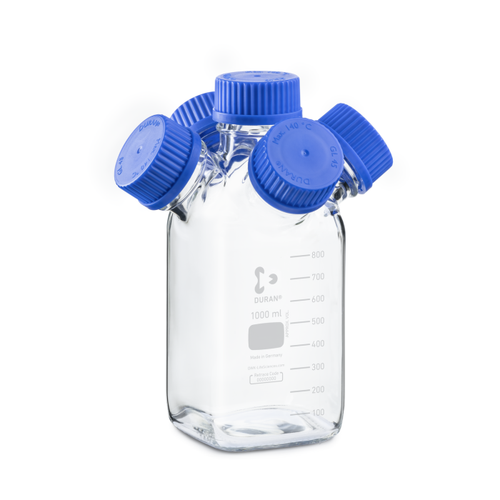
KIMBLE® 14395-1000 is a clear, 1000 mL laboratory media bottle manufactured from 33-expansion borosilicate glass by DWK Life Sciences. It belongs to the KIMBLE® / KIMAX® GL 45 laboratory bottle family and is supplied with a blue polypropylene linerless screw-thread cap.
The bottle is designed for general laboratory applications such as mixing, storing, or transporting compatible culture media, chemicals, and solvents. Enhanced white-enamel graduations, a marking area, and a 30 mm internal mouth opening support routine laboratory preparation and handling.
Selecting the correct media bottle requires evaluation of the glass, closure, working fill, chemical compatibility, thermal processing, and application cleanliness requirements. A suitable glass composition does not by itself establish a validated sterile container or a leakproof bottle assembly.
Operations takeaway: This SKU is the 1000 mL with-cap version, supplied 10 bottles per case. Its GL 45 closure, 30 mm opening, 100–900 mL graduation range, and polypropylene components should be verified as part of the laboratory's equipment and process requirements.
Specifications (SKU controls for RFQs, SOPs, and receiving)
- Manufacturer: DWK Life Sciences
- Brand: KIMBLE® / KIMAX®
- Catalog Number: 14395-1000
- Product Family: GL 45 Media Bottles with Cap
- Capacity: 1000 mL (1 liter), nominal
- Glass Material: 33-expansion, low-extractable borosilicate glass
- Glass Classification: USP Type I; ASTM E438 Type I, Class A
- Glass Color: Clear
- Bottle Outside Diameter: 101 mm
- Manufacturer-Listed Height: 225 mm
- Neck Finish: GL 45 screw thread
- Internal Mouth Diameter: 30 mm
- Cap Included: Yes
- Cap Color: Blue
- Cap Material: Polypropylene (PP)
- Cap Liner: Linerless construction
- Pour Ring: Replaceable clear/natural polypropylene
- Graduation Range: 100–900 mL
- Graduation Interval: 50 mL
- Markings: Chemically resistant white enamel
- Autoclavable: Yes, manufacturer-listed
- Case Quantity: 10 bottles
- Primary Uses: Mixing, holding, and transferring compatible laboratory media, solutions, and reagents
Documentation rule: The product's ASTM E438 Class A designation describes the glass material. It is not a Class A volumetric calibration designation. Do not assign volumetric accuracy, a certified working fill, or an individually measured bottle capacity without supporting documentation.
33-expansion borosilicate glass: properties and standards
DWK identifies the 14395-1000 bottle as manufactured from 33-expansion borosilicate glass, commonly described as borosilicate glass 3.3. This laboratory glass has a comparatively low coefficient of thermal expansion, high hydrolytic resistance, and strong resistance to many acids and other laboratory chemicals.
DWK states that the glass conforms to USP Type I and ASTM E438 Type I, Class A requirements. These are material specifications relevant to glass composition and performance rather than proof of finished-container sterility or a complete pharmaceutical package qualification.
- Glass Family: Borosilicate glass 3.3
- Linear Thermal Expansion: Approximately 3.3 × 10⁻⁶ K-1 (20–300°C), as a general material property
- Hydrolytic Resistance: ISO 719 Class HGB 1, for the glass material
- Acid Resistance: DIN 12116 Class S1, for the glass material
- Alkali Resistance: ISO 695 Class A2, for the glass material
- Glass Classification: ASTM E438 Type I, Class A
- Pharmacopoeial Classification: USP Type I glass
Material classification boundary: These values describe DWK's published 3.3-expansion borosilicate glass properties. They must not be applied as temperature ratings, pressure ratings, closure performance values, or lot-specific test results for the complete 14395-1000 bottle assembly.
Review DWK's Glass Types & Properties technical guide
GL 45 closure selection: understand the thread, mouth opening, and bottle dimensions
The GL 45 designation identifies the bottle's screw-thread finish. The 30 mm internal mouth diameter describes the opening through which materials enter or leave the bottle. These are different dimensions and must not be substituted for one another when selecting closures.
| Dimension or feature |
Meaning for product selection |
| GL 45 screw thread |
Nominal neck finish for selecting compatible GL 45 screw-thread closures |
| 30 mm opening ID |
Internal access diameter, relevant to pouring, filling, and transfer tools |
| 101 mm bottle OD |
Relevant to equipment clearance, bottle carriers, shelves, and holding fixtures |
| 225 mm height |
Manufacturer-listed bottle dimension for equipment fit; cap-on clearance should be checked |
| 1000 mL capacity |
Nominal container capacity, not a universal working fill |
For racks, autoclave baskets, storage cabinets, or automated handling, confirm clearance with the physical bottle and closure assembly. Do not assume the nominal bottle height includes every cap or accessory configuration.
Closure selection checkpoint: Match caps to the GL 45 thread finish, not the 30 mm mouth ID. Shared nominal threading does not automatically establish equivalent sealing, venting, chemical resistance, or suitability for a specific processing method.
Blue polypropylene linerless cap and replaceable pouring ring
KIMBLE® catalog number 14395-1000 includes a blue polypropylene GL 45 screw cap. The manufacturer describes the standard cap design as linerless, meaning it does not use a separately specified elastomeric or PTFE-faced liner.
KIMBLE GL 45 media bottle family documentation also identifies a replaceable natural-colored polypropylene pouring ring to assist in controlled liquid transfer. This pouring component is distinct from the screw cap and should be inspected as part of the complete bottle assembly.
- Closure Type: GL 45 screw cap
- Closure Material: Polypropylene
- Closure Color: Blue
- Liner: No separately specified liner
- Pouring Ring: Natural polypropylene, removable and replaceable
- Specialized Sealing: No validated leakproof, pressure-resistant, or sterile-venting performance established for the supplied standard cap
Polypropylene has different chemical and temperature resistance characteristics from borosilicate glass. Processes involving aggressive solvents, extended exposure, elevated temperatures, or specialized sterilization conditions require evaluation of the plastic components as well as the glass bottle.
Sealing limitation: A linerless screw cap is not automatically a leakproof transport closure, sterile barrier, or pressure-rated seal. If a process requires these characteristics, the complete container and closure arrangement must be qualified.
Chemical compatibility: evaluate the borosilicate glass and polypropylene components separately
The 33-expansion borosilicate glass offers strong chemical resistance to many common laboratory reagents. However, DWK identifies hydrofluoric acid, hot concentrated phosphoric acid, and strong alkaline solutions as conditions that can cause significant attack on this glass material.
The cap and pour ring are polypropylene components and must be evaluated independently. A chemical compatible with borosilicate glass may not be suitable for prolonged contact with the polypropylene closure under the same conditions.
| Material or condition |
Compatibility consideration |
| Borosilicate glass 3.3 |
Broad resistance to water, many acids, salt solutions, and organic solvents |
| Hydrofluoric acid |
Attacks silica-based glass; not suitable as a general borosilicate storage application |
| Hot concentrated phosphoric acid |
Can significantly corrode borosilicate glass |
| Strong alkaline solutions |
Can attack the glass surface, with effects dependent on concentration and temperature |
| Blue polypropylene cap |
Requires a separate chemical compatibility assessment for the intended contents and exposure conditions |
| Polypropylene pour ring |
Evaluate compatibility with liquids contacting the ring during transfer or storage |
Material compatibility rule: Review the full formula, chemical concentration, temperature, exposure duration, and required extractables or leachables limits. Glass compatibility alone does not establish that the entire capped bottle assembly is suitable.
1000 mL nominal capacity versus 100–900 mL graduations
The 14395-1000 bottle has a nominal capacity of 1000 mL. DWK specifies a graduated scale covering 100 mL through 900 mL, with graduation marks spaced at 50 mL intervals.
The scale and writing spot use chemically resistant white enamel paint. These features help operators estimate liquid volume and identify container contents, but the manufacturer listing does not state calibrated volumetric accuracy for this media bottle.
- Nominal Capacity: 1000 mL
- Graduation Start: 100 mL
- Graduation End: 900 mL
- Graduation Spacing: 50 mL
- Markings: White chemical-resistant enamel
- Volumetric Accuracy: No manufacturer-listed tolerance or Class A volumetric calibration for the bottle
Measurement checkpoint: Use calibrated volumetric equipment where an analytical or formulation procedure requires a defined measurement accuracy. Media bottle graduations are not a substitute for a qualified volumetric flask, pipette, or measuring device.
Autoclaving: pressure equalization, thermal management, and process controls
DWK identifies the KIMBLE® GL 45 media bottle family as autoclavable. This makes the bottles suitable for consideration in laboratory steam-processing workflows, subject to the intended process and preparation requirements.
The manufacturer's glassware care guidance emphasizes that screw caps must be loosened during autoclaving. A tightly closed bottle can develop significant internal pressure during heating or a damaging pressure differential during cooling.
- Inspect the glass: Check for cracks, chips, thread damage, or other visible defects before processing.
- Prepare the contents: Establish the appropriate liquid volume, headspace, and loading conditions through an approved procedure.
- Loosen the cap: Do not autoclave this standard media bottle with the screw cap tightly sealed.
- Allow steam circulation: Load the autoclave appropriately, following the validated or approved equipment procedure.
- Control heating and cooling: Avoid sudden thermal changes and pressure differentials.
- Use protective equipment: Follow laboratory procedures for handling hot vessels and liquid contents.
- Verify the outcome: Use the applicable monitoring and acceptance criteria when a sterilization claim is required.
Critical safety point: Never autoclave a tightly sealed standard screw-cap media bottle. The ordinary linerless polypropylene cap is not a pressure-compensating membrane closure. Autoclavability does not establish safe sealed-bottle processing.
Review DWK's Care & Maintenance of Laboratory Glassware
Autoclavability, supplied sterility, and pharmaceutical qualification
An autoclavable laboratory bottle is not necessarily supplied sterile. The reviewed DWK product listing does not establish a supplied-sterile designation, validated sterility assurance level, endotoxin limit, or ready-to-use pharmaceutical packaging status for 14395-1000.
Likewise, the USP Type I glass classification describes the glass material rather than an independently validated sterile bottle-and-cap assembly. Laboratories operating under pharmaceutical, microbiological, or other regulated quality requirements should qualify the actual cleaning, preparation, closure, filling, and storage processes.
- Supplied Sterility: Not established by the reviewed product listing
- Autoclavability: Yes, as listed by DWK
- Product-Specific Sterilization Cycle: Not provided in the reviewed SKU specifications
- Endotoxin Specification: Not identified
- Validated Container Closure Integrity: Not identified
- Process Qualification: Required according to the intended application and applicable quality procedures
Qualification boundary: Do not treat an autoclavable glass bottle with a standard linerless cap as a ready-to-use sterile pharmaceutical container. The final glass, closure, contents, and processing configuration must satisfy the applicable acceptance criteria.
Culture media, buffers, reagents, and laboratory storage applications
DWK identifies these bottles for general-purpose mixing, storage, and transport of laboratory media, chemicals, and solvents. Their clear glass bodies, graduated scale, marking field, and included caps make them useful in many routine laboratory workflows.
- Culture media: Suitable for preparation and handling workflows when the glass, closure, and processing procedure have been appropriately selected.
- Buffer solutions: Useful for mixing and temporary storage of compatible laboratory buffers.
- Chemical reagents: Evaluate the entire bottle and closure assembly against the reagent chemistry.
- Solvents: Select only after confirming compatibility with the glass and polypropylene components.
- Laboratory transfer: Use the opening and pouring ring within approved liquid-handling procedures.
- Sample preparation: The graduated body supports approximate volumes; precise analytical measurements require calibrated equipment.
Storage duration, shelf life of prepared solutions, sterility maintenance, and transport requirements depend on the contents, closure system, and laboratory quality program. These performance limits are not established by the empty bottle specification.
Pressure, vacuum, thermal shock, and use limitations
The 14395-1000 manufacturer listing does not provide a specific operating pressure rating or vacuum rating. Conventional laboratory media bottles should not be used as pressure or vacuum vessels without explicit product-specific approval.
Although borosilicate glass offers good thermal shock resistance, improper heating, sudden cooling, impact, scratches, or chemically damaged glass can increase the risk of failure.
- Positive Pressure: No finished-product rating identified
- Vacuum: No finished-product rating identified
- Closed-Bottle Autoclaving: Not appropriate with a tightly secured standard cap
- Thermal Shock: Avoid sudden heating and cooling
- Mechanical Damage: Remove chipped, cracked, or scratched bottles from service
- Cap Compatibility: Do not apply glass-only thermal or chemical limits to the complete assembly
KIMBLE media bottle configurations: with cap, without cap, coated, and light-protective
Different DWK catalog numbers identify bottles with different supplied components or specialized glass treatments. The following items are separate manufacturer products.
| Catalog Number |
1000 mL Configuration |
Case Quantity |
| 14395-1000 |
Clear media bottle with blue PP cap |
10 |
| 14396-1000 |
Clear GL 45 media bottle without cap |
10 |
| KC14395-1000 |
KIMCOTE® safety-coated GL 45 media bottle |
4 |
| 14399-1000 |
RAY-SORB® light-protective GL 45 media bottle |
1 |
The standard 14395-1000 configuration is not the same as the KIMCOTE® safety-coated bottle or RAY-SORB® light-protective bottle. Do not import safety-coating, light-transmission, or specialized packaging claims from another SKU.
KIMBLE 14395 series: select the capacity and case quantity
The GL 45 media bottle family includes multiple capacities with blue polypropylene caps. The bottle body dimensions and manufacturer case quantities change with size.
| Catalog Number |
Capacity |
OD × Height |
Bottles / Case |
| 14395-100 |
100 mL |
56 × 100 mm |
10 |
| 14395-250 |
250 mL |
70 × 138 mm |
10 |
| 14395-500 |
500 mL |
86 × 176 mm |
10 |
| 14395-1000 |
1000 mL |
101 × 225 mm |
10 |
| 14395-2000 |
2000 mL |
136 × 260 mm |
4 |
| 14395-5000 |
5000 mL |
181 × 330 mm |
1 |
| 14395-10000 |
10000 mL |
227 × 410 mm |
1 |
These dimensions and quantities are published manufacturer family specifications. Confirm each separate catalog number before changing size, purchasing alternative configurations, or qualifying new equipment fit.
Cleanroom suitability and controlled-environment considerations
The KIMBLE® 14395-1000 is a general laboratory media bottle. Its borosilicate glass construction and autoclavability do not independently establish cleanroom processing, ISO cleanliness classification, or suitability for aseptic introduction.
- ISO Cleanroom Classification: No SKU-specific cleanliness classification identified
- Supplied Sterility: Not established by the reviewed product listing
- Endotoxin Limits: No SKU-specific limit identified
- Particulate Cleanliness: No finished-product particle specification identified
- Closure Integrity: Must be established where required by the application
- Facility Introduction: Follow approved cleaning, disinfection, transfer, and material-control procedures
Controlled-environment checkpoint: In GMP, aseptic, or other quality-controlled processes, evaluate the actual bottle, cap, preparation procedure, and documentation together. USP Type I glass is a material classification and is not a substitute for process qualification.
Packaging, receiving, cleaning, and inspection checklist
DWK specifies a manufacturer case quantity of 10 bottles for catalog number 14395-1000. Facilities maintaining controlled purchasing and inventory procedures should verify the complete SKU and physical configuration upon receipt.
- Verify the catalog number: Match 14395-1000 to the purchase order and receiving documents.
- Confirm quantity: Verify the expected ten-bottle case configuration.
- Inspect the glass: Check each bottle for chips, cracks, scratches, and other visible defects.
- Check the finish: Examine the GL 45 threads and neck sealing surfaces.
- Verify closure components: Confirm the supplied blue polypropylene caps and intended pouring-ring components.
- Check dimensions: Confirm the required 1000 mL bottle configuration and equipment fit.
- Inspect graduations: Check the legibility of the 100–900 mL white-enamel scale and marking spot.
- Prepare as required: Clean, rinse, sterilize, or otherwise process the bottles according to the approved laboratory procedure.
- Record disposition: Retain identification, lot documentation, and inspection records as required by the facility's quality system.
The reviewed SKU listing does not establish a finished-product shelf life, storage temperature range, or individually validated cleaning-cycle count. Follow the applicable laboratory procedure and obtain current manufacturer documentation when needed.
Technical FAQs
Does KIMBLE 14395-1000 include the cap?
Yes. The product is the with-cap configuration and includes blue polypropylene GL 45 screw caps. The manufacturer case contains ten bottles.
What is the difference between 14395-1000 and 14396-1000?
14395-1000 is supplied with blue polypropylene caps, while 14396-1000 is cataloged as the corresponding bottle without caps. They are separate manufacturer products.
Does GL 45 mean the opening is 45 mm wide?
No. GL 45 identifies the nominal screw-thread finish. DWK lists the bottle's internal mouth opening as approximately 30 mm.
Does the bottle include a pouring ring?
KIMBLE GL 45 media bottle family documentation identifies a clear polypropylene pouring ring as an included, replaceable component. Confirm the supplied assembly if the pouring ring is an essential procurement requirement.
Is the blue cap lined with PTFE or rubber?
No separate PTFE or rubber liner is specified. The standard blue polypropylene GL 45 cap is described as linerless.
Are the graduations accurate enough for analytical volumetric measurements?
The manufacturer's 50 mL graduation interval supports approximate volume monitoring. No Class A volumetric accuracy or calibrated tolerance is established for this media bottle.
Are these bottles supplied sterile?
The reviewed DWK listing does not establish supplied sterility. Autoclavability does not mean that bottles arrive sterile.
Can the bottle be autoclaved with its cap fully tightened?
No. DWK's glassware handling guidance directs users to loosen screw caps during autoclaving to prevent dangerous pressure differences.
Does USP Type I make the bottle suitable for every pharmaceutical application?
No. USP Type I describes the glass material. Pharmaceutical suitability depends on additional container, closure, preparation, compatibility, and process qualifications.
Can this media bottle be used under vacuum or pressure?
No product-specific pressure or vacuum rating is established by the reviewed listing. Do not use it as a pressure or vacuum vessel without explicit manufacturer qualification.
Why purchase KIMBLE laboratory bottles from SOSCleanroom
- Specialty laboratory sourcing: SOSCleanroom helps laboratories source products for critical environments and routine laboratory operations.
- Exact SKU control: Our team can help distinguish bottle-only and with-cap configurations, case quantities, and related DWK product variants.
- Documentation assistance: Request support locating available manufacturer material specifications and product information.
- Procurement consolidation: Source related laboratory consumables, cleanroom supplies, and specialty products through a single supplier.
- Responsive service: Contact SOSCleanroom for formal quotations, availability, and application-related product identification.
Manufacturer documentation and authoritative technical references
-
Glass Types & Properties:
DWK Glass Material Technical Guide
— general glass classifications, hydrolytic resistance, acid and alkali resistance, thermal expansion, and material properties.
-
Care & Maintenance of Laboratory Glassware:
DWK Glassware Handling & Safety Guidance
— inspection, cleaning, heating, thermal shock, and autoclaving precautions.
-
Product-specific records: Contact SOSCleanroom for assistance requesting current specifications, manufacturer documentation, or available lot-related records for catalog number 14395-1000.
Manufacturer product specifications were used to verify dimensions, capacity, closure material, graduations, and package quantity. General technical documents provide engineering and material guidance rather than finished-product certification.
If you have any questions please email us at Sales@SOSsupply.com or give us a call at (214) 340-8574.
For additional product guidance, use the SOSCleanroom AI ChatBot or contact our team for manufacturer documentation assistance.
Technical insight: GL 45 thread compatibility, borosilicate glass properties, polypropylene closure construction, and approved processing conditions should be considered together. A nominal 1000 mL capacity and autoclavable glass designation do not independently establish a validated sterile container system.
Last updated: October 28, 2026
© 2026 SOSCleanroom. All rights reserved.